
Understanding MLM Legal Status and Pyramid Scheme Distinctions
Explore the legal framework distinguishing legitimate MLMs from illegal pyramid schemes.
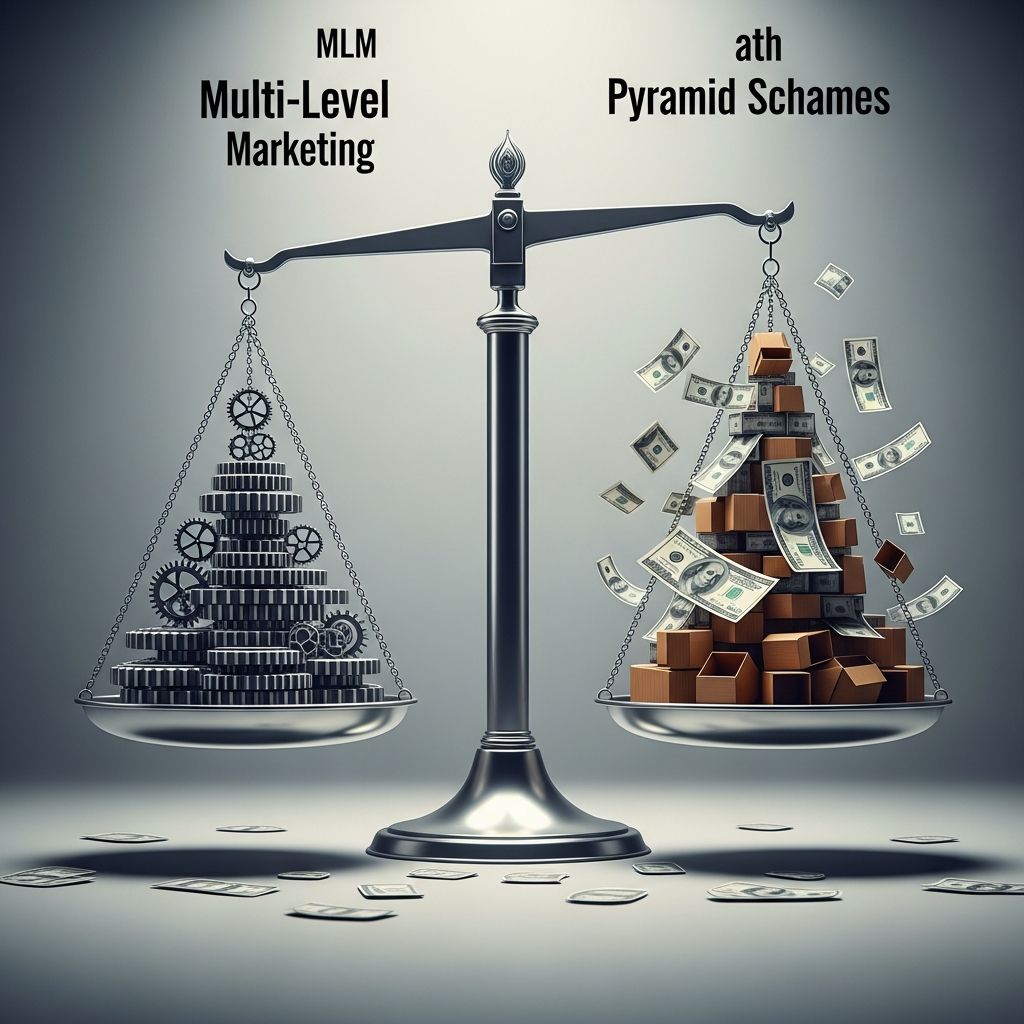
The Legal Landscape of Multi-Level Marketing
Multi-level marketing, commonly referred to as MLM or network marketing, represents a business model that has generated considerable debate among regulators, consumer advocates, and legal scholars. The fundamental question of whether MLMs are inherently illegal hinges on a nuanced understanding of how these businesses operate and whether their compensation structures prioritize product sales to actual consumers or focus primarily on recruitment activities. Understanding this distinction is critical for entrepreneurs considering launching an MLM venture and for consumers evaluating potential business opportunities.
The legal status of MLMs in the United States is not straightforward. While the Federal Trade Commission has established that multi-level marketing is not inherently illegal, certain practices and structural characteristics can transform an MLM into an unlawful pyramid scheme. This legal framework requires careful examination of how money flows through the organization and where representatives derive their income.
Distinguishing Legitimate MLMs from Pyramid Schemes
A legitimate multi-level marketing operation functions as a lawful business method that employs independent representatives to distribute consumer products or services. These representatives earn compensation through two primary channels: direct commissions from retail sales they personally generate, and commissions from retail sales produced by individuals they recruit into the network. Well-established companies such as Amway and Mary Kay Cosmetics exemplify this model, though their histories include regulatory scrutiny.
In contrast, pyramid schemes operate on fundamentally different principles. The defining characteristic of an illegal pyramid scheme is that participants generate income primarily through recruitment rather than through the sale of legitimate products to end consumers. The Federal Trade Commission’s landmark *Koscot* decision established the legal standard that pyramid schemes are “characterized by the payment by participants of money to the company in return for which they receive (1) the right to sell a product and (2) the right to receive in return for recruiting other participants into the program rewards which are unrelated to the sale of the product to ultimate users.”
This distinction proves challenging in practice because pyramid scheme operators often disguise their true nature by claiming to sell products while actually deriving the vast majority of revenue from recruitment fees, inventory purchases, and training materials mandated for participants. Courts have interpreted situations where companies place greater pressure on members to recruit new distributors than to market actual merchandise as evidence of illegal pyramiding.
Key Legal Requirements for MLM Compliance
To operate lawfully as an MLM, companies must satisfy several critical requirements established through FTC guidance and state regulations:
- Product Sales Focus: Compensation must primarily derive from the sale of tangible products or legitimate services to ultimate consumers, not from the recruitment process itself. The company must demonstrate that a substantial portion of revenue comes from retail customers rather than from distributors purchasing inventory or training materials.
- Real Products with Market Value: While an MLM can sell genuine, even high-quality products, the mere existence of real products does not automatically legitimize the business model. Regulators examine whether products would be purchased by consumers at comparable prices if they were available through traditional retail channels.
- Transparent Earnings Disclosures: Companies must provide accurate information about realistic earning potential. Exaggerated income claims or failure to disclose that the vast majority of participants earn minimal income violates FTC standards and can result in civil penalties exceeding $50,000 per violation.
- Right of Return: Participants must be able to return unsold inventory and terminate their involvement without substantial penalties, as established in settlements with companies like Vemma.
- Reasonable Entry Costs: Mandatory initial purchases, training fees, or inventory requirements must be reasonable and not disguised recruitment payments.
Why Pyramid Schemes Inevitably Collapse
The mathematical reality underlying pyramid schemes explains why regulators classify them as inherently deceptive. These schemes require continuous recruitment to sustain themselves because participants typically earn money primarily from bringing new members into the system rather than from selling products to external customers. When the pool of potential recruits becomes exhausted—a condition known as market saturation—the scheme loses its financial foundation and collapses.
The FTC has emphasized that this structural feature creates an “inevitably deceptive representation … that any individual can recoup his or her investment by means of inducing others to invest.” When the inevitable collapse occurs, the vast majority of participants, with the exception of those at the very apex of the pyramid, lose their investments entirely. This outcome is not coincidental but rather a predictable consequence of the mathematical impossibility of infinite recruitment.
Federal Trade Commission Enforcement Actions
The FTC has developed comprehensive guidance regarding MLM oversight and enforcement. The agency prohibits MLMs from making false and misleading claims in their marketing materials and advertising campaigns. Importantly, the FTC has extended liability to companies for deceptive statements made by their sellers and distributors, regardless of where those statements are made, including social media platforms and small group recruiting meetings.
The agency has also clarified that even when an MLM operates with legitimate products and retail sales, an unlawful compensation structure constitutes a pyramid scheme under Section 5 of the FTC Act. The presence of real products or significant retail customer sales does not necessarily eliminate pyramid scheme characteristics if the compensation model incentivizes recruitment over product sales.
FTC settlements have imposed strict requirements on MLM operators. In the Vemma case, for example, the settlement mandated that a majority of the company’s sales must be made to the general public rather than to distributors or other participants in the system. Such settlements establish precedent for industry-wide expectations regarding the balance between retail sales and recruitment-based revenue.
State-Level Regulations and Requirements
Beyond federal oversight, individual states have implemented their own regulations governing MLM operations. Many states specifically address pyramid promotion through dedicated statutes that define illegal practices and establish consumer protections.
Michigan’s Pyramid Promotion Act exemplifies state-level regulatory approaches. Under this framework, a multilevel marketing plan constitutes an illegal pyramid scheme if participants primarily earn money from recruitment rather than from retail product sales. Even when an MLM technically complies with the pyramid promotion statute, the state’s Consumer Protection Act may still apply if the company employs unfair, unconscionable, or deceptive marketing practices.
Maryland’s Multilevel Marketing Law requires participating companies to provide specific disclosures and allow participants to cancel their involvement with reasonable terms. California’s approach, codified in Penal Code Section 327, establishes that pyramid schemes are illegal and recognizes that most participants lose money in these schemes.
Connecticut’s consumer protection framework categorizes pyramid schemes as illegal under both state and federal law, emphasizing that if a plan’s primary profit mechanism involves recruiting new members rather than selling products or services, it constitutes an illegal pyramid scheme.
Red Flags Indicating Potential Pyramid Schemes
Consumers and potential participants should recognize warning indicators that suggest an MLM opportunity may actually be an illegal pyramid scheme:
- Emphasis on recruitment incentives exceeding emphasis on actual product sales to consumers
- Requirement to purchase substantial inventory upfront with limited buyback options
- Mandatory training or educational materials with significant associated costs
- Pressure to recruit friends and family members as primary income strategy
- Unrealistic income projections or vague earnings disclosures
- Products that lack clear consumer demand outside the distributor network
- Complex commission structures that are difficult for participants to understand
- Focus on the business opportunity itself rather than the value of products or services offered
The Role of Deceptive Marketing Practices
Even legitimate MLM companies can violate consumer protection laws through deceptive marketing and false advertising. The FTC Act and the Lanham Act both restrict companies from making false and misleading claims in commercial advertisements. This prohibition extends to statements made by MLM sellers and influencers promoting the business opportunity.
Modern enforcement challenges arise from the decentralized nature of MLM marketing. Individual distributors often make promotional claims on social media platforms, in direct messages, and during small group meetings. The FTC has issued specific guidance clarifying that companies bear responsibility for these participant statements regardless of format or distribution channel. Strategic coordination between online posts and direct messaging campaigns can constitute deliberate advertising subject to regulatory oversight.
International Perspectives on MLM Legality
Different jurisdictions have adopted varying regulatory approaches to multi-level marketing. Some countries have effectively prohibited MLM operations by classifying them as variations of pyramid schemes. China, for example, enacted a prohibition on a practice called “Chuanxiao” where multi-level marketing is recognized as a form of illegal direct sales, with regulations making it unlawful to operate downline recruitment structures.
These international differences reflect ongoing global debates about where legitimate regulatory lines should be drawn between lawful network marketing and unlawful pyramid schemes. No universal standard exists across jurisdictions, creating complexity for companies operating across borders.
Practical Guidance for Evaluating MLM Opportunities
Individuals considering participation in an MLM should conduct thorough due diligence before committing time and financial resources. Regulatory agencies recommend examining the following factors:
- Request detailed earnings statements showing what percentage of participants achieve various income levels
- Determine what percentage of company revenue derives from retail customers versus distributor purchases
- Evaluate whether products would be purchased by consumers at the stated prices through conventional retail channels
- Assess the ease and terms associated with withdrawing from the program or returning inventory
- Research regulatory history and any prior enforcement actions against the company
- Compare income opportunities in relation to actual hours and financial investment required
Frequently Asked Questions
Q: Is all multi-level marketing illegal?
A: No. The Federal Trade Commission has established that multi-level marketing is not inherently illegal. However, specific MLM structures and practices can violate laws, particularly when compensation structures prioritize recruitment over product sales or employ deceptive marketing practices.
Q: What makes a pyramid scheme different from legitimate MLM?
A: The primary distinction centers on income generation. In legitimate MLMs, participants earn primarily from selling products or services to end consumers. In pyramid schemes, participants earn primarily from recruiting others, making the business mathematically unsustainable and inherently deceptive.
Q: Can an MLM company sell real products and still be a pyramid scheme?
A: Yes. The mere existence of genuine products does not prevent a company from operating as an illegal pyramid scheme. Regulators examine whether the compensation structure and actual revenue streams prioritize recruitment incentives over legitimate product sales to outside consumers.
Q: What penalties can the FTC impose on illegal MLM operations?
A: The FTC can seek civil penalties exceeding $50,000 per violation for deceptive earnings claims and unlawful compensation structures. Additionally, the agency can mandate operational changes, impose mandatory buyback provisions, and require accurate earnings disclosures.
Q: How can I report a suspected pyramid scheme?
A: Consumers should report suspected pyramid schemes to the Federal Trade Commission’s consumer complaint database, their state attorney general’s office, or relevant state consumer protection agencies. Many states maintain dedicated resources for investigating and prosecuting pyramid scheme operators.
References
- Multi-Level Marketing — Connecticut Department of Consumer Protection. Accessed 2025. https://portal.ct.gov/dcp/common-elements/consumer-facts-and-contacts/multi-level-marketing
- Business Guidance Concerning Multi-Level Marketing — Federal Trade Commission. Accessed 2025. https://www.ftc.gov/business-guidance/resources/business-guidance-concerning-multi-level-marketing
- Multi-Level Marketing or Illegal Pyramid Scheme? — State of Michigan Department of Consumer Protection. Accessed 2025. https://www.michigan.gov/consumerprotection/protect-yourself/consumer-alerts/invest/mlm-illegal-pyramid-scheme
- Multi-Level Marketing Businesses and Pyramid Schemes — Federal Trade Commission Consumer Advice. Accessed 2025. https://consumer.ftc.gov/articles/multi-level-marketing-businesses-and-pyramid-schemes
- Multi-Level Marketing, Multi-Level Accountability — The Regulatory Review. 2025-05-14. https://www.theregreview.org/2025/05/14/bevan-multi-level-marketing-multi-level-accountability/
- Multilevel Marketing Plans — Attorney General of Maryland. Accessed 2025. https://oag.maryland.gov/i-need-to/Documents/pdfs/Legal_Requirements_for_MLMs.pdf
- Pyramid Schemes / Multi-Level Marketing — State of California Attorney General. Accessed 2025. https://oag.ca.gov/consumers/general/pyramid_schemes
Similar Articles








Read full bio of medha deb




