
From Civil War Remembrance to National Observance
Tracing Memorial Day's transformation from grassroots Civil War tributes to America's official day of military remembrance.
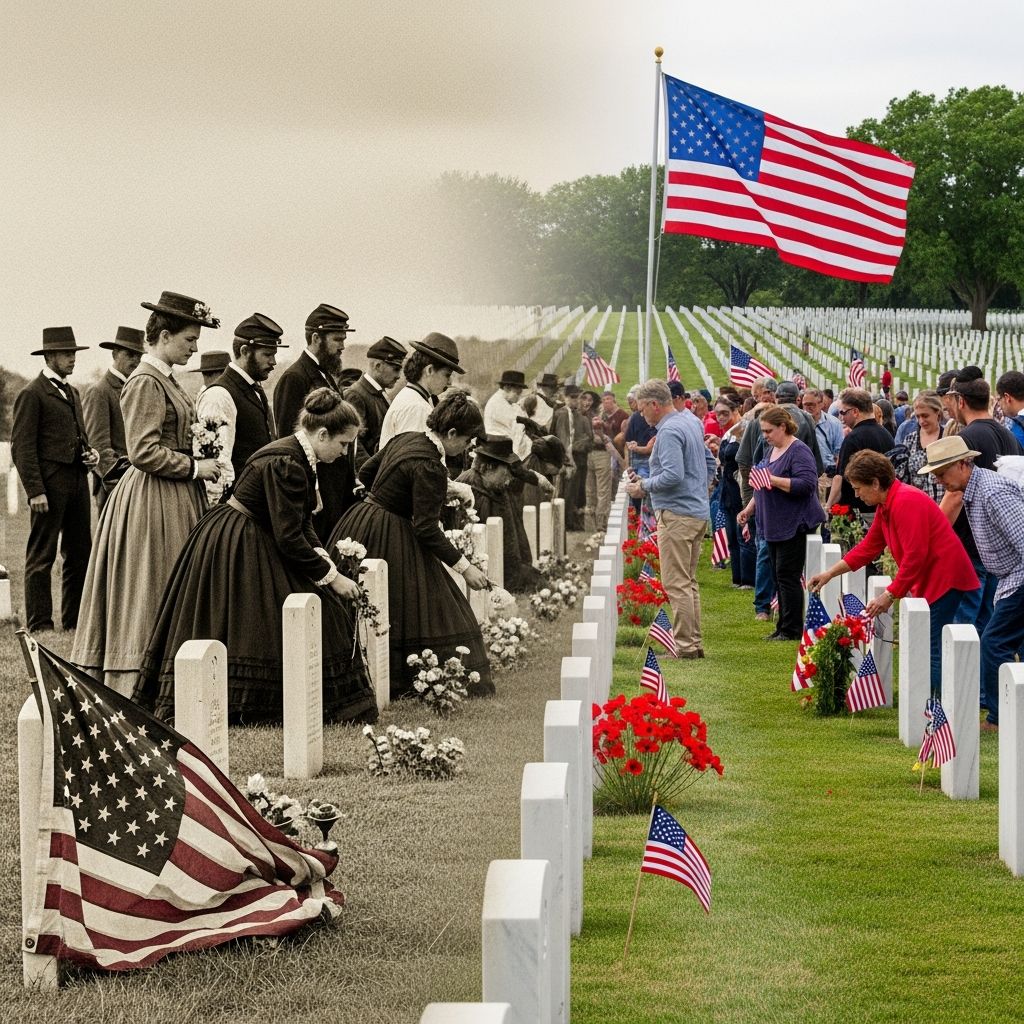
Memorial Day stands as one of the most significant observances in the American calendar, yet its path to becoming an official federal holiday was neither straightforward nor singular in origin. What began as scattered, community-driven efforts to honor Civil War casualties transformed gradually into a nationwide institution that now recognizes the sacrifices of all military personnel who died in service to the United States. Understanding this transformation requires examining multiple narratives, competing claims of origin, and the deliberate governmental decisions that ultimately shaped this solemn holiday into its modern form.
The Immediate Aftermath: Communities Remember Their Dead
In the years following the conclusion of the Civil War, Americans across the nation independently began organizing ceremonies to commemorate those who had perished. These early remembrances were not coordinated by any central authority; rather, they emerged organically from communities seeking to process their collective grief and honor their fallen neighbors. The practice of decorating graves with flowers and wreaths became the defining ritual of these gatherings, establishing a tradition that would eventually define the holiday itself.
Several communities lay claim to pioneering these early tributes. In Columbus, Mississippi, women reportedly gathered in April 1866 to place flowers on soldiers’ graves at a local cemetery. This spontaneous act of remembrance would later inspire broader recognition and contributed significantly to the movement’s momentum. Simultaneously, efforts in other towns and cities reflected the same impulse: communities gathering during spring months to beautify burial sites and reflect on wartime losses. These parallel developments across different regions demonstrate how naturally the impulse to memorialize the dead arose among the American populace.
Beyond the documented events, historians have uncovered evidence suggesting even earlier commemorations. Research conducted by scholars examining historical archives points to May 1, 1865, when a gathering in Charleston, South Carolina—reportedly organized by formerly enslaved individuals—took place at a site that had been converted from a prison for Union soldiers into a burial ground. Thousands attended this procession, led by children carrying flowers and singing patriotic music. This revelation adds important context to the broader narrative, illustrating that the impulse to honor the fallen transcended racial and social boundaries, though these contributions were largely omitted from mainstream historical accounts for decades.
Establishing Structure: The Grand Army of the Republic’s Role
While communities continued their independent observances throughout the late 1860s, a major organizational shift occurred with the intervention of the Grand Army of the Republic (GAR). This fraternal organization of Union Army veterans possessed significant political influence and held the authority to coordinate national initiatives. Recognizing the widespread desire to establish a formal memorial day, GAR leadership moved to systematize what had been fragmented local efforts.
In 1868, a former Union soldier from Ohio submitted a proposal to GAR’s Adjutant-General N.P. Chipman, suggesting that the organization should coordinate an annual national practice of honoring Civil War casualties through ceremonies and grave decoration. This proposal gained traction within GAR ranks and was elevated to Major General John A. Logan, who served as Commander-in-Chief of the organization. Logan recognized the symbolic and practical value of establishing a unified day for this observance and took decisive action.
On May 5, 1868, General Logan issued General Orders No. 11, formally establishing what was then called “Decoration Day.” This directive designated May 30 as the official day for this observance and called upon all GAR posts throughout the country to participate in ceremonies honoring the war dead. Critically, Logan expressed hope that this practice would continue “as long as a single veteran remains to tell the story of his comrade’s sacrifice.” This pronouncement gave the observance a quasi-official status and provided a national framework that individual communities could follow while maintaining their local traditions.
The significance of Logan’s order cannot be overstated. While communities had already established their own memorial practices, the formalization through a national military organization lent legitimacy and coordination to these efforts. It transformed what might otherwise have remained scattered local customs into a cohesive national movement with shared symbolism and timing.
Claims of Origins: Which Community Started It First?
The question of which location can legitimately claim to be the birthplace of Memorial Day has generated considerable historical debate and competing narratives. Multiple communities presented evidence supporting their claims, each with documented events suggesting their precedence:
- Waterloo, New York held a celebration on May 5, 1866, when the community closed all businesses and residents decorated soldiers’ graves with flowers and flags. Local officials including Welles, a druggist, and Murray, a former commanding officer and county clerk, championed this early observance.
- Boalsburg, Pennsylvania initiated grave decoration activities in 1864 when women placed flowers on Civil War casualties, particularly those from the nearby Battle of Gettysburg. This community claims continuity stretching back the furthest.
- Carbondale, Illinois organized a systematic observance in 1866 after local residents were inspired witnessing grave decoration activities and subsequently expanded these efforts into a larger ceremony at Woodlawn Cemetery.
- Columbus, Mississippi held its observance in April 1866, with women gathering to decorate soldiers’ graves in the city cemetery.
The proliferation of legitimate claims reflects the genuine nature of the grassroots movement. Rather than a single innovator establishing the practice, the impulse emerged simultaneously across numerous communities, each responding to shared historical circumstances and emotional needs.
Federal Recognition and the Waterloo Question
While multiple communities practiced grave decoration independently, the federal government ultimately needed to designate an official birthplace. In 1966, Congress passed House Concurrent Resolution 587, introduced by Congressman Samuel S. Stratton. This resolution officially recognized Waterloo, New York, as “the birthplace of Memorial Day as a national holiday to pay tribute to those who gave their lives in all our Nation’s wars.” President Lyndon B. Johnson signed a presidential proclamation supporting this designation, cementing Waterloo’s status in the official historical record.
The selection of Waterloo reflected the documented nature of its 1866 observance, where the community’s systematic approach and official closure of businesses demonstrated organizational sophistication. However, historians note this designation represents a political and administrative choice rather than absolute historical fact, given the competing claims and earlier observances by other communities and populations.
The Transformation of Purpose: Civil War to All Wars
Initially, Decoration Day honored exclusively those who perished during the American Civil War. The holiday’s early decades maintained this narrow focus, with ceremonies emphasizing the conflict’s significance and honoring both Union and Confederate soldiers. Francis Miles Finch’s widely celebrated poem “The Blue and the Gray,” published in 1867, epitomized this inclusive commemoration of all fallen soldiers regardless of which side they served.
The character of the holiday underwent significant transformation during the twentieth century. World War I’s massive casualties and subsequent conflicts prompted Americans to expand the holiday’s scope. Rather than remaining a Civil War-specific commemoration, Memorial Day gradually became recognized as a day honoring all military personnel who died in any American military conflict. This evolution reflected the nation’s changing relationship with its military history and the accumulated losses across multiple generations.
Standardization as a Federal Holiday
The process of converting Memorial Day into a formally standardized federal holiday occurred gradually. Individual states began officially recognizing the observance, starting with New York in 1873. By 1890, every northern state had adopted it, though southern states maintained somewhat different traditions and alternative dates in some cases. The observation gradually became more uniform across the nation as traditions solidified and interstate recognition increased.
In 1968, Congress enacted legislation modifying the holiday’s observance. The law changed Memorial Day from its traditional fixed date of May 30 to the last Monday in May, beginning in 1971. This shift was part of broader reorganization of federal holidays that also affected Veterans Day and other observances. The change attempted to standardize holiday scheduling while inadvertently creating some controversy among traditionalists who preferred maintaining the May 30 date.
This same legislative action standardized the holiday’s official name as “Memorial Day,” replacing the older “Decoration Day” terminology that had persisted in some regions and official contexts. The name change reflected the evolved understanding of the holiday’s purpose, emphasizing remembrance and memorial rather than the decorative aspects of the original practice.
Cultural Practices and Modern Observance
Modern Memorial Day observance incorporates multiple traditions evolved from the holiday’s origins. The practice of placing flowers and wreaths on graves continues in cemeteries nationwide. Arlington National Cemetery hosts particularly significant ceremonies that attract national attention and often include high-ranking government officials and military leadership. Many communities organize parades, public speeches, and moments of silence to honor those who died in military service.
The holiday has also become associated with the unofficial beginning of summer for many Americans, with long weekends devoted to family gatherings and recreational activities. This dual character—solemn remembrance and celebratory leisure—sometimes creates tension between the holiday’s original serious purpose and its contemporary cultural role.
Frequently Asked Questions
Q: Why was May 30 originally chosen for Decoration Day?
A: General John A. Logan selected May 30 when establishing the formal observance in 1868, though historical records do not definitively explain his specific reasoning for this date. It likely represented a compromise between various regional practices and seasonal considerations related to spring grave decoration traditions.
Q: How did Memorial Day expand beyond Civil War commemoration?
A: As America engaged in subsequent military conflicts, particularly World War I and World War II, the holiday’s scope naturally expanded to encompass all fallen service members rather than remaining exclusively focused on Civil War casualties.
Q: Why did Congress move Memorial Day to the last Monday in May?
A: In 1968, Congress standardized several federal holidays by moving them to Mondays to create predictable long weekends and reduce confusion around holiday scheduling. This change became effective in 1971.
Q: What role did the Grand Army of the Republic play in establishing Memorial Day?
A: The GAR, a veterans organization, systematized local memorial practices by having General John A. Logan issue a formal directive establishing May 30 as a national day for grave decoration ceremonies, transforming scattered community efforts into a coordinated national movement.
Q: Are there multiple communities that legitimately claim to have started Memorial Day?
A: Yes, several communities documented early grave decoration observances in 1865-1866, including Waterloo, New York; Columbus, Mississippi; Boalsburg, Pennsylvania; and Carbondale, Illinois. Congress officially designated Waterloo as the birthplace in 1966, though historians recognize the practice emerged simultaneously in multiple locations.
References
- The History of Memorial Day — Armed Services Order of the Military Family. Accessed 2026. https://www.asomf.org/the-history-of-memorial-day/
- Memorial Day: The Origins of Memorial Day — U.S. Army Center of Military History. Accessed 2026. https://history.army.mil/Research/Reference-Topics/Memorial-Day/
- What is Memorial Day? Facts, Meaning, and History — Wounded Warrior Project Newsroom. Accessed 2026. https://newsroom.woundedwarriorproject.org/What-is-Memorial-Day-Facts-Meaning-and-History
- Memorial Day History — National Cemetery Administration, U.S. Department of Veterans Affairs. Accessed 2026. https://www.cem.va.gov/history/Memorial-Day-history.asp
- The Forgotten Black History of How Memorial Day Started — TIME Magazine. Accessed 2026. https://time.com/5836444/black-memorial-day/
- Remembering the Real Reason for Memorial Day — National Constitution Center. Accessed 2026. https://constitutioncenter.org/blog/remembering-the-real-reason-for-memorial-day
- The Nation’s Sacrifice: The Origins and Evolution of Memorial Day — National Archives Prologue Blog. Accessed 2026. https://prologue.blogs.archives.gov/2018/05/24/the-nations-sacrifice-the-origins-and-evolution-of-memorial-day/
Similar Articles








Read full bio of medha deb




