Understanding the Remarkable Brevity of America’s Governing Framework
The United States Constitution stands as one of the most influential legal documents in human history, yet many Americans remain unaware of its most striking physical characteristics. At merely 4,400 words—excluding signatures—the Constitution is remarkably concise when compared to the constitutional documents of other major nations worldwide. This brevity is particularly noteworthy considering the document’s comprehensive role in establishing the entire framework of the federal government, defining the separation of powers, and outlining the fundamental rights of citizens.
To put this length into perspective, the Constitution spans approximately 17 pages when formatted with double spacing, making it possible to read the entire document in roughly thirty minutes. This economy of language reflects the Founders’ deliberate intent to create a flexible framework that could adapt to unforeseen circumstances and evolving national needs, rather than attempting to legislate every possible governmental scenario.
The Constitution’s conciseness also distinguishes it as the longest-surviving written constitution among major democracies, a testament to its enduring relevance and the wisdom embedded in its original design.
The Remarkable Story Behind the Document’s Physical Creation
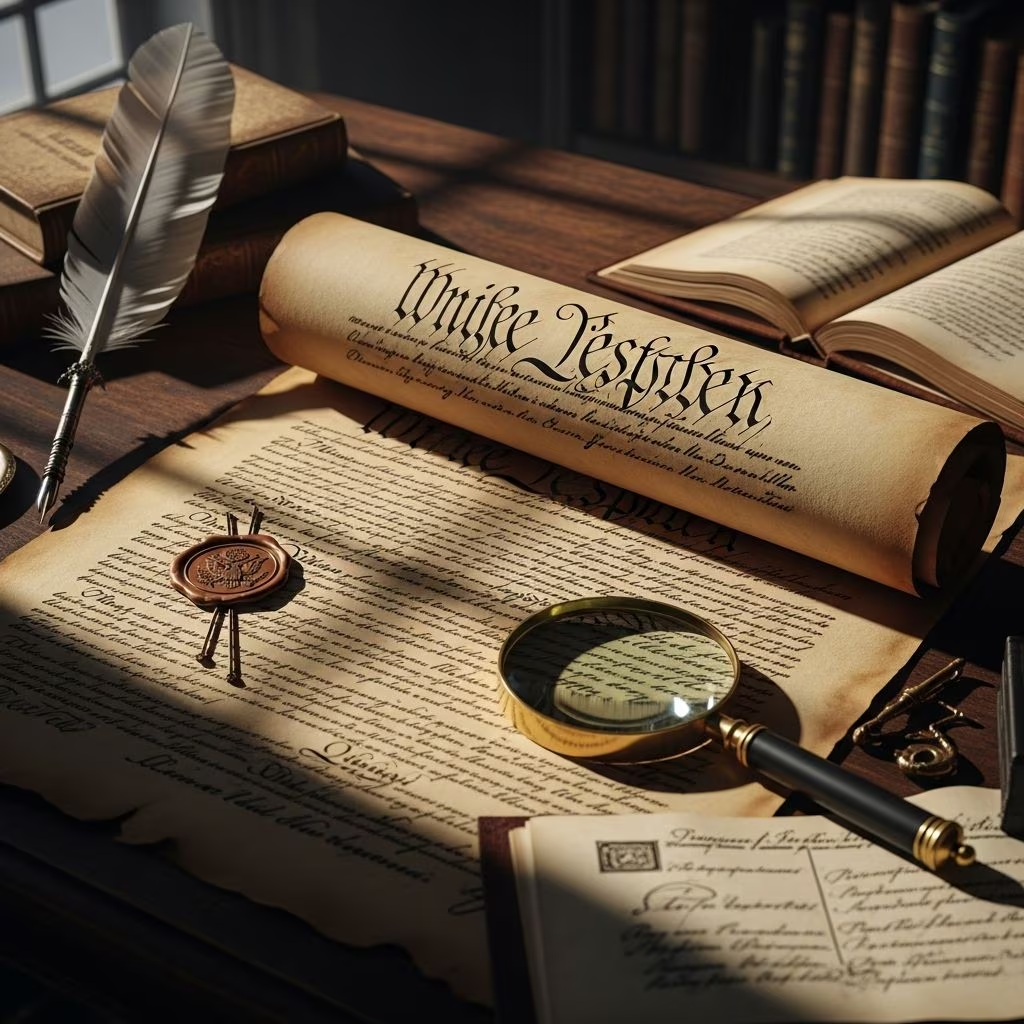
Few people realize that the Constitution was not simply printed or mass-produced, but rather meticulously handwritten by a single individual. Jacob Shallus, a clerk for the Pennsylvania General Assembly, received the assignment to transcribe the entire document from dictation during the Constitutional Convention. For his labor-intensive work, Shallus was compensated $30, an amount that translates to approximately $986 in contemporary dollars, reflecting the significant value placed on skilled penmanship in the eighteenth century.
The physical act of writing the Constitution by hand, combined with the complexity of the language and the numerous revisions required during the Convention’s debates, makes Shallus’s contribution to American history particularly significant. His careful penmanship preserved the exact wording that delegates had negotiated and agreed upon, ensuring that future generations would have an accurate record of their intentions.
Beyond Shallus’s role, the Constitution’s physical preservation presents another fascinating aspect of American history. For more than a century following its creation in 1789, the document remained in the custody of the Department of State, largely unseen by the general public. It was not until 1921 that the Constitution was transferred to the Library of Congress, and public display finally began in 1924. The document remained on view until 1954, when it was moved to its current permanent home in the National Archives Museum in Washington, D.C., where it remains one of America’s most treasured possessions.
The Absence of Key Figures at America’s Defining Moment
A counterintuitive historical fact involves two of the most prominent Founding Fathers who did not sign the Constitution: Thomas Jefferson and John Adams. Both men are central figures in American revolutionary history and played crucial roles in the nation’s early development, yet neither was present at the Constitutional Convention in 1787.
John Adams was serving as the United States minister to Great Britain during the Convention, representing American interests abroad at a critical moment in international relations. Thomas Jefferson, similarly occupied in diplomatic service, was stationed in France as the U.S. minister to that nation. Their absence during this pivotal gathering demonstrates how the young nation’s diplomatic obligations sometimes conflicted with domestic governance needs, requiring its leaders to prioritize international negotiations alongside constitutional development.
Interestingly, despite not signing the Constitution, both Adams and Jefferson later became presidents, with Adams serving from 1797 to 1801 and Jefferson from 1801 to 1809. Only two signers of the Constitution subsequently ascended to the presidency: George Washington and James Madison, highlighting the selective nature of the presidency as a path for those involved in the document’s creation.
Omissions and Silent Compromises Within the Document’s Text
The Constitution contains several conspicuous omissions that reveal much about the compromises and deliberations that shaped American governance. Most strikingly, the word “democracy” does not appear anywhere in the Constitution, despite the common characterization of the United States as a democracy. Instead, the Founders explicitly created a republic, as famously articulated by Benjamin Franklin when asked about the new government’s structure. Franklin reportedly responded, “A republic, if you can keep it,” acknowledging the fragility of this form of governance.
Similarly remarkable is the complete absence of the word “slavery” from the original Constitution, despite the document’s troubling inclusion of provisions that protected and tacitly endorsed the institution. The Three-Fifths Compromise, which counted enslaved individuals as three-fifths of a person for representation purposes, effectively embedded slavery into the governmental structure without ever naming it explicitly. Only with the ratification of the Thirteenth Amendment in 1865 did the word “slavery” finally appear in the Constitution, when that amendment abolished the practice.
These deliberate omissions reflect the Founders’ approach to contentious issues: rather than confronting them directly, they employed oblique language and calculated compromises that allowed delegates with different moral and political perspectives to support the final document.
The Demographic Composition of the Convention and Its Signers
The Constitutional Convention brought together fifty-five delegates, though only thirty-nine ultimately signed the completed document. Among these signers existed a remarkable age disparity that underscores the breadth of experience represented at the Convention.
Benjamin Franklin, at eighty-one years old, was the oldest delegate and required physical assistance to sign the document due to his advanced age and declining health. At the opposite end of the spectrum stood Jonathan Dayton of New Jersey, who at just twenty-six years old, was the youngest signer. This fifty-five-year gap between the oldest and youngest signers reflects the intergenerational cooperation that characterized the Convention, with elder statesmen like Franklin and Washington collaborating with younger, more progressive thinkers.
Jonathan Dayton went on to serve in the House of Representatives and eventually became the third Speaker of the House, demonstrating how the Constitutional Convention served as a launching pad for subsequent political careers.
Critical Compromises That Saved the Convention
The Constitutional Convention faced numerous moments where disputes threatened to derail the entire enterprise. Perhaps the most critical was the dispute over representation, which nearly fractured the Convention into irreconcilable factions. Larger states favored representation based on population, while smaller states demanded equal representation regardless of size, fearing that a purely democratic system would render them politically irrelevant.
Connecticut delegate Roger Sherman proposed a solution that became known as the Great Compromise: the House of Representatives would feature proportional representation based on population, while the Senate would grant each state equal representation with two senators. This compromise passed by the narrowest of margins—5 to 4, with Massachusetts divided—yet it proved instrumental in preserving the Convention and, arguably, the union itself.
Another critical compromise involved slavery and representation. Southern states sought full representation for their slave populations, while Northern delegates opposed this, recognizing the moral contradiction. The resulting Three-Fifths Compromise counted enslaved persons as three-fifths of a person for representation purposes, a calculation that enhanced Southern political power while avoiding explicit constitutional language about slavery.
The Right to Vote: An Evolving and Contested Right
A fundamental aspect of the Constitution that often surprises modern Americans is the document’s failure to establish requirements or qualifications for voting rights. The Constitution does not explicitly grant voting rights to any class of citizens; instead, it left this determination to individual states.
At the outset of the Union, voting was restricted to male property owners, excluding the vast majority of the population. African Americans were not considered citizens and therefore could not vote, while women of all races were systematically excluded from the electoral process. Native Americans, despite being the original inhabitants of the continent, were denied voting rights until 1924, more than 135 years after the Constitution’s ratification.
This incomplete framework necessitated subsequent constitutional amendments to expand voting rights. The Fifteenth Amendment (1870) prohibited racial discrimination in voting, the Nineteenth Amendment (1920) granted women’s suffrage, and the Twenty-Sixth Amendment (1971) lowered the voting age to eighteen. The gradual expansion of voting rights represents one of the Constitution’s most significant evolutions through the amendment process.
Puzzling Proposals and Historical What-Ifs
Throughout the Constitutional Convention, delegates proposed numerous provisions that, had they been adopted, would have radically altered the American governmental system. One particularly striking proposal suggested limiting the standing army to just 5,000 soldiers, reflecting delegates’ concerns about maintaining a strong central military force that might threaten civilian liberty.
General George Washington, recognizing the impracticality of this limitation, responded with famous sarcasm. He agreed to the 5,000-soldier limit, he stated, provided that a corresponding stipulation was added: no invading army could exceed 3,000 troops. His wit effectively illustrated the absurdity of the proposal, and it was ultimately rejected in favor of granting Congress the power to establish and maintain military forces as deemed necessary.
These rejected proposals illuminate the nuanced debates occurring behind the Convention’s closed doors, where delegates grappled with fundamental questions about executive power, military authority, and the prevention of tyranny.
The Role of James Madison and the Establishment of Constitutional Structure
James Madison earned his designation as the “Father of the Constitution” through his pivotal contributions to both the document’s structure and the subsequent Bill of Rights. Madison proposed the resolution that established various Cabinet positions within the Executive Branch, creating the governmental framework upon which presidential administration would be built.
Beyond structural innovations, Madison was instrumental in shepherding twelve proposed amendments through the ratification process, ten of which became the Bill of Rights. His advocacy for these amendments proved crucial in securing ratification of the Constitution itself, as the lack of constitutional protections for individual rights had been the primary sticking point during state ratification proceedings.
Madison’s influence on constitutional development extended throughout his political career, culminating in his presidency from 1809 to 1817. His historical prominence is commemorated on the $5,000 bill, a denomination that, while rarely seen in circulation today, remains legal tender.
Physical Preservation and Modern Scientific Conservation
The Constitution’s survival as a legible document across more than two centuries owes much to modern conservation techniques. In the 1950s, recognizing the fragility of the aging parchment, conservators placed the Constitution within a specially designed glass encasement filled with inert helium gas and sealed to prevent deterioration. This scientific approach to preservation protects the document from environmental factors such as humidity fluctuations and oxidation that would otherwise gradually destroy the ink and parchment.
The Constitution’s current display at the National Archives represents the culmination of centuries of concern for its preservation, reflecting the document’s status as an irreplaceable artifact of national heritage.
Spelling Errors and Other Textual Anomalies
Despite Jacob Shallus’s careful penmanship, the Constitution contains several spelling irregularities that reflect eighteenth-century orthographic conventions. Most notably, “Pensylvania” appears above the signers’ names, lacking the second “n” that characterizes the modern spelling of Pennsylvania. While this spelling was technically correct in 1781 when the Constitution was drafted, it now appears as an obvious anomaly, serving as a tangible reminder of how language conventions have evolved over time.
These textual features remind observers that even America’s most sacred document is ultimately a human creation, subject to the limitations and peculiarities of its creators’ era.
Frequently Asked Questions About the U.S. Constitution
Q: Why didn’t Thomas Jefferson and John Adams sign the Constitution?
A: Both men were serving as diplomatic representatives abroad during the Constitutional Convention. Adams was the U.S. minister to Great Britain, while Jefferson held the position of minister to France. Their diplomatic responsibilities conflicted with attendance at the Convention, yet both later became presidents despite not signing the document.
Q: How long is the Constitution?
A: The Constitution contains 4,400 words, excluding signatures, making it the shortest written constitution of any major world government. It spans approximately 17 pages when formatted with double spacing.
Q: Does the Constitution mention the right to vote?
A: No. The Constitution does not establish voting requirements or qualifications. This omission allowed states to determine their own voting rules, which initially restricted voting to male property owners and excluded women, African Americans, and Native Americans from political participation.
Q: What is the Great Compromise?
A: Proposed by Roger Sherman of Connecticut, the Great Compromise resolved disputes over representation by creating a bicameral legislature. The House of Representatives provides proportional representation based on state population, while the Senate grants each state two equal representatives.
Q: Why doesn’t the Constitution use the word “democracy”?
A: The Founders established a republic, not a direct democracy. They believed a representative system would better protect individual rights and prevent the tyranny of the majority. The distinction between a republic and a democracy was intentional and central to their constitutional design.
Q: Who physically wrote the Constitution?
A: Jacob Shallus, a clerk for the Pennsylvania General Assembly, handwrote the entire Constitution by dictation. He was paid $30 for this work, equivalent to approximately $986 in modern currency.
References
- Fascinating Facts about the US Constitution — Constitution Facts. Accessed April 2026. https://www.constitutionfacts.com/us-constitution-amendments/fascinating-facts/
- Fascinating Facts about the U.S. Constitution — State Bar of New Mexico. Accessed April 2026. https://www.sbnm.org/
- Constitution Day: 10 Facts You May Not Know About America’s Founding Document — First Liberty Institute. Accessed April 2026. https://firstliberty.org/news/constitution-day-10-facts/
- U.S. Constitution Fun Facts — Northern State University. Accessed April 2026. https://www.northern.edu/
- Fascinating Facts About the U.S. Constitution — American Civil Liberties Union of Wyoming. Accessed April 2026. https://www.aclu-wy.org/
- 5 Facts About the U.S. Constitution — Acton Institute. September 17, 2019. https://www.acton.org/publications/transatlantic/2019/09/17/5-facts-about-us-constitution
- 10 Facts About the Constitution of the United States — U.S. National Archives. Accessed April 2026. https://www.archives.gov/
- 5 Science Facts About The U.S. Constitution — Smithsonian Institution. Accessed April 2026. https://ssec.si.edu/stemvisions-blog/5-science-facts-about-us-constitution