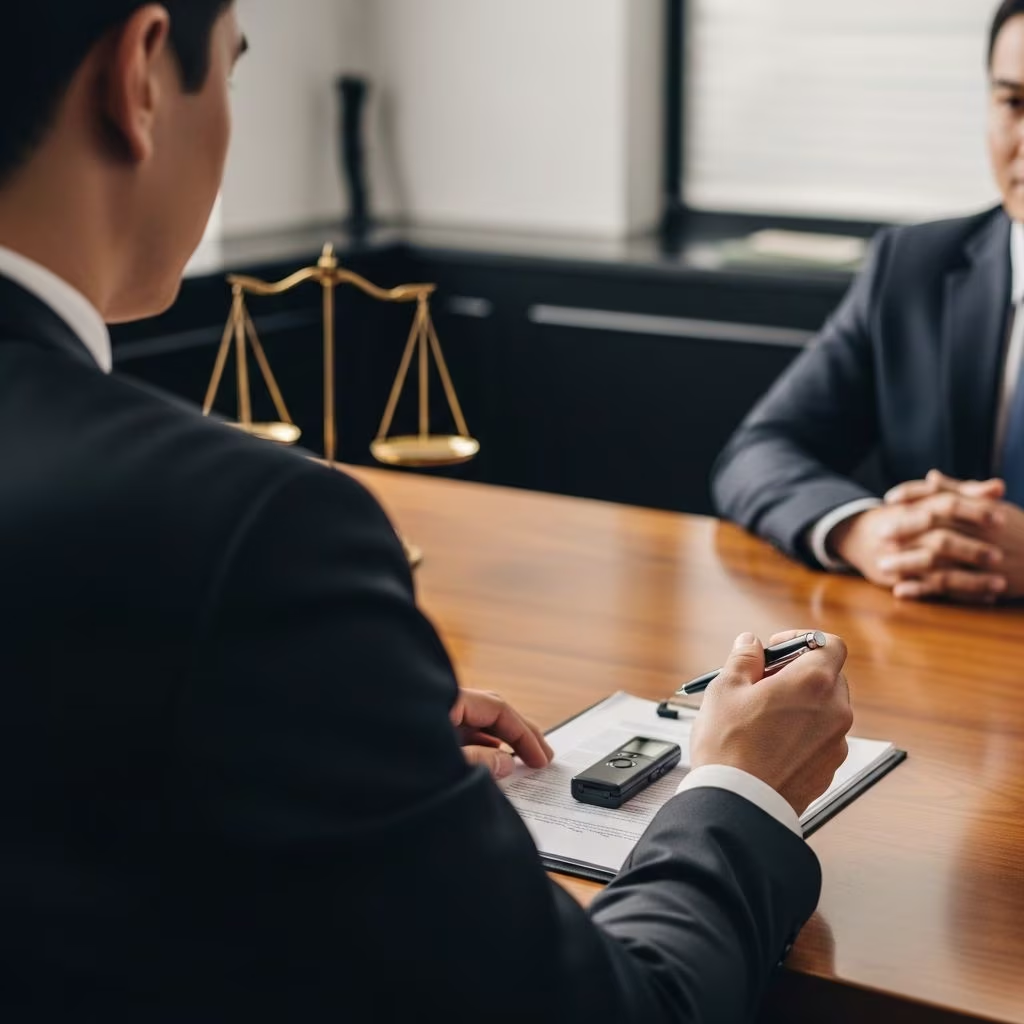
Attorneys hold a unique position of trust, where client confidences form the bedrock of their professional relationship. Yet, the advent of easy recording technology raises profound questions: Can lawyers ethically record conversations with clients without their knowledge? This practice treads a fine line between legal permissibility and ethical integrity, influenced by state wiretapping laws and professional conduct rules. While technology enables such actions, the potential to erode client trust makes it a high-risk strategy.
Understanding Consent Laws Across U.S. Jurisdictions
Recording laws in the United States vary significantly by state, creating a patchwork of regulations that attorneys must navigate carefully. These laws stem from wiretapping statutes designed to protect privacy in communications.
States are broadly categorized into two types: one-party consent and all-party (or two-party) consent jurisdictions. In one-party consent states, a participant in the conversation can legally record it without informing others. This applies to the majority of U.S. states, including New York, where a lawyer could record a client meeting if they themselves are part of the discussion. Conversely, all-party consent states require every participant to agree beforehand. Currently, 11 states enforce this stricter standard, such as California (Cal. Penal Code §632) and Florida (Fla. Stat. §934.03(2)(d)). Violating these laws can lead to criminal penalties, civil lawsuits, or evidence suppression in court.
| Consent Type | Examples | Implications for Lawyers |
|---|---|---|
| One-Party | New York, North Carolina, Texas | Legal to record secretly if lawyer participates |
| All-Party | California, Florida, Illinois | Must obtain consent from all; secret recording illegal |
This table highlights the divide, underscoring why attorneys practicing across state lines or in federal matters must verify applicable rules. Federal wiretap laws generally follow one-party consent but defer to stricter state standards when applicable.
Professional Conduct Rules and ABA Guidance
Beyond criminal law, ethical standards govern attorney behavior. The American Bar Association (ABA) Model Rules of Professional Conduct, adopted or adapted by most states, prohibit misconduct involving “dishonesty, fraud, deceit, or misrepresentation” under Rule 8.4(c).
Early ABA guidance was unequivocal. Formal Opinion 337 (1974) deemed secret client recordings as inherently deceptive, violating trust essential to the profession. However, Formal Opinion 01-422 (2001) revised this stance, stating that such recordings “do not necessarily violate the Model Rules,” provided they comply with local recording laws and do not involve lying about the recording. The committee remained divided, with a majority advising against the practice due to its potential to damage client relationships.
The ABA warned that discovering a secret recording could “undermine the relationship of trust and confidence that clients need to have with their lawyers.”
This evolution reflects technological changes but emphasizes transparency. Lawyers cannot falsely deny recording or use it coercively. State bars may impose stricter interpretations; for instance, North Carolina’s ethics opinions caution against using illegally obtained recordings, even from third parties.
High-Profile Cases Illuminating the Risks
Real-world examples demonstrate the perils. In 2016, attorney Michael Cohen secretly recorded a discussion with then-client Donald Trump about a potential payment to a former Playboy model. When CNN aired the tape in 2018, it fueled legal battles and public scrutiny. Cohen defended it as a note-taking substitute, but it amplified distrust amid his other controversies.
Such incidents ripple beyond individuals. They invite bar complaints, malpractice suits, and reputational harm. Clients discovering post hoc recordings may terminate representation, demand files, or file grievances alleging breach of confidentiality under Rule 1.6. Courts have admitted such recordings in one-party states but scrutinized their procurement for ethical lapses.
Risks and Consequences of Secret Recordings
- Legal Penalties: In all-party states, felonies with fines up to $10,000 or jail time; civil damages for privacy invasion.
- Disciplinary Actions: State bars can suspend or disbar for Rule 8.4 violations, even if not criminal.
- Evidentiary Challenges: Judges may exclude recordings if obtained deceptively, per rules like Federal Rule of Evidence 403.
- Client Trust Erosion: Discovery leads to lost business, negative reviews, and referrals.
- Collateral Issues: Recordings may capture privileged information, complicating storage under data protection laws.
Quantitatively, while exact statistics are scarce, ethics hotlines report rising inquiries on recording tech. A 2023 survey by the National Conference of Bar Presidents noted 15% of ethics opinions involved digital privacy.
Best Practices for Ethical Recording in Legal Practice
To harness recording benefits—accurate recall, dispute prevention—without pitfalls, adopt these strategies:
- Secure Informed Consent: Verbally request and document agreement at meeting start. Use forms: “Do you consent to audio recording for note accuracy?”
- Disclose Transparently: State device presence and purpose upfront, even in one-party states.
- Secure Storage: Encrypt files, limit access, delete after use to protect Rule 1.6 confidentiality.
- Alternatives to Secret Taping: Employ note-taking apps, joint summaries, or client-verified minutes.
- Policy Development: Firm-wide guidelines trained via CLE, covering interstate nuances.
Many firms now use video conferencing with built-in recording notices, normalizing the practice while preserving trust.
State-Specific Nuances and Federal Overlaps
Navigating multi-jurisdictional practice demands vigilance. For example, Florida’s all-party rule has led to high-profile prosecutions, while New York’s one-party leniency facilitated Cohen’s action. Federal cases under 18 U.S.C. § 2511 align with one-party but yield to state law for intrastate calls.
Remote work post-pandemic complicates matters; a Zoom call with parties in different states triggers the strictest applicable law. Attorneys should consult local ethics counsel or bar resources.
Frequently Asked Questions (FAQs)
Is it ever okay for a lawyer to record a client without telling them?
In one-party consent states, yes legally, but ABA ethics strongly discourage it to avoid deceit perceptions.
What happens if a client finds out about a secret recording?
Potential bar complaints, lawsuits for breach of trust, and immediate relationship breakdown.
Can secret recordings be used as evidence in court?
Possibly, if legally obtained, but ethical issues may lead to exclusion or sanctions.
How many states require all-party consent?
Eleven, including California and Florida.
What’s the ABA’s current stance?
Not per se unethical if legal, but inadvisable due to trust erosion.
Building Trust in the Digital Age
As recording devices proliferate—from smartphones to wearables—lawyers must prioritize ethics over convenience. Open communication fosters durable client bonds, essential for effective representation. Firms investing in consent protocols and training mitigate risks while leveraging tech benefits.
Ultimately, the profession’s hallmark is candor. Choosing transparency over secrecy not only complies with rules but elevates practice standards. As clients grow tech-savvy, those demanding privacy will favor ethical attorneys.
References
- Covert Recording: “What Kind of a Lawyer Would Tape a Client?”: The Ethics of Secretly Recording Your Clients — Caitlyn Parsley, Walsworth. 2018-10-03. https://digitaleditions.walsworth.com/article/Covert+Recording:+%E2%80%9CWhat+Kind+of+a+Lawyer+Would+Tape+a+Client%3F%E2%80%9D:+The+Ethics+of+Secretly+Recording+Your+Clients/3205928/531592/article.html
- Use of Tape Recording Made by Someone Other Than the Lawyer’s — North Carolina State Bar. 2023-01-15. https://www.ncbar.gov/for-lawyers/ethics/adopted-opinions/rpc-220/
- The Ethics of Secretly Recording Your Clients — Bush Ross, P.A. 2018-10-11. https://www.bushross.com/assets/htmldocuments/2018_10_11_10_05_38.pdf
- ABA Model Rules of Professional Conduct, Rule 8.4 — American Bar Association. 2024-08-01. https://www.americanbar.org/groups/professional_responsibility/publications/model_rules_of_professional_conduct/rule_8_4_misconduct/