
Laws vs Regulations: Key Legal Distinctions
Unravel the essential differences between laws and regulations: origins, enforcement, and real-world impacts on daily life and business.
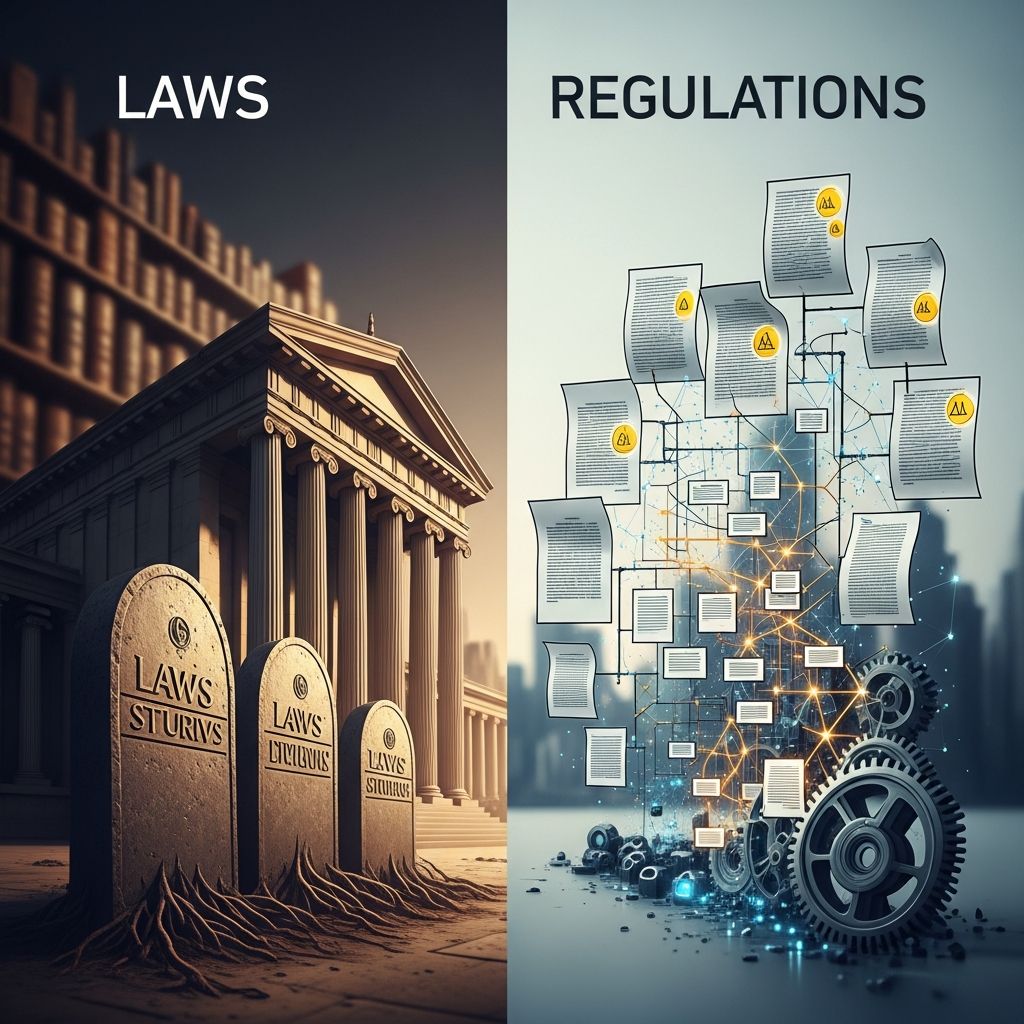
Laws establish the foundational rules of society, enacted by elected legislatures, while regulations provide the operational details crafted by government agencies to make those laws actionable.
Foundational Concepts in Legal Rulemaking
At the heart of any democratic system lies a structured approach to governance through binding rules.
Laws
, often termed statutes or acts, originate from legislative bodies like Congress or state assemblies. These represent the ‘what’ and ‘why’ of societal standards, setting broad principles that guide behavior and resolve disputes. For instance, the Civil Rights Act of 1964 outlines prohibitions against discrimination, creating a legal obligation without specifying every enforcement step.In contrast,
regulations
—also called rules—emerge from executive agencies delegated authority by these statutes. They address the ‘how,’ translating abstract legal mandates into concrete procedures. Agencies such as the Environmental Protection Agency (EPA) or Food and Drug Administration (FDA) draft regulations after public input, ensuring practical application. This division allows legislatures to focus on policy while experts handle technicalities.How Laws Come into Existence
The journey of a law begins with a proposed bill introduced in a legislative chamber. It undergoes debates, amendments, committee reviews, and votes in both houses—such as the House of Representatives and Senate at the federal level. Presidential or gubernatorial approval (or veto override) finalizes it. Once enacted, laws appear initially as slip laws, then in compilations like the U.S. Statutes at Large and ultimately the U.S. Code, organized by subject for accessibility.
This process ensures democratic input, with representatives accountable to voters. Laws carry the full weight of sovereignty, enforceable via courts with penalties like fines or imprisonment for violations.
The Regulatory Development Process
Agencies receive statutory authority to implement laws, initiating a rulemaking procedure. They propose rules in the Federal Register, inviting public comments—often 30 to 60 days—for revisions. Final rules publish in the Federal Register and codify in the Code of Federal Regulations (CFR). This transparency fosters accountability, though less politically charged than legislation.
Regulations must align with enabling statutes; courts can strike them down if they exceed authority, especially post-Chevron deference shifts emphasizing judicial interpretation. Examples include EPA’s emissions standards under the Clean Air Act or FDA drug approval protocols.
Comparative Analysis: Laws and Regulations Side-by-Side
To clarify distinctions, consider this table outlining core attributes:
| Aspect | Laws (Statutes/Acts) | Regulations (Rules) |
|---|---|---|
| Origin | Legislative bodies (Congress, state legislatures) | Executive agencies (EPA, FDA, etc.) |
| Purpose | Broad principles and prohibitions | Specific implementation and procedures |
| Process | Bill introduction, votes, executive sign-off | Notice-and-comment rulemaking in Federal Register |
| Enforceability | Courts and law enforcement | Agency actions, exams, civil penalties |
| Publication | U.S. Code, Statutes at Large | Code of Federal Regulations |
| Amendment | New legislation required | Agency rulemaking or statutory change |
This framework highlights how laws provide the skeleton, regulations the muscle.
Practical Examples Across Sectors
In environmental protection, the Clean Air Act (law) mandates pollution controls, while EPA regulations specify emission limits and monitoring tech. Healthcare sees the Affordable Care Act (statute) requiring coverage expansions, with Centers for Medicare & Medicaid Services (CMS) regulations detailing provider reimbursements.
Financial services exemplify this too: The Truth in Lending Act (law) demands transparent credit terms, implemented by Regulation Z from the Consumer Financial Protection Bureau, outlining disclosure forms. These pairings ensure laws remain adaptable yet enforceable.
Enforcement Mechanisms and Consequences
Law violations trigger judicial proceedings—criminal for intent-based offenses, civil for harms. Prosecutors prove elements beyond reasonable doubt. Regulations, enforced by agencies, often involve administrative actions like audits, fines, or license revocations before court escalation.
Both bind parties, but regulations target regulated entities (e.g., businesses), while laws apply universally. Non-compliance risks escalate: warnings, penalties, or shutdowns.
Interplay with Policies, Guidance, and Ordinances
- Policies: Internal organizational guidelines, non-binding but aligned with laws/regulations for consistency.
- Guidance: Agency recommendations clarifying rules, influential in exams but not enforceable.
- Ordinances: Local laws by municipalities, akin to statutes but city/county-specific.
- Acts/Statutes: Synonymous with laws, denoting enacted bills.
This ecosystem layers governance: laws at top, regulations below, others supporting.
Challenges in Compliance and Reform
Navigating dual systems demands vigilance; laws evolve slowly, regulations nimbly but bureaucratically. Businesses track Federal Register updates; violations cost billions yearly. Reform efforts target overregulation via executive orders or congressional review.
Citizens influence via comments, lobbying, or votes. Understanding empowers engagement.
Frequently Asked Questions (FAQs)
What fundamentally separates a law from a regulation?
Laws are statutes passed by legislatures establishing broad rules, while regulations are agency-issued rules detailing compliance.
Can regulations override or change laws?
No, regulations derive authority from laws and cannot contradict them; courts invalidate overreaching rules.
Where do I find current federal laws and regulations?
Laws in the U.S. Code; regulations in the Code of Federal Regulations and Federal Register.
Are state-level laws and regulations similar to federal ones?
Yes, states mirror federal structures with legislatures passing statutes and agencies issuing rules, plus local ordinances.
How does public input affect regulations?
Proposed rules solicit comments in the Federal Register, often shaping finals for better practicality.
Navigating the Legal Landscape
Grasping laws versus regulations demystifies governance, aiding citizens, professionals, and firms in compliance. As society evolves, this distinction ensures flexible yet firm rule of law.
References
- Difference Between Laws, Regulations, Acts, Guidance & Policies — One Education. 2023-05-15. https://www.oneeducation.org.uk/difference-between-laws-regulations-acts-guidance-policies/
- Ask Civics 101: What Are The Differences Between Laws, Regulations, Ordinances And Statutes — NHPR. 2021-08-06. https://www.nhpr.org/nh-news/2021-08-06/ask-civics-101-what-are-the-differences-between-laws-regulations-ordinances-and-statutes
- Laws and Regulations: Home — University of Colorado LibGuides (.edu). 2024-01-10. https://libguides.colorado.edu/lawsandregs
- Laws vs. Regulations vs. Guidance – New Interagency Statement Provides Clarification — Ncontracts. 2023-11-20. https://www.ncontracts.com/nsight-blog/laws-vs-regulations-vs-guidance-new-interagency-statement-provides-clarification
- Law, Rule, Regulation and Policy — Yakima Regional Clean Air Agency (.gov equivalent local). 2022-07-12. https://www.yakimacleanair.org/services/definitions.html
- The Difference Between a Law and a Regulation in Healthcare, Post-Chevron — RAC Monitor. 2024-07-05. https://racmonitor.medlearn.com/the-difference-between-a-law-and-a-regulation-in-healthcare-post-chevron/
Similar Articles








Read full bio of medha deb




