
Laser Pointer Laws: Legal Risks Explained
Navigate the complex world of laser pointer regulations: from federal bans to state rules and safe usage guidelines.
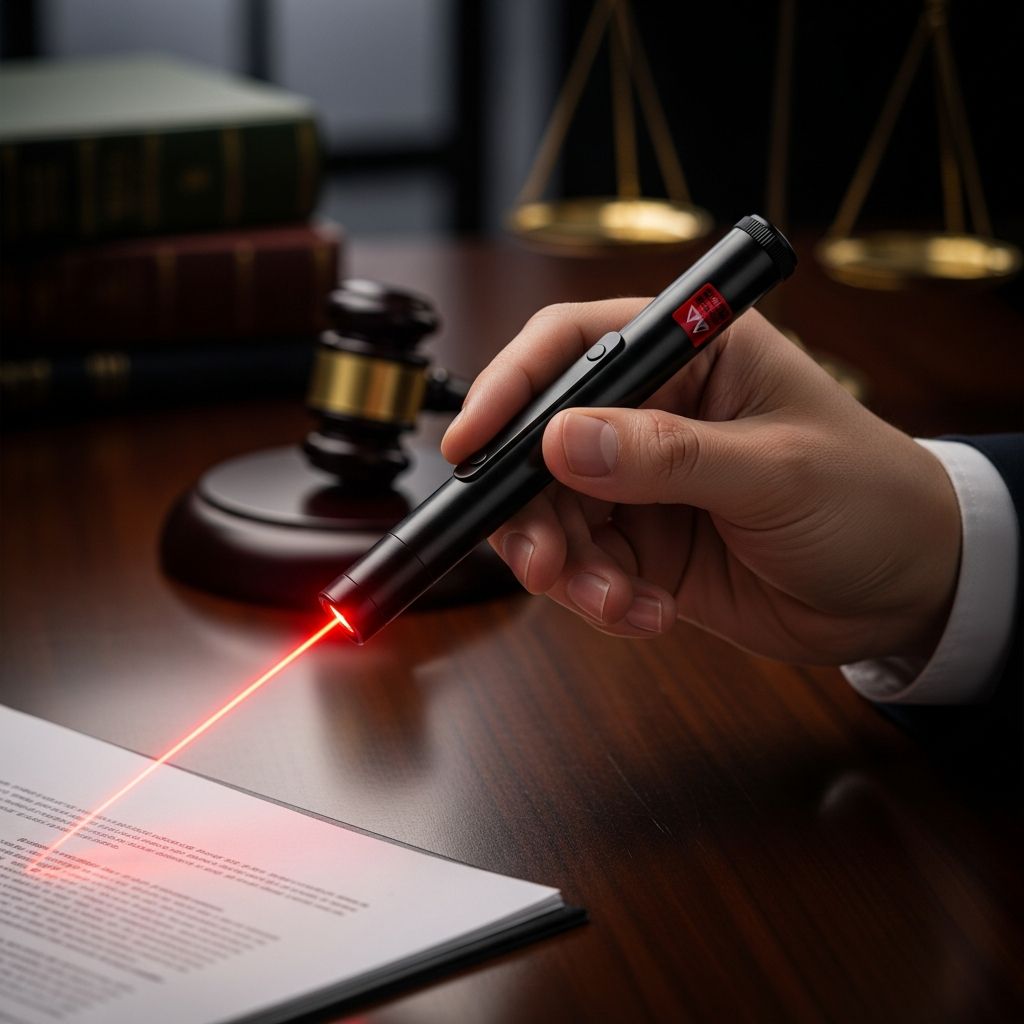
Laser pointers, once simple presentation aids, now carry significant legal weight due to their potential for harm. Federal statutes criminalize directing beams at aircraft, while states impose additional controls on possession and sales. Understanding these rules prevents severe penalties, including imprisonment and hefty fines.
Federal Framework Governing Laser Devices
The U.S. government regulates laser pointers through multiple agencies, prioritizing public safety in aviation and maritime contexts. A core prohibition stems from 18 U.S.C. § 39A, which makes it a federal offense to knowingly aim a laser pointer at an aircraft or its flight path within special aircraft jurisdiction. Violators face up to five years in prison and fines up to $250,000. This law, enacted to protect pilots, defines a laser pointer as any device amplifying electromagnetic radiation for pointing or highlighting purposes.
The Federal Aviation Administration (FAA) actively enforces this, reporting 12,840 laser strikes on aircraft in 2024 alone, each posing risks to pilots and passengers. Civil penalties can reach $25,000 per incident, with law enforcement pursuing criminal charges. Similarly, directing lasers at maritime vessels is illegal, extending protections to sea travel.
The Food and Drug Administration (FDA), via its Center for Devices and Radiological Health (CDRH), sets performance standards under 21 CFR 1040.10 and 1040.11. These require proper labeling, safety features, and emission limits for consumer products. Lasers exceeding 5 milliwatts marketed as ‘pointers’ violate these rules, though possession by consumers remains legal if compliant otherwise.
State-Level Variations in Laser Restrictions
While federal law provides a baseline, states add layers of regulation, often targeting minors, public disturbances, or specific targets like law enforcement. For instance, Hawaii bars those under 18 from possessing laser pointers, with confiscation possible. South Carolina mirrors this, prohibiting sales to and possession by minors.
Illinois mandates registration for all Class 3B and Class 4 lasers and criminalizes discharges into cockpits. New Hampshire outlaws shining lasers at occupied aircraft, vehicles, windows, or people. Oregon’s ‘unlawful directing’ statute covers misuse in public spaces.
Other states focus on officers: Puerto Rico and Virginia prohibit aiming at law enforcement. Washington State deems laser discharge unlawful, while Oklahoma’s Laser Safety Act imposes $100 fines for first offenses, escalating to $500. Local rules, like Ocean City’s, New Jersey, ban on sales and possession, demonstrate municipal authority.
| State/Territory | Key Restriction | Penalty Example |
|---|---|---|
| Hawaii | No possession by under-18s | Confiscation |
| Illinois | Register Class 3B/4 lasers | Criminal for cockpit aim |
| New Hampshire | No shine at aircraft/vehicles/people | Misdemeanor/felony |
| Oklahoma | Laser Safety Act violations | $100 first, $500 second |
| South Carolina | No sales/possession by minors | Fines |
| Virginia | No aim at law enforcement | Misdemeanor |
This table summarizes select state rules; always verify local codes as they evolve.
FDA Standards and Manufacturing Compliance
FDA oversight ensures lasers sold in the U.S. meet safety thresholds. Products must bear caution labels warning against aircraft or vehicle targeting. Green laser pointers raise special concerns due to their visibility and potential modifications boosting power beyond limits.
Non-compliant devices—those lacking safety interlocks or proper classifications—face recalls or seizures. Manufacturers marketing high-power units as ‘pointers’ breach regulations, but end-users aren’t penalized for possession alone. The FDA inspects light shows and online sellers to curb unsafe imports, noting risks of customs blocks on foreign overpowered models.
- FDA Key Requirements: Emission limits, aperture labels, safety features for higher classes.
- Consumer Tip: Verify FDA compliance stickers; avoid ‘toy’ labeled high-power greens.
- Enforcement: Recalls for defects; import bans for non-U.S. makers.
Dangers Posed by Misuse and Real Incidents
Laser pointers can temporarily blind pilots, causing disorientation mid-flight. A momentary flash disrupts depth perception, risking crashes. Maritime strikes endanger navigators similarly. Eye damage is permanent for direct hits, especially from Class 3B or higher.
Incidents surged, with FAA data showing thousands annually. A 2012 federal law escalation reflected growing threats from accessible devices. Public spaces see assaults via pointers, prompting ‘assault by laser’ charges in states like California’s Penal Code 417.25, punishable by up to 30 days jail for threatening aims.
Responsible Ownership and Best Practices
Legal ownership hinges on responsible use. Federal law permits any power if FDA-compliant and not falsely labeled. Avoid pointing skyward near airports—use apps like FAA’s laser map for no-fly zones.
- Store securely away from children.
- Use indoors for presentations only.
- Nevada: Check for minor sale bans (e.g., Act 382 fines $100).
Parents: Supervise youth, as many states restrict access. Educators: Opt for low-power reds over greens.
Buying Guide: Avoiding Illegal Products
Internet sellers peddle unapproved high-power lasers. Legitimate ones comply with CDRH; shun those exceeding 5mW without pro labeling. Imported greens often fail standards, risking non-delivery via customs.
Check for FDA variance if over Class IIIa. Reputable vendors provide specs; buyer beware of ‘military-grade’ hype.
Frequently Asked Questions
Are laser pointers completely illegal in the U.S.?
No, ownership and safe use are legal under federal law if compliant with FDA standards. Misuse, like aiming at aircraft, is criminal.
Can minors own laser pointers?
Not in states like Hawaii or South Carolina without supervision; sales to minors banned in several.
What happens if I point a laser at a plane accidentally?
Intent matters, but ‘knowingly’ under §39A triggers penalties. FAA pursues even perceived threats.
Is it okay to shine lasers at police or drivers?
No—states like Virginia criminalize this; it’s assault in many jurisdictions.
How powerful can a legal consumer laser be?
Any power if properly labeled and not sold as a ‘pointer’ over 5mW.
Recent Enforcement Trends and Future Outlook
Laser incidents peaked in recent years, prompting stricter FAA tracking. States continue tightening rules, with more minor bans likely. Tech advances may yield safer designs, but user education remains key.
Advocacy groups like Laser Pointer Safety push precise terminology, distinguishing manufacturing flaws from use crimes. Stay informed via official sites to comply.
References
- U.S. Laws for Lasers and Pointers — LaserPointerSafety.com. Accessed 2026. https://www.laserpointersafety.com/rules-general/uslaws/uslaws.html
- Laser Rules for U.S. Consumers — LaserPointerSafety.com. Accessed 2026. https://www.laserpointersafety.com/rules-general/rules-US-consumers/rules-US-consumers.html
- 18 U.S. Code § 39A – Aiming a laser pointer at an aircraft — U.S. House. N/A. https://www.law.cornell.edu/uscode/text/18/39A
- Illuminating Facts About Laser Pointers — FDA.gov. Accessed 2026. https://www.fda.gov/radiation-emitting-products/alerts-and-notices/illuminating-facts-about-laser-pointers
- Laser Safety — FAA.gov. Accessed 2026. https://www.faa.gov/about/initiatives/lasers
Similar Articles








Read full bio of medha deb




