
Lactation Rights in the Workplace: Employer Guide
Essential guide for employers on federal and state laws supporting breastfeeding employees with break times, private spaces, and accommodations.
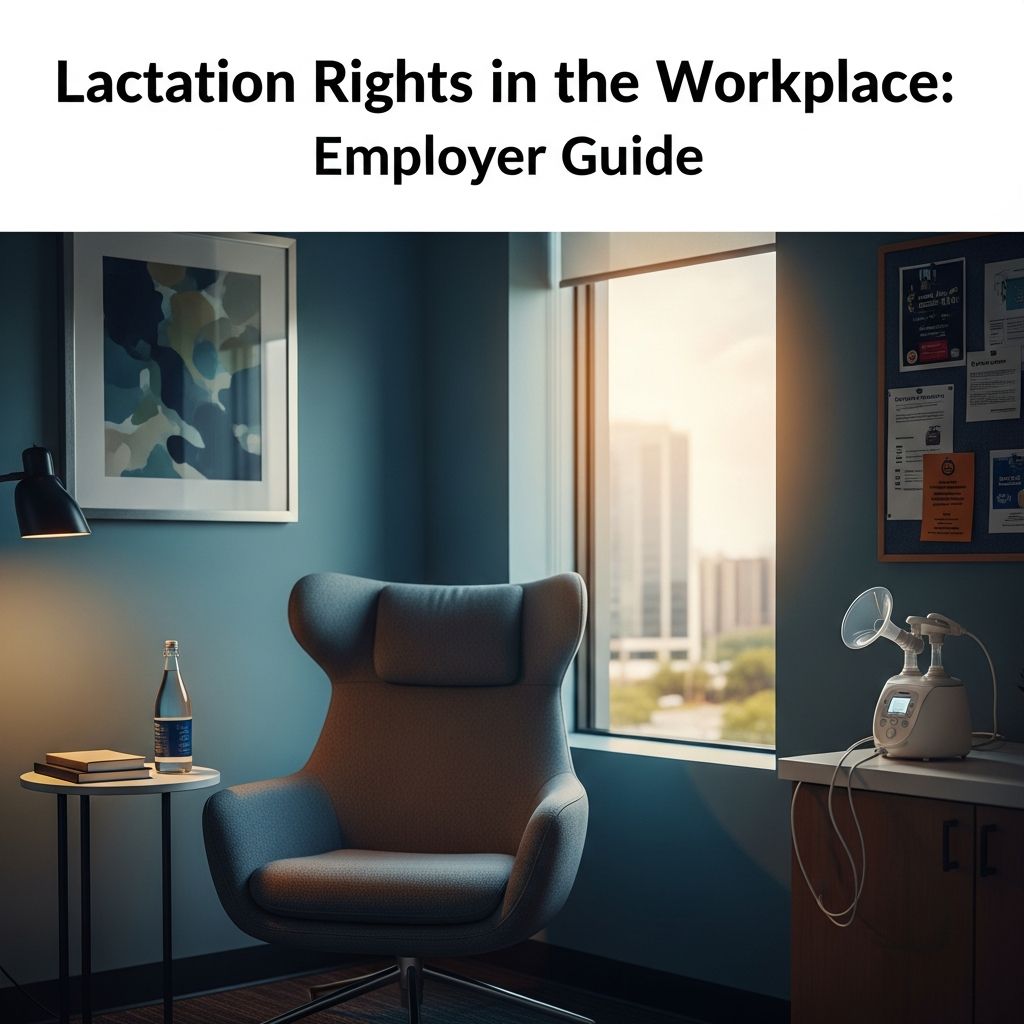
Supporting nursing employees through proper lactation accommodations is not only a legal obligation but also boosts retention and productivity. Federal laws like the Fair Labor Standards Act (FLSA) and the Providing Urgent Maternal Protections (PUMP) for Nursing Mothers Act set minimum standards, while many states offer enhanced protections.
Core Federal Requirements for Lactation Support
The foundation of workplace lactation rights stems from amendments to the FLSA. Employers must provide reasonable break time each time a nursing employee needs to express milk for her child, up to one year after birth. This applies to most employees, expanded by the PUMP Act in 2022 to cover nearly all workers, including previously exempt ones.
A suitable space is equally critical: it must be private, shielded from view, free from intrusion, and not a bathroom. These provisions ensure dignity and functionality for pumping.
| Requirement | Details | Source |
|---|---|---|
| Break Time | Reasonable duration as needed, unpaid unless overlapping with paid breaks | FLSA Section 7(r) |
| Space | Clean, private, non-bathroom with nearby electricity access | PUMP Act |
| Duration | Up to 1 year post-birth | DOL Guidelines |
Recent Expansions: The Impact of the PUMP Act
Enacted in December 2022, the PUMP Act closed gaps in the original FLSA by extending protections to salaried, exempt employees and remote workers where applicable. It mandates compliance across employer sizes and introduces enforcement mechanisms, including a 10-day cure period for space violations before legal action.
Employees can sue for remedies like back pay, reinstatement, and attorney fees if employers fail to comply. This shift emphasizes proactive policy development.
Navigating State-Specific Lactation Protections
Federal law sets a floor, but states often provide ceilings of protection. Employers must adhere to the stricter standard. For instance, some states extend accommodations beyond one year or mandate paid breaks.
- California: Requires paid break time equivalent to other employees and lactation rooms with specific amenities.
- New York: Mandates a 30-minute paid break daily for up to three years post-birth.
- Texas: Aligns closely with federal rules but adds anti-discrimination clauses.
Review local laws via state labor departments, as over 30 states plus D.C. have surpassed federal minima. Union contracts may impose additional rules.
Implementing Effective Lactation Policies
A robust policy outlines procedures, communicates rights, and fosters inclusivity. Key elements include:
- Designated lactation space with lockable door, chair, table, electrical outlet, and sink nearby.
- Flexible scheduling for breaks, potentially covering pumping time with meal or rest periods.
- Confidential request process without medical proof required.
- Training for managers on accommodations and anti-harassment.
Normalize support by integrating into employee handbooks and onboarding. Employee resource groups for parents can provide peer mentoring.
Overlaps with Broader Workplace Protections
Lactation rights intersect with the Pregnant Workers Fairness Act (PWFA), requiring reasonable accommodations for pregnancy-related conditions without undue hardship. Pumping needs may qualify indefinitely under PWFA if ongoing.
The Pregnancy Discrimination Act further prohibits adverse actions against breastfeeding employees, treating lactation needs comparably to other medical conditions. Courts increasingly view denials as discriminatory.
| Law | Key Protection | Time Limit |
|---|---|---|
| FLSA/PUMP | Break time + space | 1 year |
| PWFA | Reasonable accommodations | No limit (needs-based) |
| Pregnancy Discrimination Act | Non-discrimination | N/A |
Common Compliance Pitfalls and Solutions
Many employers falter by designating bathrooms as pumping areas or denying breaks due to ‘coverage’ issues. Solutions involve mapping employee needs and cross-training staff.
Remote workers pose unique challenges; provide guidance on private home spaces during work hours. Small businesses (under 50 employees) previously exempt now comply unless undue hardship proven—a high bar.
Business Benefits of Lactation Support
Beyond compliance, accommodations enhance morale, reduce turnover (costing up to 200% of salary), and promote health. Breastfeeding reduces infant illnesses, indirectly aiding attendance. Studies show supportive policies correlate with higher retention rates among new mothers.
Step-by-Step Accommodation Process
- Request: Employee notifies supervisor or HR verbally or in writing.
- Dialogue: Engage in good-faith discussion on needs and solutions.
- Provide: Grant breaks/space promptly; track via app or log if needed.
- Review: Periodically reassess as needs evolve.
- Document: Maintain records for compliance audits.
Frequently Asked Questions (FAQs)
Do I have to pay for lactation breaks?
No, federal law does not require compensation unless it coincides with paid rest breaks or state law mandates it.
Can I require a doctor’s note for pumping?
No, such requests violate privacy; accommodations based on employee-stated needs.
What if providing space causes undue hardship?
Rare for most employers; must prove significant difficulty/expense. Alternatives like shared shielded spaces often suffice.
How does this apply to remote employees?
PUMP covers them; ensure work-from-home policies allow private pumping during shifts.
Are there protections beyond one year?
Federal: no, but PWFA may extend; check state laws.
Enforcement and Seeking Help
File complaints with DOL Wage and Hour Division or pursue private lawsuits post-10-day notice for space issues. EEOC handles discrimination claims.
Resources: DOL Nursing Mothers page, state labor sites, and advocacy groups like U.S. Breastfeeding Committee.
References
- Frequently Asked Questions – Pumping Breast Milk at Work — U.S. Department of Labor. 2023-01-01. https://www.dol.gov/agencies/whd/nursing-mothers/faq
- Workplace Lactation Laws — Pregnant@Work. 2024-01-15. https://pregnantatwork.org/workplace-lactation-laws/
- What Employers Need to Know — Office on Women’s Health. 2023-06-20. https://womenshealth.gov/supporting-nursing-moms-work/what-law-says-about-breastfeeding-and-work/what-employers-need-know
- Breastfeeding and Returning to Your Workplace — Centers for Disease Control and Prevention. 2024-02-10. https://www.cdc.gov/infant-toddler-nutrition/breastfeeding/returning-to-your-workplace.html
- Breast Pumping at Work Laws + Lactation Accommodations — Mamava. 2023-12-05. https://www.mamava.com/breastfeeding-laws/at-work
- Time and Place to Pump at Work: Your Rights — U.S. Equal Employment Opportunity Commission. 2024-03-15. https://www.eeoc.gov/time-and-place-pump-work-your-rights
Similar Articles








Read full bio of medha deb




