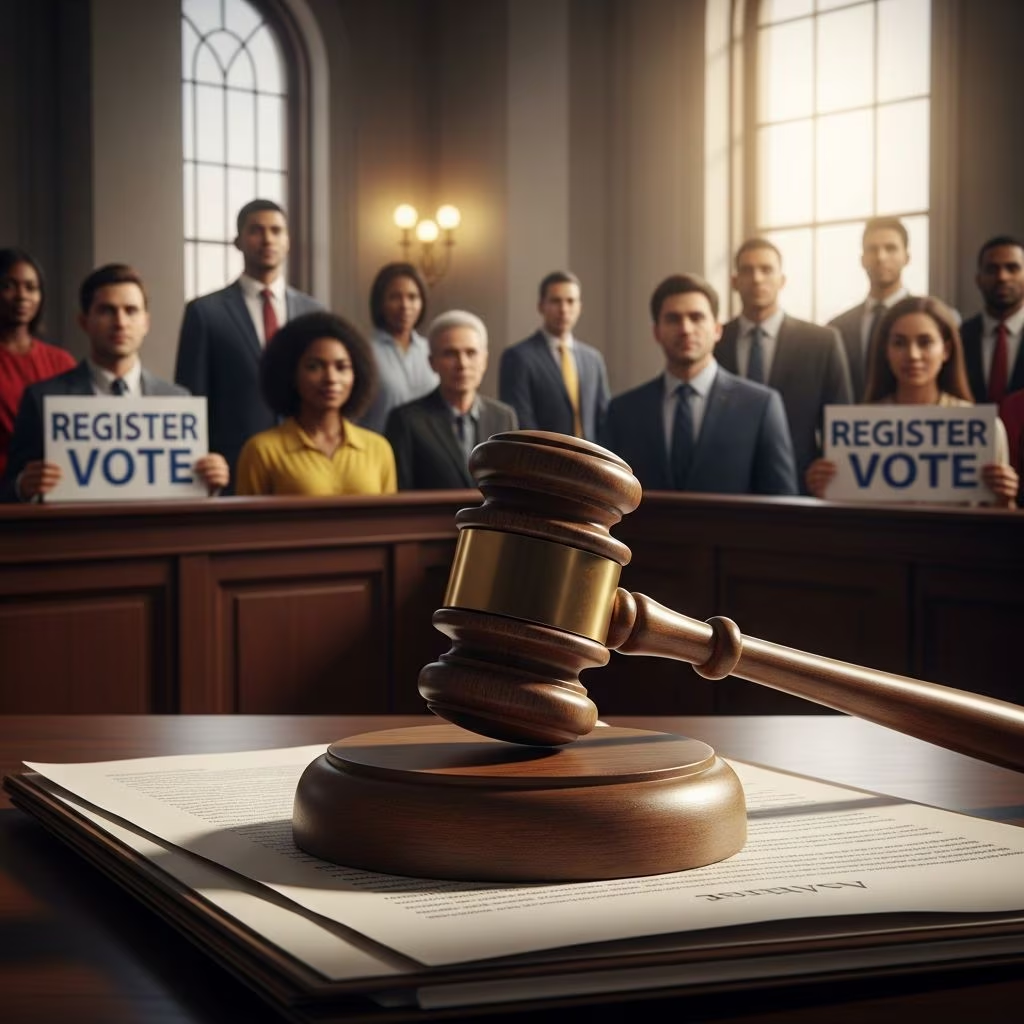
Voter registration serves as the gateway to democratic participation in the United States, yet it remains a battleground for competing interests in election integrity and access. Recent legislative pushes, such as Florida’s adoption of stringent citizenship verification rules and the federal SAVE America Act, have ignited fierce debates and lawsuits. These developments highlight tensions between preventing non-citizen voting and ensuring eligible Americans can exercise their rights without undue hurdles.
Citizenship Documentation: The New Frontier of Voter ID Laws
One of the most contentious issues is the push for documentary proof of citizenship during registration. Proponents argue it safeguards elections against rare instances of non-citizen participation, while critics warn it erects barriers for millions of lawful voters lacking easy access to documents like birth certificates or passports.
Florida’s recent law, modeled after the SAVE America Act, mandates such proof not only for new registrants but retroactively for those already on rolls. This has prompted immediate legal challenges from groups like the ACLU and League of Women Voters, claiming violations of the First and Fourteenth Amendments by burdening core voting rights. Naturalized citizens, elderly voters from the Jim Crow era, name-changed married women, and low-income individuals are particularly vulnerable, as many lack readily available paperwork.
The SAVE Act, passed by the House in February 2026, extends these requirements nationwide for federal elections, demanding proof at registration, photo ID at polling places, and ID copies with mail ballots. It also imposes criminal penalties on election officials for non-compliance, potentially deterring registrations out of fear. Courts have historically scrutinized such measures under the Anderson-Burdick balancing test, weighing state interests against voter burdens. Precedents like Crawford v. Marion County Election Board affirm that states must show concrete threats outweighing impediments.
Voter Roll Maintenance: Balancing Accuracy and Fairness
Maintaining accurate voter lists is essential, but aggressive purges risk disenfranchising legitimate voters. The SAVE Act mandates frequent reviews and data-sharing with federal authorities to flag non-citizens, overriding state processes in some cases. Florida’s version amplifies state agency roles in verification, building on existing constitutional bans on non-citizen voting.
Opponents highlight how retroactive applications could erroneously remove voters whose records mismatch due to name changes or missing documents. For instance, Puerto Ricans relocating after hurricanes may struggle with pre-2010 birth records. Federal law already criminalizes false citizenship attestations as felonies under the 1996 Illegal Immigration Reform Act, questioning the necessity of added layers.
| Aspect | Proponents’ View | Critics’ View |
|---|---|---|
| Citizenship Proof | Prevents rare non-citizen votes; 99% compliant via REAL ID | Disenfranchises vulnerable groups; minimal fraud evidence |
| Roll Purges | Ensures list accuracy | Risks mass eligible voter removal |
| Official Liability | Promotes accountability | Causes caution, strains workforce |
Federal vs. State Authority in Election Rules
The SAVE Act’s preemption of state registration processes raises federalism concerns. While targeting federal elections, it imposes uniform standards stricter than many states’, conflicting with the National Voter Registration Act (NVRA) of 1993. A 2026 presidential executive order invokes the Help America Vote Act and constitutional duties to push citizenship verification, urging states to align procedures.
States like Arizona and Kansas have experimented with proof requirements since 2004, often via dual systems allowing federal-only voting for those without full proof. Judicial blocks, such as in Kansas, underscore enforcement challenges. Critics argue these federal mandates undermine state sovereignty and NVRA’s streamlined processes, like mail and DMV registrations where voters affirm citizenship under penalty of perjury.
Disproportionate Effects on Marginalized Communities
Documentation hurdles disproportionately impact communities of color, seniors, students, disabled voters, and transgender individuals. Brennan Center analyses predict millions blocked, echoing past Voter ID impacts. In Florida, Black elders without birth certificates and naturalized immigrants face acute risks.
- Low-income voters: Often lack funds for document fees or travel.
- Rural residents: Limited access to vital records offices.
- Mobility-impaired: Hardship obtaining replacements.
- Transgender voters: Name/gender mismatches trigger scrutiny.
Studies show non-citizen voting is ‘virtually nonexistent,’ with existing penalties sufficient deterrence. Yet backers cite isolated Florida cases among 13.3 million voters to justify expansions.
Judicial Precedents and Future Outlook
Supreme Court rulings provide a framework. In Crawford (2008), photo ID was upheld narrowly due to in-person fraud evidence, but proof-of-citizenship lacks similar justification. Earlier cases like Anderson v. Celebrezze demand factual showings of threats. Ongoing Florida suits invoke these, seeking injunctions before 2026 midterms.
Nationally, SAVE Act’s Senate fate remains uncertain, with state legislatures tracking via NCSL. Bipartisan Policy Center notes no partisan skew in documentation access, but implementation could chill turnout. Election workers face burnout from added liabilities, potentially worsening shortages.
Practical Steps for Voters and Advocates
To navigate these changes:
- Verify registration status via state portals.
- Gather documents early: passport, birth certificate, naturalization papers.
- Update records for name changes.
- Assist vulnerable voters through drives.
- Monitor lawsuits via ACLU or Campaign Legal Center.
Advocates should prioritize litigation and public education, emphasizing federal laws’ adequacy.
Frequently Asked Questions (FAQs)
What documents prove U.S. citizenship for registration?
Typically birth certificates, passports, naturalization certificates, or REAL ID-compliant driver’s licenses. Requirements vary by state and new laws like SAVE.
Can non-citizens vote in U.S. elections?
No, it’s a federal felony under the 1996 Immigration Act, punishable severely.
Does Florida’s new law affect current voters?
Yes, retroactively; lacking proof risks removal from rolls.
Will SAVE Act become law?
Passed House in 2026; Senate debate ongoing, with state preemption issues.
How to challenge unfair voter purges?
Contact groups like League of Women Voters or file via NVRA provisions.
State-by-State Comparison of Requirements
| State | Citizenship Proof? | Retroactive? | Key Notes |
|---|---|---|---|
| Florida | Yes (new law) | Yes | Lawsuits pending |
| Arizona | Partial (dual system) | No | Federal-only for some |
| Kansas | Yes (unenforced) | No | Court-blocked |
| Federal (SAVE) | Yes | N/A | Preempts states |
These evolving rules underscore the need for vigilance. As courts weigh in, voters must prepare while advocates fight for access.
References
- Voting Rights Advocates Sue to Block Florida’s Restrictive “Show Your Papers” Law — ACLU. 2026 (approx). https://www.aclu.org/press-releases/voting-rights-advocates-sue-to-block-floridas-restrictive-show-your-papers-law
- The Supreme Court and Voting Identification — SCOTUSblog. 2026-03. https://www.scotusblog.com/2026/03/the-supreme-court-and-voting-identification/
- DeSantis Signs Florida’s Version of SAVE America Act, Draws Immediate Lawsuit — Politico. 2026-04-01. https://www.politico.com/news/2026/04/01/desantis-signs-floridas-version-of-save-america-act-draws-immediate-lawsuit-00854039
- Five Things to Know About the SAVE America Act — Bipartisan Policy Center. 2026 (approx). https://bipartisanpolicy.org/article/five-things-to-know-about-the-save-act/
- Ensuring Citizenship Verification and Integrity in Federal Elections — White House. 2026-03. https://www.whitehouse.gov/presidential-actions/2026/03/ensuring-citizenship-verification-and-integrity-in-federal-elections/
- 9 Things to Know About the Proposed SAVE America Act — NCSL. 2026-03-23. https://www.ncsl.org/state-legislatures-news/details/9-things-to-know-about-the-proposed-save-america-act