
Key Evidence in Massachusetts Child Custody Cases
Understand the Massachusetts documents, records, and testimony that most strongly influence child custody and parenting time decisions in court.
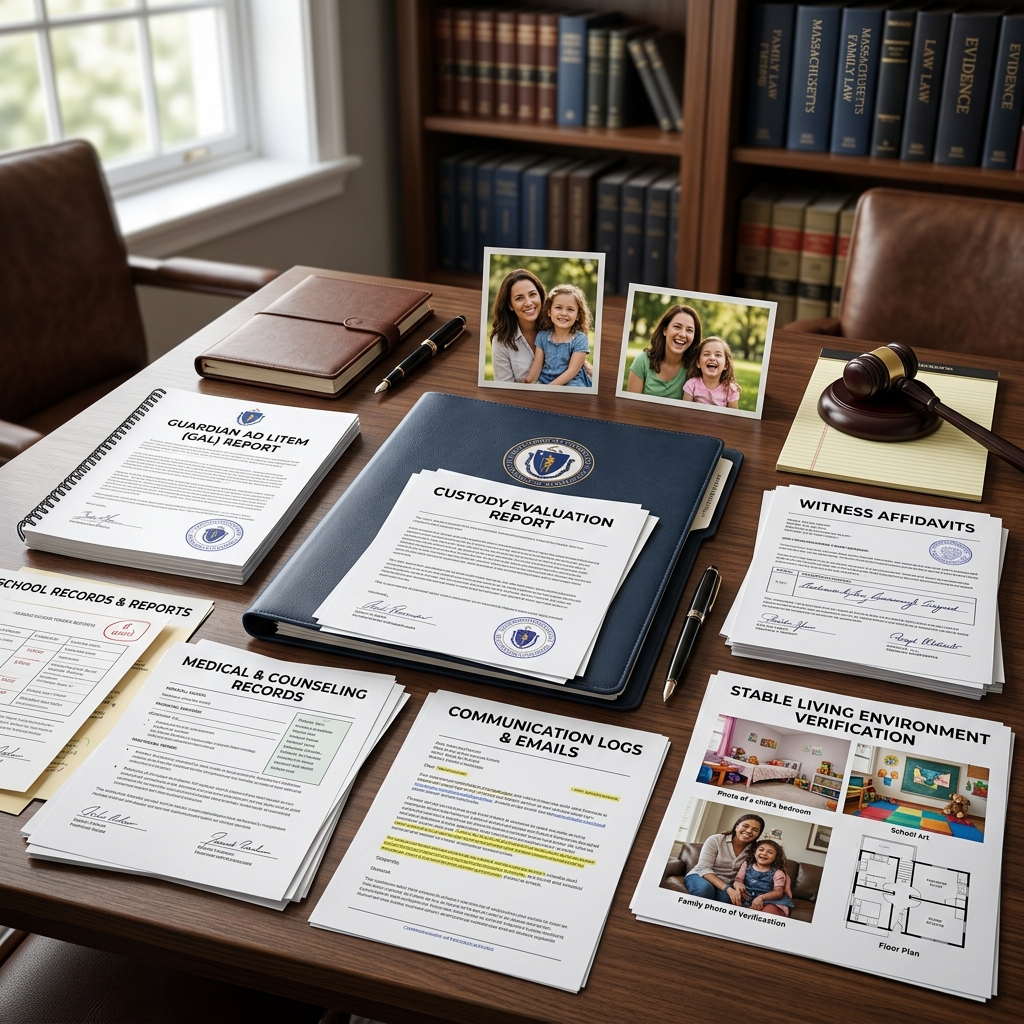
When parents go to court over child custody and parenting time in Massachusetts, judges rely heavily on documents and evidence to understand the child’s life and each parent’s role. The right paperwork and records can make the difference between a weak case and a well-supported, persuasive presentation to the court.
This guide explains the main types of documents and evidence used in Massachusetts custody matters, how they fit into the legal process, and practical steps parents can take to gather and organize them effectively.
1. How Massachusetts Courts Decide Custody and Parenting Time
Massachusetts courts base custody and parenting time decisions on the best interests of the child. Judges examine evidence about the child’s safety, stability, emotional well-being, and each parent’s ability to meet the child’s needs.
Evidence is used to answer questions such as:
- Who has been the child’s primary caregiver day to day?
- How well do the parents communicate and cooperate about the child?
- Is the child’s environment safe, stable, and supportive?
- Does either parent present a risk due to substance use, violence, or neglect?
Under the Massachusetts Guide to Evidence, a wide range of materials can be considered in child custody and child protective cases, including documents, affidavits, and witness testimony. The focus is not what a parent wants, but what arrangement most effectively protects and supports the child.
2. Core Court Forms and Case-Opening Documents
Every custody case starts with specific Massachusetts court forms. These initial filings both open the case and provide the first set of information the judge will see.
2.1 Required Forms When Filing for Custody or Parenting Time
According to the Massachusetts Trial Court, typical forms in a custody or parenting time case include:
- Complaint for Support–Custody–Parenting Time (CJD 109) – Begins the case and states what custody and parenting time orders the parent is requesting.
- Certified Copy of Birth Certificate or Voluntary Acknowledgment of Parentage – Establishes the child’s identity and legal parentage.
- Affidavit of Care and Custody (Child Care or Custody Disclosure Affidavit) – Tells the court about other cases or orders involving the child, such as previous custody, guardianship, or abuse and neglect matters.
- Financial Statement and, where support is at issue, a Child Support Guidelines Worksheet – Provides detailed income and expense information for child support decisions.
- Motion for Temporary Orders (CJD 400) – Used when a parent needs interim custody, parenting time, or child support orders while the case is pending.
These forms ensure the court has basic facts about the family, the child’s residence, financial circumstances, and any existing legal history connected to the child.
2.2 The Home State Rule and Jurisdiction
Massachusetts typically requires that the child has lived in the state for at least six months immediately before a custody complaint is filed, known as the home state rule. Proof of the child’s residence, such as school records or medical records, can support this requirement and confirm the court’s authority to decide the case.
3. Everyday Documentation That Strengthens Your Case
Beyond official forms, judges rely heavily on day-to-day records that show how each parent cares for the child. These materials often provide the clearest picture of what life looks like for the child in each household.
3.1 Parenting Logs and Journals
A detailed parenting log can be powerful evidence of involvement and stability. Useful entries include:
- Drop-offs and pick-ups for school, daycare, and activities.
- Homework help, reading time, and learning activities.
- Meals, bedtime routines, and daily caregiving tasks.
- Medical appointments and how health needs are managed.
- Positive interactions, such as attending performances, games, or conferences.
Family law practitioners recommend keeping notes in a consistent, organized format so they can be easily referenced and presented chronologically.
3.2 Communication Records Between Parents
Communication records are often central to demonstrating cooperation or, if necessary, documenting conflict.
Common forms of communication evidence include:
- Emails detailing schedule changes, decision-making, and problem-solving.
- Text messages about pickups, drop-offs, and parenting issues.
- Messages through parenting apps used to coordinate activities or exchange information.
Lawyers often advise parents to keep as much communication as possible in writing and to develop a system for storing and organizing digital correspondence. These records can show whether a parent responds promptly, shares information, and avoids inflammatory language.
3.3 Social Media and Digital Footprint
Social media postings can sometimes be used as evidence of a parent’s behavior or lifestyle. Courts may consider online photos, posts, or messages when they are relevant to the child’s safety or the parent’s claims. Parents should assume that anything publicly posted could be reviewed in a custody case and act accordingly.
4. Financial, Medical, and School Records
Objective third-party records provide powerful support because they are created in the ordinary course of business and often reflect long-term patterns. Massachusetts courts frequently look at financial, medical, and educational records to understand the child’s circumstances.
4.1 Financial Documents
Financial records help demonstrate a parent’s ability to meet the child’s basic needs and uphold court-ordered support.
- Income statements and tax returns – Show earnings and financial capacity.
- Bank statements – Document spending patterns and payment of child-related expenses.
- Receipts for child-related costs – Provide evidence of spending on clothing, school supplies, activities, medical bills, and childcare.
These materials connect directly to the financial disclosures required by Massachusetts courts and inform decisions about child support and overall stability.
4.2 Medical and Health Records
Medical records can demonstrate both the child’s health needs and how each parent manages them.
- Doctor’s notes and visit summaries.
- Therapy or counseling records, where appropriate and lawfully obtained.
- Medication lists and treatment plans.
- Specialist evaluations for ongoing or serious conditions.
These records can show who schedules appointments, attends visits, follows medical advice, and communicates with providers.
4.3 School and Educational Records
Academic and school-related documents often reveal how well the child is doing and how involved each parent is in their education.
- Report cards and progress reports – Indicate academic performance and attendance trends.
- Attendance records – May suggest issues with tardiness or absences connected to home routines.
- Teacher notes and evaluations – Provide independent observations of behavior and performance.
- Records of meetings, such as parent–teacher conferences or special education planning sessions.
Courts may consider whether parents attend important school events, communicate with teachers, and support the child’s educational needs.
5. Witness Testimony and Expert Opinion
Documents are crucial, but custody cases also rely on people who can explain what they have observed. Massachusetts law allows judges to consider testimony from lay witnesses and experts in child-related proceedings.
5.1 Character and Parenting Witnesses
Witnesses who know the family can offer valuable third-party perspectives on parenting behavior and the child’s experience.
- Teachers or school staff.
- Coaches and activity leaders.
- Childcare providers or babysitters.
- Neighbors or extended family members with direct knowledge of interactions.
Written character references or in-court testimony can support claims about stability, involvement, and appropriate parenting.
5.2 Professional and Expert Testimony
Expert witnesses may be used when specialized knowledge is needed, for example in cases involving abuse, neglect, or complex psychological issues.
- Mental health professionals who have evaluated the child or family.
- Medical experts in cases involving serious health conditions.
- Custody evaluators or guardians ad litem, where appointed.
Under the Massachusetts Guide to Evidence, affidavits and expert evaluation materials may be admissible in child custody and protective proceedings, subject to the rules the court applies. These opinions can help the judge understand the potential impact of different custody arrangements on the child.
6. Organizing Evidence for a Massachusetts Custody Hearing
Having strong evidence is only helpful if it is well organized. Parents who represent themselves, and those working with attorneys, benefit from presenting documents clearly and logically so judges can quickly find key information.
6.1 Chronological and Topic-Based Systems
Family law practitioners commonly recommend organizing evidence in two complementary ways:
- Chronological order – Create timelines showing major events, incidents, and milestones, and cross-reference each event with the supporting documents.
- By topic – Group materials into categories such as communication, finances, health, education, and parenting activities.
This dual approach lets the court see both the sequence of events and the overall patterns in each area of the child’s life.
6.2 Practical Tips for Organizing Digital and Paper Records
- Maintain folders on your computer for each category (e.g., “School,” “Medical,” “Communication”).
- Use date-based file names to make searching easier (for example, 2025-09-03-school-email.pdf).
- Store backup copies securely, but avoid posting or sharing case files on social media.
- For physical documents, use binders with labeled sections and an index at the front.
- Consult with an attorney or legal aid provider about which documents are most important for your specific case.
7. Comparing Types of Evidence Commonly Used
The table below compares key categories of evidence often used in Massachusetts child custody matters.
| Evidence Type | Main Purpose | Examples |
|---|---|---|
| Court Forms and Case Filings | Establish jurisdiction, basic facts, and requested orders. | Complaint for Support–Custody–Parenting Time, Affidavit of Care and Custody, Financial Statements. |
| Parenting Records | Show day-to-day caregiving and involvement. | Parenting logs, schedules, notes on homework and activities. |
| Communication Documentation | Demonstrate cooperation or conflict between parents. | Emails, text messages, parenting app logs. |
| Financial, Medical, and School Records | Provide objective proof of stability and attention to needs. | Tax returns, bank statements, medical reports, report cards, attendance records. |
| Witness and Expert Testimony | Offer third-party views and specialized opinions. | Teachers, childcare providers, mental health professionals, custody evaluators. |
8. Practical Strategies for Parents Preparing for Custody Litigation
Although every case is unique, certain practical strategies consistently help parents present stronger, clearer evidence to Massachusetts courts.
8.1 Focus Evidence on the Child’s Needs
Judges expect parents to frame their arguments around what is best for the child, not what is most convenient or satisfying for the adults involved. When gathering documents:
- Highlight records showing the child’s progress, stability, and emotional well-being.
- Collect materials demonstrating how your proposed plan supports education, health, and safe relationships.
- Avoid evidence that primarily speaks to personal grievances unless it directly affects the child’s welfare.
8.2 Stay Organized and Respect Procedural Requirements
Massachusetts custody procedures include deadlines, required forms, and specific rules about how evidence is submitted. Parents strengthen their credibility by:
- Filing all required forms completely and on time.
- Responding promptly to court notices and requests for information.
- Working with an attorney or legal aid, if possible, to ensure compliance with evidence rules.
8.3 Maintain Professional Communication
Because emails and texts may be reviewed in court, parents are often advised to communicate as though a judge will eventually read their messages.
- Keep messages brief, factual, and child-focused.
- Avoid insults, threats, or sarcasm.
- Confirm agreements and changes in writing.
This professional tone not only helps co-parenting but also may support the parent’s case if communication becomes evidence.
9. Frequently Asked Questions (FAQs)
9.1 What is the single most important type of evidence in a Massachusetts custody case?
There is no single item that wins a case. Courts look at the total picture, including parenting records, communication history, financial and school documents, and witness testimony, all evaluated under the best interests of the child standard.
9.2 Do I need an Affidavit of Care and Custody for every custody filing?
In Massachusetts, an Affidavit of Care and Custody (Child Care or Custody Disclosure Affidavit) is required in cases involving the care, custody, or visitation of a child, to disclose any related proceedings or orders.
9.3 Can social media posts really affect my custody case?
Yes. Social media posts may be used to show a parent’s activities, state of mind, or inconsistencies with claims made in court, especially when they relate directly to the child’s safety or the parent’s behavior.
9.4 How far back should my documentation go?
There is no fixed rule, but many parents gather several years of records when possible, especially for ongoing issues like schooling, medical treatment, or long-term communication patterns. For recently emerging concerns, more recent, detailed documentation can be particularly important.
9.5 Is expert testimony always necessary?
Not always. Many custody cases rely primarily on everyday documents and lay witnesses. Expert testimony is more common where specialized knowledge is needed, such as complex psychological evaluations or serious health conditions that significantly affect the custody analysis.
References
- Filing for child custody or parenting time in Massachusetts — Massachusetts Trial Court, Mass.gov. 2024-02-01. https://www.mass.gov/info-details/filing-for-child-custody-or-parenting-time-in-massachusetts
- Massachusetts Guide to Evidence, 2025 Edition, Section 1115 — Massachusetts Supreme Judicial Court. 2025-01-01. https://codes.findlaw.com/ma/massachusetts-guide-to-evidence-2025-edition/ma-r-evid-sect-1115/
- What is The Best Evidence To Win A Child Custody Case in MA? — Law Office of Bill Farias. 2026-01-12. https://www.billfariaslaw.com/blog/what-is-the-best-evidence-to-win-a-child-custody-case-in-ma/
- What to Document in Child Custody Cases — O’Connor Family Law. 2023-08-15. https://www.familylawma.com/blog/what-to-document-in-child-custody-cases/
- How to Show the Judge It Is in Your Child’s Best Interest for You to Have Custody or Parenting Time — MassLegalHelp/Massachusetts Law Reform Institute. 2019-06-10. https://www.masslegalhelp.org/children-families-divorce/custody-parenting-time-visitation/how-show-judge-it-your-childs-best-interest-you-have-custody-or-parenting-time
- Child Custody Laws in Massachusetts: What Every Parent Needs to Know — Lynch & Owens, P.C. 2025-04-22. https://www.lynchowens.com/blog/2025/april/child-custody-laws-in-massachusetts-what-every-p/
- Chapter 9: Child Custody — MassLegalServices (Massachusetts Law Reform Institute). 2018-01-01. https://www.masslegalservices.org/system/files/library/Chapter%209.pdf
Similar Articles








Read full bio of Sneha Tete


