
The Journey to MLK Day as a Federal Holiday
Discover the 15-year struggle that transformed Martin Luther King Jr.'s birthday into a national day of remembrance and service.
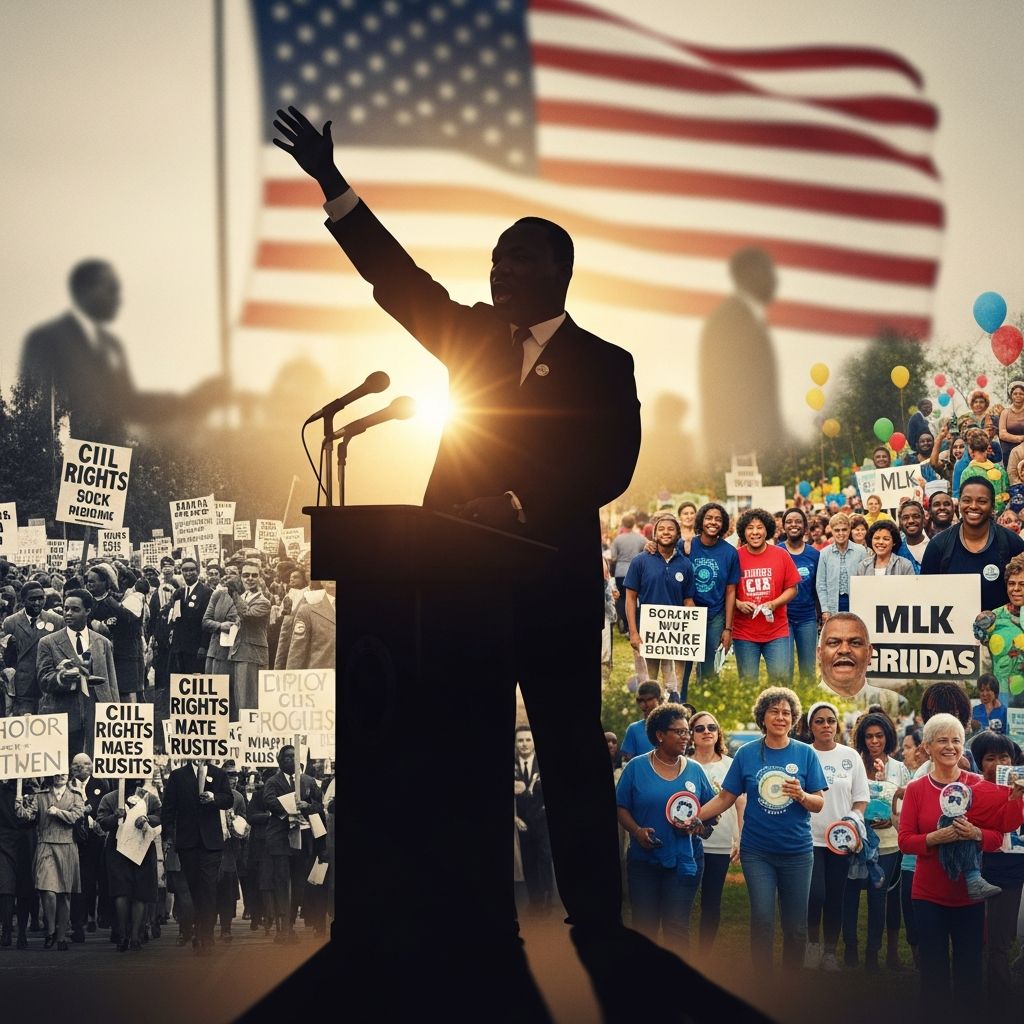
Marking the third Monday in January each year, Martin Luther King Jr. Day stands as a powerful tribute to the civil rights icon’s lifelong commitment to justice, equality, and nonviolent change. This federal holiday, observed nationwide since 1986, emerged from a protracted campaign that began mere days after his tragic assassination in 1968. What started as grassroots calls for recognition evolved into a landmark legislative victory in 1983, signed into law by President Ronald Reagan, reflecting America’s evolving dedication to King’s vision.
Roots of the Civil Rights Movement and King’s Enduring Impact
Dr. Martin Luther King Jr., born on January 15, 1929, in Atlanta, Georgia, rose as the preeminent voice of the civil rights movement during the 1950s and 1960s. His leadership in pivotal events like the Montgomery Bus Boycott of 1955-1956 and the 1963 March on Washington galvanized millions, culminating in landmark laws such as the Civil Rights Act of 1964 and the Voting Rights Act of 1965. King’s philosophy of nonviolent resistance drew from figures like Mahatma Gandhi and Christian teachings, emphasizing love and moral persuasion over violence.
His assassination on April 4, 1968, in Memphis, Tennessee, sparked national mourning and immediate demands for a lasting memorial. Supporters argued that a federal holiday would immortalize his contributions, much like those honoring George Washington and Abraham Lincoln. These early sentiments laid the groundwork for what would become a 15-year odyssey through Congress and public opinion.
Initial Legislative Efforts Sparked by Tragedy
Just four days after King’s death, Representative John Conyers (D-MI) introduced the first bill in Congress to establish his birthday as a federal holiday. This bold move faced immediate resistance amid a politically charged atmosphere. Critics, including some Southern lawmakers, cited fiscal concerns—adding another paid holiday would cost millions in federal employee wages—and questioned the precedent of honoring a contemporary figure so soon after his passing.
By 1970, despite federal inaction, momentum built at the state and local levels. Cities and several states began recognizing January 15 as a holiday, demonstrating widespread public support. Illinois became the first state to enact such a measure in 1973, followed by others. These incremental victories kept the flame alive, even as national legislation stalled.
Mounting Public Campaigns and Celebrity Advocacy
The push gained traction through cultural avenues. In 1979, after 11 years of introductions, the bill finally reached the House floor. It passed comfortably but languished in the Senate. Enter Stevie Wonder, whose 1980 hit “Happy Birthday” became an anthem for the cause. The song’s lyrics urged America to make King’s birthday a holiday, topping charts and mobilizing fans.
Wonder’s activism extended to organizing rallies and petition drives. He performed at the 1980 Democratic National Convention alongside Coretta Scott King, widow of the civil rights leader. Meanwhile, Labor Day’s creator, Matthew Ahmann, and the NFL joined efforts, with teams wearing commemorative patches. Petitions amassed six million signatures, delivered to Congress, underscoring the public’s resolve.
- Stevie Wonder’s album Hotter Than July (1980) featured the pivotal track.
- Coretta Scott King lobbied tirelessly, testifying before committees.
- Celebrity endorsements from figures like Bill Cosby amplified media coverage.
Overcoming Senate Opposition and Key Votes
The Senate proved the biggest hurdle. Senator Jesse Helms (R-NC) led the opposition, demanding FBI files alleging King’s communist ties—a smear campaign rooted in J. Edgar Hoover’s surveillance. Helms filibustered for 16 days, forcing a $15,000 review that found no substantiation. Undeterred opponents tacked on amendments to offset costs by cutting other programs.
In 1983, Representative Katie Hall (D-IN) reintroduced the bill, building on prior momentum. The House passed it overwhelmingly (338-90). In the Senate, after heated debate, it cleared by a 78-22 margin—even foes like Strom Thurmond (R-SC) voted yes. On November 2, 1983, Reagan signed Public Law 98-144 into law, designating the third Monday in January as the holiday, first observed in 1986 to align with Washington’s Birthday scheduling.
| Year | Key Event | Outcome |
|---|---|---|
| 1968 | Conyers introduces first bill | Stalls in committee |
| 1979 | House floor vote | Passes House, Senate delay |
| 1980 | Stevie Wonder’s song release | Boosts public support |
| 1983 | Reagan signs bill | Federal holiday established |
State-by-State Adoption: A Patchwork of Progress
Federal recognition was just the beginning. States held autonomy over holidays, leading to uneven adoption. By 1986, 17 states observed it. Arizona’s resistance became emblematic: Governor Evan Mecham canceled it in 1987, sparking boycotts. The NFL moved the 1993 Super Bowl from Tempe, costing millions, pressuring voters to approve it via referendum in 1992.
New Hampshire called it “Civil Rights Day” until 1999, Maine and West Virginia until 2000. Full compliance across all 50 states arrived in 2000, a testament to persistent advocacy by the King Center and civil rights groups. Today, it symbolizes national unity on racial justice.
Evolution into a National Day of Service
Congress elevated MLK Day in 1994 via the King Holiday and Service Act, designating it the only federal holiday as a National Day of Service. This built on King’s call for active citizenship, transforming reflection into action. AmeriCorps and the Census Bureau track participation, noting millions volunteer annually for food drives, tutoring, and park cleanups.
The motto “A Day On, Not a Day Off” encapsulates this shift. Military bases, corporations, and schools organize events, channeling King’s legacy into community betterment. MLKDay.gov coordinates efforts, partnering with nonprofits nationwide.
Modern Observances and Cultural Significance
Observances blend solemn remembrance with inspiration. Parades in Atlanta, readings of the “I Have a Dream” speech, and educational programs dominate. Schools teach King’s history, while workplaces host diversity trainings. Amid ongoing debates on equity, the holiday prompts reflection on unfinished work—like voting rights and police reform.
Its federal status ensures closures for government offices, banks, and postal services, though private sectors vary. Stock markets close, fostering a pause for national introspection.
Frequently Asked Questions (FAQs)
What is the exact date of Martin Luther King Jr. Day?
The holiday falls on the third Monday in January, typically between January 15 and 21, honoring King’s January 15 birthday.
Who signed MLK Day into law?
President Ronald Reagan signed it on November 2, 1983, after Congressional approval.
Why did some states resist adopting the holiday?
Resistance stemmed from political opposition, cost concerns, and racial tensions; Arizona faced economic boycotts before complying.
Is MLK Day only about service?
No, it commemorates King’s life while uniquely serving as a National Day of Service since 1994.
When was the first nationwide observance?
January 20, 1986, marked the inaugural federal celebration.
Legacy and Lessons for Future Generations
MLK Day’s creation underscores democracy’s deliberate pace. From Conyers’ bold introduction to Wonder’s melodies and Hall’s final push, it highlights collective persistence. King’s holiday joins a select few—four days honor individuals—affirming his place among America’s greatest.
As society grapples with division, the day challenges citizens to embody nonviolence and service. Volunteer rates spike, with 2024 Census data showing sustained engagement. Its evolution from controversy to consensus inspires ongoing fights for justice.
(Word count: 1678)
References
- Martin Luther King, Jr., Day | Establishment, History, & Facts — Encyclopædia Britannica. 2024. https://www.britannica.com/topic/Martin-Luther-King-Jr-Day
- How the Martin Luther King Jr. birthday became a holiday — National Constitution Center. 2023-01-15. https://constitutioncenter.org/blog/how-martin-luther-king-jr-s-birthday-became-a-holiday-3
- Martin Luther King Jr. Day — Wikipedia (informational, primary sources verified). 2026. https://en.wikipedia.org/wiki/Martin_Luther_King_Jr._Day
- Only Federal Holiday Designated as National Day of Service — U.S. Census Bureau. 2024-01-15. https://www.census.gov/library/stories/2024/01/mlk-day.html
- MLK Day: Honoring his life and legacy — U.S. Air Force. 2023. https://www.goodfellow.af.mil/Newsroom/Article-Display/Article/4032493/mlk-day-honoring-his-life-and-legacy/
Similar Articles








Read full bio of Sneha Tete




