
Jail for Unpaid Littering Fines: Why a Federal Judge Called It Unconstitutional
How a New Jersey federal ruling on a $200 littering ticket exposes broader constitutional limits on jailing people who cannot afford to pay fines.
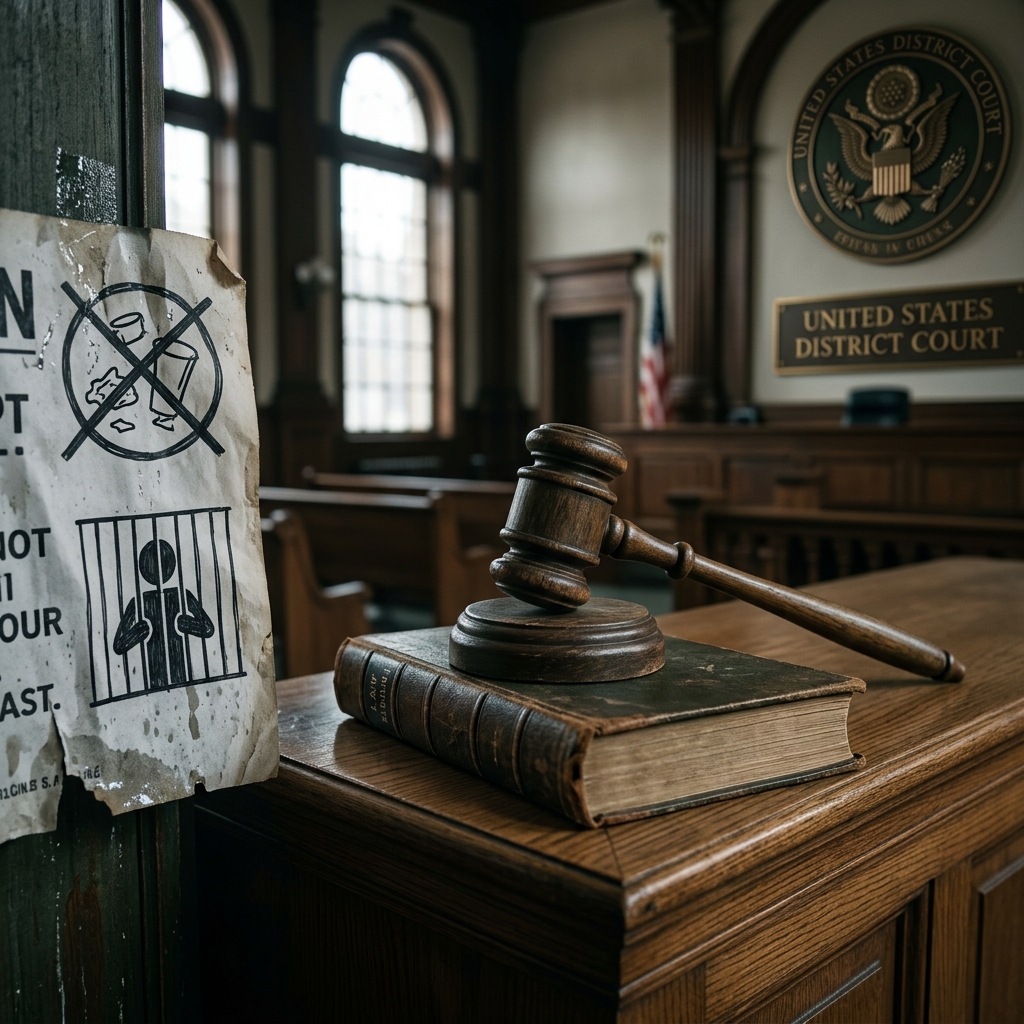
Across the United States, littering is usually treated as a minor offense, punished with fines, community service, or educational programs. Yet in one New Jersey township, a modest littering ticket spiraled into jail time when a young man could not immediately pay what the court demanded. A federal judge later condemned this practice as unconstitutional, comparing the municipal court’s actions to a modern-day debtor prison.
This ruling goes far beyond a single ticket. It raises fundamental questions about how courts handle fines and fees, how they treat people without money, and where the Constitution draws the line between legitimate punishment and unlawful incarceration based solely on poverty.
The New Jersey Littering Case: What Happened?
The controversy began in Burlington Township, New Jersey, when a college student received a littering ticket that carried a monetary penalty and associated court costs. The total amount was in the low hundreds of dollars—roughly similar to typical municipal littering fines in many states. When the student appeared in municipal court, he had only a handful of change in his pocket and told the judge he could not pay the full amount on the spot.
Instead of setting up a payment plan, scheduling an ability-to-pay hearing, or offering community service, the municipal court ordered the student to serve jail time because he lacked the money to pay immediately. According to the federal lawsuit and press reports, he was taken into custody from the courtroom and jailed solely due to his inability to pay, not because he refused to pay or committed any new offense.
Why the Federal Judge Objected
The case eventually reached federal court, where a U.S. district judge sharply criticized the township’s conduct. In the judge’s view, jailing someone who cannot pay “on the spot” effectively coerces payment from desperate family or friends and punishes poverty rather than wrongdoing. The court concluded that such practices violate fundamental constitutional principles, including due process and equal protection.
- No inquiry into ability to pay: The municipal court never held a meaningful hearing to determine whether the defendant genuinely could afford the fine.
- No consideration of alternatives: The court failed to explore options like payment plans, community service, or reduced financial obligations.
- Punishment tied to poverty: Jail was imposed solely because the defendant lacked money at that moment, not because of any willful refusal to comply.
These features placed the case squarely at odds with decades of Supreme Court precedent restricting incarceration for nonpayment of fines.
Debtor Prisons: A Discredited Practice Resurfacing in Municipal Courts
Historically, debtor prisons were institutions that jailed people purely for unpaid civil debts. The United States gradually abandoned formal debtor prisons in the 19th century, but critics argue that similar practices have quietly resurfaced through municipal fines and fees.
Organizations like the American Civil Liberties Union have documented cases in which low-income defendants are incarcerated for traffic tickets, municipal code violations, or minor criminal justice debts when they cannot pay immediately, even though they are not refusing to pay. In the New Jersey case, the ACLU of New Jersey joined the lawsuit, arguing that the Burlington Township Municipal Court’s actions resembled a modern debtor prison and violated both state and federal constitutional guarantees.
| Feature | Old Debtor Prisons | Modern Municipal Practices |
|---|---|---|
| Basis for incarceration | Civil or personal debts | Unpaid fines and fees tied to minor offenses |
| Role of ability to pay | Often ignored; prison until debt paid | Sometimes ignored when courts demand immediate payment |
| Constitutional scrutiny | Widely condemned and abolished | Increasingly challenged as unconstitutional discrimination based on income |
| Available alternatives | Few or none | Community service, payment plans, reduced fines—if courts choose to use them |
What the Supreme Court Says About Jail for Unpaid Fines
The federal judge’s ruling in the New Jersey littering case did not arise in a vacuum. It rests on a line of U.S. Supreme Court decisions that have repeatedly warned courts against converting unpaid fines into incarceration when the nonpayment stems from poverty, not defiance.
Key Supreme Court Precedents
- Williams v. Illinois: The Court held that extending a defendant’s maximum prison term simply because they could not pay fines or court costs discriminates against indigent defendants under the Equal Protection Clause.
- Tate v. Short: The Court struck down a scheme in which a traffic offense punishable only by a fine was converted into jail time for a defendant too poor to pay. This effectively turned a fine-only offense into a jailable offense for the poor but not for the rich.
- Bearden v. Georgia: The Court ruled that a judge cannot revoke probation and imprison someone for failure to pay a fine or restitution unless the court finds the nonpayment was willful or that no adequate alternative to incarceration exists. Inability to pay, standing alone, cannot justify jail.
Together, these cases establish a central principle: courts must distinguish between willful nonpayment and inability to pay. When a defendant genuinely lacks the resources to pay, the Constitution requires courts to consider other options before imposing jail.
Littering Laws and Typical Penalties
Littering is widely regulated at the state and local level. Many jurisdictions treat littering as a misdemeanor or infraction with penalties that include fines, community service, or mandated litter pickup. Jail is sometimes authorized for more serious or repeated violations, but for small-scale littering, the primary sanction is financial.
- States often set maximum fines, such as several hundred to around one thousand dollars, for first-time littering offenses.
- Some states require courts to impose community service or litter-gathering labor in addition to any fine.
- For minor littering, imprisonment is usually reserved for repeat offenses or egregious conduct.
Against this backdrop, jailing a person who merely cannot afford to pay a relatively modest littering fine—and who has not committed a more serious offense—stands out as an atypical and constitutionally suspect practice.
Why Ability-to-Pay Hearings Matter
In response to concerns about unconstitutional fine enforcement, New Jersey’s court system has begun to reform how municipal courts handle unpaid fines and fees. A statewide report on municipal court operations emphasizes the importance of mandatory ability-to-pay hearings when a defendant fails to pay, plain-language notices explaining consequences, and broader use of alternative sentences.
Core Elements of an Ability-to-Pay Process
- Assessment of income and expenses: Courts gather information about a defendant’s earnings, essential living costs, and dependents to determine what they can reasonably afford.
- Consideration of alternatives: Judges evaluate whether payment plans, community service, or reduced fines can meet the goals of punishment and deterrence without causing severe financial harm.
- Clear notice: Defendants receive written and oral explanations of their rights, the availability of alternatives, and the court’s expectations.
- Limits on warrants and jail: Bench warrants and incarceration are reserved for serious offenses or cases where defendants willfully ignore court obligations, not simply where they cannot pay.
The Burlington Township case illustrates what can go wrong when courts skip these steps and treat every unpaid fine as an immediate pathway to jail.
Income-Based Fines and the Question of Fairness
Legal scholars have argued that flat fines can be inherently unfair because they punish the poor more harshly than the rich for the same offense. An article in the University of Chicago Law Review notes that fixed fines may create a “cycle of debt and jail” for low-income offenders, while wealthier offenders experience minimal consequences.
Although the Supreme Court has not mandated income-based fine systems, its decisions strongly suggest that courts must at least avoid punishing people more severely solely because they are poor. That means:
- Courts cannot automatically convert unpaid fines to jail when nonpayment is involuntary.
- Judges must consider whether alternative sanctions can achieve deterrence and accountability without incarceration.
- When fines and fees accumulate to unpayable levels, courts should reassess whether the total financial burden is realistic for the defendant’s circumstances.
The New Jersey littering case serves as a vivid example of a flat fine system clashing with constitutional limits: a relatively small ticket became grounds for jail simply because the person involved lacked immediate cash.
Practical Lessons for Defendants and Courts
The federal judge’s ruling has practical implications for both individuals facing fines and the courts that impose them.
For People Facing Littering or Other Fines
- Ask for an ability-to-pay hearing: If you cannot afford a fine, you can request that the court evaluate your financial situation before imposing or enforcing payment.
- Explore alternatives: Many courts can offer payment plans, community service, or reduced fines, especially where full payment would cause hardship.
- Document your finances: Bring pay stubs, bills, and other evidence of income and expenses to demonstrate inability to pay, rather than simple refusal.
- Seek legal help: Legal aid organizations and civil rights groups often assist people facing incarceration or other sanctions for unpaid fines.
For Municipal Courts and Judges
- Implement clear procedures: Courts should adopt written policies requiring ability-to-pay assessments before issuing arrest warrants or imposing jail for unpaid fines.
- Use plain language notices: Defendants need to understand their rights and obligations, including available alternatives to full immediate payment.
- Reserve jail for willful noncompliance: Incarceration should be limited to cases where defendants purposefully evade court orders, not where they lack financial means.
- Monitor for patterns of discrimination: Courts should review data to ensure that poor and wealthy defendants are treated equally when it comes to sanctions for nonpayment.
Broader Policy Debates: Fines, Fees, and Justice
The Burlington Township case fits into a nationwide debate over the role of fines and fees in the criminal justice system. Some jurisdictions rely heavily on monetary sanctions to fund courts and local governments, a practice critics say can distort law enforcement priorities and disproportionately burden low-income residents.
Policy discussions increasingly focus on:
- Reducing reliance on fines: Shifting away from heavy financial penalties for minor offenses and toward non-monetary sanctions or restorative practices.
- Ensuring transparency: Clearly disclosing all fees and surcharges attached to tickets so defendants understand the full cost.
- Protecting constitutional rights: Training judges and court staff on Supreme Court precedent governing incarceration for nonpayment.
- Designing equitable sanctions: Considering income-based fines or sliding-scale penalties to keep punishments proportionate across socioeconomic lines.
The federal judge’s decision in the littering case adds judicial momentum to efforts aimed at preventing courts from functioning as revenue-collection agencies that punish poverty.
Frequently Asked Questions (FAQs)
Can I be jailed for not paying a littering ticket?
Jail is sometimes authorized for certain littering offenses, especially repeat or severe violations. However, Supreme Court precedent and federal rulings indicate that a court cannot jail you just because you are too poor to pay, without assessing your ability to pay and considering alternatives.
What should I do if I cannot afford my fine?
You should inform the court of your financial situation and request an ability-to-pay hearing. Bring documentation showing your income and expenses, and ask about payment plans or community service in place of full immediate payment.
Is it constitutional for courts to use fines?
Yes. Fines are a traditional form of punishment and generally constitutional. Problems arise when courts use fines and fees in ways that discriminate against poor defendants—for example, converting an unpaid fine to jail time without determining whether nonpayment was willful or unavoidable.
What did the federal judge in New Jersey decide?
The judge concluded that Burlington Township’s municipal court violated constitutional protections when it jailed a man who could not pay his littering ticket on the spot. The ruling criticized the practice as akin to a modern debtor prison and emphasized that jailing someone solely for poverty is unconstitutional.
Are states changing how they handle unpaid fines?
Some states, including New Jersey, have begun reforming municipal court practices by mandating ability-to-pay hearings, limiting arrest warrants for nonpayment, and encouraging alternatives such as payment plans and community service.
References
- Man Jailed for Inability to Immediately Pay $200 Littering Ticket Deserves Justice, ACLU-NJ Says — American Civil Liberties Union of New Jersey. 2015-10-06. https://www.aclu.org/press-releases/man-jailed-inability-immediately-pay-200-littering-ticket-deserves-justice-aclu-nj
- Man jailed for inability to pay $239 littering ticket on the spot is vindicated in court — American Civil Liberties Union of New Jersey. 2017-05-24. http://www.aclu-nj.org/press-releases/man-jailed-inability-pay-239-littering-ticket-spot-vindicated-court/
- Federal judge blasts township court for jailing man who couldn’t pay littering ticket — ABA Journal. 2017-05-26. https://www.abajournal.com/news/article/federal_judge_blasts_township_court_for_jailing_man_who_couldnt_pay_litteri
- Municipal Court Operations, Fines, and Fees — New Jersey Courts. 2019-01-01. https://www.njcourts.gov/sites/default/files/courts/municipal/njc-2019-report.pdf
- The Constitutionality of Income-Based Fines — University of Chicago Law Review. 2018-01-01. https://lawreview.uchicago.edu/print-archive/constitutionality-income-based-fines
- Litter in the United States — Background summary drawing on statutory sources and environmental analyses. 2013-10-04 (accessed 2024). https://en.wikipedia.org/wiki/Litter_in_the_United_States
- States with Littering Penalties — National Conference of State Legislatures. 2016-06-01. https://www.ncsl.org/environment-and-natural-resources/states-with-littering-penalties
Similar Articles








Read full bio of medha deb




