
Golf Ball Hits Your Car: 5 Immediate Steps To Protect Claims
Unsure who pays when a golf ball dents your car? Learn liability rules, insurance options, and steps to recover costs effectively.
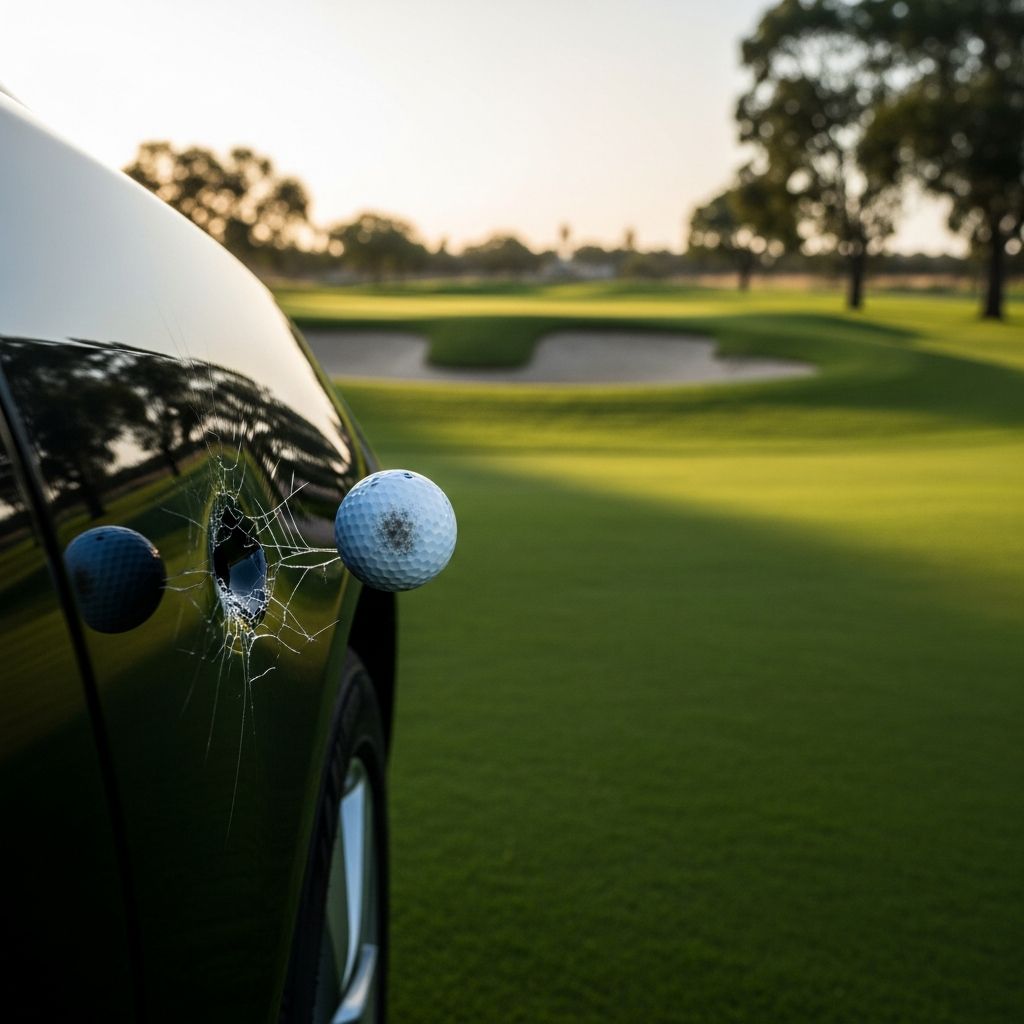
Golfers occasionally send balls astray, potentially damaging nearby vehicles. Typically, the golfer bears responsibility for such incidents, but outcomes depend on insurance, location, and proof of negligence. This guide explores key aspects, from immediate actions to long-term prevention.
Understanding Liability in Golf-Related Vehicle Damage
Liability centers on negligence: golfers must swing with reasonable care to avoid foreseeable harm. An errant shot striking a parked car or one driving by often qualifies as negligence, making the golfer accountable for repairs.
Courses generally avoid liability through waivers and ‘assumed risk’ doctrines, unless their layout creates excessive hazards like tees aimed at parking areas. Courts assess if courses took reasonable precautions, such as nets or signage.
- Golfer’s duty: Hit safely, warn of risks.
- Course’s role: Design safely, post warnings.
- Victim’s position: No fault if legally parked.
Insurance Coverage for Golf Ball Impacts
Your auto policy’s comprehensive coverage handles non-collision damage like golf balls, hail, or vandalism. Expect to pay a deductible, after which your insurer may subrogate against the golfer’s policy.
| Coverage Type | What It Covers | Deductible Notes |
|---|---|---|
| Comprehensive | Golf ball dents, cracks | Standard deductible; glass often reduced/zero |
| Collision | Not applicable (requires vehicle contact) | N/A |
| Golfer’s Homeowners/Renters | Liability for off-course damage | Covers repairs if claimed |
Many golfers carry homeowners or renters insurance with liability limits up to $100,000+, sufficient for most car repairs. If unidentified, file under your comprehensive without fault.
Immediate Steps After a Golf Ball Strikes Your Vehicle
Act swiftly to protect your claim:
- Document everything: Photos of damage, ball, location, witnesses. Note time, weather.
- Identify the golfer: Politely ask nearby players; get contact info.
- Notify the course: Report to pro shop for records, possible CCTV.
- Avoid driving if unsafe: Windshield cracks demand professional assessment.
- Contact insurer: File claim promptly; provide evidence.
Witness statements strengthen cases, especially if the golfer denies responsibility.
Legal Recourse if Insurance Falls Short
If the golfer refuses payment and your deductible exceeds repair costs, consider small claims court. Limits vary by state (e.g., $5,000-$10,000), with low filing fees (~$50-$150).
Prove negligence via photos, witnesses, course maps showing proximity. Golfers’ insurance often settles to avoid litigation. Courses rarely liable without design flaws.
Damage Cost Averages
- Dent repair: $500-$2,000
- Windshield replacement: $200-$1,500 (often no deductible)
- Paintless dent removal: $100-$500
Golf Course Design and Risk Factors
Modern courses mitigate risks with tree lines, mounds, and netting. However, older layouts or public courses near roads heighten incidents. Drivers near courses should park distantly.
In ‘nuisance’ lawsuits, repeated stray balls can pressure courses for changes, but single incidents favor golfers’ liability.
Common Scenarios and Outcomes
Parked in Course Lot
Your comprehensive covers; course may assist voluntarily but disclaims liability via signage.
Driving on Adjacent Road
Golfer liable if shot foreseeably dangerous; prove via trajectory, no barriers.
Unknown Culprit
Insurance handles; subrogation seeks golfer if identified later.
Preventing Golf Ball Damage Near Courses
Proactive measures reduce risks:
- Park away from tees, greens.
- Use car covers in high-risk spots.
- Alert courses to hazards.
- Opt for comprehensive with low glass deductible.
Golfers: Inform partners of insurance; carry club liability if frequent player.
Frequently Asked Questions
Does my car insurance cover golf ball damage?
Yes, under comprehensive coverage as ‘other than collision.’ Glass claims often waive deductibles.
Can I sue the golf course?
Rarely, only if negligent design proven; waivers protect them.
What if I can’t find the golfer?
File with your insurer; they may recover costs via subrogation.
Is the golfer always at fault?
Usually, if negligent; ‘assumed risk’ applies near courses but not public roads.
How much does repair cost?
Varies: minor dents $300+, windshields $300-$1,000.
State Variations in Liability Laws
Laws differ: California emphasizes course protections; Florida stresses golfer negligence. Always check local statutes or consult attorneys for jurisdiction-specific advice.
In summary, preparedness via insurance and documentation ensures swift resolutions. Golf enjoys millions annually; rare incidents resolve equitably with proper steps.
References
- Who Is Responsible If a Golf Ball Hits a Car? — Preferred Insurance. 2023. https://www.preferredlax.com/who-is-responsible-if-a-golf-ball-hits-a-car/
- While driving on a public road, my car got hit by a golf ball — Avvo Legal Answers. 2015-01-15. https://www.avvo.com/legal-answers/while-driving-on-a-public-road-my-car-got-hit-by-a-1463391.html
- Hit a car windshield with a golf ball; legal steps and liability? — Justia Answers. 2025-05-28. https://answers.justia.com/question/2025/05/28/hit-a-car-windshield-with-a-golf-ball-le-1062562
- A Golf Ball Hits My Car, Who Pays? — Western National Insurance. 2023. https://www.wnins.com/blog/golfballhitscar.html
- Who is responsible when a golf ball hits a car? | 2 News gets answers — KJRH-TV (YouTube). 2023. https://www.youtube.com/watch?v=9o4rdlRaFF8
Similar Articles








Read full bio of Sneha Tete




