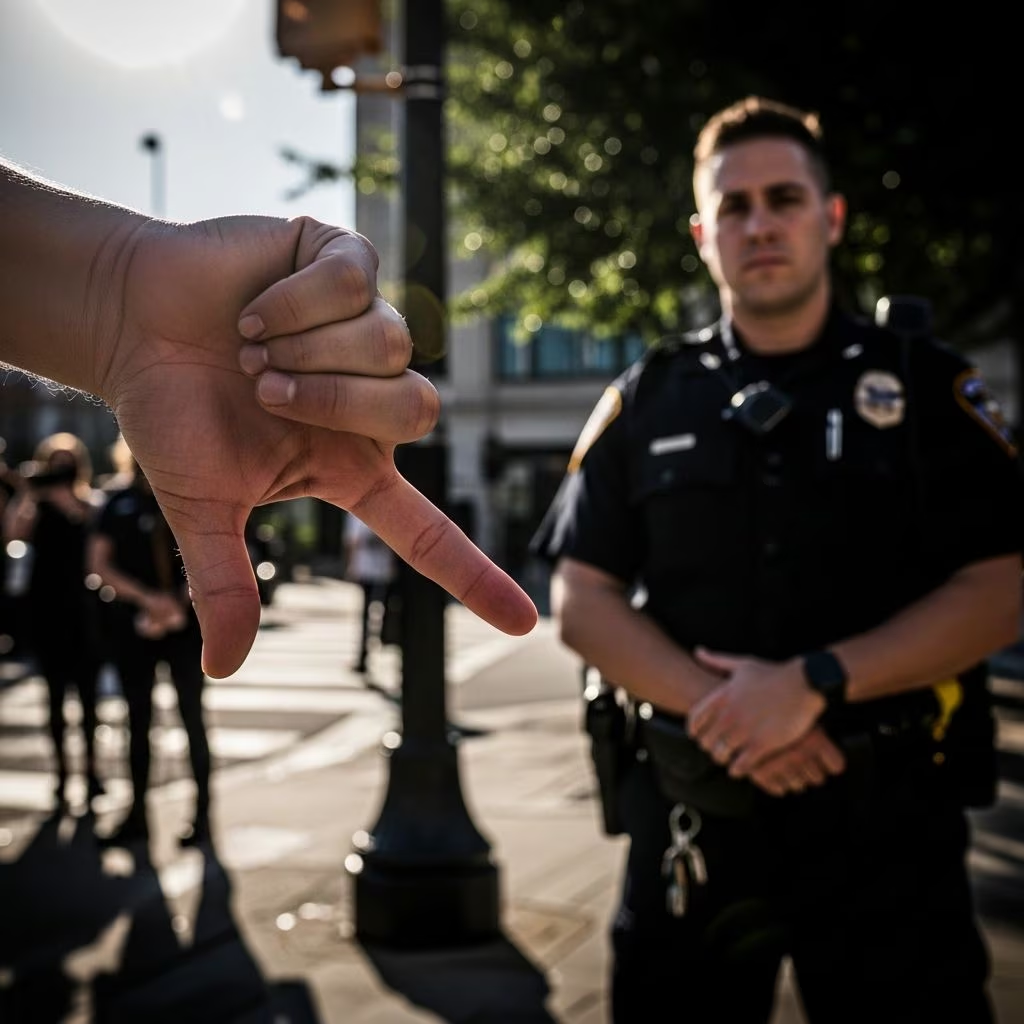
Understanding Constitutional Protections for Nonverbal Expression
The relationship between law enforcement and citizens remains a complex area of constitutional law, particularly when examining the boundaries of free speech and expressive conduct. One frequently asked question concerns whether individuals possess the right to communicate disapproval toward police officers through hand gestures. The answer, while rooted in constitutional protections, requires nuanced understanding of both legal precedent and practical considerations.
The First Amendment of the United States Constitution protects freedom of speech, yet this protection is not absolute. Courts have consistently distinguished between categories of speech that receive full constitutional protection and those that fall outside this umbrella. When considering nonverbal communication directed at law enforcement, federal courts have increasingly recognized that certain gestures constitute protected expressive conduct rather than criminal behavior.
The Constitutional Foundation: First Amendment and Expressive Conduct
The Supreme Court has long acknowledged that the First Amendment extends beyond spoken and written words to encompass nonverbal forms of expression. This recognition emerged through decades of judicial interpretation, establishing that conduct communicating a particularized message receives First Amendment protection when two criteria are met: the conduct conveys an apparently intentional communicative message, and the likelihood exists that the audience will understand the message.
Gestures directed toward police officers generally satisfy these criteria. A middle finger raised toward an officer unmistakably communicates disapproval, frustration, or defiance. The message is clear, the intent obvious, and the audience—the officer—would certainly comprehend the meaning. This clarity of expression has been instrumental in courts’ decisions to extend First Amendment protection to such conduct.
However, the First Amendment contains recognized exceptions. Speech that incites imminent lawless action, constitutes true threats, or falls into narrow categories like obscenity receives diminished or no protection. Law enforcement has argued that offensive gestures might fall into these categories, yet courts have largely rejected such characterization when the gesture stands alone without accompanying threatening behavior or violent incitement.
Landmark Court Cases Establishing Protective Precedent
The Sixth Circuit Court of Appeals addressed this issue directly in a significant case involving a Michigan motorist. The court ruled definitively that a nonverbal gesture alone does not provide lawful justification for police intervention. The officer in question had initiated a traffic stop and issued a citation for a non-moving violation. After the officer provided the citation, the driver extended her middle finger out the car window as she departed. The officer subsequently upgraded the ticket to a moving violation charge, effectively retaliating against the expressive conduct.
This second stop violated the driver’s constitutional rights, the appellate court determined. The judge noted that while rudeness and ingratitude might offend social norms and violate principles of courtesy, such departures from politeness do not constitute illegal conduct. The opinion emphasized a fundamental democratic principle: government officials, including police officers, must tolerate disrespectful expression from citizens, even when that expression targets them directly.
Federal courts have examined similar scenarios across multiple jurisdictions. In 2006, a New York case involving a driver who gestured at an officer using radar equipment reinforced this protective standard. Courts consistently dismissed charges when the defendant’s conduct consisted solely of the gesture without additional criminal activity or threatening behavior accompanying the expression.
The Distinction Between Protected and Unprotected Conduct
While courts have clearly established that offensive hand gestures receive First Amendment protection, this protection operates within specific boundaries. The critical distinction lies between the gesture itself and the context surrounding it. A single, isolated middle finger directed at a police officer—while disrespectful and impolite—remains constitutionally protected. The situation changes dramatically when other elements enter the equation.
Conduct that may strip away protection includes:
- Accompanying threats, whether explicit or veiled, directed toward the officer
- Aggressive physical movements or actions suggesting imminent violence
- Statements inciting others to commit illegal acts or violence
- Behavior designed to provoke an immediate physical altercation
- Harassment constituting a pattern of threatening communication
Police officers retain the authority to initiate stops and arrests when they possess probable cause for legitimate criminal violations. If an individual’s conduct involves breach of peace or disorderly conduct—typically understood as conduct creating substantial risk of public alarm or serious offense—officers may intervene. However, courts have consistently held that a gesture alone does not satisfy this threshold.
Qualified Immunity and Law Enforcement Protection
Even when officers violate citizens’ constitutional rights, legal mechanisms protect those officers in many circumstances. Qualified immunity is a doctrine permitting law enforcement personnel to escape liability for constitutional violations if the violated right was not clearly established at the time of the alleged violation or if the officer reasonably believed probable cause existed to arrest or stop the individual.
This protection complicates matters for citizens seeking redress after wrongful arrest or retaliation based on expressive conduct. An individual arrested for flipping off a police officer might ultimately prevail in establishing that their constitutional rights were violated, but doing so requires litigation that could extend for years. The practical burden of defending oneself through the legal system—attorney fees, court costs, time away from employment—represents a substantial consequence even when the underlying charge lacks merit.
Strategic Considerations During Law Enforcement Interactions
Understanding one’s legal rights differs fundamentally from exercising those rights in practical situations. While constitutional protections may support a gesture’s legality, immediate consequences can still follow such expressive conduct.
Potential outcomes of expressing disapproval toward officers include:
- Intensified police scrutiny of the individual and vehicle
- Searches of the vehicle or person for contraband or violations
- Discovery of unrelated traffic violations or infractions
- Escalation of charges beyond the original traffic citation
- DUI investigations if the officer suspects drug or alcohol impairment
- Creation of documented hostility affecting future interactions
An officer encountering an offensive gesture may legally issue citations for traffic violations, conduct vehicle searches if probable cause exists, investigate suspected impairment, or pursue other legitimate law enforcement activities. The gesture itself cannot justify these actions, but it creates an atmosphere of tension potentially motivating the officer to explore other avenues for investigation.
Contextual Factors Influencing Legal Outcomes
Courts consider multiple contextual elements when evaluating whether challenged conduct crosses the line from protected expression into criminal behavior. The presence of onlookers or bystanders weighs differently than an isolated interaction between officer and citizen. Conduct creating risk of public disruption receives closer scrutiny than private expressions. The overall tone and manner of the interaction—whether escalating toward confrontation or remaining relatively calm—influences judicial interpretation.
Geographic location and local ordinances also matter. Different jurisdictions maintain varying standards for disorderly conduct and breach of peace. What constitutes protected expression in one state or county might receive different treatment elsewhere. Individuals cannot assume that a legal principle applied in federal court will receive identical treatment in local municipal proceedings.
The Role of Jurisdictional Variations
While federal courts have broadly recognized First Amendment protection for nonverbal expressions toward police, state and local courts sometimes reach different conclusions. State constitutions occasionally provide greater protection than the federal instrument, but they may also permit narrower interpretations. State disorderly conduct statutes vary considerably in their definitions and scope.
A gesture that receives clear protection in one state’s appellate decisions might face greater legal vulnerability in another jurisdiction. This variation means that constitutional principles, while fundamental, operate within a landscape of local legal subtleties. Individuals traveling between states or relocating should familiarize themselves with their new jurisdiction’s approach to similar matters.
Practical Recommendations for Citizens
While legality provides one framework for decision-making, practical wisdom suggests additional considerations. The constitutional right to express disapproval toward law enforcement does not automatically translate into advisability. Several factors warrant contemplation before engaging in expressive conduct during police encounters.
First, recognize that officers retain substantial discretionary authority over their investigative activities. Offensive gestures may motivate officers to exercise that discretion more aggressively. Second, understand that vindication through litigation requires resources and time even when the defendant ultimately prevails. Third, acknowledge that police interactions can escalate rapidly, and maintaining a calm demeanor generally produces better outcomes than confrontational expression. Fourth, remember that while the gesture itself may be constitutionally protected, accompanying statements or conduct might not be.
Finally, exercise the right to remain silent during police encounters. Anything said can be used against the individual in subsequent legal proceedings. The combination of an offensive gesture with statements that could be interpreted as threatening significantly complicates the legal landscape and strengthens the prosecution’s case.
Common Questions About Expressive Rights and Law Enforcement
Q: Is flipping off a police officer technically illegal?
A: No. Federal courts have established that the gesture, standing alone without accompanying criminal conduct, constitutes protected First Amendment expression. However, this legal protection does not prevent arrest or other negative consequences from occurring.
Q: Can an officer legally arrest me for giving them the middle finger?
A: An officer cannot legally arrest you solely for the gesture. However, if the officer claims probable cause based on other factors—breach of peace, disorderly conduct, or accompanying threatening behavior—an arrest could occur. You would then need to fight the charges in court, which requires time and resources.
Q: What happens if I’m arrested for a gesture I later proved was protected?
A: The charges might be dismissed, and you could potentially sue the officer for violating your rights. However, qualified immunity often protects officers from liability, and litigation can take years to resolve.
Q: Does my gesture automatically give police the right to search my vehicle?
A: The gesture alone does not provide search authority. However, it may create reasonable suspicion or establish probable cause for investigation of other matters, potentially leading to searches based on those independent findings.
Q: Are there any circumstances where a gesture loses constitutional protection?
A: Yes. If the gesture accompanies explicit threats, incitement to violence, or other clearly illegal conduct, protection diminishes or disappears. The specific context matters considerably.
Conclusion: Balancing Rights and Practical Reality
Citizens possess constitutionally protected rights to express disapproval toward police through nonverbal gestures, a principle firmly established through federal appellate precedent. This protection reflects fundamental democratic values and limits on governmental power to restrict expression merely because that expression offends or disrespects state actors. Yet understanding legal rights requires distinguishing between abstract constitutional principles and practical consequences flowing from exercise of those rights.
The gesture itself cannot provide legal justification for arrest or investigation, but the confrontational environment it creates may motivate officers to pursue legitimate enforcement activities more aggressively. Vindication through litigation remains possible but uncertain, expensive, and time-consuming even for sympathetic defendants. Ultimately, individuals must weigh abstract constitutional protections against concrete practical considerations when facing law enforcement encounters.
References
- U.S. Court Affirms Right to Flip Off Cops – Why It’s Not Always Legal — Car and Driver. 2018. https://www.caranddriver.com/news/a26840600/court-ruling-hand-gestures-drivers/
- Is It Illegal to Flip Off a Cop? Examining the Legal and Social Implications — Performance Protocol. December 6, 2024. https://www.performance-protocol.com/post/is-it-illegal-to-flip-off-a-cop-examining-the-legal-and-social-implications
- If I Flip Off a Cop, Can I Get Arrested? — CDH Law. https://lawcdh.com/if-i-flip-off-a-cop-can-i-get-arrested/
- Can I Legally Flip off the Police? — Wirth Law Office. April 2021. https://www.wirthlawoffice.com/tulsa-attorney-blog/2021/04/can-i-legally-flip-off-the-police
- What Happens If I Flip Off a Cop? — Aer Law Group. https://www.aerlawgroup.com/blog/what-happens-if-i-flip-off-a-cop/
- Can You Be Arrested for Giving the Finger to Police? — TalksOnLaw. https://www.talksonlaw.com/briefs/can-you-be-arrested-for-giving-the-finger-to-police