
Fault Rules in Injury Claims: Contributory vs Comparative
Unlock the key differences between contributory and comparative negligence that determine compensation in personal injury cases across U.S. states.
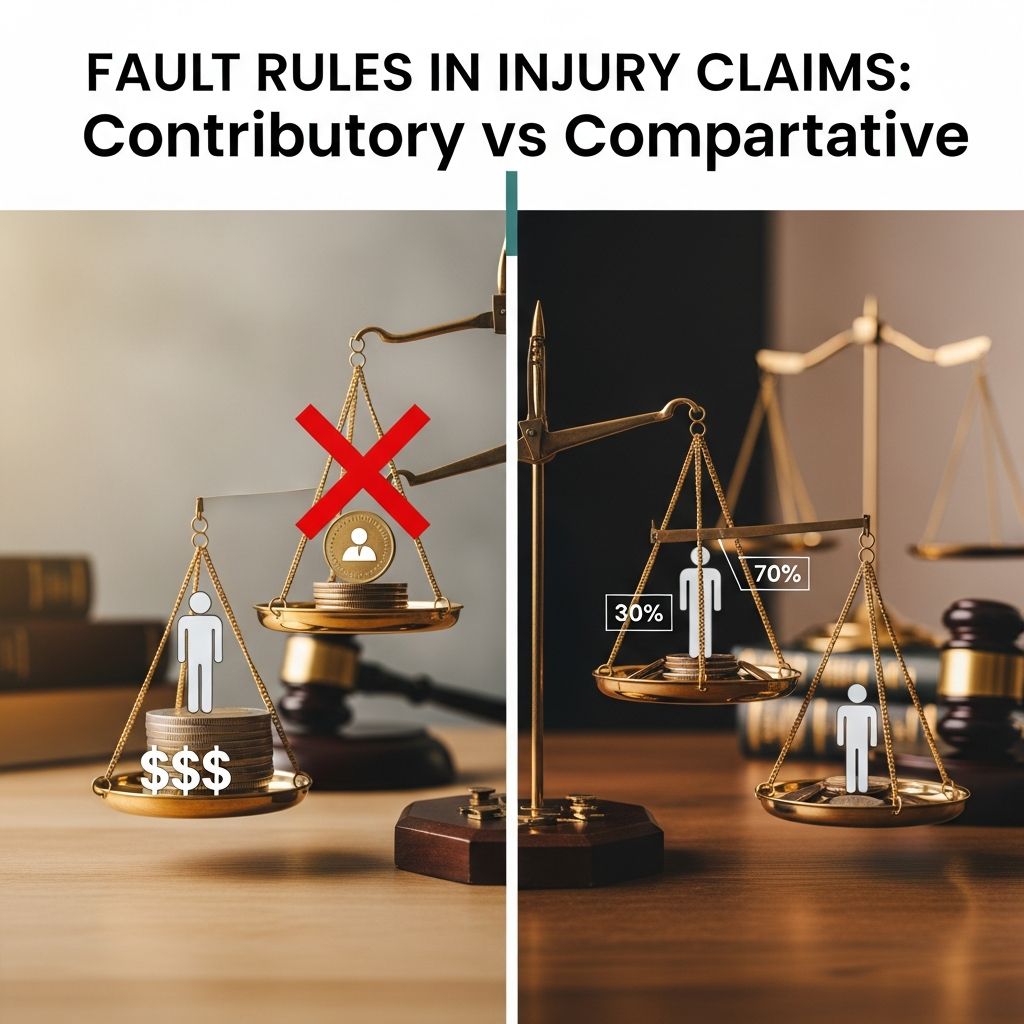
In personal injury litigation, determining who bears responsibility for an accident profoundly influences the outcome of a case. Two primary legal frameworks govern this process: contributory negligence and comparative negligence. These doctrines dictate whether an injured party can secure compensation when their own actions played a role in the incident. Understanding these rules is crucial for anyone navigating a claim, as they vary significantly by jurisdiction and can drastically alter potential recoveries.
Foundations of Negligence in Personal Injury Cases
Negligence forms the cornerstone of most personal injury lawsuits. To establish a valid claim, plaintiffs must demonstrate four essential elements: a duty of care owed by the defendant, a breach of that duty, actual harm suffered, and a direct causal link between the breach and the injury. For instance, a driver owes a duty to operate their vehicle safely; running a red light breaches this duty and may cause a collision leading to injuries.
Once negligence is proven, courts or juries assess relative fault. This is where contributory and comparative negligence diverge sharply, affecting how damages—such as medical bills, lost wages, and pain and suffering—are awarded.
Contributory Negligence: The Harsh All-or-Nothing Barrier
Contributory negligence represents one of the strictest defenses in tort law. Under this rule, if the plaintiff contributed even minimally—say, 1%—to their own harm, they are entirely barred from recovering any damages. This ‘pure’ form originated in common law and persists in only a handful of states, prioritizing absolute accountability over proportional justice.
Consider a pedestrian struck by a vehicle while jaywalking against a ‘walk’ signal. Even if the driver was speeding, the pedestrian’s minor fault could nullify their claim entirely. Proving zero contribution from the plaintiff is challenging, as juries often scrutinize behaviors like not wearing a seatbelt or ignoring warning signs.
States Adhering to Contributory Negligence
Only five jurisdictions maintain this doctrine: Alabama, Maryland, North Carolina, Virginia, and the District of Columbia. In these areas, defendants aggressively pursue evidence of plaintiff fault to invoke the bar.
- Alabama: Applies strictly in auto accidents and premises liability.
- Maryland: Known for upholding the rule in pedestrian and vehicle cases.
- North Carolina: Bars recovery if plaintiff negligence exceeds zero percent.
- Virginia: Emphasizes driver responsibility but nullifies claims with any plaintiff error.
- District of Columbia: Follows federal influences but retains the harsh standard.
Comparative Negligence: A Fairer Proportional Approach
The majority of U.S. states have shifted to comparative negligence, which apportions fault percentages and reduces awards accordingly. This system acknowledges shared responsibility, allowing partial recovery based on the defendant’s greater culpability.
There are two main variants: pure and modified. In pure comparative negligence, plaintiffs recover damages minus their exact fault percentage, even if over 50%. Modified versions impose thresholds, typically 50% or 51%, beyond which recovery is barred.
Pure Comparative Negligence Explained
Pure comparative negligence permits recovery regardless of fault level. If damages total $100,000 and the plaintiff is 90% at fault, they receive $10,000. This encourages defendants to settle, as juries can still assign liability.
About a dozen states, including California, Florida, and New York, adopt this model. It promotes equity in complex accidents involving multiple parties.
Modified Comparative Negligence Variations
Modified rules dominate, used by roughly 35 states. They blend proportionality with a fault cap:
| Rule Type | Threshold | Example States | Recovery Rule |
|---|---|---|---|
| 50% Bar Rule | Plaintiff ≤50% at fault | Arizona, Colorado, Texas | Damages reduced by plaintiff’s % |
| 51% Bar Rule | Plaintiff <51% at fault | Georgia, Montana, South Carolina | Full bar if 51% or more |
In a 50% bar state, a plaintiff 49% at fault in a $200,000 claim recovers $102,000. At 51%, recovery drops to zero.
Real-World Scenarios Illustrating the Doctrines
Auto collisions highlight these differences vividly. Scenario: Driver A rear-ends Driver B, who was texting but braking late.
- Contributory State: B recovers nothing due to any fault.
- Pure Comparative: If B 30% at fault, award reduced by 30%.
- Modified 50%: B recovers proportionally if under 50%.
In slip-and-fall cases, a store’s wet floor causes injury. If the plaintiff ignored a ‘wet floor’ sign, contributory negligence bars all claims, while comparative reduces them.
Strategic Implications for Plaintiffs and Defendants
Plaintiffs in contributory states must compile ironclad evidence of zero fault, often using dashcams, witnesses, and expert reconstructions. Comparative jurisdictions allow more flexibility, focusing on minimizing assigned fault through mitigation evidence like prompt medical care.
Defendants leverage these rules in discovery, seeking admissions of plaintiff errors. Settlements often hinge on fault predictions; comparative states see higher trial rates due to predictable reductions.
How Fault Percentages Are Determined
Juries allocate fault based on evidence: eyewitness accounts, accident reports, forensics, and expert testimony. Factors include speed, signals, distractions, and compliance with laws. Judges instruct on standards, ensuring allocations reflect causation.
Multiple defendants complicate matters; fault is divided among all parties, including non-sued ones via jury verdict forms.
Evolution and Criticisms of These Systems
Contributory negligence, once universal, faced backlash for injustice—e.g., a 10% faulty plaintiff losing $200,000. Landmark cases like Missouri’s Gustafson v. Benda (1983) ushered in comparative fault for fairness.
Criticisms persist: Pure comparative may incentivize risky behavior; strict contributory discourages meritorious claims. Modified strikes a balance but creates threshold disputes.
U.S. State Fault Rule Overview
| Contributory | Pure Comparative | Modified 50% | Modified 51% |
|---|---|---|---|
| AL, MD, NC, VA, DC | AK, AZ*, CA, FL, LA, NM, NY, OR | AR, CO, GA*, ID, KS, KY, MI, NE, OK, TN, UT, WA | CT, DE, HI, IL, IN, IA, ME, MA, MN, MT, NV, NH, NJ, ND, OH, PA, RI, SC, SD, VT, WI, WY |
| *Some variations |
Note: Rules can apply differently in product liability or strict liability. Always verify with local counsel.
Practical Tips for Injury Victims
- Document Everything: Photos, police reports, medical records build your case.
- Seek Legal Advice Early: Attorneys assess jurisdiction-specific risks.
- Avoid Admissions: Don’t apologize or speculate fault at scenes.
- Consider Insurance: Many policies include med-pay regardless of fault.
- Negotiate Settlements: Insurers factor doctrines into offers.
Frequently Asked Questions (FAQs)
What if I’m mostly at fault—can I still win?
In pure comparative states, yes, reduced by your percentage. Modified bars over 50/51%; contributory bars any fault.
Does seatbelt non-use count as fault?
Yes, in many states as evidence of contributory or comparative negligence, potentially reducing awards.
Can fault change on appeal?
Rarely; appeals focus on legal errors, not reweighing evidence.
What about multi-vehicle accidents?
Fault is apportioned among all parties; several liability rules may apply.
Is comparative negligence federal law?
No, it’s state-specific; federal cases may borrow state rules.
References
- Comparative Fault vs Contributory Negligence — Simon Law PC. 2023. https://simonlawpc.com/blog/personal-injury/comparative-fault-vs-contributory-negligence/
- What is the Difference Between Contributory Negligence and Comparative Negligence — Munley Law. 2024. https://munley.com/personal-injury-lawyers/what-is-the-difference-between-contributory-negligence-and-comparative-negligence/
- Contributory Negligence vs Comparative Negligence Explained — Lowman Law Firm. 2023. https://www.lowmanlawfirm.com/blog/contributory-negligence-vs-comparative-negligence-the-difference
- Comparative & Contributory Negligence in Personal Injury Lawsuits — Justia. 2024. https://www.justia.com/injury/negligence-theory/comparative-contributory-negligence/
- What Is the Difference Between Contributory Negligence and Comparative Negligence — MD Accident Law. 2023. https://www.mdaccidentlaw.com/faqs/what-is-the-difference-between-contributory-negligence-and-comparative-negligence/
- Comparative Negligence — Legal Information Institute, Cornell Law School. 2025-03-15. https://www.law.cornell.edu/wex/comparative_negligence
- Contributory Negligence Vs. Comparative Negligence — Horton Mendez. 2024. https://hortonmendez.com/contributory-negligence-vs-comparative-negligence-heres-what-you-need-to-know/
Similar Articles








Read full bio of Sneha Tete




