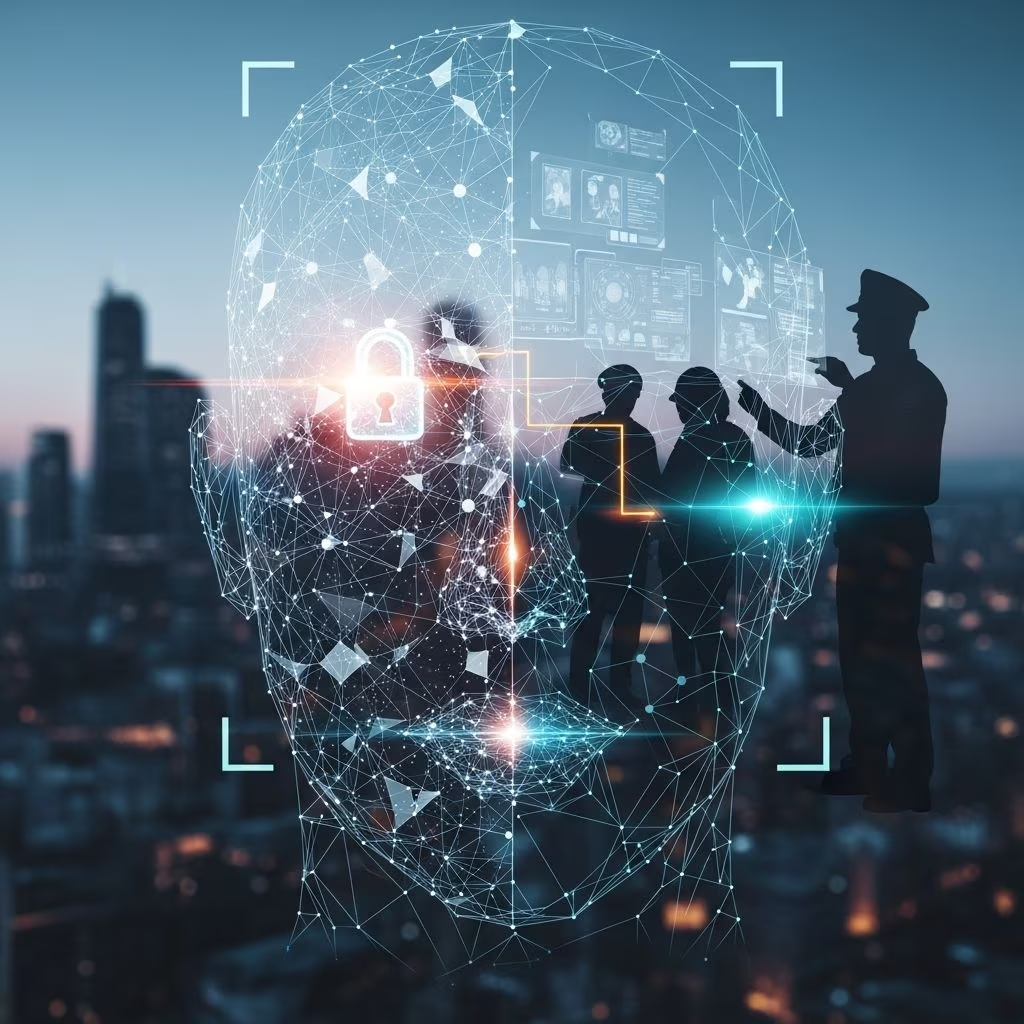
Facial recognition technology (FRT) has emerged as a powerful tool for law enforcement, enabling rapid identification from images and videos against vast databases. While it promises faster investigations and public safety improvements, concerns over accuracy, bias, and privacy persist, demanding careful oversight.
The Mechanics of Facial Recognition in Criminal Probes
At its core, FRT analyzes facial features from probe images—such as surveillance footage or social media photos—and compares them to databases of known individuals, often mugshots. This process typically follows a structured four-step protocol: image collection, algorithmic scanning, candidate ranking, and human verification by facial examiners.
Investigators deploy FRT when traditional methods stall, inputting a perpetrator’s image to generate leads. Systems like those from IDEMIA, trusted by over 85 governments, integrate FRT with fingerprint matching and data analytics for comprehensive results. Federal agencies, including 42 with law enforcement arms, have adopted it variably, per a 2021 Government Accountability Office report.
Proven Applications and Success Stories
FRT shines in real-world scenarios. In Scranton, Pennsylvania, police identified a sexual assault suspect via social media photos processed through FRT. Arizona convenience store robbery investigators matched surveillance footage to a suspect swiftly. Florida authorities exonerated a man accused of vehicular homicide by locating a key witness using the tool.
Public opinion aligns with these benefits: 78% of Americans believe widespread FRT use would help find missing persons, and 74% expect quicker crime resolutions. About 63% accept scanning crowds at concerts, and 61% at protests, viewing it as aiding crowd control (split 50-50 overall).
- Victim identification: Speeds location of endangered persons.
- Suspect tracking: Narrows fields from billions of images.
- Exonerations: Clears innocents by finding true perpetrators or witnesses.
Public Attitudes: Optimism Tempered by Privacy Fears
Americans largely see FRT’s societal upsides outweighing downsides, yet majorities (over 70%) anticipate reduced privacy from pervasive surveillance. Half of U.S. adults’ faces reside in police databases, per a 2016 Georgetown study, amplifying tracking via public cameras.
Acceptance varies by context: 68% reject street scanning as intrusive, favoring targeted uses like events. This reflects broader unease with data collection by governments and firms, where most feel daily life is inescapably monitored.
| Context | Acceptable (%) | Not Acceptable (%) |
|---|---|---|
| Large events (e.g., concerts) | 63 | 37 |
| Public protests | 61 | 39 |
| Street walking | 31 | 68 |
Data from Pew Research Center survey.
Technical Limitations and Error Rates
Despite advances since the 1960s—from manual coding to AI-driven automation—FRT falters on low-quality images, lighting variances, angles, and demographics. NIST tests reveal higher error rates for Black and Asian faces, women, and youth, fueling bias claims.
Systems generate candidate lists reviewed by humans, but cognitive biases and poor training compound machine flaws. Georgetown’s analysis flags FRT as prone to errors from manipulated evidence or subjective judgments, undermining its forensic validity.
Real-World Harms: False Arrests and Misuse
Errors yield tangible damage. Multiple Black men faced wrongful arrests after FRT misidentifications, sparking lawsuits against departments. In some cases, FRT served as primary arrest evidence, defying ‘leads-only’ protocols. NACDL warns of Brady violations if error rates and biases go undisclosed to defense.
Surveillance potential chills First Amendment rights via movement tracking, potentially breaching Fourth Amendment protections. Without oversight, adoption proliferates inequities and privacy erosions.
Regulatory Gaps and Agency Responsibilities
No comprehensive federal FRT law exists; state rules vary widely. NYPD policy mandates corroboration beyond FRT for arrests or warrants. CBP processed 540 million travelers by mid-2024 using biometrics.
Best practices urge:
- Leads-only application, never sole probable cause.
- Human oversight at every step.
- Bias audits and transparency reporting.
- Serious crimes prioritization.
- Public engagement on policies.
2020 saw tech firms like Amazon pause police sales amid protests, highlighting self-regulation needs.
Defense Perspectives: Opportunities and Cautions
FRT aids defense by verifying alibis or identifying true culprits, but attorneys must demand validation data, error disclosures, and challenge admissibility. NACDL advises scrutinizing database composition, match thresholds, and examiner qualifications to counter overreliance.
Future Directions: Balancing Innovation and Rights
FRT’s evolution—from phone unlocks to policing—demands guardrails. Proponents tout efficiency; critics decry unchecked power. Legislators need templates for oversight ensuring equity, accuracy, and accountability.
Agencies should invest in training, diverse datasets, and independent audits. Public trust hinges on demonstrating benefits without sacrificing liberties.
Frequently Asked Questions
How accurate is police facial recognition?
Accuracy varies; NIST benchmarks show demographic differentials, with higher errors for certain groups. Always requires human corroboration.
Is facial recognition legal for police use?
No blanket federal ban; usage guided by policies and state laws. Courts assess reasonableness under Fourth Amendment.
Can FRT exonerate the innocent?
Yes, by identifying actual perpetrators or witnesses, as in Florida vehicular case.
What biases affect FRT?
Disparities in error rates for race, gender, age due to training data imbalances.
Should police disclose FRT use in court?
Defense experts argue yes, under Brady, including match scores and limitations.
References
- Position Paper: Facial Recognition Technology for Law Enforcement Investigations — IDEMIA Public Security. 2025-04-17. https://www.idemia.com/wp-content/uploads/2025/04/position-paper-facial-recognition-technology-law-enforcement-investigations-idemia-17042025.pdf
- Public Views of Police Use of Facial Recognition Technology — Pew Research Center. 2022-03-17. https://www.pewresearch.org/internet/2022/03/17/public-more-likely-to-see-facial-recognition-use-by-police-as-good-rather-than-bad-for-society/
- Advisory: Defense Use of Facial Recognition Technology — National Association of Criminal Defense Lawyers (NACDL). N/A. https://www.nacdl.org/getattachment/94f8d9f8-eba4-44f7-8763-47a2f3038e8a/defenseusefacialrecognitionadvisory.pdf
- Facial Recognition in Law Enforcement: Promises and Pitfalls — Lexipol. 2024. https://www.lexipol.com/resources/blog/facial-recognition-in-law-enforcement-promises-and-pitfalls/
- A Forensic Without the Science: Face Recognition in U.S. Criminal Investigations — Georgetown Law Center on Privacy & Technology. N/A. https://www.law.georgetown.edu/privacy-technology-center/publications/a-forensic-without-the-science-face-recognition-in-u-s-criminal-investigations/
- Regulating Police Use of Face Recognition Technology — Policing Project. N/A. https://www.policingproject.org/regulating-police-use-of-face-recognition-technology
- Profiling in a Digital Age: Facial Recognition, Video Surveillance & Policing — Harvard Kennedy School. N/A. https://www.hks.harvard.edu/centers/wiener/programs/criminaljustice/news-events/surveillance-facial-recognition-policing