
Supreme Court Books: Essential Reads To Understand The Court
Discover transformative books that illuminate the Supreme Court's pivotal role in shaping American law and society over centuries.
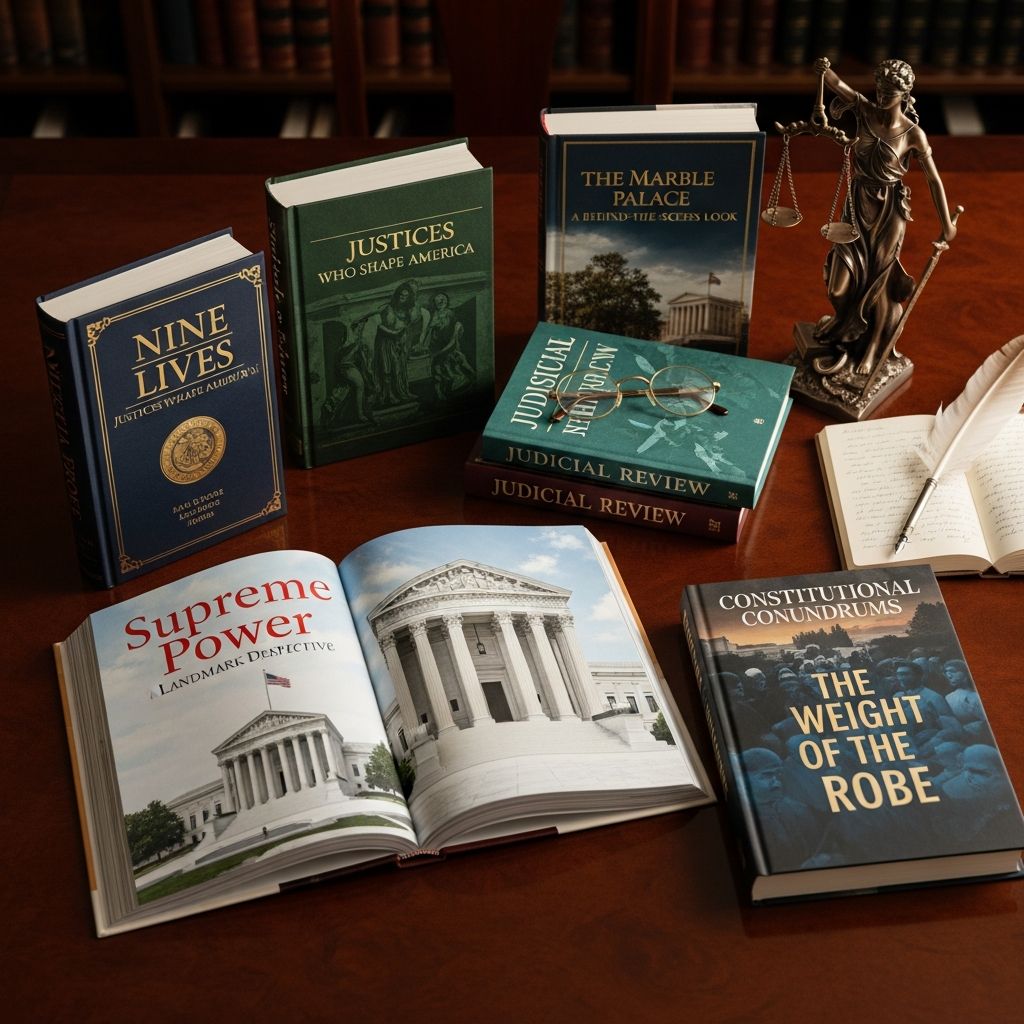
The Supreme Court of the United States stands as a cornerstone of American democracy, interpreting the Constitution and resolving pivotal disputes that have molded the nation’s legal landscape. For those eager to grasp its enduring influence, a handful of meticulously crafted books provide unparalleled depth. This article highlights standout works that chronicle the Court’s journey, spotlight influential justices, and dissect transformative rulings, drawing from expert recommendations and scholarly acclaim.
Foundational Narratives of Judicial Power
Understanding the Supreme Court’s origins requires texts that trace its development from a nascent institution to a powerhouse of constitutional authority. One seminal work offers a comprehensive overview of this evolution, blending historical analysis with insightful commentary on the Court’s shifting role in governance.
Robert G. McCloskey’s The American Supreme Court, now in its sixth edition updated by Sanford Levinson, serves as the definitive primer. This book meticulously documents the Court’s ideological phases—from its early establishment under John Marshall to modern interpretive battles. McCloskey, a mid-20th-century constitutional expert, elucidates how justices have balanced federal power against state sovereignty, often through landmark opinions that redefined liberty and equality. Readers appreciate its accessible prose, making complex doctrines approachable for novices while rewarding experts with nuanced critiques.
Complementing this broad sweep is Bernard Schwartz’s A History of the Supreme Court, which delivers a one-volume chronicle praised for its scholarly rigor. Schwartz examines pivotal eras, including the Marshall Court’s expansion of national authority and the Warren Court’s civil rights revolution, supported by primary documents and judicial correspondence. These narratives reveal the Court not as a monolith but as a dynamic body responsive to societal pressures.
Portraits of Trailblazing Chief Justices
Individual justices often personify the Court’s epochs, and biographical accounts bring their legacies to life. Chief Justice John Marshall exemplifies this, transforming a fledgling tribunal into a bulwark of federal supremacy.
R. Kent Newmyer’s John Marshall and the Heroic Age of the Supreme Court captures this transformative period (1801-1835), detailing Marshall’s strategic jurisprudence in cases like Marbury v. Madison, which established judicial review. Newmyer portrays Marshall as a visionary who navigated political tempests, forging doctrines that endure today. The book draws on archival letters and contemporary accounts, illustrating how Marshall’s intellect and diplomacy elevated the judiciary.
Similarly, Newmyer’s work on Joseph Story, Supreme Court Justice Joseph Story: Statesman of the Old Republic, profiles Marshall’s key ally. Story’s contributions to contract law and commerce clause interpretations are vividly explored, highlighting his role in solidifying nationalist principles amid states’ rights challenges. These biographies humanize legal giants, showing personal motivations behind doctrinal shifts.
Landmark Cases That Reshaped America
Certain decisions have reverberated through history, and dedicated studies unpack their contexts and consequences. The Dred Scott ruling, for instance, epitomizes judicial missteps with lasting repercussions.
Don Fehrenbacher’s The Dred Scott Case provides an exhaustive examination of the 1857 decision denying citizenship to African Americans, fueling sectional strife toward the Civil War. Fehrenbacher analyzes Chief Justice Taney’s opinion, courtroom dynamics, and broader implications for slavery and federalism, using trial transcripts and political records. This work underscores how judicial choices can exacerbate national divisions.
Richard Kluger’s Simple Justice chronicles the Brown v. Board of Education saga, overturning school segregation in 1954. Spanning decades of activism, the narrative details Thurgood Marshall’s advocacy, NAACP strategies, and the Court’s deliberative process under Earl Warren. Kluger’s vivid storytelling, backed by interviews and memos, illustrates the human struggle for equality. These case studies reveal the Court’s power to both hinder and advance justice.
Racial Justice and the Court’s Evolving Stance
The judiciary’s grappling with racial equality forms a recurring theme, chronicled in works that span from Reconstruction to the Civil Rights era.
Michael Klarman’s From Jim Crow to Civil Rights dissects this arc, arguing that Court rulings like Plessy v. Ferguson entrenched segregation until external forces prompted change. Klarman integrates social history with legal analysis, showing how Brown reflected broader shifts rather than isolated heroism. This perspective challenges heroic narratives, emphasizing contextual influences.
- Key Insight: The Court’s racial jurisprudence evolved reactively, influenced by mob violence, political mobilization, and World War II dynamics.
- Comparative Impact: Pre-1930s decisions upheld white supremacy; post-war rulings began dismantling it.
- Modern Relevance: Echoes persist in voting rights and affirmative action debates.
Modern Justices and Institutional Critiques
Recent scholarship profiles contemporary figures and questions the Court’s democratic role. John Jeffries’ biography of Lewis F. Powell explores the Nixon appointee’s centrist influence on privacy rights (Roe v. Wade) and affirmative action (Regents of the University of California v. Bakke). Powell’s pragmatic swing votes highlight the Court’s internal balances.
Brian E. Butler’s The Democratic Constitution critiques judicial supremacy, advocating experimentalism over rigid originalism. Analyzing two centuries of cases, Butler posits that democratic experimentation should guide interpretation, challenging dominance of textualism. Such works provoke debate on the Court’s unelected authority.
| Justice | Key Cases | Legacy |
|---|---|---|
| John Marshall | Marbury v. Madison | Judicial review foundation |
| Joseph Story | Dartmouth College v. Woodward | Contract protections |
| Lewis Powell | Roe v. Wade | Privacy and balance |
| Earl Warren | Brown v. Board | Civil rights expansion |
Why These Books Matter Today
In an era of polarized rulings on abortion, guns, and elections, these texts equip readers to contextualize current controversies. They reveal patterns: the Court’s conservatism in crises, liberalism in prosperity, and perennial tension between law and politics. For law students, historians, or citizens, these volumes foster informed discourse.
Explore further through the Supreme Court Historical Society’s publications, which target general audiences with accessible Supreme Court narratives.
Practical Reading Guide
- Beginners: Start with McCloskey for overview.
- Case Enthusiasts: Dive into Fehrenbacher or Kluger.
- Biography Fans: Newmyer’s Marshall and Story.
- Critical Theory: Klarman or Butler for provocative takes.
Frequently Asked Questions
What is the most essential book for Supreme Court newcomers?
The American Supreme Court by McCloskey offers the best broad introduction, covering eras accessibly.
How did John Marshall shape the judiciary?
Through judicial review and federalist rulings, he elevated the Court from weak to authoritative.
Why study Dred Scott today?
It exemplifies flawed reasoning with citizenship implications, mirroring ongoing equality debates.
Did Brown v. Board end segregation immediately?
No; Kluger details resistance and gradual implementation via activism.
Are there modern critiques of Court power?
Yes, Butler argues for democratic experimentalism over supremacy.
References
- The best books on The Supreme Court of the United States — fivebooks.com. Accessed 2026. https://fivebooks.com/best-books/supreme-court-united-states-michael-klarman/
- A Supreme Court Reading List — University of Chicago Press Blog. 2022-05-12. https://pressblog.uchicago.edu/2022/05/12/a-supreme-court-reading-list.html
- Publishing Program — Supreme Court Historical Society. Accessed 2026. https://supremecourthistory.org/society-publications-program/
- A History of the Supreme Court — Oxford University Press. Accessed 2026. https://global.oup.com/academic/product/a-history-of-the-supreme-court-9780195093872
Similar Articles








Read full bio of Sneha Tete




