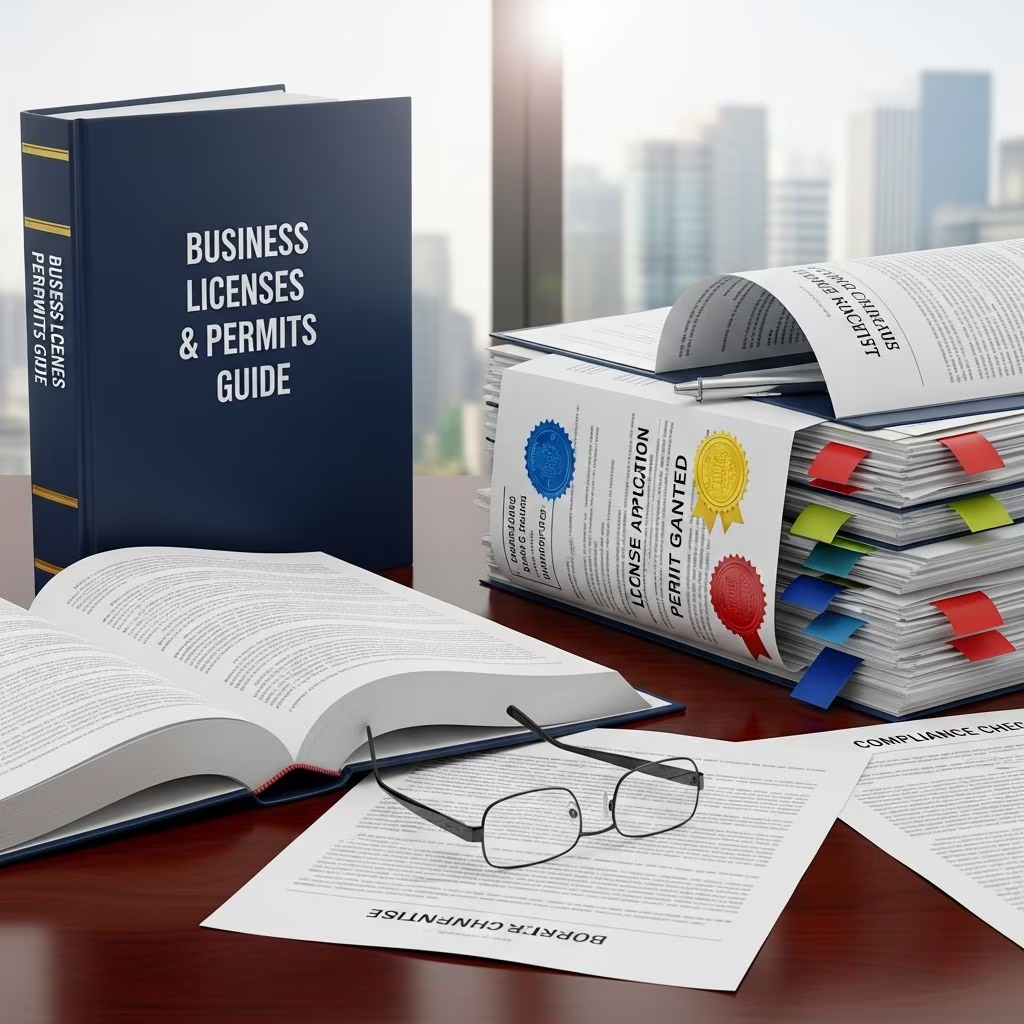
Launching a business requires more than a great idea and funding; it demands compliance with various legal requirements to operate lawfully. Licenses and permits serve as official approvals ensuring your operations meet safety, health, tax, and zoning standards. Failing to secure them can result in hefty fines, shutdowns, or legal action. This guide explores the landscape of business authorizations across federal, state, and local jurisdictions, helping entrepreneurs identify and obtain what’s needed.
Understanding the Layers of Regulation
Government oversight on businesses occurs at three primary levels: federal, state, and local. Federal rules apply nationwide for activities impacting interstate commerce or national security. State regulations address broader industry standards and taxation within borders. Local governments handle community-specific concerns like zoning and public health. Your business type, location, and activities dictate the exact combination required.
Most startups begin by assessing their industry. For instance, a food truck needs health inspections alongside general registrations, while a tech consultancy might only require basic tax permits. Always cross-check with official resources, as requirements evolve with laws and local ordinances.
Federal Business Authorizations: When National Rules Apply
Not every business needs federal licenses, but those in regulated sectors do. These are mandatory for operations involving public safety, interstate trade, or specialized goods. The U.S. Small Business Administration (SBA) lists key categories where federal involvement is essential.
| Business Activity | Description | Issuing Agency |
|---|---|---|
| Agriculture | Import/export of animals, plants, biologics | U.S. Department of Agriculture (USDA) |
| Alcoholic Beverages | Manufacture, wholesale, retail sales | Alcohol and Tobacco Tax and Trade Bureau (TTB) |
| Aviation | Aircraft operation, maintenance, transport | Federal Aviation Administration (FAA) |
| Firearms & Explosives | Manufacture, sale, import | Bureau of Alcohol, Tobacco, Firearms and Explosives (ATF) |
| Transportation (Maritime) | Cargo shipping by sea | Maritime Administration |
Federal permits often involve rigorous applications, background checks, and fees varying by activity. For example, firearms dealers must comply with ATF protocols, including secure storage mandates. Check the SBA’s permit finder tool for specifics.
State-Level Licensing: Core Requirements for Operations
Every state mandates some form of registration for legal operation. These cover general business operation, professional credentials, and sales taxation. A state tax ID or seller’s permit is common if selling taxable goods or services.
- General Business License: Authorizes overall operations; required in states like Maryland via the Department of Labor.
- Professional/Occupational Licenses: Essential for fields like healthcare, law, construction, or cosmetology, verifying qualifications.
- Sales Tax Permit: Needed to collect/remit sales tax; mandatory in 45 states plus D.C.
- Industry-Specific: Liquor licenses, childcare certifications, or contractor bonds.
Application processes differ: some states offer online portals like Wisconsin’s One Stop Business Portal for streamlined submissions. Fees range from $50 to several hundred dollars, often renewable annually. Visit your Secretary of State’s website for tailored checklists.
Local Permits: Community and Site-Specific Rules
Cities, counties, and municipalities enforce permits tied to physical locations and public welfare. These ensure businesses align with neighborhood standards and safety protocols.
- Business Operation License: Basic approval to conduct commerce within city limits.
- Zoning Approval: Confirms your site suits the business type (e.g., no retail in residential zones).
- Health & Safety Permits: Critical for food services, salons, or medical practices; involves inspections.
- Signage & Building Permits: Regulates exterior displays and structural changes.
- Fire Department Clearance: For high-occupancy or hazardous material sites.
Home-based ventures often need a home occupation permit, checking lease terms and inventory limits. Contact your city clerk or use tools like Wolters Kluwer’s state-by-state search for county specifics.
Step-by-Step Process to Secure Your Licenses
- Identify Your Needs: Use SBA’s license-permit lookup or state portals to match your NAICS code (industry classification).
- Gather Documentation: EIN, business formation papers, ID, lease agreements, and proof of insurance.
- Apply Online or In-Person: Prioritize digital systems for speed; pay fees via credit card where possible.
- Schedule Inspections: Health, fire, or building officials may visit pre-approval.
- Track Renewals: Set calendar reminders; many expire yearly.
- Consult Professionals: Attorneys or services like CT Corporation aid complex cases.
Processing times vary from days to months; start early to avoid delays. Budget 1-5% of startup costs for fees.
Industry Spotlights: Tailored Authorization Examples
Different sectors face unique hurdles. Here’s a breakdown:
| Industry | Key Licenses/Permits | Level |
|---|---|---|
| Restaurant/Food Service | Health, food handler, liquor (if serving alcohol) | Local/State |
| Construction/Contractor | Contractor’s license, bond, workers’ comp | State |
| Retail/E-commerce | Seller’s permit, EIN for sales tax | State/Federal (if interstate) |
| Healthcare/Beauty | Professional license, health inspection | State/Local |
| Online-Only | Sales tax nexus registration per state | State |
For e-commerce, post-Wayfair ruling, nexus rules trigger multi-state tax permits if sales thresholds are met.
Consequences of Non-Compliance and Proactive Tips
Operating without proper licenses invites penalties: fines up to $10,000 per violation, cease-and-desist orders, or criminal charges in extreme cases. Insurance may deny claims, and customers lose trust. Proactive steps include annual audits, subscribing to regulatory updates, and using compliance software.
Leverage free resources: SBA counseling, SCORE mentors, or state economic development offices. For multi-location expansions, track variances via centralized dashboards.
Frequently Asked Questions (FAQs)
What if my business operates online only?
Secure sales tax permits for states with economic nexus (e.g., $100K sales or 200 transactions). Federal EIN is standard; no local zoning needed without a physical site.
How much do licenses typically cost?
Fees range $0-$1,000+; general state licenses average $100, locals $50-300, federal $200-2,000 based on complexity.
Do sole proprietors need licenses?
Yes, same as entities for taxes/permits, but skip entity registration unless using a DBA.
Can I apply for all at once?
Many states offer one-stop portals (e.g., Wisconsin); otherwise, sequence federal first, then state/local.
What about renewals and changes?
Track dates; notify authorities of address/ownership shifts within 30 days typically.
References
- What Licenses Do I Need to Start a Business? — The Hartford. 2024. https://www.thehartford.com/business-insurance/strategy/starting-business/licenses-for-business
- Apply for Licenses and Permits — U.S. Small Business Administration. 2025-10-01. https://www.sba.gov/business-guide/launch-your-business/apply-licenses-permits
- Business Licenses and Permits: An Overview — U.S. Chamber of Commerce. 2024. https://www.uschamber.com/co/start/startup/business-licenses-and-permit-guide
- Navigating Business Licensing Requirements Across the States — Incauthority. 2024. https://www.incauthority.com/blog/business-licensing-by-state/
- Small Business License Requirements: A State Guide — Nolo. 2024. https://www.nolo.com/legal-encyclopedia/small-business-license-requirements-a-50-state-guide
- Do I Need a Business License in the US? — Stripe. 2025. https://stripe.com/resources/more/do-i-need-a-business-license-in-the-us-here-is-how-to-know
- Wisconsin One Stop Business Portal — State of Wisconsin. 2026-01-15. https://onestop.wi.gov/OpenMyBusiness