Introduction: The Transformation of School Discipline
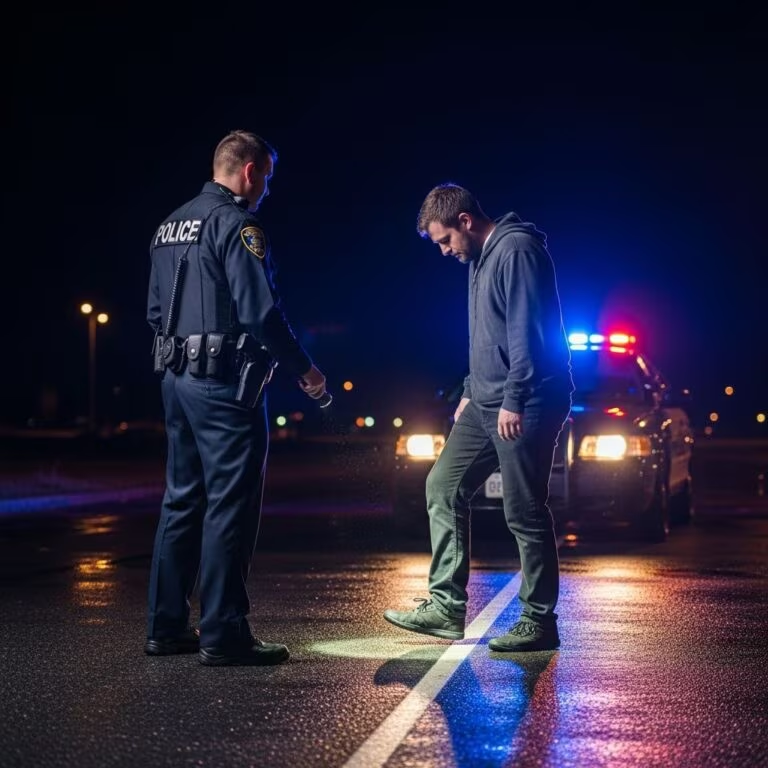
For decades, public schools in the United States were primarily viewed as community sanctuaries designed to foster learning, development, and social cohesion. However, a stark shift in disciplinary paradigms over the past quarter-century has fundamentally altered the educational landscape. The increasing reliance on law enforcement personnel—often referred to as School Resource Officers (SROs)—to manage student behavior has transformed many hallways into environments resembling the criminal justice system. This phenomenon is a driving force behind the “school-to-prison pipeline,” a deeply entrenched systemic issue where punitive policies funnel vulnerable children out of public educational institutions and directly into the juvenile and adult criminal justice systems.
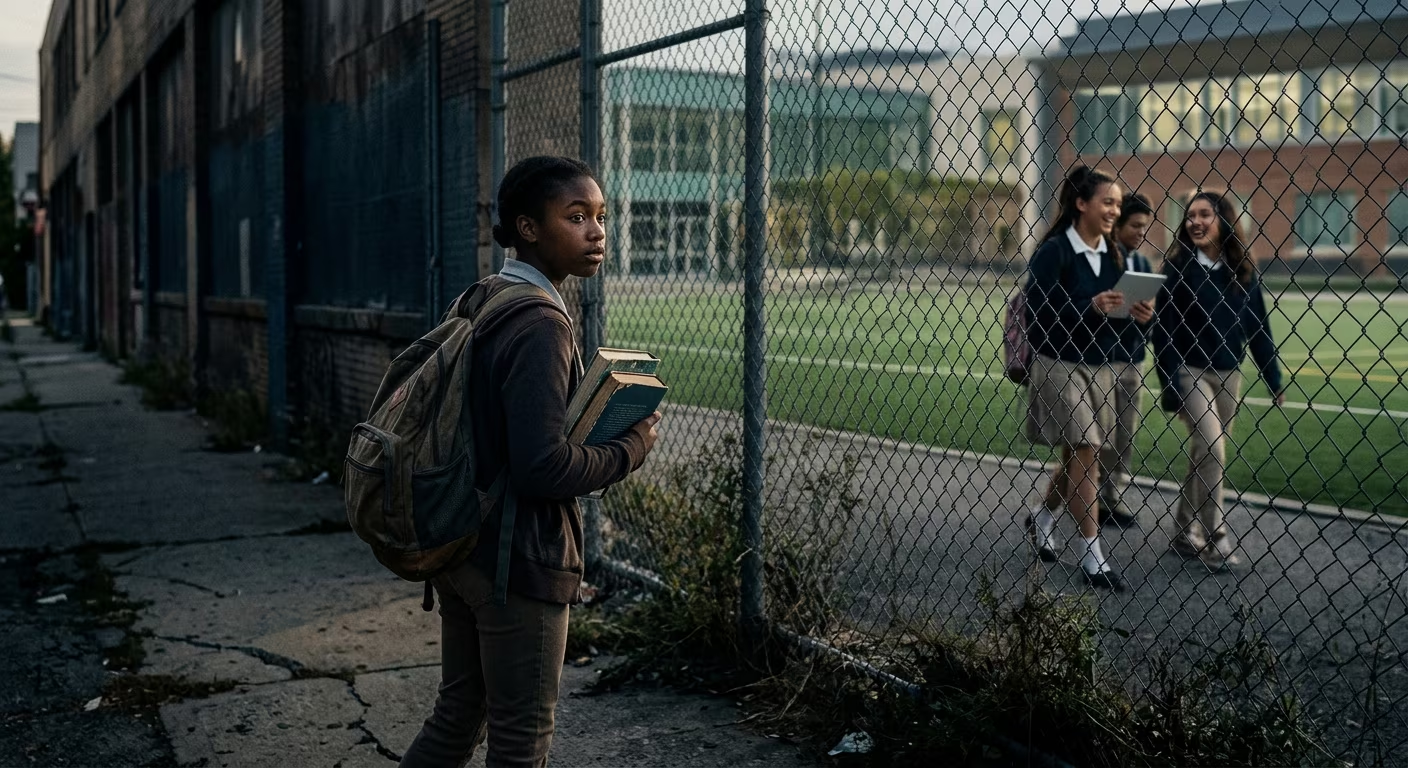
While the presence of police in schools is frequently justified under the guise of enhancing physical safety against external threats, the empirical reality reveals a deeply troubling narrative. Rather than broadly protecting students, the integration of law enforcement into educational settings has overwhelmingly resulted in the criminalization of minor infractions and typical adolescent behavior. More alarmingly, this punitive framework does not impact all demographics equally. It specifically and aggressively targets marginalized groups, casting a disproportionately wide net over Black, Brown, and Indigenous students, particularly those who also have diagnosed learning or behavioral disabilities. Understanding this intersection of race, structural inequity, and disability is essential to dismantling discriminatory educational policies and ensuring that schools remain places of growth, rather than sites of early incarceration.
Intersecting Identities: Race, Disability, and Disproportionate Discipline
When examining the demographics of students who are suspended, expelled, or arrested on school grounds, a glaring and persistent disparity emerges. Black, Latine, and Indigenous students consistently face harsher punishments compared to their white peers for similar behaviors. A comprehensive 2024 analysis by the U.S. Government Accountability Office (GAO) discovered that Native Hawaiian/Pacific Islander, Black, and American Indian/Alaska Native students were arrested at rates two to three times higher than their white counterparts . These disparities are not indicative of higher rates of misbehavior among students of color; rather, they reflect systemic biases, subjective disciplinary practices, and an institutional readiness to view the behavior of marginalized youth through a lens of criminality rather than developmental need.
The situation becomes exponentially more dire when disability intersects with race. Students with disabilities—ranging from autism spectrum disorders and ADHD to emotional and behavioral disorders—often require specialized support, de-escalation strategies, and academic accommodations. However, in schools where SROs handle disciplinary issues, the manifestations of these disabilities are frequently met with force rather than care. The GAO report further highlighted that when race, gender, and disability status overlap, the arrest disparities widen significantly. Boys with disabilities, especially Black and Brown boys, are profoundly overrepresented in school-related arrests and referrals to law enforcement, revealing a catastrophic failure to accommodate their educational rights .
When a school police officer responds to a student experiencing a mental health crisis or a behavioral outburst related to an Individualized Education Program (IEP), the officer’s training—rooted primarily in law enforcement, command presence, and threat neutralization—often escalates the situation. Handcuffs and physical restraints are deployed in scenarios where a trained counselor’s intervention is warranted. This dynamic violates the fundamental rights of students under the Individuals with Disabilities Education Act (IDEA) and Section 504 of the Rehabilitation Act, denying them a safe and equitable educational environment while inflicting lasting psychological trauma.
The Role of the Civil Rights Data Collection (CRDC)
To understand the full scope of educational inequities and track discriminatory practices across districts, stakeholders rely heavily on quantitative evidence. In the United States, the primary vehicle for this transparency is the Civil Rights Data Collection (CRDC), administered by the Department of Education’s Office for Civil Rights. The CRDC is a mandatory, biennial survey that gathers comprehensive data from nearly every public school district in the country. It details student enrollment patterns, access to advanced educational programs, and, critically, school climate factors such as suspensions, expulsions, and school-related arrests .
The data harvested by the CRDC is indispensable for civil rights advocacy and legislative reform. It forces school districts to hold up a mirror to their own disciplinary practices and provides the empirical foundation necessary for federal investigations into discriminatory policies. However, the efficacy of this data relies entirely on its accurate collection and timely publication. Historically, delays in the release of CRDC data have severely hampered the ability of civil rights organizations, parents, and policymakers to hold educational institutions accountable. When administrative bodies stall the publication of crucial data sets, they obscure the continuing rise of discriminatory policing in schools, leaving advocates without the necessary tools to demand immediate reform.
When the federal government obscures or delays the release of data detailing the intersections of race, disability, and school arrests, it effectively shields discriminatory practices from public and legal scrutiny. Robust civil rights enforcement requires not only the diligent collection of data but also its immediate, uncompromised dissemination. Legal experts and advocates argue that without current, granular statistics, challenging the school-to-prison pipeline in courts or legislative bodies becomes an uphill battle against invisible, yet deeply felt, systemic barriers that continue to ruin the futures of thousands of young people each year.
Funding Misalignment: Cops Instead of Counselors
The prioritization of school policing over student well-being is not merely a policy failure; it is a profound misalignment of financial resources. Across the nation, school districts operate on limited, heavily scrutinized budgets, forcing administrators to make difficult decisions regarding staff hiring, facility maintenance, and student support services. Far too often, these financial decisions favor the expansion of security apparatuses over the provision of essential mental health and developmental resources. Millions of dollars are funneled into SRO salaries, surveillance technology, and security hardware, starving critical support departments of much-needed capital.
A foundational 2019 analysis conducted by the American Civil Liberties Union (ACLU), which remains highly relevant as a baseline for measuring educational resource disparities, revealed staggering gaps in the American public education system. According to the report, 1.7 million students attend schools equipped with police officers but entirely lacking school counselors. Furthermore, 3 million students are in schools with police but no nurses, and a shocking 10 million students attend schools with SROs but no social workers . These figures underscore a national prioritization of punishment over prevention, healing, and care.
Law enforcement officers are generally not equipped, nor are they required to be comprehensively trained, to provide psychological support or trauma-informed interventions to children. Despite this glaring gap in expertise, they become the default responders to behavioral issues simply because mental health professionals are absent from the campus. This vacuum of care ensures that students experiencing trauma, domestic instability, or learning difficulties are met with punitive measures instead of therapeutic counseling. The misallocation of funds into policing directly deprives marginalized students of the basic support systems necessary to thrive academically and emotionally, perpetuating a generational cycle of disadvantage.
Restorative Alternatives: Dismantling the School-to-Prison Pipeline
Reversing the harmful impacts of school policing requires a fundamental paradigm shift away from punitive, zero-tolerance models toward restorative, community-centered approaches. The solution is not merely to offer police officers brief seminars on adolescent psychology, but rather to remove law enforcement entirely from daily school discipline. Those financial resources must be aggressively reinvested into hiring highly trained mental health practitioners, special education coordinators, and dedicated intervention specialists.
First, adopting Restorative Justice (RJ) practices is a proven, evidence-based method for drastically improving school climates. RJ focuses on peer mediation, understanding the root causes of conflict, and repairing harm through structured dialogue rather than exclusionary discipline. When schools prioritize restorative practices over punitive ones, they routinely see dramatic reductions in out-of-school suspension rates, increased overall student engagement, and a significant narrowing of the racial discipline gap.
Second, educational institutions must implement comprehensive trauma-informed care at every administrative and instructional level. Recognizing that many behavioral issues stem from adverse childhood experiences (ACEs)—such as systemic poverty, community violence, or institutional racism—allows educators to respond with empathy and targeted support. Hiring adequate numbers of school psychologists and social workers ensures that students with disabilities or trauma backgrounds receive the structural accommodations they are legally and morally owed, rather than being treated as security threats.
Finally, sustained legislative action is required to redefine the concept of school safety. True safety is not achieved through the proliferation of metal detectors and armed guards, but through robust community investment, mental health accessibility, and the creation of an inclusive, nurturing educational environment. By demanding rigorous data transparency, reallocating educational budgets to favor health over handcuffs, and prioritizing the holistic well-being of Black, Brown, and Indigenous students with disabilities, society can finally dismantle the catastrophic machinery of the school-to-prison pipeline.
Frequently Asked Questions (FAQs)
- What exactly is the school-to-prison pipeline?
The school-to-prison pipeline refers to a network of systemic policies and practices in public education that pushes students, particularly those from marginalized backgrounds, out of school and into the juvenile and adult criminal justice systems. This pipeline is primarily driven by zero-tolerance discipline policies and the heavy, normalized presence of police in schools. - How do school police officers affect students with disabilities?
Students with disabilities are disproportionately arrested and referred to law enforcement by school police officers. Often, typical behavioral manifestations of a physical, learning, or emotional disability are wrongly criminalized and met with physical restraint or arrest, rather than being appropriately addressed through the student’s Individualized Education Program (IEP) or by a qualified mental health professional. - What is the Civil Rights Data Collection (CRDC)?
The CRDC is a mandatory survey administered by the U.S. Department of Education’s Office for Civil Rights. It collects detailed data from public schools across the country regarding student access to courses, resources, and school climate factors, including discipline and arrest rates disaggregated by race, gender, and disability status. - Why is there a push for “Counselors Not Cops”?
“Counselors Not Cops” is an advocacy movement highlighting the severe underfunding of school mental health professionals in contrast to the overfunding of school police forces. The movement argues that investing in counselors, social workers, and psychologists creates demonstrably safer, more supportive school environments, whereas funding police criminalizes typical student behavior and harms marginalized youth. - Are zero-tolerance discipline policies effective?
No. Decades of comprehensive academic and federal research demonstrate that zero-tolerance policies do not improve school safety or student behavior. Instead, they exponentially increase suspension and dropout rates while disproportionately harming students of color and those with disabilities, further fueling the school-to-prison pipeline.
References
- K-12 Education: Differences in Student Arrest Rates Widen when Race, Gender, and Disability Status Overlap — U.S. Government Accountability Office. 2024-07-08. https://www.gao.gov/products/gao-24-106206
- 2020-21 Civil Rights Data Collection: Student Discipline and School Climate in U.S. Public Schools — U.S. Department of Education. 2023-11. https://ocrdata.ed.gov/assets/downloads/Student_Discipline_and_School_Climate_Part_4.pdf
- Cops and No Counselors — American Civil Liberties Union. 2019-02-20. https://www.aclu.org/report/cops-and-no-counselors