
Echoes of Greenwood: How Historical Trauma Shapes Modern Tulsa
How the 1921 Tulsa Race Massacre shapes modern urban inequality.
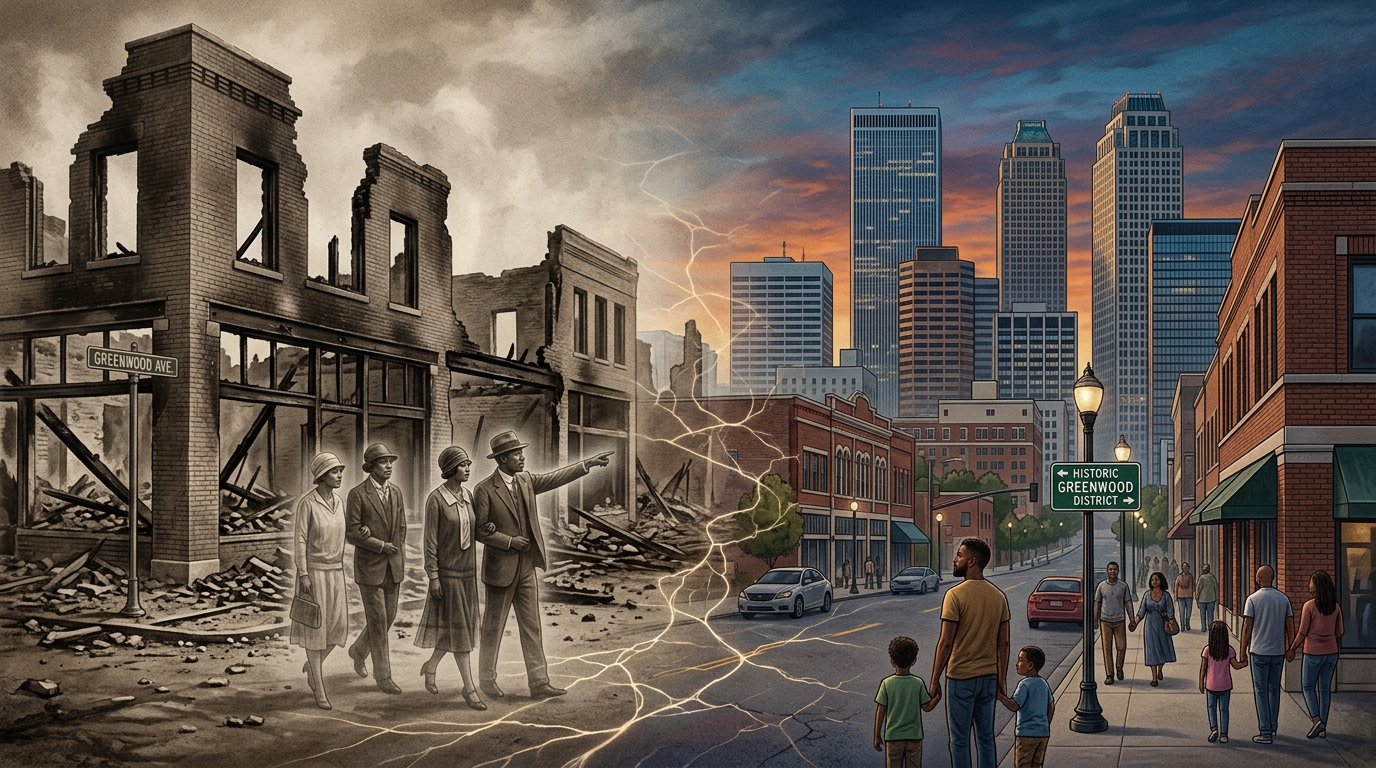
The Long Shadow of Historical Violence on Modern Urban Centers
The architecture of American inequality is rarely an accident; rather, it is meticulously built upon the foundations of historical violence and deliberate, exclusionary policy. In many major urban centers across the United States, the scars of the past are deeply woven into the modern social fabric. The assumption that historical atrocities remain safely confined to history books fails to account for the intergenerational transmission of trauma, the intentional destruction of community wealth, and the resilience of systemic barriers. Perhaps nowhere is this unbroken continuum of racial injustice more distinctly visible than in Tulsa, Oklahoma.
More than a century after one of the most devastating incidents of domestic terror in American history, the legacy of the 1921 Tulsa Race Massacre continues to reverberate through the city’s modern neighborhoods. This historical catastrophe did not merely result in a temporary loss of life and property; it permanently altered the trajectory of an entire demographic. By examining the current landscape of Tulsa—ranging from its stark geographic segregation to modern disparities in law enforcement and public health—we can clearly see how the troubling past continues to dictate the present. Understanding Tulsa requires acknowledging that historical trauma is not a static event, but a living, breathing reality that shapes the daily lives of its residents.
The Eradication of Black Wall Street and Generational Wealth
Before the devastating events of May 1921, the Greenwood District of Tulsa was a beacon of extraordinary Black prosperity. Colloquially and proudly celebrated as “Black Wall Street,” the neighborhood was a self-sustaining economic ecosystem. Denied access to white-owned businesses and banks due to rigid segregation laws, Black Tulsans built their own parallel economy. The district boasted thriving hotels, movie theaters, law offices, medical practices, and countless retail stores. The dollar circulated within the Greenwood community numerous times before leaving, creating a robust foundation for intergenerational wealth that was almost unprecedented for African Americans in the early 20th century.
This prosperity was brutally interrupted between May 31 and June 1, 1921. Sparked by an unsubstantiated accusation against a young Black man, deputized white mobs, armed and supported by local officials, descended upon Greenwood. The attack was systematic and militarized, including one of the first instances of aerial bombing on American soil. In the span of just 24 hours, the mob completely decimated 35 square blocks of the neighborhood. Over 1,200 homes and businesses were burned to the ground. While official records of the era suppressed the true toll, modern historical commissions estimate that up to 300 Black residents were murdered, and thousands more were forced into internment camps.
The immediate aftermath was characterized by a profound lack of accountability. No individual or entity was ever criminally prosecuted for the mass murder and arson. Furthermore, insurance claims filed by Black business owners and homeowners were systematically denied, often citing “riot clauses.” This refusal to compensate the victims resulted in the immediate, catastrophic erasure of millions of dollars in generational wealth, forcing once-prosperous families into sudden and enduring destitution.
Institutionalizing Inequity: Post-Massacre Policies
The flames of the 1921 massacre extinguished the physical infrastructure of Greenwood, but it was the subsequent decades of municipal, state, and federal policies that systematically suppressed its resurrection. The violence of 1921 was swiftly followed by the violence of bureaucracy. City planners and politicians implemented aggressive zoning laws designed to prevent Black residents from rebuilding their community. In the following decades, the practice of redlining—spearheaded by the federal Home Owners’ Loan Corporation—categorized Black neighborhoods in North Tulsa as “hazardous” for investment. This institutionalized denial of capital meant that families could not secure mortgages to buy homes, effectively locking them out of the primary mechanism for wealth accumulation in mid-century America.
As the civil rights era approached, new methods of displacement emerged under the guise of “urban renewal.” In the 1960s and 1970s, the federal government and local planners routed the construction of Interstate 244 directly through the heart of what remained of the Greenwood District. This aggressive infrastructure project displaced hundreds of Black-owned businesses and homes, physically and economically severing the community from the more prosperous sectors of the city. The highway remains today as a concrete monument to the deliberate marginalization of North Tulsa, illustrating how systemic disenfranchisement shifted from overt mob violence to quiet, devastating administrative policy.
The Modern Criminalization of North Tulsa
Today, the physical manifestations of systemic racism in Tulsa have evolved, heavily concentrated within the practices of the criminal justice system. The historical legacy of over-policing and controlling Black bodies has seamlessly transitioned into modern law enforcement statistics. Human rights organizations and civil rights advocates have extensively documented how law enforcement practices in the city reflect deeply entrenched racial disparities.
Data analyses reveal that Black Tulsans face a significantly higher likelihood of interacting with the police compared to their white counterparts. Despite making up approximately 15% of the city’s population, Black residents account for a disproportionately large percentage of arrests and instances where force is used by officers. Statistical reviews show that Black individuals in Tulsa are over two times more likely to be arrested than white residents.
Furthermore, the nature of these encounters highlights systemic biases. Traffic stops in predominantly Black and lower-income neighborhoods in North Tulsa are not only more frequent but are consistently longer in duration. These stops carry a much higher likelihood of escalating into vehicle searches, aggressive questioning, and eventual arrests. This disproportionate enforcement creates a devastating feedback loop: heightened police presence leads to higher arrest rates for minor offenses, which in turn leads to crippling court fines, job loss, and prolonged entanglement in the penal system, thereby perpetuating the cycle of poverty that began a century ago.
Socioeconomic Divides and the Geography of Health
The geographical division of Tulsa into the predominantly Black North and the predominantly White South provides a stark, statistical representation of racial inequality. The socio-economic chasm between these two sides of the same city is a direct, measurable consequence of the historical destruction of wealth and the subsequent decades of systemic neglect. The disparities extend far beyond bank accounts; they dictate the quality of daily life, educational opportunities, and profoundly, life expectancy.
A lack of investment has turned large portions of North Tulsa into “food deserts,” where residents lack reliable access to full-service grocery stores offering fresh, nutritious food. Combined with chronic underinvestment in healthcare facilities, the environmental and physiological stress of poverty—often referred to as allostatic load—takes a severe physical toll on the community.
| Metric | North Tulsa (Predominantly Black) | South Tulsa (Predominantly White) |
|---|---|---|
| Average Life Expectancy | ~70 Years | ~81 Years |
| Poverty Rate | 34% | 13% |
| Median Household Income | ~$29,000 | ~$60,000 |
This 11-year gap in life expectancy is a staggering indictment of systemic inequality. It proves that the denial of generational wealth, compounded by discriminatory housing and policing practices, literally robs people of years of their lives. The health outcomes of North Tulsa are not the result of individual choices, but rather the culmination of a century of structural abandonment.
The Century-Long Battle for Reparative Justice
The pursuit of accountability for the 1921 massacre has been an arduous, century-long battle characterized by immense resilience in the face of continuous institutional rejection. For decades, survivors and their descendants have fought not only for financial restitution but for the basic acknowledgement of the state’s role in the destruction of their community. Central to this fight have been the remaining centenarian survivors, such as Viola Fletcher and Lessie Benningfield Randle, who have spent the twilight of their lives demanding justice in the courtroom.
Legal advocates sought reparations under state public nuisance laws, arguing that the massacre created a nuisance that continues to inflict economic and social harm on the Greenwood community today. However, in June 2024, the Oklahoma Supreme Court delivered a devastating blow to this effort, affirming the dismissal of the survivors’ claims. The court ruled that while the grievances were historically legitimate, they did not fall within the legal scope of the state’s public nuisance statute, effectively closing one of the last remaining avenues for direct judicial reparations for the survivors.
Despite this severe legal setback, the push for reparative justice has found new momentum in the political sphere. In 2025, acknowledging the deep, unhealed wounds of the city, progressive municipal leadership announced a groundbreaking step forward. The city unveiled a monumental $105 million reparations package, often referred to as the “Road to Repair.” This initiative, driven by the establishment of a private charitable trust, aims to directly address the economic, educational, and health disparities stemming from the 1921 massacre. While financial compensation can never truly replace the lives lost or the century of compounded wealth that was stolen, these contemporary efforts represent a crucial shift from historical denial to tangible accountability. They underscore the reality that in order to build an equitable future, a society must bravely confront, and materially repair, the sins of its past.
Frequently Asked Questions (FAQ)
- What was the 1921 Tulsa Race Massacre?
The Tulsa Race Massacre was a two-day incident of racial violence in 1921 where a white mob, armed and supported by local authorities, attacked the prosperous Black neighborhood of Greenwood in Tulsa, Oklahoma. They destroyed 35 square blocks, burned over 1,200 homes, and killed up to 300 Black residents. - How did the massacre impact modern-day Tulsa?
The uncompensated destruction of Black Wall Street erased millions in generational wealth. Subsequent policies like redlining and urban renewal prevented the community from rebuilding, directly resulting in today’s stark disparities in poverty, income, and life expectancy between North and South Tulsa. - Are there racial disparities in modern Tulsa policing?
Yes. Statistical analyses show that Black residents in Tulsa are disproportionately targeted by law enforcement. They are significantly more likely to be subjected to longer traffic stops, aggressive searches, and are arrested at more than double the rate of white residents. - Have the survivors received reparations?
For over a century, survivors received no direct judicial compensation. In 2024, the Oklahoma Supreme Court dismissed a major reparations lawsuit filed by the last living survivors. However, in 2025, city officials announced a $105 million initiative designed to address the socio-economic damage caused by the massacre.
References
- Policing, Poverty, and Racial Inequality in Tulsa, Oklahoma — Human Rights Watch. 2019-09-11. https://www.hrw.org/report/2019/09/12/get-ground/policing-poverty-and-racial-inequality-tulsa-oklahoma
- The Case for Reparations in Tulsa, Oklahoma — Human Rights Watch. 2020-05-29. https://www.hrw.org/report/2020/05/29/case-reparations-tulsa-oklahoma
- Oklahoma Supreme Court rejects reparations for Tulsa Race Massacre — Associated Press. 2024-06-12. https://apnews.com/article/tulsa-race-massacre-lawsuit-dismissed-oklahoma-reparations-9d62d22a84a625a585794719d9b69b27
- City Announces Reparations for Tulsa Race Massacre — Equal Justice Initiative. 2025-06-12. https://eji.org/news/city-announces-reparations-for-tulsa-race-massacre/
Similar Articles








Read full bio of Sneha Tete


