
E-Signatures: Legal Strength and Hidden Risks
Uncover the legal power of electronic signatures and the critical pitfalls that could undermine their enforceability in disputes.
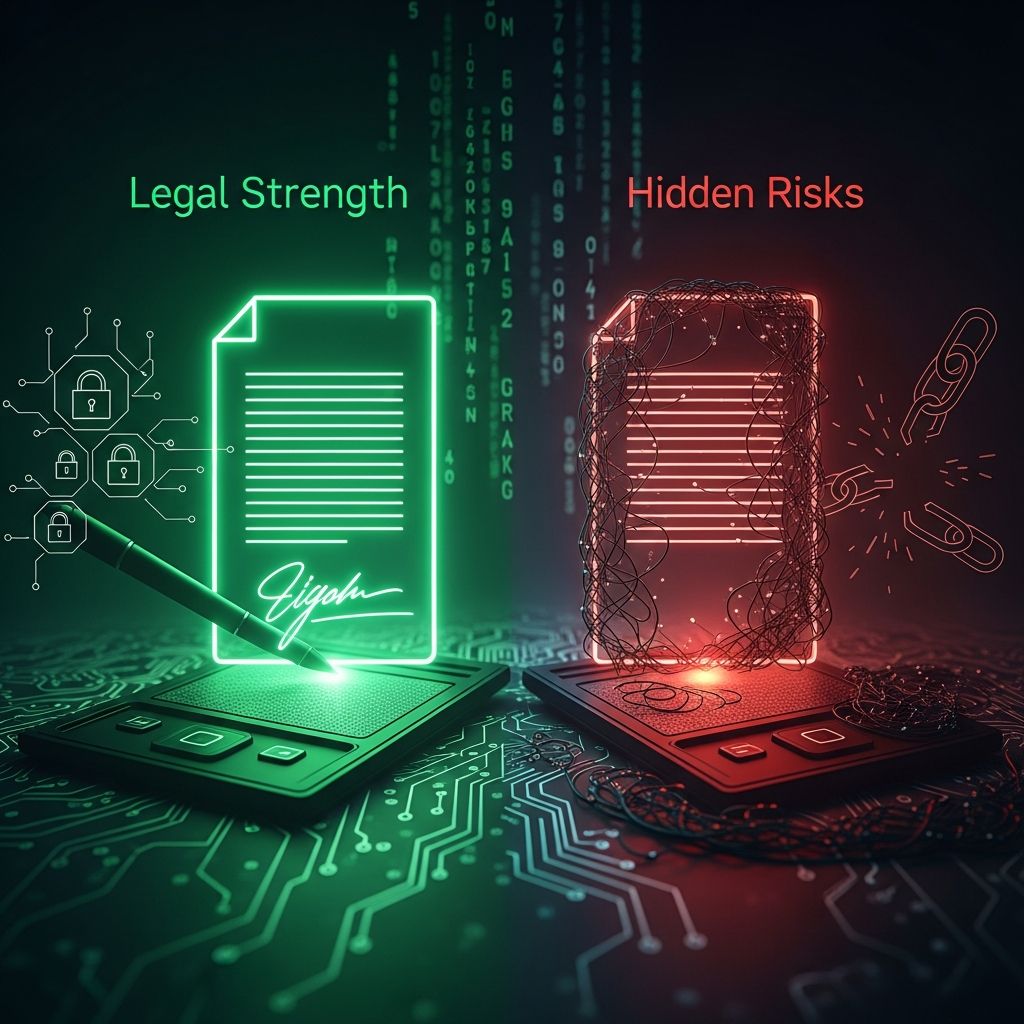
Electronic signatures have transformed how agreements are executed in the digital age, offering speed and convenience over traditional paper methods. Governed by federal and state laws, they carry the same weight as handwritten signatures in most cases, yet certain weaknesses can render them unenforceable.
The Foundation of E-Signature Legality in America
The backbone of e-signature validity rests on two cornerstone pieces of legislation: the Electronic Signatures in Global and National Commerce Act (ESIGN) of 2000 and the Uniform Electronic Transactions Act (UETA). ESIGN ensures that no contract or signature can be invalidated solely because it is in electronic form, applying nationwide. UETA, adopted by nearly all states except New York (which has equivalent rules), mirrors this by equating electronic records and signatures with their physical counterparts when core conditions are satisfied.
These laws emerged to eliminate barriers to e-commerce, recognizing that digital transactions demand equal legal protection. For instance, ESIGN explicitly allows electronically signed agreements as court evidence and prohibits denying their enforceability based on format alone. Together, they confirm that e-signatures create binding contracts if intent is clear and processes are secure.
Essential Criteria for Enforceable Electronic Signatures
To qualify as legally binding, e-signatures must fulfill strict requirements under ESIGN and UETA. Failure in any area invites challenges to authenticity or validity.
- Intent to Sign: The signer must demonstrate clear intent to execute the document, often via a deliberate action like clicking ‘Sign’ or typing a name.
- Consent to Electronic Transactions: All parties must agree to conduct business digitally, typically through a checkbox or explicit acknowledgment.
- Identity Verification (Attribution): The signature must link unmistakably to the signer, using methods like email verification, knowledge-based authentication, or digital certificates.
- Record Association and Retention: The signature process must generate reproducible records, including timestamps and audit trails, preserved accurately for future reference.
- Security Against Tampering: Documents require encryption and tamper-evident seals to prove no post-signing alterations occurred.
A table summarizing these criteria highlights their interdependence:
| Criterion | Description | Legal Basis |
|---|---|---|
| Intent | Deliberate signing action | ESIGN/UETA |
| Consent | Agreement to e-format | ESIGN §101(c) |
| Attribution | Link to signer’s identity | UETA §9 |
| Record Retention | Audit trails and copies | ESIGN §101(g) |
| Security | Encryption, no alterations | Best practices per Adobe |
Meeting these ensures the e-signature matches a ‘wet’ signature’s legal force.
Will Your E-Signature Survive a Courtroom Challenge?
Courts routinely uphold e-signatures as admissible evidence, often deeming them more reliable than handwritten ones due to embedded security features like audit logs. Judges evaluate under the same standards as traditional signatures: authenticity, non-tampering, and signatory capacity.
However, admissibility hinges on proof. Without robust audit trails showing who signed, when, and from where—or evidence of encryption—doubts arise. For example, if metadata reveals post-signature edits, the document may be tossed. E-sign platforms with PKI (Public Key Infrastructure) or blockchain timestamps bolster defensibility, providing forensic-level verification superior to ink analysis.
Real-world cases affirm this: disputes involving DocuSign or Adobe Sign have favored digital records when logs proved integrity, underscoring that preparation trumps format.
Documents That Demand Traditional Ink
Not all agreements can go digital. Specific categories mandate ‘wet’ signatures to prevent fraud or meet statutory formalities:
- Wills and codicils, requiring physical execution for probate validity.
- Real estate deeds and certain mortgages, varying by state.
- Court filings, powers of attorney (in some jurisdictions), and family law documents like adoptions.
- Uniform Commercial Code negotiable instruments (e.g., promissory notes over certain amounts).
State variations abound—lawyers must consult local rules, as California might permit e-signs on more deeds than Texas. Always verify before digitizing high-stakes papers.
Common Traps That Invalidate Digital Agreements
Even compliant e-signatures falter from overlooked errors. Top pitfalls include:
- Inadequate Authentication: Relying on weak methods like unverified email links allows impersonation claims.
- Missing Audit Trails: No logs mean no proof of signing sequence or device used.
- Tamper Suspicions: Unsigned changes post-signature, detectable via hash mismatches.
- No Consent Records: Absent proof parties agreed to e-format voids the process.
- Platform Shortcomings: Free tools lacking ESIGN compliance expose to disputes.
Avoid these by selecting certified platforms (e.g., those compliant with SOC 2 standards) and training users on protocols.
Global Perspectives: E-Signatures Beyond U.S. Borders
While U.S. laws set a high bar, international rules differ. The EU’s eIDAS regulation tiers signatures: Simple (basic clicks), Advanced (certified identity), and Qualified (government-issued, equivalent to handwritten). Many Asian and Middle Eastern nations align with U.S. standards via UNCITRAL models, but always check cross-border enforceability.
For multinational deals, hybrid approaches—using qualified signatures—minimize risks.
Best Practices for Ironclad Digital Signatures
To maximize enforceability:
- Choose ESIGN/UETA-certified providers with audit trails and encryption.
- Implement multi-factor authentication for high-value contracts.
- Retain full signing histories indefinitely for litigious documents.
- Include explicit e-consent language in agreements.
- Consult counsel for exceptions or complex transactions.
These steps not only ensure legality but enhance efficiency, reducing paper costs by up to 80% per studies on digital workflows.
Frequently Asked Questions About E-Signatures
Are e-signatures valid in every U.S. state?
Yes, under ESIGN federally and UETA in 49 states (New York equivalents apply).
Can e-signatures replace handwritten ones completely?
No, exceptions like wills and some deeds require wet ink.
What if someone disputes my e-signature’s authenticity?
Provide audit logs, IP data, and authentication records to affirm validity.
Is a scanned handwritten signature considered electronic?
Yes, if intent and attribution are proven, but typed or clicked are preferable for trails.
How long must e-signature records be kept?
Indefinitely for enforceable reference, per retention rules.
Future-Proofing Your Digital Agreements
As AI and blockchain evolve, e-signatures will gain tamper-proof enhancements like self-sovereign identity verification. Staying compliant means monitoring updates to ESIGN/UETA and adopting advanced tools. Businesses embracing these now sidestep tomorrow’s disputes.
References
- Are electronic signatures legally binding in court? — Adobe Acrobat. 2023. https://www.adobe.com/acrobat/hub/do-electronic-signatures-hold-up-in-court.html
- Electronic Signatures 101: Are they Legal? — Clio. 2025-08-07. https://www.clio.com/blog/are-electronic-signatures-legal/
- E-Signatures: What Are the Legal Requirements? — Purdue Global Law School. 2023. https://www.purduegloballawschool.edu/blog/news/e-signatures-legal-requirements
- Is My Electronic Signature Valid? — Lifelong Lawyers. 2023. https://lifelonglawyers.com/is-my-electronic-signature-valid/
- Are electronic signatures legal? — ShareFile. 2023. https://www.sharefile.com/resource/blogs/are-electronic-signatures-legal
- Are Electronic Signatures Legal? — DocuSign. 2023. https://www.docusign.com/blog/are-electronic-signatures-legal
- Electronic Signature Laws & Regulations – United States — Adobe HelpX. 2023. https://helpx.adobe.com/legal/esignatures/regulations/united-states.html
Similar Articles








Read full bio of Sneha Tete




