
Drug Paraphernalia Possession: Felony or Misdemeanor?
Uncover whether possessing drug paraphernalia leads to felony charges, state variations, penalties, and vital defense strategies.
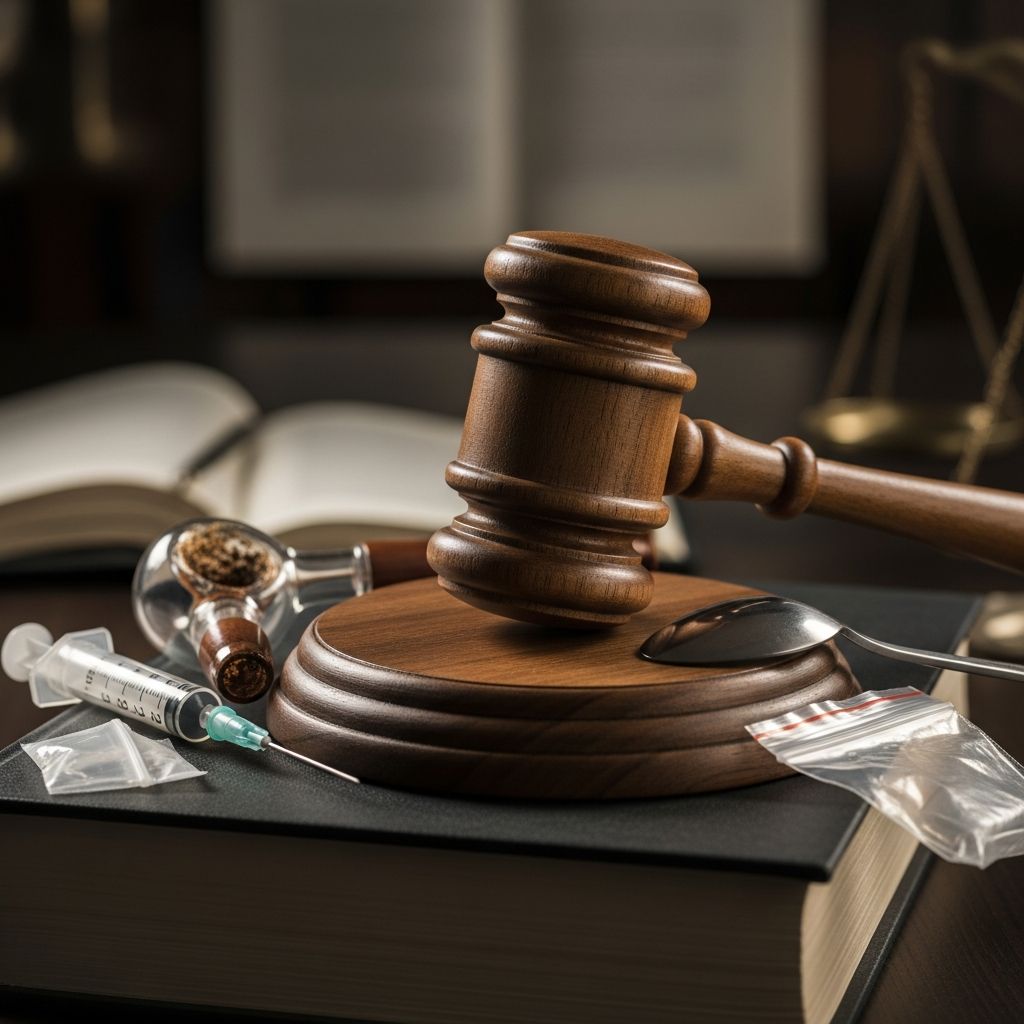
Possessing items associated with illegal drug use often triggers criminal charges, but whether this constitutes a felony hinges on jurisdiction, intent, and circumstances. Most states classify simple possession as a misdemeanor, while federal law treats certain violations as felonies punishable by up to three years in prison.
Defining Drug Paraphernalia Under U.S. Law
Drug paraphernalia encompasses any equipment, product, or material designed or intended for manufacturing, processing, or introducing controlled substances into the body. Federal statute 21 U.S.C. § 863 explicitly lists examples like pipes, bongs, scales, syringes, and testing kits primarily meant for illicit drugs such as marijuana, cocaine, or methamphetamine.
Courts evaluate items based on multiple factors to determine paraphernalia status:
- Proximity to controlled substances or residue on the object.
- Statements from the owner about its intended use.
- Evidence of intent to distribute or manufacture drugs.
- Location, such as near schools, which escalates charges.
Common household items like spoons or straws can qualify if context suggests drug-related purpose, as seen in Maryland and Delaware codes.
Federal Framework for Paraphernalia Offenses
No federal law directly criminalizes mere possession of drug paraphernalia for personal use. However, offenses involving sale, manufacture, or distribution trigger felony penalties: up to three years imprisonment and fines under Title 18.
Seizure and forfeiture apply upon conviction, with items handed to the General Services Administration for destruction or law enforcement use. This framework influences state laws but leaves simple possession to local jurisdiction.
State-by-State Breakdown of Penalties
Penalties vary widely across states, with most treating basic possession as a misdemeanor but elevating to felonies for repeat offenses, sales, or proximity to minors/schools. Below is a comparative table of select states:
| State | Simple Possession | Aggravated (e.g., Sale, Near School) | Key Notes |
|---|---|---|---|
| Maryland | Misdemeanor: Up to 2 years jail, $500-$2,000 fine | Varies by intent | Considers owner statements, prior convictions |
| Delaware | Class B Misdemeanor (personal use); Civil penalty for marijuana ($100) | Class G Felony (use/possession with intent) | Residue, proximity key factors |
| Alabama | Misdemeanor: Up to 1 year | Felony: Up to 10 years (sale/near school) | Sliding scale severity |
| Virginia | Unlawful possession: Misdemeanor/Class 1 | Felony if distribution intent | Includes syringes, packaging |
| New York | Misdemeanor (2nd degree use) | Escalates with diluents/sales | Possession/sale of adulterants |
| Washington DC | Up to 30 days jail, $250 fine | N/A | Based on drug residue, location |
Many states follow patterns from summaries: first offenses as Class A misdemeanors, subsequent as felonies (e.g., Class D or C). Manufacturing paraphernalia often carries harsher Class B or C felony penalties, especially involving firearms or minors.
When Does Possession Escalate to a Felony?
Simple possession rarely qualifies as a felony nationwide; escalation occurs in these scenarios:
- Repeat offenses: Second or subsequent violations upgrade to felonies in states like those outlined in national summaries.
- Sale or delivery: Providing paraphernalia to others, especially minors three years younger, results in Class B felonies.
- Manufacturing intent: Items used to produce controlled substances trigger felony charges.
- Location-based enhancements: Near schools or involving specific drugs like fentanyl elevates to Class D felonies.
- Federal involvement: Interstate commerce or mail-order sales invoke 21 U.S.C. § 863 felonies.
For instance, Delaware treats general use/possession as a Class G felony if intent is proven beyond personal marijuana use.
Potential Consequences Beyond Jail Time
Convictions carry collateral impacts:
- Fines: $100 civil penalties to thousands in criminal cases.
- Probation: Supervised terms with drug testing.
- License suspension: Driver’s licenses affected in many states.
- Employment/education barriers: Criminal records hinder job prospects and housing.
- Forfeiture: Items seized permanently.
In DC, even minor charges mean 30 days jail plus $250 fines, compounding with possession charges.
Building a Strong Legal Defense
Challenging paraphernalia charges requires scrutinizing evidence. Key defenses include:
- Lack of intent: Prove item has legitimate uses (e.g., medical syringes).
- Illegal search/seizure: Suppress evidence from warrantless searches.
- No residue/proximity: Absence of drugs weakens case.
- First-time diversion: Programs dismiss charges upon completion.
- Constitutional challenges: Argue overbreadth in vague statutes.
Courts weigh factors like prior convictions or owner statements, providing avenues to rebut presumptions.
Recent Trends and Decriminalization Efforts
As of 2026, marijuana-related paraphernalia faces softening in legalization states. Delaware imposes only civil penalties for personal marijuana use quantities. National summaries note allowances in some contexts post-2022 reforms. However, harder drugs maintain strict enforcement.
Frequently Asked Questions (FAQs)
What items count as drug paraphernalia?
Items like pipes, needles, scales, or bongs designed for controlled substances, determined by intent and context.
Is paraphernalia possession always a crime?
No, federal law doesn’t criminalize simple possession; states vary, often misdemeanors unless aggravated.
Can I get felony charges for a pipe in my car?
Possibly, if near drugs or schools; factors like residue elevate risks.
What if it’s for legal marijuana?
Some states like Delaware treat as civil violations only.
How to fight paraphernalia charges?
Hire an attorney to challenge intent, search legality, and evidence strength.
References
- What Is Possession of Drug Paraphernalia in Maryland? — eLawrenceLaw. Accessed 2026. https://www.elawrencelaw.com/blog/what-is-possession-of-drug-paraphernalia-in-maryland/
- What Is Possession of Drug Paraphernalia? — LawInfo.com. Accessed 2026. https://www.lawinfo.com/resources/drug-crime/possession-of-paraphernalia.html
- Subchapter V. Drug Paraphernalia — Delaware Code Online (.gov). Accessed 2026. https://delcode.delaware.gov/title16/c047/sc05/index.html
- Drug Paraphernalia Summary of State Laws — Legislative Analysis (.org). 2022-09. https://legislativeanalysis.org/wp-content/uploads/2022/09/Drug-Paraphernalia-Summary-of-State-Laws-FINAL.pdf
- Washington DC Drug Possession Attorney | Role of Paraphernalia — Washington DC Criminal Lawyer. Accessed 2026. https://washingtondccriminallawyer.net/dc-drug-lawyer/possession/
- §5–619 – Laws – Statute Text — Maryland General Assembly (.gov). Accessed 2026. https://mgaleg.maryland.gov/mgawebsite/Laws/StatuteText?article=gcr§ion=5-619
- 220.50 – NYS Open Legislation — NYSenate.gov (.gov). Accessed 2026. https://www.nysenate.gov/legislation/laws/PEN/220.50
- 54.1-3466. Possession or distribution of controlled paraphernalia — Virginia Law (.gov). Accessed 2026. https://law.lis.virginia.gov/vacode/title54.1/chapter34/section54.1-3466/
- 21 USC 863: Drug paraphernalia — U.S. House of Representatives (.gov). Accessed 2026. https://uscode.house.gov/view.xhtml?req=%28title%3A21+section%3A863+edition%3Aprelim%29
Similar Articles








Read full bio of Sneha Tete




