
Divorce vs Simplified Dissolution: Key Differences
Understand the core distinctions between traditional divorce and simplified dissolution to choose the right path for ending your marriage efficiently.
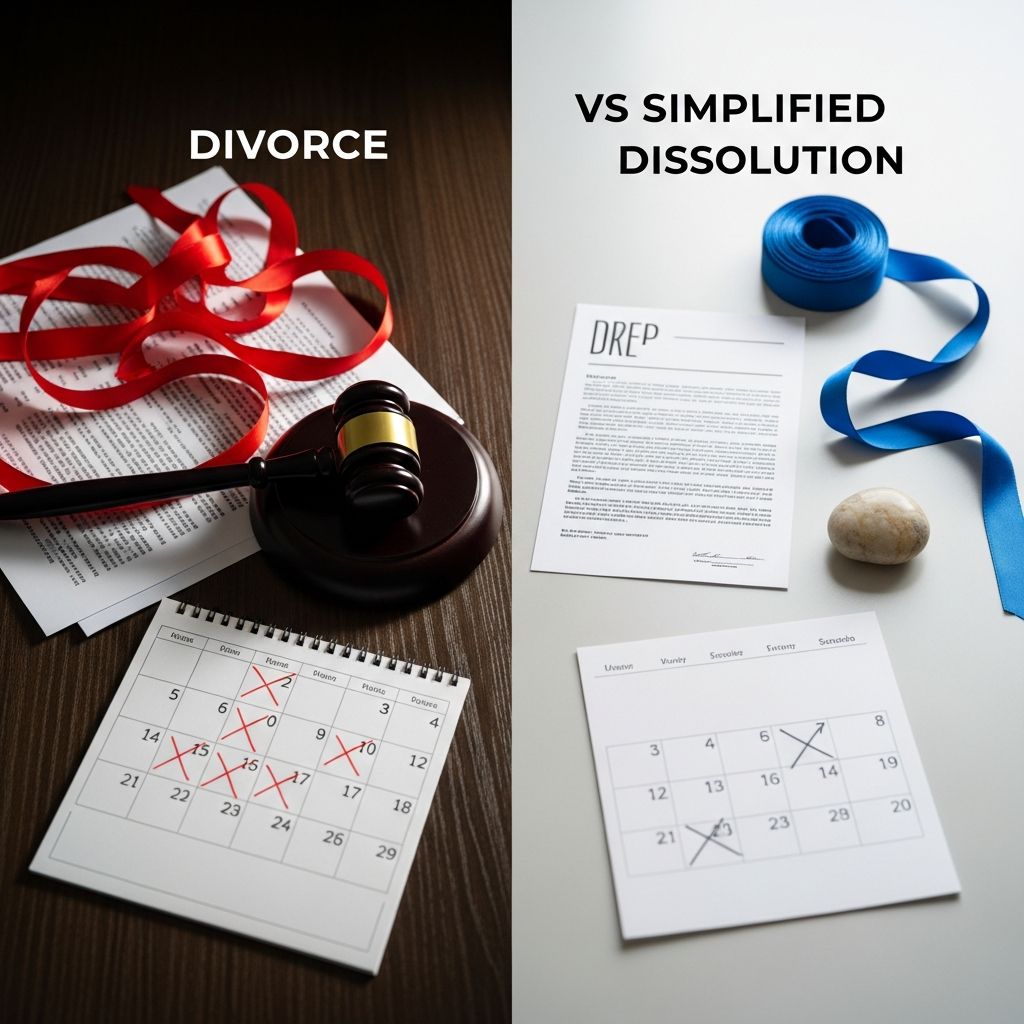
Ending a marriage legally can take different paths depending on your circumstances, with
traditional divorce
andsimplified dissolution
(also known as summary dissolution) being the primary options in many U.S. states. Traditional divorce handles complex cases involving disputes over assets, children, or support, while simplified dissolution offers a streamlined process for eligible couples with minimal complications. Both achieve the same end—legally terminating the marriage—but differ significantly in requirements, timeline, and expense.Understanding Traditional Divorce
Traditional divorce, often called a contested or standard divorce, is the default method for dissolving a marriage when couples cannot agree on key issues or do not meet simplified criteria. In no-fault states like California, one spouse files citing irreconcilable differences, requiring no proof of wrongdoing. This process involves extensive paperwork, financial disclosures, potential court hearings, and possibly trials if disputes arise over property division, child custody, or alimony.
Couples must navigate residency rules, such as living in the state for six months and the county for three months in California. Filing fees alone can reach $435 per spouse, plus attorney costs that escalate with complexity. The mandatory six-month waiting period applies in many states, but active litigation can extend proceedings to over a year.
What Makes Simplified Dissolution Unique?
Simplified dissolution is a faster, cheaper alternative designed for low-conflict separations. It requires full agreement between spouses on all terms, eliminating court battles. No hearings are needed; the court reviews paperwork and approves after a waiting period. This option suits short-term marriages with few assets, no children, and no support claims, making it ideal for amicable splits.
Originating in states like California and Nevada, it’s called summary divorce in Nevada, where parties file a joint petition agreeing on everything from property to debts. The outcome mirrors divorce: full legal freedom to remarry, but with far less bureaucracy.
Strict Eligibility Rules for Simplified Dissolution
Not every couple qualifies for this expedited route. States impose rigorous criteria to ensure fairness and prevent abuse. Common requirements include:
- Marriage duration under 5 years (e.g., California).
- No minor children or pregnancy.
- Community property value below $53,000 (updated in California as of 2024).
- Joint debts (excluding car loans) under $7,000-$9,000.
- Mutual waiver of spousal support.
- Full agreement on asset/debt division via signed paperwork.
- Residency: At least 6 months in state, 3 months in county (California).
These thresholds vary by state. Nevada’s summary divorce similarly limits property and requires agreement on all terms. Failure to meet any criterion defaults couples to traditional divorce.
Comparing Processes: Step-by-Step Breakdown
The procedural differences highlight why simplified dissolution saves time and money. Here’s a side-by-side comparison:
| Aspect | Simplified Dissolution | Traditional Divorce |
|---|---|---|
| Petition Type | Joint petition signed by both. | Unilateral filing by one spouse. |
| Court Hearings | None required. | Often multiple, including trials. |
| Paperwork | Minimal forms (e.g., FL-800 in CA). | Extensive disclosures and motions. |
| Filing Fee | $435 per couple (CA). | $435+ per person (CA). |
| Timeline | 6 months waiting, no delays. | 6+ months, often 1+ years. |
| Agreement Needed | Full consensus mandatory. | Not required; court decides disputes. |
For simplified dissolution, steps include confirming eligibility, completing a joint form, exchanging disclosures, filing, waiting six months, and receiving judgment automatically. Traditional divorce adds negotiation, mediation, or litigation phases.
Financial Implications: Costs and Savings
Cost is a major differentiator. Simplified dissolution avoids attorney fees since no court appearances occur, with total expenses often under $500 beyond filing. Traditional divorces average thousands due to legal representation, especially in contested cases involving experts for valuations or custody evaluations.
Property rules also impact finances. In simplified cases, couples divide limited assets themselves, waiving rights to future claims. Traditional processes equitably divide all marital property, potentially awarding support. Debt handling follows similar lines, with joint agreement in simplified vs. court allocation in divorce.
State Variations Across the U.S.
While California pioneered simplified dissolution, rules differ nationwide. Nevada uses ‘summary divorce’ for agreeing couples, bypassing judicial decisions on custody or property. Ohio distinguishes dissolution (no-fault, agreement-based) from fault-based divorce requiring proof like adultery.
Virginia offers summary dissolution for qualifying couples, emphasizing speed and low stress. Always check state-specific statutes, as eligibility like property caps adjusts (e.g., California’s 2024 increase). Federal uniformity doesn’t exist; consult local courts.
Pros and Cons of Each Option
Simplified Dissolution Advantages
- Quicker resolution without emotional court drama.
- Lower costs, preserving limited assets.
- Less paperwork and stress for cooperative couples.
Simplified Dissolution Drawbacks
- Inflexible eligibility excludes most couples.
- No support or complex division options.
- Irrevocable after filing, with revocation possible only within waiting period.
Traditional Divorce Advantages
- Handles children, high assets, disputes.
- Court enforces fair outcomes.
- Available to all, regardless of agreement.
Traditional Divorce Drawbacks
- Prolonged, expensive, adversarial process.
- Emotional toll from hearings.
- Higher fees and unpredictability.
Real-World Scenarios: Which Path Fits?
Consider a couple married 3 years, no kids, $40,000 joint assets, $5,000 debt, fully agreeing: Simplified dissolution is perfect, finalizing in 6 months cheaply. Contrast with parents of two young children disputing custody and a $200,000 home: Traditional divorce ensures judicial oversight.
Even eligible couples might opt for divorce if uncomfortable waiving support or fearing future regrets. Pre-filing counseling or mediation can clarify choices.
Frequently Asked Questions
Can I switch from simplified dissolution to divorce?
Yes, during the 6-month waiting period, you can revoke and file for traditional divorce if circumstances change.
Does simplified dissolution work for domestic partnerships?
In California, yes, for unregistered domestic partners meeting the same criteria.
Is spousal support possible in simplified dissolution?
No, both must waive it permanently.
How long is the waiting period in most states?
Typically 6 months from filing, matching divorce minimums.
What if we have a prenup?
It can facilitate agreement for simplified dissolution, but review ensures compliance with eligibility.
Next Steps for Your Situation
Assess eligibility first using state court websites. Gather financial docs, discuss terms openly, and consider free legal aid or self-help centers. For complexities, consult a family law attorney early. Choosing correctly minimizes stress and costs, paving the way for fresh starts.
References
- Is Summary Dissolution the Same as Divorce? — Hello Divorce. 2024. https://hellodivorce.com/divorce-in-california/summary-dissolution-vs-divorce
- What’s the Difference Between Divorce, Dissolution, and Legal Separation? — K&H Law Group. Accessed 2026. https://www.kandhlawgroup.com/blog/whats-the-difference-between-divorce-dissolution-and-legal-separation/
- Divorce and Dissolution: What’s the Difference? — Half Price Lawyers. Accessed 2026. https://www.halfpricelawyers.com/family-law/divorce-and-dissolution-whats-the-difference/
- What’s the Difference Between Divorce and Dissolution? — Shur Law. Accessed 2026. https://shurlaw.com/whats-the-difference-between-divorce-and-dissolution/
- Summary and Default Divorce Legal Procedures — Justia. Accessed 2026. https://www.justia.com/family/divorce/the-divorce-process/summary-and-default-divorce/
Similar Articles








Read full bio of medha deb




