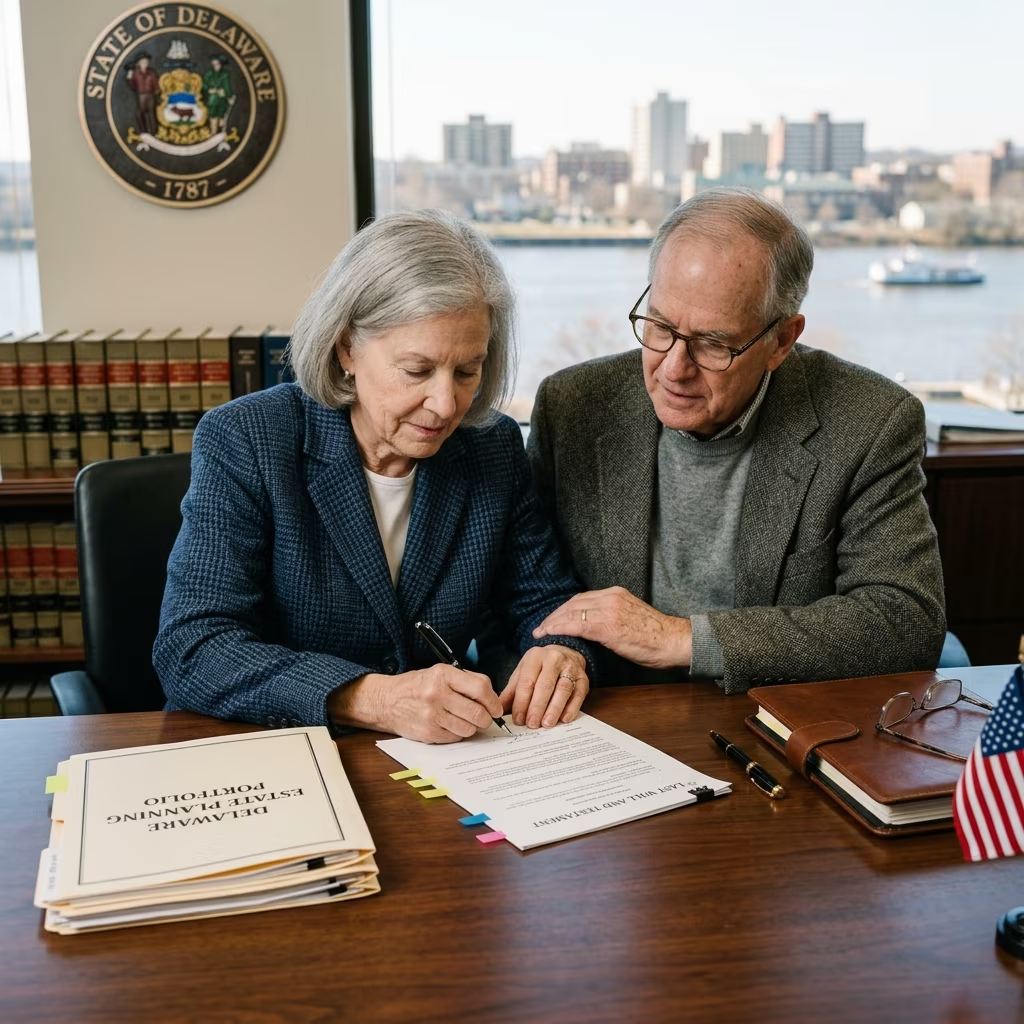
Delaware law offers a relatively straightforward framework for creating a valid last will and testament, but small mistakes can still lead to disputes or an estate being treated as if no will exists at all. A clear understanding of the legal rules—combined with practical planning—helps ensure your wishes are honored and your family is protected.
Who Can Make a Will in Delaware?
Delaware statutes set basic eligibility rules for anyone who wants to make a will. These rules focus on age and mental capacity, and they apply whether you are leaving real estate, financial assets, or personal belongings.
- Minimum age: You must be at least 18 years old to make a will disposing of real or personal property.
- Mental capacity: You must have a sound and disposing mind and memory, meaning you understand that you are making a will, know the nature and extent of your property, and recognize the natural objects of your bounty (such as close family members).
- Voluntary decision: The will must reflect your own decisions, free from fraud, coercion, or undue influence. Allegations of undue influence or lack of capacity are among the most common grounds for will contests.
If you do not meet the age or competency requirements, any purported will can be declared invalid, and your estate will be handled under Delaware intestate succession rules instead.
Formal Requirements for a Valid Delaware Will
Even if you are eligible to make a will, Delaware law imposes specific formalities to ensure the document can be recognized and enforced by the probate court.
Writing and Signature
Delaware requires that every will be in writing and properly signed.
- Written document: The will must be a written instrument. Typewritten, computer-generated, or handwritten (holographic) wills can all be valid if legal requirements are satisfied.
- Signature by the testator: The person making the will (the testator) must sign it, or someone else may sign the testator’s name in the testator’s presence and at the testator’s express direction.
- Clear testamentary intent: The document should make clear that it is intended to function as a will and dispose of property upon death.
Witnesses and Attestation
Witnessing requirements exist to reduce fraud and to provide evidence that the will was properly executed.
- Number of witnesses: At least two credible adult witnesses must sign the will.
- Presence: Witnesses must subscribe their names in the presence of the testator when the will is signed or acknowledged.
- Who may serve as a witness: Delaware permits beneficiaries to serve as witnesses, although this can increase the risk of future disputes over undue influence.
In practice, many estate planners recommend using disinterested witnesses (people who are not beneficiaries) to reduce the chance of a challenge and to strengthen the will’s evidentiary value.
Holographic and Self-Proving Wills
Delaware recognizes certain handwritten wills, and it allows a will to be made “self-proving” to simplify later probate proceedings.
- Holographic wills: A will written entirely in the testator’s handwriting can be valid if it meets all other requirements for age, capacity, signature, and witnesses.
- Self-proving wills: A will may include a self-proving affidavit signed by the testator and witnesses before a notary public. This affidavit allows the will to be accepted by the court without requiring witness testimony about execution, streamlining the probate process.
Key Roles and Clauses in a Delaware Will
A well-drafted will should do more than just say “who gets what.” It typically addresses several core roles and contingency plans.
- Executor (personal representative): Names the person who will handle your estate, file documents, pay debts, and distribute property according to your will.
- Guardians for minor children: Designates who will care for minor children if both parents die, subject to court approval.
- Specific gifts: Identifies particular assets, such as real estate or heirlooms, and the beneficiaries who should receive them.
- Residual clause: Provides instructions for any remaining property not specifically mentioned elsewhere in the will.
- Alternate beneficiaries: Names backups in case a primary beneficiary predeceases you or cannot accept the gift.
What Happens If You Do Not Have a Will?
When a Delaware resident dies without a valid will, they are considered to have died intestate. In that situation, state law—not the decedent—determines who inherits and in what proportions.
Intestate Succession Overview
Delaware intestate succession statutes establish a hierarchy of relatives who may inherit when no valid will exists.
| Family Situation | Typical Intestate Heirs |
|---|---|
| Surviving spouse and children | Estate generally divided among spouse and children according to statutory formulas. |
| Surviving spouse, no children | Spouse and possibly parents may share in the estate, depending on circumstances. |
| No spouse, but children | Children or their descendants inherit the estate, typically per stirpes. |
| No spouse or descendants | Parents, siblings, and other next of kin inherit in a priority order set by statute. |
| No identifiable next of kin | If no eligible relatives can be located, the estate may ultimately pass to the State. |
These statutory rules rarely match a person’s exact preferences, which is why having a valid will is a central component of Delaware estate planning.
Spouses, Children, and Disinheritance
Delaware law gives special attention to the rights of spouses and certain protections for children, especially when a will omits them.
Elective Share Rights for Spouses
Even if a Delaware testator chooses not to leave property to a spouse in their will, the surviving spouse may still be entitled to claim an elective share of the estate under state law.
- Elective share concept: The elective share allows a surviving spouse to claim a portion of the decedent’s estate, overriding the will to that extent, unless this right was waived—such as in a valid premarital agreement.
- Amount: Under Delaware law, the elective share may be up to approximately one-third of the estate.
- Planning implications: Estate plans that disinherit a spouse or leave only minimal property should account for elective share rights to avoid unintended results.
Children and Omitted Heirs
Children do not automatically have a right to inherit if you leave them out of your will, but special protections may apply to children born or adopted after the will is signed.
- No general forced share: Delaware does not generally require you to leave property to adult children.
- After-born or later-adopted children: When a child is born or adopted after the execution of the will and is not mentioned, courts may treat the omission as accidental and award that child a share of the estate.
- Express disinheritance: If you intend to disinherit a child, clear language stating this intention in your will can help avoid ambiguity and disputes.
Changing or Revoking a Delaware Will
Estate plans often evolve over time as family circumstances, finances, and goals change. Delaware law provides structured ways to revoke or amend a will.
Methods of Revocation
A Delaware last will and testament, or any clause in it, may be revoked or altered only through specific legally recognized actions.
- Physical destruction: Canceling, tearing, burning, or otherwise destroying the will by the testator (or by someone at the testator’s direction and in the testator’s presence) with the intent to revoke.
- New will: Executing a subsequent valid will that expressly revokes or conflicts with the prior will.
- Written revocation: Signing a separate written instrument declaring revocation, with the same formalities required for a will (including proper witnessing).
Codicils: Updating Without Replacing
Instead of replacing the entire will, you may sometimes wish to make targeted changes. A codicil is a legal document that amends, rather than replaces, a previously executed will.
- Purpose: Codicils are used to update specific provisions—such as changing an executor, adding a beneficiary, or updating asset descriptions—without rewriting the entire will.
- Formalities: A codicil must meet the same formal requirements as a will, including being in writing, signed by the testator, and properly witnessed.
- Integration: The codicil and the original will are read together. Careful drafting helps avoid conflicting instructions.
Probate and Filing Duties After Death
Once a testator dies, the will does not automatically take effect. Instead, it generally must be admitted to probate through the Register of Wills in the county where the decedent resided.
Delivering the Will
Delaware imposes a specific duty on anyone holding an original document that appears to be a will.
- Delivery requirement: The person in possession of an original will must deliver it to the appropriate Register of Wills office within a short period—typically ten days after learning of the testator’s death.
- Consequences of delay: Failure to file promptly can complicate probate, delay distributions, and may result in legal consequences.
Opening the Estate
To begin administration of a Delaware estate, the executor or another interested party petitions the Register of Wills for authority to act.
- Petition for letters: If the will names an executor, that person typically seeks letters testamentary. If there is no will, eligible relatives petition for letters of administration according to a statutory priority list (spouse, children, parents, siblings, and so on).
- Notice to creditors: Once the estate is opened, a legal notice of the filing is published to alert creditors that they may submit claims for payment from the estate.
- Asset collection: The personal representative must identify, safeguard, and eventually distribute probate assets, paying valid debts and expenses before transferring the remaining property to beneficiaries or heirs.
Will Contests and Challenges
Interested parties who believe a will is invalid or improperly executed may file objections in probate court within the applicable time limits.
- Common grounds:
- Lack of proper signing or witnessing under Delaware formal requirements.
- Alleged lack of testamentary capacity at the time of execution.
- Claims of fraud, duress, or undue influence over the testator.
- Forgery or tampering with the document.
Contests can significantly delay administration and reduce the estate through legal costs, which is why careful compliance with Delaware’s will statutes and use of experienced counsel are important risk-management strategies.
Practical Planning Tips for Delaware Residents
Legal requirements are only one part of sound estate planning. Practical preparation helps ensure that your will can be implemented efficiently and with minimal stress for your survivors.
- Inventory your assets: Prepare a detailed list of your real estate, financial accounts, business interests, and valuable personal property. This helps you make informed decisions and supports your executor after your death.
- Clarify beneficiaries: Decide who should receive particular assets and who should share in your residuary estate, considering family dynamics and potential future changes.
- Choose a capable executor: Select someone who is willing and able to handle financial, legal, and administrative tasks. Many people also designate alternates in case the primary executor cannot serve.
- Coordinate non-probate transfers: Review beneficiary designations on life insurance, retirement accounts, and payable-on-death (POD) or transfer-on-death (TOD) accounts to ensure they align with your will.
- Consider professional legal advice: While Delaware permits handwritten wills and does not require attorney involvement, qualified legal counsel can help you navigate complex family situations, tax concerns, business ownership, and multi-state assets.
- Store documents safely: Keep your original will in a secure but accessible location, and make sure your executor knows where to find it. Avoid hiding the document so well that it cannot be located when needed.
- Review periodically: Major life events—marriage, divorce, birth or adoption of children, significant asset changes—should prompt a review of your will and related estate planning documents.
Frequently Asked Questions About Delaware Wills
Do I need a lawyer to write a valid will in Delaware?
No. Delaware does not require that a will be drafted or signed under the supervision of a lawyer. However, legal counsel is strongly recommended, especially if you have substantial assets, a blended family, or wish to include tax-planning or asset-protection strategies.
Is a handwritten will valid in Delaware?
Yes. A handwritten (holographic) will can be valid if it meets Delaware’s requirements for age, capacity, signature, and witnesses. A fully handwritten document that is properly signed and witnessed may be enforced, but informal handwritten notes that do not meet these standards may fail.
Can a beneficiary witness my will?
Unlike some states that restrict or void gifts to interested witnesses, Delaware allows a beneficiary to serve as a witness to the will. Nonetheless, using disinterested witnesses is often considered best practice to minimize challenges based on undue influence or conflicts of interest.
What if I lose the original will?
Probate courts generally prefer an original, signed document. If the original is lost or destroyed without clear evidence of intent to revoke, the court may consider secondary evidence, such as copies and witness testimony, but the process is more complex and uncertain. Safe storage of the original document is critical.
How often should I update my will?
There is no fixed schedule, but Delaware residents should review their wills after significant life changes, such as marriage, divorce, births, deaths of beneficiaries, major financial events, or relocation. Updates can be made via a new will or a codicil, following the same execution formalities.
References
- Title 12, Delaware Code, Chapter 2: Wills — State of Delaware. Accessed 2024-10-01. https://delcode.delaware.gov/title12/c002/sc01/
- How to Make a Will in Delaware FAQ — FindLaw. 2023-06-15. https://www.findlaw.com/forms/resources/estate-planning/last-will-and-testament/how-to-make-a-will-in-delaware-faq.html
- Wills and Estates FAQ — Sussex County Register of Wills. 2022-09-01. https://sussexcountyde.gov/wills-and-estates
- Kent County Register of Wills Brochure — Kent County, Delaware. 2024-05-01. https://www.kentcountyde.gov/files/sharedassets/public/v/1/content-publishers/wills/wills-pdf/our-kc-row-website-brochure_may-2024.pdf
- Questions About Wills — Delaware State Funeral Directors Association. 2021-03-10. http://www.dsfda.org/Questions-About-Wills.html
- Understanding Wills in Delaware — Dunlap Bennett & Ludwig. 2022-11-01. https://www.dbllawyers.com/understanding-wills-in-delaware/
- Wills: Delaware (Q&A Guide) — Morris, Nichols, Arsht & Tunnell LLP. 2020-08-15. https://www.morrisnichols.com/media/publication/15479_Wills_Delaware_28w-016-2453_29.pdf