
Shared Title After Divorce: 5 Practical Steps To Protect Home
A practical guide to handling shared home ownership, title changes and legal protections when a marriage ends.
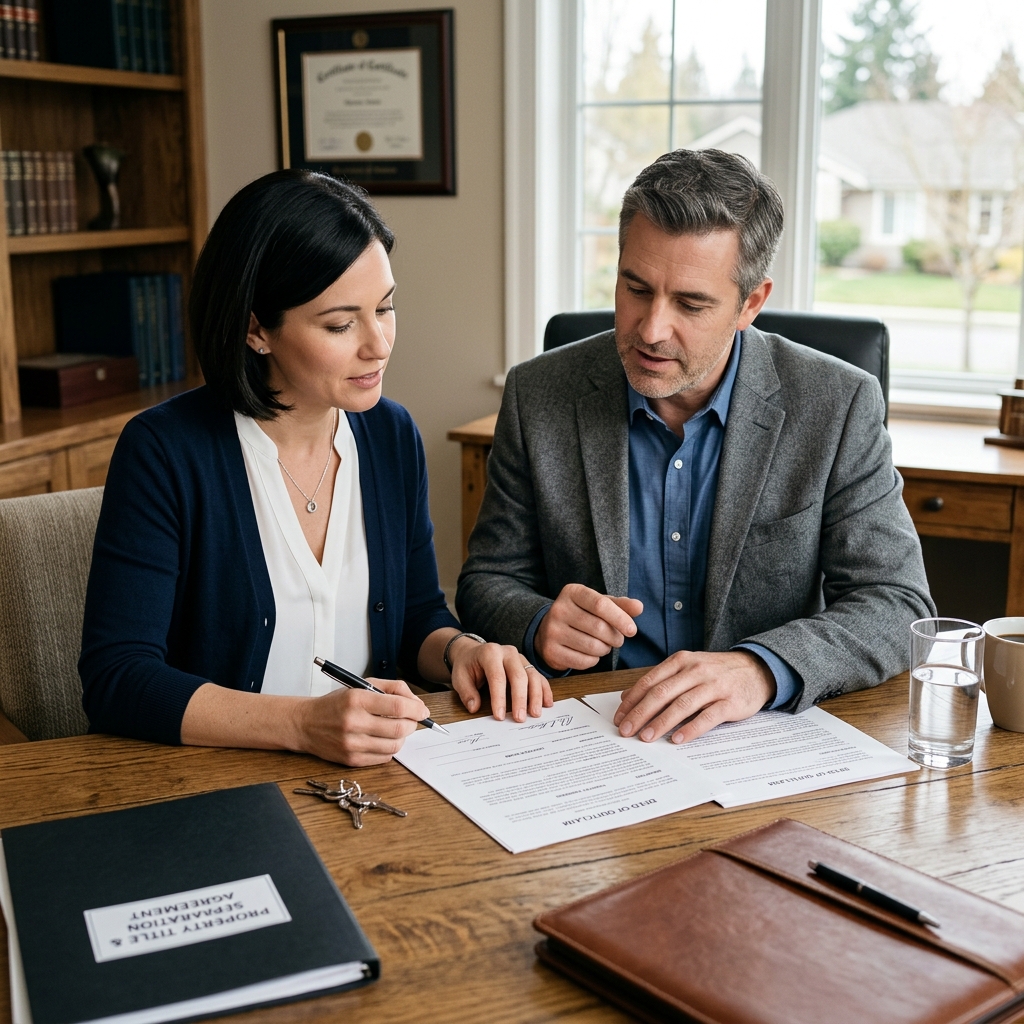
When a marriage ends, deciding what happens to the family home is often one of the most emotionally charged and financially significant issues. The divorce decree may say who gets the house, but that alone does not change the legal title or the mortgage. To fully resolve ownership, you must understand how home titles work, how courts divide property, and what legal tools you can use to transfer or share the home after divorce.
This guide explains what it means to keep a shared title after divorce, the legal and financial consequences of doing so, and the practical steps to update ownership records safely. It is informational only and does not replace advice from a qualified attorney or financial professional.
1. How Divorce Affects Ownership of the Family Home
Divorce changes your legal relationship with your spouse, but it does not automatically rewrite property records. The way your home is handled depends on the legal framework in your state and the terms of your divorce judgment.
1.1 Marital vs. Separate Property
Court decisions about the home start with whether it is considered marital property or separate property:
- Marital property generally includes assets acquired during the marriage, regardless of whose name is on the title, unless it was a gift or inheritance.
- Separate property usually covers assets owned before marriage or received individually as a gift or inheritance, which may stay with that spouse.
Even if only one spouse is listed as owner on the deed, many states treat a home acquired during the marriage as marital property that must be divided fairly.
1.2 Community Property vs. Equitable Distribution
States follow different systems for dividing marital assets:
| System | Key Principle | Impact on the Home |
|---|---|---|
| Community Property | Most marital property is owned equally by both spouses. | Courts often split home equity 50/50 or offset with other assets. |
| Equitable Distribution | Property is divided fairly, but not necessarily equally. | Home may go to one spouse, with a buyout or other compensation to the other. |
Judges may consider factors such as each spouse’s income, contributions to the marriage, and the needs of any minor children when deciding who should stay in the home or whether it should be sold.
2. Common Outcomes for the Home in Divorce
By settlement or court order, the marital home typically ends up in one of three main scenarios.
2.1 One Spouse Keeps the Home
In many divorces, one spouse is awarded the home. This often happens when:
- Minor children live primarily with one parent and staying in the home is in their best interests.
- One spouse is better able to afford the mortgage and ongoing expenses.
Even if one spouse is awarded the home, the title and mortgage must be updated to reflect that change, which typically involves:
- Transferring the other spouse’s ownership interest via a deed (such as a quitclaim or warranty deed).
- Refinancing the mortgage into the name of the spouse who is keeping the home, if possible.
2.2 The Home Is Sold
Sometimes neither spouse can afford to keep the home or both agree that selling is the cleanest solution. In this case:
- The house is listed for sale and sold to a third party.
- Sale proceeds are used to pay off the mortgage and liens.
- Remaining equity is divided according to the divorce decree (for example, 50/50 or another agreed ratio).
2.3 Both Spouses Retain Ownership for a Time
In some divorces, both spouses continue to own the property after the divorce, usually temporarily.
This may be done to:
- Allow children to remain in the home for a set period before sale.
- Wait for a stronger real estate market to sell.
- Give one spouse more time to qualify for a refinance.
Continuing to share the title after divorce can work, but it involves ongoing legal, financial, and practical risks if not carefully managed.
3. What It Means to Share a Home Title After Divorce
Sharing the title after divorce means both ex-spouses remain legal owners in property records. The divorce decree may outline how the home will eventually be handled, but until the title changes, both parties have ownership rights and obligations.
3.1 Ownership Rights Under a Shared Title
When both ex-spouses remain on the deed, they typically have:
- Legal ownership interest in the property and its equity.
- Potential rights to occupy the home, depending on the divorce judgment and any orders about exclusive possession.
- The ability to participate in decisions affecting the property, such as sale or further encumbrances.
However, the divorce decree can modify these rights, granting one party the right to live in the home while both remain owners until a future event, such as sale or refinance.
3.2 Ongoing Financial Responsibilities
If both spouses remain on the mortgage, the lender still views them as jointly liable—even if the divorce decree assigns payment responsibility to one person.
Key obligations may include:
- Mortgage payments and late fees.
- Property taxes and insurance.
- Major maintenance or repairs, depending on agreements between the parties.
Failure to make payments can damage both parties’ credit, lead to foreclosure, and erode the equity each hoped to preserve in the property.
4. Legal Tools to Transfer or Restructure Title
Whether you intend to share the home for a period or fully transfer it to one spouse, you will likely use one or more forms of deed to change title records.
4.1 Quitclaim Deeds
A quitclaim deed is a simple instrument for transferring whatever ownership interest one spouse has in the property to the other, without warranties about title quality.
- Purpose: Quickly transfer interest from one ex-spouse to the other after divorce.
- Process:
- The transferring spouse signs the quitclaim deed in front of a notary.
- The deed is delivered to the spouse keeping the property or their lawyer.
- The deed is then recorded with the appropriate land records office (often the county Register of Deeds).
- Effect: Changes who owns the property in public records, but does not alter mortgage obligations.
Quitclaim deeds are frequently used because they are relatively inexpensive and straightforward, especially when the transfer is made in accordance with a divorce judgment.
4.2 Warranty Deeds
A warranty deed transfers property while promising that the grantor has good title and will defend it against future claims.[10]
In a divorce context:
- Some ex-spouses prefer warranty deeds when they want greater assurance about title quality.
- Lenders or title companies may recommend specific deed types when a property is refinanced or sold.[10]
Whether a quitclaim or warranty deed is best depends on the state’s laws, the property’s history, and guidance from legal and real estate professionals.[10]
4.3 Recording the New Deed
Signing a deed is not enough; it must be properly recorded:
- New deeds are filed with the local land records office (such as a county clerk or Register of Deeds).
- Recording updates public ownership records and protects the new owner’s rights against third parties.
- It is often advisable to keep copies of the recorded deed and divorce judgment for future reference.
5. Coordinating Title Changes with the Mortgage
A crucial point in post-divorce property planning is that deeds affect ownership, while mortgage documents create debt obligations. Changing one does not automatically change the other.
5.1 Refinancing When One Spouse Keeps the Home
When one spouse is awarded the home, a typical path is:
- Appraise the home to determine current fair market value.
- Calculate equity by subtracting the mortgage and liens from the value.
- Agree on each spouse’s share of equity, often guided by the divorce judgment.
- Refinance the mortgage into the name of the spouse keeping the home, if they qualify.
- Execute a deed (for example, quitclaim) transferring the departing spouse’s interest.
Refinancing can remove the departing spouse from responsibility for future mortgage payments and help align legal title with actual ownership and occupancy.
5.2 Risks of Staying on the Mortgage After Divorce
If a departing spouse remains on the mortgage but no longer lives in the home, they face several risks:
- Credit damage if payments are missed.
- Difficulty qualifying for new loans due to existing mortgage debt.
- Exposure to foreclosure and loss of equity if the loan goes unpaid.
Because of these risks, many legal and financial experts emphasize resolving both title and mortgage issues as part of the overall divorce plan.
6. When Ex-Spouses Choose to Keep a Shared Title
Despite the challenges, some ex-spouses intentionally keep a shared title after divorce. This arrangement might be used as a short- to medium-term strategy.
6.1 Potential Advantages
- Stability for children: Joint ownership can allow the family home to remain intact until children reach a certain age or milestone.
- Time to improve finances: One or both spouses may need time to increase income or creditworthiness before refinancing or selling.
- Market timing: Owners may prefer to delay sale until local real estate conditions become more favorable.
6.2 Significant Drawbacks
However, ongoing shared ownership after divorce often brings complications:
- Continuing financial entanglement through joint mortgage liability.
- Disagreements over repairs, rent, improvements, or timing of sale.
- Exposure to each other’s financial behavior, including late payments or new liens on the property.
To reduce conflicts, any shared-title arrangement should be documented clearly in the divorce judgment or a later written agreement, specifying who pays what, who occupies the home, and when and how it will eventually be sold or refinanced.
7. Practical Steps to Safely Handle Your Home Title After Divorce
If you are facing decisions about a shared home after divorce, consider the following practical roadmap:
7.1 Clarify Legal Orders and Property Status
- Review your divorce decree carefully to see exactly what it says about the home, occupancy, and future sale or transfer.
- Confirm whether the property is considered marital or separate under your state’s law.
- Obtain a recent property tax statement or title report to verify current owners and liens.
7.2 Decide on Long-Term Ownership Goals
- Do you want to keep the home, sell it, or own it jointly for a limited time?
- Can you realistically afford the mortgage and ongoing costs on your own?
- Are you willing to remain financially tied to your ex-spouse for as long as a shared title lasts?
7.3 Work With Professionals
- Family law attorney: To interpret court orders, draft or review deeds, and advise on rights.
- Real estate / title professional: To prepare accurate deed documents and ensure proper recording.
- Mortgage lender or broker: To evaluate refinance options and affordability.
7.4 Execute Deeds and Record Changes Promptly
- Prepare the appropriate deed (quitclaim or warranty) consistent with your divorce decree.[10]
- Ensure the transferring spouse signs before a notary.
- Record the deed with the correct public office and keep copies for your records.
7.5 Align Title Changes With Mortgage Plans
- Coordinate timing so that deed transfers and mortgage refinancing support each other.
- Avoid remaining indefinitely on a mortgage for a home you no longer control or occupy.
- Consider refinancing, selling, or structured buyouts to fully separate finances.
8. Frequently Asked Questions
Q1: If my ex-spouse was awarded the house, do we still need a new deed?
Yes. A divorce judgment alone does not change the title records. If both names are on the existing deed, or if the deed is not in the name of the person who will keep the property, a new deed must be prepared and recorded to reflect the new owner.
Q2: Can a quitclaim deed remove my name from the mortgage?
No. A quitclaim deed only changes who owns the property. It does not modify the mortgage contract. You remain liable on the loan unless the mortgage is paid off, refinanced, or otherwise legally changed with the lender.
Q3: Is it safe to keep a shared title with my ex after divorce?
It can work in some situations, especially when there is clear written agreement on payments, use of the property, and future sale. However, it also keeps you financially and legally intertwined with your ex, which can create risks if either party fails to meet obligations or if disputes arise.
Q4: Do I need my ex-spouse’s consent to change the deed?
In most cases, yes. The person whose ownership interest is being transferred must sign the new deed. If your ex-spouse refuses to sign a deed that implements the court’s orders, you may need to seek enforcement through the court.
Q5: Why should I record the deed right away?
Recording promptly ensures that public records show the correct owner, which protects you when dealing with lenders, buyers, and other parties. Delay can cause confusion, complicate future transactions, and expose you to unexpected claims.
References
- Divorce and Real Estate — Texas Legal Services Center (TexasLawHelp). 2023-02-01. https://texaslawhelp.org/article/divorce-and-real-estate
- Divorce Basics: Dividing Your Property and Debt — Michigan Legal Help. 2024-01-10. https://michiganlegalhelp.org/resources/family/divorce-basics-dividing-your-property-and-debt
- Quitclaim Deeds and Divorce — Michigan Legal Help. 2023-11-15. https://michiganlegalhelp.org/resources/family/quitclaim-deeds-and-divorce
- Divorce and Home Ownership Rights — MoneyHelper (UK Government-backed service). 2022-05-05. https://www.moneyhelper.org.uk/en/family-and-care/divorce-and-separation/protecting-your-home-ownership-rights-during-divorce-or-dissolution
- Which Deed Is Best for Transferring Ownership in Divorce? — Divorce Lending Association. 2023-09-12. https://www.divorcelendingassociation.com/blog/which-deed-is-best-for-transferring-ownership-in-divorce.cfm
- Taking Ownership of the Family Home After Divorce — The Rubinstein Law Firm. 2022-03-08. https://www.therubinsteinfirm.com/about/blog/taking-ownership-of-the-family-home-after-divorce_ae136.html
- What Do You Do with the Deed to Your House After Divorce? — Jordan & White, LLC. 2021-07-20. https://jordanwhitellc.com/what-do-you-do-with-the-deed-to-your-house-after-divorce/
Similar Articles








Read full bio of Sneha Tete


