
Job Loss for Marijuana Use: Rights, Risks, and Remedies
Understand when employers can fire workers for marijuana use, how changing cannabis laws affect workplace rights, and what legal options exist after termination.
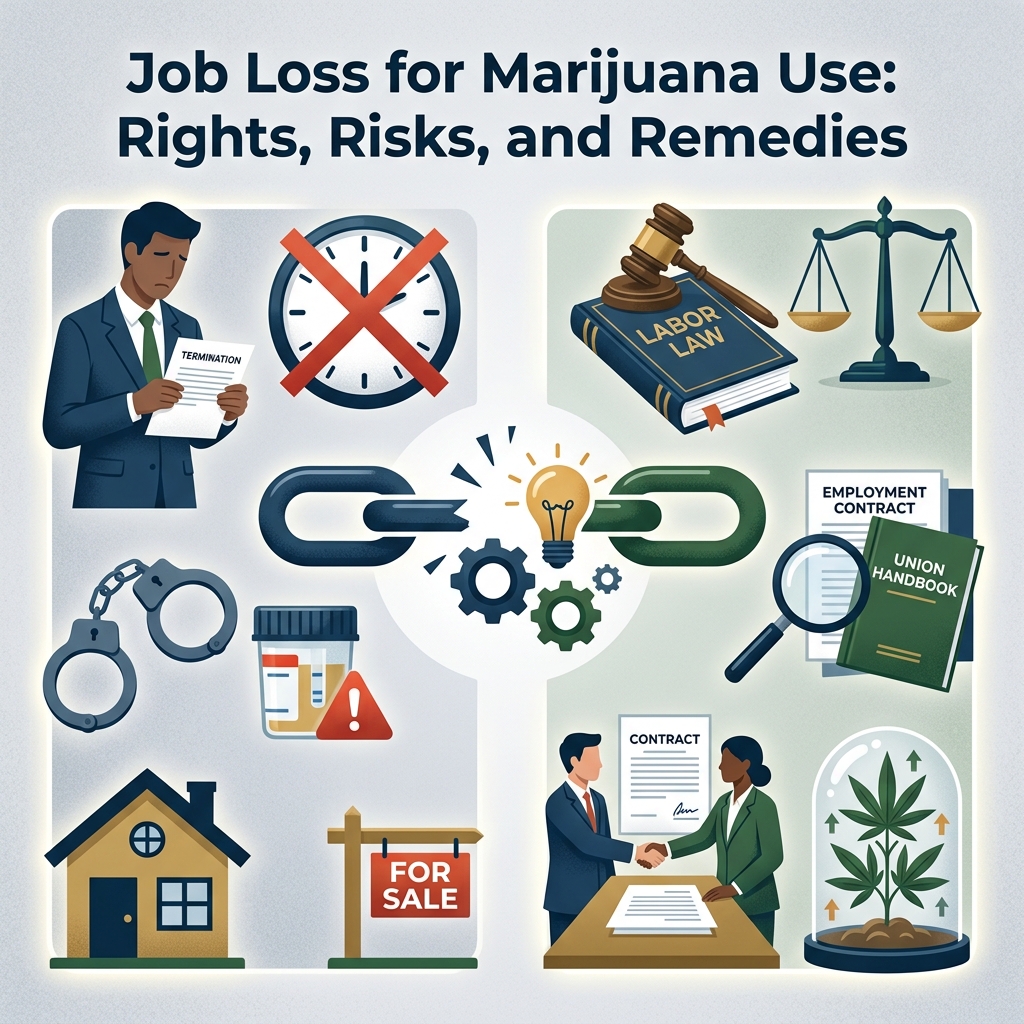
As more states legalize marijuana for medical and recreational purposes, many workers assume that legal cannabis use cannot jeopardize their jobs. In reality, marijuana remains illegal under federal law, and employers still have broad authority to restrict drug use and terminate employees in many situations. Understanding this tension between federal prohibition, state legalization, and workplace rules is essential if you are worried about being fired for marijuana use or have already lost a job after a positive drug test.
This article explains how employers typically treat marijuana use, the difference between on-duty and off-duty consumption, the impact of medical marijuana, and the kinds of legal claims that may arise after termination. It also outlines practical steps workers can take when facing discipline or job loss due to cannabis.
Marijuana, Federal Law, and the Workplace
Marijuana sits in a unique legal position. At the federal level, cannabis is classified as a Schedule I controlled substance under the Controlled Substances Act, which signals that it is considered to have a high potential for abuse and no accepted medical use. At the same time, most states now allow some form of marijuana use, whether medical, recreational, or both.
Despite this widespread state-level legalization, federal law still influences workplace policies in several key ways:
- Federal criminal status: Because marijuana remains a prohibited drug federally, employee use is still considered “illegal drug use” for purposes of certain federal laws, including the Americans with Disabilities Act (ADA).
- Federal safety regulations: Workers in safety-sensitive positions regulated by federal agencies (such as transportation or certain defense-related jobs) often face mandatory drug testing and strict zero-tolerance rules for marijuana.
- Federal funding and contracts: Employers that receive federal funding or hold federal contracts may be required to maintain drug-free workplaces. In these settings, federal obligations can justify policies that prohibit marijuana use even when state law allows it.
In practical terms, this means an employee might comply fully with state law and still be subject to discipline or termination if the employer must follow federal rules or chooses to enforce a drug-free policy.
State Legalization vs. Employer Control
State marijuana laws fall into several broad categories. Some states allow only medical use; others permit both medical and adult recreational use; a few still prohibit cannabis entirely. Even in jurisdictions with comprehensive legalization, employment protections are far from uniform.
Key patterns include:
- Medical marijuana protections: More than twenty states include some employment protections for registered medical marijuana patients. These safeguards typically limit an employer’s ability to fire or refuse to hire someone solely because they are a cardholder or test positive for marijuana, as long as they are not impaired at work.
- Recreational marijuana protections: A smaller but growing number of states extend protection to lawful recreational cannabis use outside of work. For example, New York Labor Law §201-d prohibits discrimination against employees for legal cannabis use outside of work hours, away from the employer’s premises, and without using the employer’s equipment.
- At-will employment and employer discretion: In many states, at-will employment allows employers to terminate workers for almost any non-discriminatory reason, including marijuana use, unless specific statutes limit this power.
Even where state law recognizes off-duty cannabis use as lawful, statutes often contain exceptions. These may permit employers to act when employees are impaired at work, occupy safety-sensitive positions, or when compliance with federal law or contracts requires a stricter approach.
On-Duty vs. Off-Duty Marijuana Use
A crucial distinction in most workplace policies and state statutes is the difference between on-duty and off-duty use.
On-Duty Use and Impairment at Work
There is broad consensus that employers may prohibit employees from being under the influence of marijuana during work hours and on company property. This holds true even in states with strong protections for off-duty use. Common elements include:
- Ban on use at work: Employers almost universally forbid employees from consuming cannabis during work hours or at the workplace.
- Impairment standards: Many state laws and workplace policies allow discipline or termination when an employee manifests specific, observable symptoms of impairment that interfere with job performance or workplace safety.
- Drug-free workplace policies: Employers often adopt written policies declaring a zero-tolerance approach to drug use on the job, covering both illegal drugs and certain legal substances when used in ways that cause impairment.
For workers, the takeaway is clear: even if you are a medical marijuana patient or live in a state with legal recreational cannabis, coming to work high or using marijuana on company property can still lead to discipline or termination.
Off-Duty Use and Legal Protections
Off-duty use is more complicated. Some states explicitly protect lawful cannabis consumption outside of work, while others leave decisions entirely to employers.
Examples of stronger protections include:
- New York: Adult-use cannabis is treated as a legal consumable product, and employers are prohibited from discriminating against employees for off-duty, off-premises use in accordance with state law.
- New Jersey: Employers generally may not take adverse action based solely on lawful cannabis use outside of work, and a positive test must be combined with evidence of impairment to justify discipline.
- Some medical marijuana states: Where statutes protect cardholders, employers often cannot fire an employee simply for being a registered patient or for testing positive, if use is off-duty and the employee is not impaired at work.
In contrast, other states either explicitly allow employers to enforce zero-tolerance policies or remain silent on the question, leading courts to favor employer prerogatives in many disputes.
Drug Testing and Positive THC Results
Drug testing is a common flashpoint. Marijuana tests often detect metabolites that remain in the body long after the psychoactive effects have worn off. This means a worker can test positive days or weeks after using cannabis, even if they are sober at the time of the test.
Key issues include:
- Pre-employment screening: Many employers test applicants and may decline to hire those who test positive for THC, unless state law restricts this practice or protects off-duty use.
- Random testing: In safety-sensitive industries or workplaces with drug-free policies, employees may face random tests. A positive result can trigger discipline, suspension, or termination, depending on the jurisdiction and employer policy.
- Post-incident testing: After workplace accidents or safety incidents, employers may require tests to determine whether impairment contributed to the event.
Some states now require more than a positive test to justify discipline. For instance, New Jersey requires both testing and an impairment evaluation by a certified Workplace Impairment Recognition Expert (WIRE) before an employer can rely on cannabis use in taking adverse action. In New York, guidance emphasizes that employers should identify specific articulable symptoms of impairment rather than relying solely on test results.
Medical Marijuana and Disability Considerations
Workers who use marijuana for medical reasons often wonder whether disability laws protect them from termination. At the federal level, the ADA does not shield employees from adverse action based on marijuana use because the statute excludes individuals engaged in illegal drug use from its protections.
However, the legal picture changes at the state level:
- State medical marijuana statutes: Many states with medical programs include provisions that prevent discrimination against registered patients, at least when they are not impaired at work.
- Public policy claims: Some states recognize wrongful termination claims where the firing violates clear public policy, such as statutory protections for lawful medical cannabis use.
- Interactive process for accommodations: Even if marijuana itself is not protected under the ADA, employers may still need to consider reasonable accommodations for the underlying medical condition. This might involve discussing alternative treatments or schedule modifications, rather than accommodating cannabis use directly.
Employees should recognize that state protections often have limits, particularly for positions where impairment could pose serious safety risks or where federal rules constrain employer discretion. In such settings, even medical marijuana patients may face stricter standards.
When Termination for Marijuana Use May Be Unlawful
Termination based on marijuana use is not automatically lawful, nor automatically unlawful. It depends heavily on the interaction between federal law, state statutes, employer policy, and the circumstances of the case. Potential legal issues include:
| Scenario | Possible Legal Concern |
|---|---|
| Employee fired solely for lawful off-duty use in a state with explicit protections | May violate state employment or cannabis statutes; possible wrongful termination or statutory claim. |
| Medical marijuana patient fired solely for cardholder status or positive test | In some states, may conflict with medical marijuana anti-discrimination provisions or public policy. |
| Employee terminated after positive test but no evidence of impairment | In jurisdictions requiring proof of impairment (e.g., New Jersey), discipline based solely on test results may be challengeable. |
| Employee in federally regulated safety-sensitive role fired after positive test | Termination may be legally supported by federal mandates and drug-free workforce requirements. |
Workers who believe their termination conflicts with state cannabis protections or broader employment laws should consult an employment attorney promptly to evaluate potential claims and deadlines.
Practical Steps If You Are Fired for Marijuana Use
Facing job loss is stressful, and termination involving marijuana may feel particularly confusing. The following steps can help you protect your interests and assess your options:
- Gather documentation: Keep copies of termination notices, performance evaluations, emails, drug test results, and any written workplace policies related to drug use and testing.
- Review employer policies: Examine your employee handbook, drug-free workplace policy, and any agreements you signed to see how marijuana use and testing are addressed.
- Note your jurisdiction: Identify whether your state has medical or recreational legalization, and whether statutes provide employment protections for off-duty use or registered patients.
- Consider your role: Determine whether your position is considered safety-sensitive or subject to federal regulations that may limit protections.
- Consult a qualified attorney: An employment lawyer familiar with cannabis laws can evaluate whether your termination may violate state statutes, public policy, or anti-discrimination protections.
Early legal advice is especially important because deadlines for filing claims or complaints can be short, and factual details—such as whether you were impaired or whether the employer followed proper testing procedures—often determine the outcome.
Strategies for Employees to Reduce Risk
Workers who choose to use marijuana, whether medically or recreationally, can take steps to reduce the risk of workplace conflict or termination:
- Understand local law: Learn your state’s cannabis and employment rules, including whether off-duty use is protected and how medical patients are treated.
- Avoid on-duty use: Do not consume cannabis during work hours or report to work under the influence, especially in safety-sensitive roles.
- Follow medical guidelines: For medical patients, work closely with healthcare providers to time doses in a way that minimizes workplace impairment.
- Communicate carefully: Consider whether and how to disclose medical marijuana use, and be prepared to discuss non-cannabis alternatives if workplace policies are strict.
- Know testing policies: Understand whether your employer uses pre-employment, random, or post-incident testing and what consequences attach to positive results.
These strategies cannot guarantee job security, but they can help workers make informed decisions and avoid preventable conflicts.
Frequently Asked Questions
Can I be fired for legal, off-duty marijuana use?
Yes, in many states an employer can still terminate employees for off-duty marijuana use if workplace policies and state law allow it. However, some jurisdictions, such as New York and New Jersey, restrict employers from taking action based solely on lawful off-duty cannabis use. Whether termination is lawful depends on your state’s statutes and the specifics of your job.
Does having a medical marijuana card protect my job?
A medical marijuana card may provide some protection in states whose laws prohibit discrimination against registered patients, but it is not an absolute shield. Employers generally may still ban on-duty impairment, and federal requirements or safety-sensitive positions can override certain protections.
Can a positive drug test alone justify firing me?
In many workplaces, a positive test is grounds for discipline or termination if the employer has a clear policy and state law does not limit such action. In states like New Jersey, however, a positive test must be combined with evidence of impairment, often documented by a certified impairment recognition expert.
Do federal laws ever require my employer to fire me?
Federal law does not automatically require termination in every case, but it can compel employers—especially those with federal contracts, funding, or safety-sensitive roles—to maintain drug-free workplaces and take action against employees who test positive for marijuana. Employers may face penalties or lose contracts if they fail to comply.
What should I do if I think my firing was illegal?
Document what happened, preserve all relevant communications, review your employer’s policies, and speak with an employment attorney experienced in cannabis and workplace law. An attorney can clarify whether state statutes or public policy provide a basis to challenge your termination.
References
- Off-Duty Marijuana Use: Can I Be Fired for Smoking Pot Legally? — Nolo. 2025-01-15. https://www.nolo.com/legal-encyclopedia/off-duty-marijuana-can-fired-smoking-pot-legally.html
- Marijuana Use in Employment in New York — Mansell Law. 2024-03-01. https://www.newyorkcity-employmentlawyer.com/medical-and-recreational-cannabis-marijuana-use-and-employment-in-new-york/
- Adult Use Cannabis and the Workplace (Labor Law 201-d) — New York State Department of Labor. 2023-10-01. https://dol.ny.gov/adult-use-cannabis-and-workplace-p420
- Workplace & DUI Laws — New Jersey Cannabis Regulatory Commission. 2023-06-20. https://www.nj.gov/cannabis/adult-personal/workplace-dui-laws/
- South Jersey Workplace Marijuana Discrimination Lawyers — Castellani Law Firm. 2023-09-01. https://www.castellanilaw.com/new-jersey-workplace-marijuana-discrimination-lawyer
- Cannabis Legalization and Employment Protections — Marijuana Policy Project. 2024-02-10. https://www.mpp.org/issues/legalization/cannabis-legalization-and-employment-protections/
- FAQ: What Arizona’s Marijuana Law Means for Employers — The Mahoney Group. 2021-11-05. https://www.mahoneygroup.com/marijuana-workplace/
Similar Articles








Read full bio of medha deb




