The moral and legal boundaries of any democratic nation are most rigorously tested not during times of profound peace, but in moments of profound fear. When national security is threatened, the temptation to bypass established ethical frameworks in favor of absolute security becomes a siren call for policymakers. One of the most glaring examples of this phenomenon in modern history is the debate surrounding the practice of simulated drowning, widely known as waterboarding. For decades, the United States maintained a consistent, unwavering legal stance on this brutal technique: it was universally recognized and prosecuted as a severe war crime. However, the legal and ethical paradigm violently shifted at the dawn of the twenty-first century.
Following the unprecedented tragedies of September 11, 2001, an atmosphere of existential dread permeated the intelligence community and the broader government. Driven by the desperate need for actionable intelligence, certain government factions initiated a campaign of legal gymnastics designed to rebrand torture as “enhanced interrogation.” The core argument was built upon a dangerous premise of exceptionalism—the idea that an action’s legality and morality are dictated not by the severity of the act itself, but by the nationality of the person inflicting it. This article explores the physical reality of waterboarding, traces the United States’ historical prosecution of the practice, examines the stark hypocrisy of post-9/11 policy shifts, and underscores why the definition of torture must remain absolute, unconditional, and universally applied under international law.
The Mechanics of Asphyxiation: The Anatomy of Simulated Drowning
To understand the legal and moral gravity of waterboarding, one must first dismantle the sanitized bureaucratic language often used to describe it. Terms like “harsh interrogation,” “coercive tactics,” or “stress techniques” entirely fail to capture the visceral reality of the act. Waterboarding is not merely a psychological scare tactic or a harmless ruse; it is the deliberate, controlled infliction of severe suffocation and physical trauma.
During the procedure, the victim is typically immobilized on a board, often inclined so that the head is positioned lower than the feet. A cloth is tightly placed over the nose and mouth, and water is continuously poured over the face. This creates an immediate physical barrier that makes inhalation impossible, instantly triggering the body’s involuntary gag reflex and the overwhelming, primal panic of drowning. The physiological response is immediate, severe, and undeniable. As the lungs struggle for oxygen, the heart rate skyrockets, carbon dioxide builds up in the bloodstream, and the victim experiences the literal, agonizing sensation of imminent death.
The consequences extend far beyond the duration of the immediate interrogation session. Medical professionals, psychologists, and human rights observers have extensively documented the long-term physical and psychological devastation wrought by the procedure. Survivors frequently suffer from prolonged respiratory issues, traumatic brain injuries caused by oxygen deprivation (hypoxia), and severe, chronic post-traumatic stress disorder (PTSD). The terror instilled by the procedure is so profound that even decades later, victims can experience paralyzing flashbacks triggered by the simple act of taking a shower, swimming, or encountering heavy rain.
Historical Precedents: Prosecuting the “Water Cure”
The modern attempt to carve out legal loopholes for waterboarding stands in stark contrast to more than a century of American military and civilian jurisprudence. Historically, the United States recognized no ambiguity regarding the nature of this technique. When foreign powers or rogue military units subjected individuals to simulated drowning, the U.S. government forcefully and unequivocally classified it as torture.
The Philippine-American War
The American military’s confrontation with what was then termed the “water cure” dates back to the Philippine-American War at the turn of the 20th century. During this conflict, widespread reports emerged that American soldiers were forcing water down the throats of captured Filipino insurgents in an attempt to extract critical tactical information and crush the rebellion. The public outcry in the United States upon learning of these tactics was swift, highly vocal, and severe. In response to the domestic backlash and the undeniable violation of military ethics, the U.S. military command responded by formally court-martialing the responsible officers. The military justice system explicitly condemned the practice as a grievous violation of the established laws of war. Even at the turn of the century, military tribunals understood that severe cruelty could not be legally or morally justified simply by the pressing exigencies of a counterinsurgency campaign.
World War II Tribunals
The United States’ absolute stance against the practice solidified further during the aftermath of World War II. Following the total defeat of the Axis powers, the Allied forces convened the historic International Military Tribunals to hold war criminals accountable. Japanese military personnel who had systematically subjected American prisoners of war to simulated drowning—often chillingly referred to during the trials as the “water treatment”—were aggressively prosecuted for war crimes. The United States led the charge in demanding severe, uncompromising punishments, successfully securing convictions that resulted in decades-long prison sentences and even capital executions for the leading perpetrators. During these tribunals, there was absolutely no debate among the prosecuting attorneys or military judges regarding whether the technique constituted torture. The undeniable suffering of American soldiers made the classification instantaneous and undeniable under global law.
The Vietnam Era Courts-Martial
This legal consistency persisted uninterrupted into the Vietnam War. In 1968, a highly publicized photograph was published showing a U.S. soldier participating in the waterboarding of a captured North Vietnamese prisoner of war. The military’s reaction was swift and decisive. The soldier involved was immediately court-martialed and discharged from the armed forces. The Department of Defense maintained that such actions blatantly violated the Geneva Conventions and deeply dishonored the military code of conduct. Up until the dawn of the global War on Terror, the precedent remained entirely unbroken: simulated drowning was an illegal, prosecutable offense under all circumstances.
The Post-9/11 Paradigm Shift: Rebranding Cruelty
The consistency of a century of military law was unceremoniously dismantled in the wake of the 9/11 attacks. The U.S. government, operating under the immense, unprecedented pressure to prevent further acts of mass terrorism, sought ways to extract immediate information from suspected operatives held in covert CIA “black sites.” To circumvent the established domestic and international legal prohibitions against torture, the administration turned to its Office of Legal Counsel.
The result was a series of deeply controversial memorandums, now commonly referred to as the “Torture Memos.” These documents represented a masterclass in legal obfuscation. Lawyers argued that for an act to legally constitute torture under U.S. law, the physical pain inflicted must be equivalent in intensity to the pain accompanying “serious physical injury, such as organ failure, impairment of bodily function, or even death.” Because waterboarding was a “controlled” simulation of drowning that supposedly did not permanently destroy a vital organ, they reasoned, it fell just below the legal threshold of torture.
This sophisticated legal maneuvering effectively rebranded a universally recognized war crime into a permissible “enhanced interrogation technique.” By selectively altering the vocabulary and narrowing the legal definitions, policymakers provided a shield of legal immunity for intelligence officers, authorizing the systematic asphyxiation of detainees. It was a stark, radical departure from the nation’s historical values, driven entirely by the dangerous belief that exceptional threats warranted exceptional ethical exemptions.
The Core Contradiction: When Americans Are on the Board
The most profound flaw in the legal justifications of the post-9/11 era is the inherent, inescapable hypocrisy of the standard applied. A fundamental tenet of justice and international human rights law is universal applicability; a crime is defined by the objective severity of the act and the human suffering it causes, not by the identity, nationality, or uniform of the perpetrator or the victim. Yet, the entire policy of “enhanced interrogation” relied entirely on a blatant double standard.
If a foreign intelligence agency, a hostile state power, or a non-state terrorist actor were to capture an American citizen, soldier, or intelligence officer and subject them to waterboarding, the response from the U.S. government would be immediate and absolute. It would be universally denounced across all branches of government as a barbaric act of torture, a flagrant violation of foundational human rights, and an actionable war crime. Politicians, diplomats, and military leaders would rightly demand immediate justice and accountability on the international stage.
This cognitive dissonance reveals the inherent fragility of the exceptionalist argument. If an action causes such severe mental and physical suffering that its use against an American is instantly recognizable as torture, then that action cannot miraculously transform into a benign, lawful interrogation tool simply because an American is the one pouring the water. Pain is universal, the physiological panic of drowning is universal, and therefore, the legal definition of the crime must remain universally applied.
International Law: The Absolute Prohibition of Torture
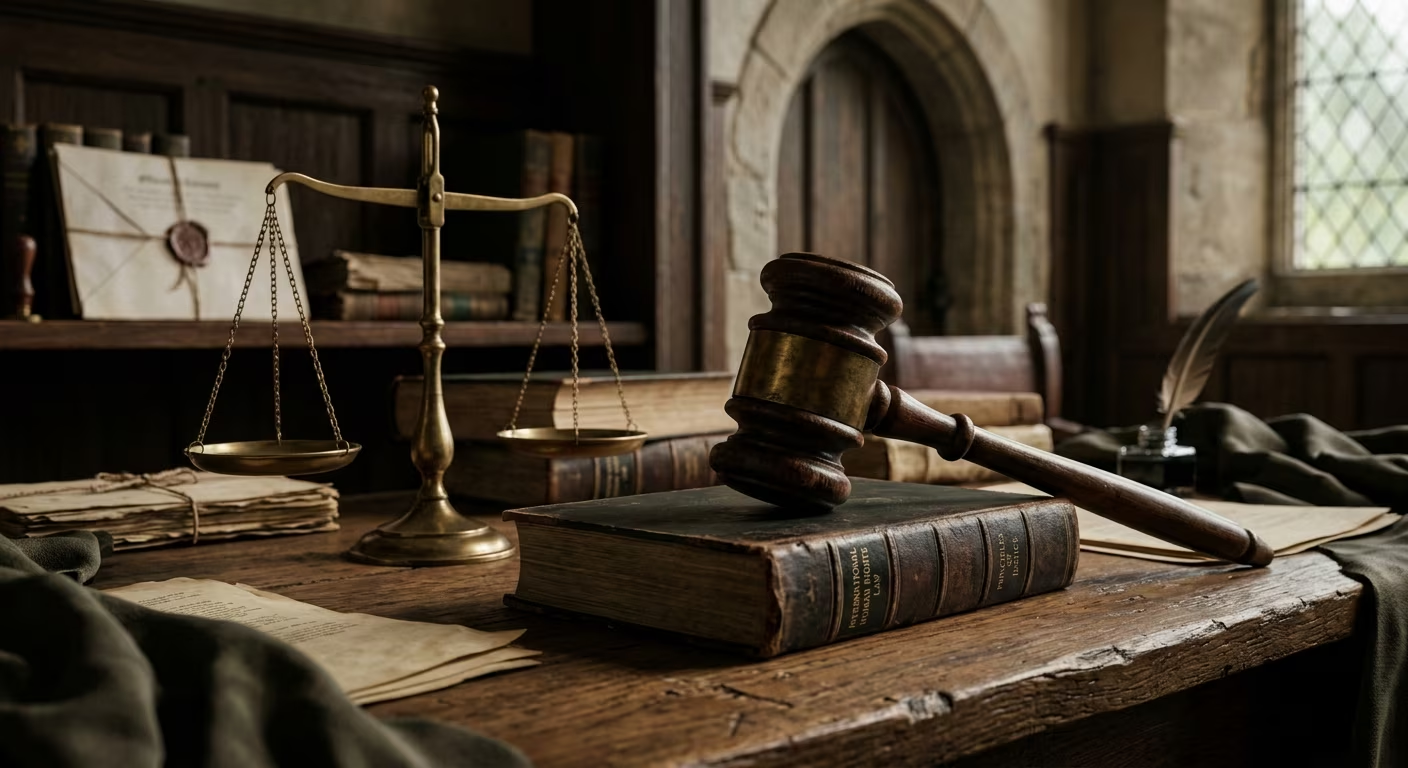
The global community long ago recognized the catastrophic dangers of allowing individual states to redefine cruelty based on their own fluctuating national security interests. Consequently, international law has established an uncompromising, rigidly defined framework regarding the treatment of prisoners. The cornerstone of this global legal framework is the United Nations Convention Against Torture and Other Cruel, Inhuman or Degrading Treatment or Punishment (CAT), a treaty that the United States has formally ratified.
Article 2 of the Convention is unequivocal in its mandate. It explicitly states that “no exceptional circumstances whatsoever, whether a state of war or a threat of war, internal political instability or any other public emergency, may be invoked as a justification of torture.” This specific clause was drafted precisely to prevent the exact rationale utilized during the War on Terror. The drafters of the international treaty fully understood that governments would inevitably face security crises and would always attempt to use those crises to justify brutal, authoritarian measures.
United Nations legal experts and international human rights monitors have repeatedly condemned the attempt to carve out exceptions for specific interrogation techniques. Authorities have explicitly stated that waterboarding undeniably amounts to torture, emphasizing that no domestic legal redefinition or internal government memorandum can override a state’s binding international obligations. When a nation ratifies the CAT, it commits to a universal standard of human dignity that cannot be suspended at the convenience of the state.
The Geopolitical and Moral Fallout of Conditional Definitions
The consequences of adopting a conditional, elastic definition of torture extend far beyond academic legal debates; they inflict profound, lasting damage on a nation’s geopolitical standing and directly threaten the safety of its citizens abroad. When a global superpower publicly justifies techniques historically classified as war crimes, it severely undermines its own moral authority.
The long-term geopolitical costs of this double standard are extensive and highly damaging:
- Erosion of Moral Authority: It severely compromises the nation’s diplomatic ability to advocate for human rights globally, allowing authoritarian regimes to deflect criticism by citing the U.S. precedent of “enhanced interrogation.”
- Endangerment of Captured Personnel: It completely undermines the principle of reciprocity under the Geneva Conventions. If a nation lowers the standard of treatment for its prisoners, it implicitly lowers the standard of treatment it can demand when its own soldiers are captured.
- Propaganda for Extremists: The use of highly publicized, brutal tactics serves as a powerful, enduring recruitment tool for hostile non-state actors and terrorist organizations.
- Degradation of Intelligence: Information extracted under severe physical and mental duress is notoriously unreliable, frequently leading to false confessions and wasted investigative resources.
The erosion of these absolute prohibitions creates a substantially more dangerous world for everyone, substituting the international rule of law with the volatile rule of force. Ultimately, true, lasting national security cannot be successfully purchased at the cost of the very democratic values a nation claims to be defending.
Frequently Asked Questions (FAQs)
What is the legal definition of torture under international law?
Under the UN Convention Against Torture, torture is legally defined as any act by which severe pain or suffering, whether physical or mental, is intentionally inflicted on a person for purposes such as obtaining information, securing a confession, punishment, or intimidation, by or at the instigation of a public official.
Did the United States consider waterboarding a crime before 9/11?
Yes. Throughout the 20th century, the United States consistently prosecuted waterboarding as a severe war crime. This historical record included court-martialing U.S. soldiers during the Philippine-American War and the Vietnam War, as well as heavily prosecuting Japanese military personnel during the post-World War II international tribunals.
Can a state of emergency or an active war justify the use of torture?
No. International law, specifically Article 2 of the United Nations Convention Against Torture, explicitly states that no exceptional circumstances whatsoever, including an active state of war, political instability, or a public emergency, can be invoked to legally justify torture. The prohibition is universally absolute.
Why was the term “enhanced interrogation” created?
The terminology was actively utilized by government officials and lawyers post-9/11 to bypass the strict legal restrictions and profound moral stigma associated with the word “torture.” By semantically redefining severe coercive tactics as “enhanced interrogation,” policymakers attempted to create a protective legal shield for intelligence officers conducting these operations.
What are the documented long-term effects of waterboarding on a victim?
Medical evidence shows that survivors frequently suffer from severe, long-lasting consequences, including chronic respiratory distress, traumatic brain damage resulting from hypoxia, and severe post-traumatic stress disorder (PTSD). The psychological trauma frequently leads to debilitating panic attacks and profound phobias that can last for decades.
References
- Torture is torture, and waterboarding is not an exception – UN expert urges the US not to reinstate it — UN Office of the High Commissioner for Human Rights (OHCHR). 2017-01-30. https://www.ohchr.org/en/press-releases/2017/01/torture-torture-and-waterboarding-not-exception-un-expert-urges-us-not
- Convention against Torture and Other Cruel, Inhuman or Degrading Treatment or Punishment — UN Office of the High Commissioner for Human Rights (OHCHR). 1984-12-10. https://www.ohchr.org/en/instruments-mechanisms/instruments/convention-against-torture-and-other-cruel-inhuman-or-degrading
- USA and Torture: A History of Hypocrisy — Human Rights Watch. 2014-12-09. https://www.hrw.org/news/2014/12/09/usa-and-torture-history-hypocrisy