
Decoding Congress: A Guide to Legislative Terminology
Master congressional jargon to empower your civic engagement and advocacy.
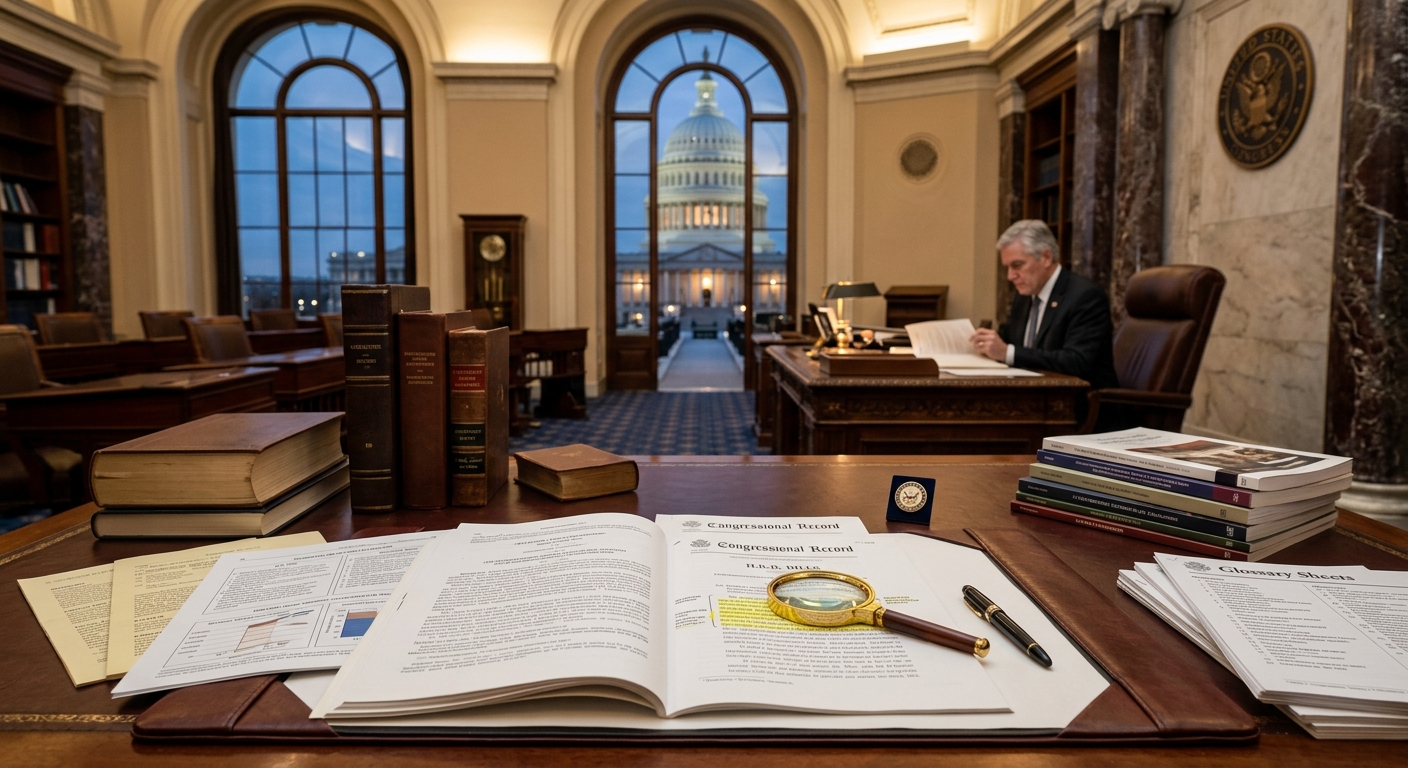
Decoding the Complex Language of the United States Congress
The political theater of the United States Capitol often seems to operate in a language entirely of its own. When tuning into a congressional broadcast, following a political campaign, or reading an in-depth policy analysis, citizens are frequently bombarded with terms that sound more like archaic legalistic incantations than modern democratic processes. You might hear that a popular bill survived a contentious “markup,” was subjected to a sudden “motion to recommit,” faced an agonizing “filibuster,” or desperately required “cloture” to advance.
This specialized lexicon—what many informally call legislative jargon or “Congress-ese”—can act as an unintentional barrier to entry for the average citizen looking to understand or influence the laws governing their everyday lives. The terminology is dense because it is built upon centuries of tradition. The legislative branch of the federal government relies on historic parliamentary procedures adapted from British norms, layered with the constitutional mandates of the United States, and refined by strict chamber rules designed to structure debate and protect minority rights.
Understanding this specialized vocabulary is not merely an academic exercise reserved for political science students; it is a fundamental prerequisite for effective civic engagement. By demystifying the terminology used in both the House of Representatives and the Senate, ordinary citizens, grassroots advocates, and community leaders can better navigate the labyrinthine lawmaking process. When you learn to speak the native language of lawmakers, you are far better equipped to hold them accountable, track the real progress of crucial legislation, and time your advocacy efforts for maximum impact. This comprehensive guide decodes the essential vocabulary of the legislative machinery, illuminating the treacherous path a bill takes from a mere idea to the ultimate law of the land.
The Lifespan of Legislation: From Conception to Committee
Before a proposal can be subjected to the rigorous debates of the House or Senate floors, it must survive the grueling early stages of the legislative gauntlet. This initial phase comes with its own distinct set of procedural terms that dictate how an idea is introduced and formally scrutinized.
Sponsorship and Co-sponsorship
Every single piece of legislation begins with a primary “sponsor”—the elected member of Congress who introduces the bill and serves as its chief public advocate. However, a solitary sponsor rarely possesses the political capital required to push a bill through the system alone. To demonstrate broad, undeniable support, the sponsor will actively recruit “co-sponsors” from their colleagues. When a bill enjoys bipartisan co-sponsorship, its chances of advancing significantly increase, as it signals cross-party appeal. An “original co-sponsor” is a member who officially signs onto the bill before it is formally introduced to the clerk, signaling immediate and unified backing from the very start.
Committee Jurisdiction and the Crucial “Markup”
Once a bill is introduced and assigned a sequential legislative number (such as H.R. for House resolutions or S. for Senate bills), it is formally referred to a committee possessing “jurisdiction” over its subject matter. For example, a bill concerning farm subsidies will be sent directly to the Agriculture Committee, while foreign aid packages head to Foreign Affairs. It is within these specialized committees and their subcommittees that the true, detailed heavy lifting of the legislative process occurs.
The most critical term to understand in this early phase is the “markup.” A markup session is a formal, highly structured meeting where committee members review the proposed legislation line by excruciating line. During this session, members fiercely debate the merits of the bill, propose substantive alterations, and vote on individual amendments. The term originates from the literal, historical act of “marking up” a physical paper document with a red pen to indicate structural changes, deletions, and additions. If a bill successfully survives the grueling markup process, the committee will ultimately vote to “report it out” to the full chamber for broader consideration. It is worth noting that the vast majority of bills introduced in Congress never make it past this stage; they are simply ignored by committee leadership and effectively die in committee without ever receiving a hearing.
Chamber Dynamics: The Rules of Floor Debate
If a bill manages to navigate the perilous committee phase, it advances to the floor of the House or Senate for full consideration. The rules governing debate differ drastically between the two chambers, producing a unique set of legislative tactics and associated vocabulary.
Unanimous Consent Agreements
The United States Senate is famous for its historical emphasis on unlimited debate and the individual rights of every single senator. Because standard parliamentary procedures can be agonizingly slow and cumbersome, the Senate frequently relies on “unanimous consent” to expedite routine business. A unanimous consent agreement is a formal proposition to set aside the regular, lengthy rules and fast-track a decision, provided that not a single senator present objects to the motion. These crucial agreements are often negotiated quietly behind closed doors by party leadership to establish strict time limits on floor debate or to restrict the specific types of amendments that can be offered. A single, solitary objection from any senator can instantly derail a unanimous consent request, forcing the chamber back into its slow, methodical, and time-consuming rulebook.
The Filibuster: The Ultimate Delaying Tactic
Perhaps the most famous—and arguably the most controversial—term in the modern congressional dictionary is the “filibuster.” Derived from an old Dutch word for a freebooter or pirate, a filibuster is an obstructionist tactic used almost exclusively in the Senate to prevent a measure from being brought to a final, decisive vote. Because Senate rules generally allow for practically unlimited debate, a senator or a coordinated group of senators can theoretically speak for as long as they physically wish, holding the floor captive and halting all other legislative business.
While historical, dramatic filibusters famously involved lawmakers reading from telephone books, reciting Shakespeare, or analyzing recipes for hours on end (often referred to as the “talking filibuster”), the modern Senate often utilizes a much more insidious “silent filibuster.” In today’s highly polarized climate, the mere formalized threat of a filibuster is often entirely sufficient to halt a bill’s progress, unless the majority leadership knows they can muster the supermajority of votes required to legally overcome it.
Cloture: Piercing the Filibuster
The procedural and mathematical antidote to the filibuster is known as “cloture.” Established formally under Senate Rule XXII, invoking cloture is the sole procedural method that the Senate can legally utilize to break a filibuster and force a mandatory end to debate. Crucially, cloture requires a formidable supermajority vote to succeed. For the vast majority of legislation, 60 out of 100 senators must affirmatively agree to invoke cloture.
If the elusive 60-vote threshold is successfully reached, debate on the bill is strictly capped at an additional 30 hours, after which the Senate must proceed to hold a final, simple-majority vote on the passage of the bill itself. Understanding the nuanced distinction between a filibuster and cloture is absolutely vital for political observers: the filibuster is the obstructionist tactic of delay, while cloture is the formal parliamentary mechanism utilized to break that delay.
Parliamentary Maneuvers and Voting Procedures
The strategic maneuvers deployed right before a final vote is tallied are heavily steeped in specialized tactics that can completely alter the fate of a bill at the eleventh hour. These final procedural steps define how accountability is recorded.
Comparison of Chamber Voting Methods
There are distinct ways lawmakers put their positions on the record. The table below outlines the primary mechanisms used to pass or fail legislative actions:
| Voting Method | Description | Accountability Level |
|---|---|---|
| Voice Vote | Members collectively shout “yea” or “nay” in unison. The presiding officer judges the outcome solely by volume. | Low (Individual stances are not officially recorded) |
| Roll Call Vote | Individual names are called by the clerk, or electronic voting cards are used to register a specific, recorded vote. | High (Creates a permanent public record for every member) |
| Unanimous Consent | Action proceeds swiftly if no member present voices an objection to the proposed motion. | Variable (Relies entirely on passive, collective agreement) |
The Motion to Recommit
In the House of Representatives, the “motion to recommit” is typically the final parliamentary maneuver permanently available to the minority party immediately before a bill faces its ultimate passage vote. It is essentially a procedural motion to send the legislation completely back to the committee that originally reported it. There are generally two forms: a simple motion to recommit, which effectively attempts to kill the bill permanently, and a motion to recommit “with instructions.” The latter requires the committee to immediately adopt a specific, often highly controversial amendment before sending the bill right back to the floor. This tactic is masterfully used to force majority party members to take a politically uncomfortable, on-the-record vote right before the bill passes.
Points of Order
Both legislative chambers operate under agonizingly complex, voluminous rulebooks. If a sitting member genuinely believes that a pending legislative action, a newly proposed amendment, or even a floor speech explicitly violates these established rules—such as proposing an expenditure that violates an adopted congressional budget, or introducing an amendment that is not “germane” (relevant) to the underlying bill—they will abruptly interrupt proceedings to raise a “point of order.” The presiding officer must then consult the chamber’s nonpartisan parliamentarian and issue a formal ruling. Sustained points of order can instantly derail amendments or entirely invalidate pages of legislative text.
The Final Frontier: Executive Action
A bill’s triumphant passage through both the House and the Senate does not automatically guarantee its place in the permanent statute books. The United States Constitution requires the legislative branch to present the final, completely identical text to the President, triggering the final phase of terminology.
Presidential Vetoes and the Pocket Veto
Upon formally receiving a passed bill, the President has exactly ten days (excluding Sundays) to take definitive action. If the President signs it, the bill immediately becomes law. If the President deeply objects to the policy, they will legally return the bill to its original chamber accompanied by a formal veto message explicitly outlining their objections. This is a standard “veto.”
However, a fascinating procedural quirk known as the “pocket veto” can occasionally occur depending entirely on the legislative calendar. If Congress formally adjourns its session during that critical ten-day window, legally preventing the physical return of the bill to the chamber, the President can simply choose not to sign the document. In this unique scenario, the bill dies quietly in the President’s “pocket,” and Congress has absolutely no constitutional opportunity to override the executive decision.
The Veto Override
A standard presidential veto is not necessarily a permanent death sentence for popular legislation, though it presents a truly formidable hurdle. Congress can attempt a “veto override.” To successfully enact the bill over the President’s explicit objections, both the House and the Senate must successfully pass the legislation a second time, this time securing a grueling two-thirds supermajority in each chamber. Given the highly polarized nature of modern political factions, successful veto overrides are exceedingly rare events.
Empowering Civic Engagement Through Legislative Literacy
Why does aggressively mastering this arcane legislative terminology matter for the average citizen sitting at home? The answer lies in the fundamental mechanics of effective grassroots advocacy. When a community organization urgently urges citizens to “call their representative,” the specific timing and procedural context of that phone call are absolutely critical.
If you deeply understand that a vital bill is currently trapped in the “markup” phase, you know immediately that contacting a representative who does not sit on that specific committee will yield very little immediate result. Instead, your precious advocacy efforts must be laser-focused strictly on committee members who are currently wielding the red pen and debating the bill’s finer regulatory details.
Furthermore, understanding these complex procedures helps citizens efficiently cut through pervasive political spin. A representative might confidently boast to their constituents at a town hall that they proudly voted in favor of a popular healthcare bill on final passage. However, a closer look at the raw congressional record might reveal that they previously voted enthusiastically for a “motion to recommit” explicitly designed to gut the bill’s core protections, or that they quietly opposed “cloture” to delay the bill indefinitely. True fluency in “Congress-ese” aggressively strips away the polished rhetoric, allowing informed voters to evaluate their lawmakers based on their concrete, procedural actions rather than their carefully crafted press releases.
Frequently Asked Questions (FAQ) About Congressional Procedure
What is the exact difference between a bill and a resolution?
A bill is a formal legislative proposal that, if passed by both chambers and signed by the President, becomes a binding, enforceable law. Resolutions, on the other hand, generally express the collective sentiments, internal chamber rules, or formal opinions of Congress. While “joint resolutions” are treated similarly to bills and can have the force of law, “simple resolutions” (affecting only one chamber) and “concurrent resolutions” (affecting both chambers but lacking presidential approval) do not create binding law.
What does it mean when legislation is “tabled”?
To “table” a measure is a powerful parliamentary motion to immediately and permanently suspend consideration of a bill, amendment, or resolution. Because a successfully tabled measure is almost never brought back up for debate during the same session, a successful motion to table is functionally equivalent to decisively killing the legislation without having to take a direct vote on its actual merits.
What is a “rider” in congressional terms?
A rider is an informal, widely used term for a specific amendment or policy provision forcefully attached to a larger piece of legislation, which is often entirely unrelated to the underlying bill’s primary subject matter. Riders are frequently attached to “must-pass” bills, such as massive budget appropriations or defense authorizations, to ensure their safe passage, as the controversial provisions likely might not survive a vote on their own independent merits.
How long does a congressional session actually last?
A new, numbered Congress legally begins every two years following the November nationwide congressional elections. Each two-year Congress is evenly divided into two distinct, one-year “sessions.” Any piece of legislation that is not formally passed by both chambers by the absolute end of the second session completely dies and must be freshly reintroduced from scratch in the next Congress.
References
- About Senate Rules — United States Senate. https://www.senate.gov/about/powers-procedures/rules.htm
- Filibuster and Cloture — United States Senate. https://www.senate.gov/about/powers-procedures/filibusters-cloture.htm
- The Legislative Process — Congress.gov, Library of Congress. https://www.congress.gov/legislative-process
- How Our Laws Are Made — U.S. House of Representatives. https://www.house.gov/the-house-explained/the-legislative-process
Similar Articles








Read full bio of Sneha Tete


