
Criminal Grand Juries Across the United States
Explore how criminal grand juries work, where they are used, and what they mean for prosecution, defendants, and the justice system.
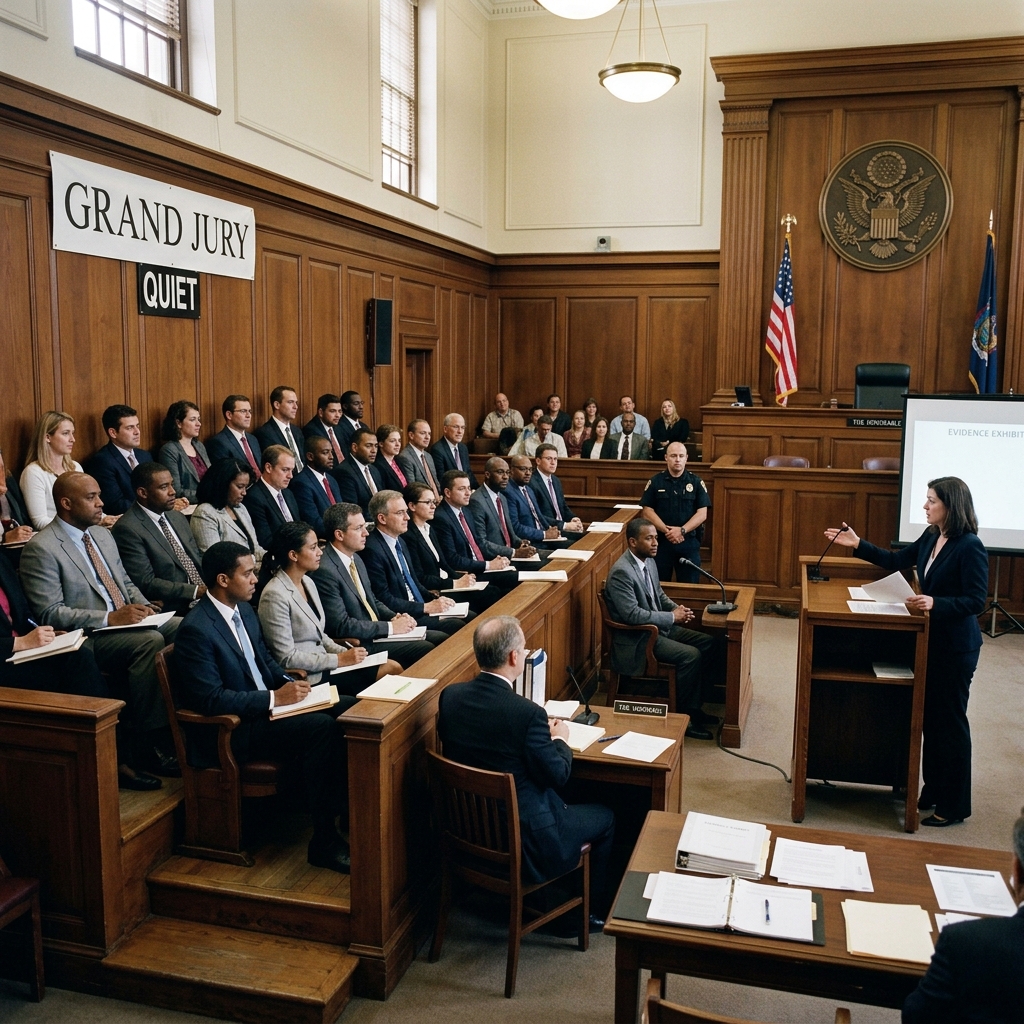
In the United States, criminal cases can begin in different ways, but one of the most distinctive features of American criminal procedure is the grand jury. A criminal grand jury is a group of citizens empowered to decide whether there is enough evidence to bring formal charges, known as an indictment, against a suspect. Although the federal government must use grand juries to charge most serious offenses, individual states vary widely in how often they rely on them and for which types of crimes.[10]
What Is a Criminal Grand Jury?
A criminal grand jury is not the same as the jury that decides guilt or innocence at trial. Instead, it is an accusatory body that evaluates evidence presented by prosecutors to determine whether there is probable cause to believe a crime has been committed and that a specific person committed it.
- Size: Typically between 16 and 23 members, far larger than a trial jury, which usually has 6 to 12 jurors.
- Function: Decides whether to issue an indictment; does not decide guilt or innocence.
- Standard: Uses the probable cause standard rather than the higher trial standard of proof beyond a reasonable doubt.
In practice, the grand jury meets with a prosecutor, hears witness testimony, reviews documents or physical evidence, and then votes in secret on whether to return an indictment.
Grand Juries Versus Trial Juries
Understanding the distinction between grand juries and trial (or petit) juries clarifies why some states use grand juries frequently while others rarely do.
| Feature | Criminal Grand Jury | Criminal Trial Jury |
|---|---|---|
| Primary Purpose | Decide whether to charge a person by indictment | Decide guilt or innocence at trial |
| Typical Size | 16–23 members | 6–12 members |
| Standard of Proof | Probable cause | Beyond a reasonable doubt |
| Who Participates | Prosecutor and witnesses; usually no judge or defense counsel in the room | Judge, prosecutor, defense counsel, defendant, and witnesses |
| Outcome | Indictment or no bill (no indictment) | Conviction or acquittal |
| Confidentiality | Proceedings are secret | Proceedings are usually public |
Because grand jury proceedings are secret, they can protect witnesses and ongoing investigations, but they also draw criticism for lack of transparency and limited defense participation.
Federal Requirement and State Flexibility
The U.S. Constitution’s Fifth Amendment requires the federal government to use grand juries to charge most serious offenses, particularly felonies, but this requirement does not automatically bind the states.[10] The U.S. Supreme Court has interpreted the grand jury clause as applying only to federal prosecutions, leaving each state free to decide whether, when, and how to use grand juries in criminal cases.[10]
As a result, three broad approaches have emerged at the state level:
- Mandatory use: Some states require grand jury indictments for certain serious crimes, such as capital offenses or specific violent felonies.
- Optional use: Many states permit, but do not require, prosecutors to seek grand jury indictments, allowing alternatives like a judge-approved charging instrument.
- Limited or rare use: A few states rarely rely on grand juries, reserving them for unusual cases or specific statutory situations.
States that do not emphasize grand juries often rely instead on a procedure known as a information or complaint, in which a prosecutor files formal charges and a judge evaluates probable cause in a preliminary hearing.
How Grand Jury Proceedings Work
Although details vary by jurisdiction, criminal grand jury proceedings share several common features across the United States.
Selection and Term of Service
Grand jurors are drawn from the same general pool of citizens used for trial juries, but they may serve for longer periods and hear multiple cases.
- Number of jurors: Federal law typically provides for between 16 and 23 grand jurors.
- Quorum: A minimum number of jurors must be present to hear evidence, often at least 16 in federal court.
- Length of service: Federal grand juries can serve up to 18 months, with possible extension in complex matters.
Evidence and Witnesses
Grand juries hear testimony and review documents, but the rules are more flexible than those that apply at trial.
- Hearsay: Evidence that would be excluded as hearsay in a trial can be presented to a grand jury.
- Illegally obtained evidence: In federal practice, evidence that might be suppressed at trial can still be shown to the grand jury.
- Exculpatory evidence: Prosecutors are not always required to present evidence favorable to the suspect, especially in federal proceedings.
After hearing the evidence, grand jurors deliberate privately and then vote. In federal court, at least 12 jurors must agree to issue an indictment.
Which States Use Criminal Grand Juries?
Every state has some legal mechanism that allows for grand juries, but the frequency and scope of their use differ significantly. Broadly speaking, the states can be grouped by how central grand juries are to their felony charging process.
States That Frequently Use Grand Juries in Felony Cases
Several states use criminal grand juries as a common or primary tool for charging serious offenses. In these jurisdictions, prosecutors regularly present felony cases to grand juries, especially for violent or high-profile matters.
- New York: Grand juries are routinely used for felony charges; state law requires that most serious offenses be reviewed by a grand jury unless the defendant waives the right or certain exceptions apply.
- Texas: Grand juries play a central role in felony charging, and the state maintains statutory procedures for regular grand jury use similar to federal practice.[10]
- Southern and Gulf states: States such as Louisiana and Mississippi have long traditions of grand jury involvement in major criminal prosecutions, particularly for capital or violent felonies.[10]
In these states, grand juries function as an institutional check on prosecutorial decisions and are integrated into everyday criminal practice.
States With Limited or Selective Grand Jury Use
Other states treat grand juries as a supplemental or exceptional procedure. Prosecutors may turn to a grand jury for:
- Complex or multi-defendant investigations
- Organized crime, public corruption, or large-scale financial crimes
- Sensitive cases where secrecy is important to protect witnesses or evidence
In these jurisdictions, routine felony charging often proceeds by information or complaint, followed by a preliminary hearing before a judge.
States Where Grand Juries Are Rarely Used
A small number of states have moved away from regular grand jury use, emphasizing judicial review of charging through preliminary hearings and robust discovery. Even in these states, grand juries usually remain available by statute, but they may be reserved for unusual cases or for specific categories of offenses.[10]
Why States Differ in Their Use of Grand Juries
Several factors influence whether a state heavily relies on criminal grand juries or prefers alternative charging methods.
Historical and Cultural Traditions
Grand juries trace back to English legal history and were adopted early in American colonial law. States that retained strong ties to these traditions have often preserved the grand jury as a core institution, particularly in the South and Northeast.[10]
Constitutional and Statutory Design
State constitutions and statutes vary. Some echo the federal Fifth Amendment and expressly guarantee grand jury indictment for serious crimes. Others authorize grand juries but also permit prosecution by information with judicial oversight, giving prosecutors and courts more flexibility.
Practical Considerations
States consider practicality and resource constraints when choosing charging procedures:
- Caseload: High-volume criminal systems may favor streamlined preliminary hearings before judges.
- Complex cases: Grand juries can efficiently handle many witnesses and extensive evidence in long-running investigations.
- Witness safety: The secrecy of grand jury proceedings can protect witnesses in cases involving gangs, organized crime, or public corruption.
Impact of Grand Juries on Defendants and Prosecutors
The presence or absence of a grand jury requirement affects both prosecutors’ strategies and defendants’ rights in significant ways.
For Prosecutors
- Investigative tool: Grand juries can issue subpoenas, compel testimony, and gather documents, helping prosecutors build complex cases.
- Screening mechanism: A grand jury’s probable cause determination provides institutional support for charging decisions, especially in controversial cases.
- Secrecy: Proceedings occur out of public view, which can be crucial in sensitive investigations but also shields prosecutorial decisions from immediate scrutiny.
For Defendants
- Limited participation: Defense counsel often cannot attend grand jury sessions, and defendants may not present their own evidence or cross-examine witnesses.
- Lower standard of proof: Probable cause is a relatively low threshold, meaning many cases advance beyond the grand jury stage.
- Presumption of innocence: Even after an indictment, defendants remain presumed innocent and must be proven guilty at trial.
In states that rely heavily on grand juries, defense strategy must account for the likelihood of indictment and focus on challenging evidence later in the process, such as at trial or through pretrial motions.
Common Misunderstandings About Grand Juries
Because grand jury proceedings are secret and technically complex, several misconceptions are common among the public.
- “An indictment means the person is guilty.” In reality, an indictment is only a formal accusation based on probable cause. The defendant must still be proven guilty beyond a reasonable doubt at trial.
- “All states use grand juries the same way.” States differ significantly; some use grand juries routinely for felonies, others only in limited circumstances.[10]
- “The judge runs the grand jury like a trial.” Grand juries usually meet without a judge present; the prosecutor guides the proceedings and instructs jurors on applicable law.
Practical Tips for Navigating a State Grand Jury
For individuals and attorneys dealing with a potential state grand jury investigation, a few practical points can help guide expectations.
- Learn your state’s rules: Whether a grand jury is likely to be used depends heavily on state law and local prosecutorial practice.
- Understand the limited role of defense: Defense counsel may advise clients about their rights but may not participate directly inside the grand jury room.
- Prepare for possible indictment: In jurisdictions where grand juries are common, defendants and counsel should treat a grand jury investigation as a serious step toward formal charges.
FAQs About Criminal Grand Juries in the States
Do all states have grand juries?
All states provide some mechanism for convening grand juries, but many do not use them routinely. Instead, they may rely on informations or complaints evaluated by judges in preliminary hearings for most felony charges.[10]
Which states rely most on criminal grand juries?
States such as New York, Texas, and several Southern states frequently use grand juries for felony prosecutions, sometimes requiring indictment for serious offenses like violent felonies or capital crimes.[10]
Can a prosecutor charge someone without a grand jury?
In the federal system, most serious crimes must be charged by grand jury indictment, but in many states prosecutors may file charges through an information or complaint that a judge reviews for probable cause.[10]
Is a grand jury the same as a preliminary hearing?
No. A preliminary hearing is held before a judge, usually with both prosecution and defense present, and occurs in open court. A grand jury is a group of citizens who meet in secret, guided by a prosecutor, to decide whether to indict.
What happens after a grand jury issues an indictment?
After indictment, the defendant appears in court for an initial hearing where charges are explained, rights are reviewed, counsel is arranged, and bail or detention is determined. The case then proceeds through discovery and pretrial motions to trial or plea negotiations.
References
- El gran jurado en Estados Unidos: ¿qué es? — America.gov (U.S. Department of State). 2016-08-25. https://archive-share.america.gov/es/el-gran-jurado-en-estados-unidos-que-es/
- El Proceso de Justicia Penal — U.S. Department of Justice. 2020-01-15. https://www.justice.gov/es/enrd/el-proceso-de-justicia-penal
- Descripción General de un Proceso Penal — Federal Defenders of New York. 2019-05-10. https://www.federaldefendersny.org/descripcin-general-de-un-proceso-penal
- ¿Qué es un gran jurado en Estados Unidos? — Abogado.com (Martindale-Hubbell). 2021-03-01. https://www.abogado.com/recursos/ley-criminal/qu-es-un-gran-jurado.html
- Gran Jurado — U.S. District Court, Central District of California (Pro Se Resources). 2018-09-30. https://prose.cacd.uscourts.gov/es/glossary/granjurado
- ¿Cómo Funciona el Proceso del Gran Jurado en un Caso Penal? — The Law Offices of Jeffrey Lichtman (NY defense counsel blog). 2020-02-12. https://www.nydefensecounsel.com/es/blog/como-funciona-el-proceso-del-gran-jurado-en-un-caso-penal/
- COMPARATIVA DE LA FIGURA DEL JURADO EN ESPAÑA Y ESTADOS UNIDOS — Universidad Pontificia Comillas (Repositorio Comillas). 2017-06-01. https://repositorio.comillas.edu/rest/bitstreams/145631/retrieve
Similar Articles








Read full bio of medha deb




