
Copyright Lawsuits Reshape Hip-Hop’s Creative Foundation
How landmark court cases transformed sampling from artistic freedom to licensed necessity.
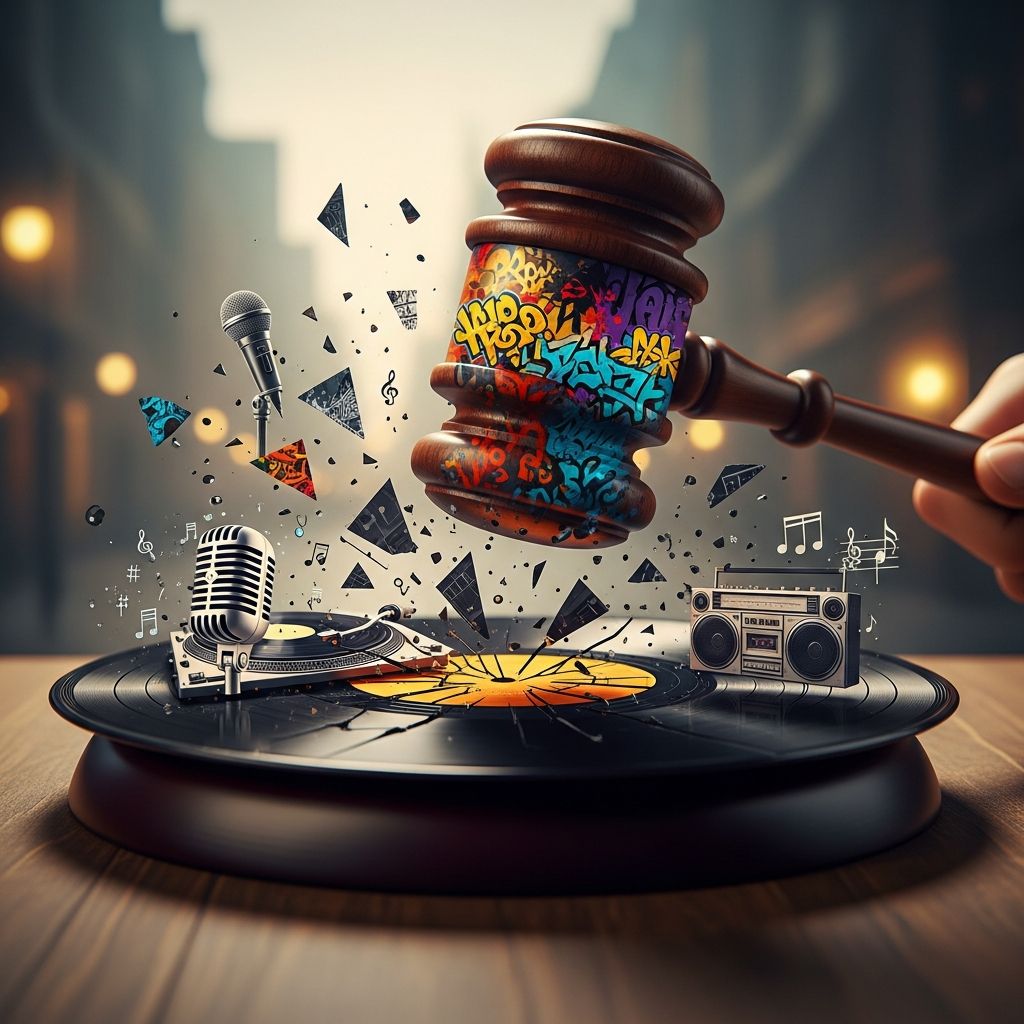
The Birth of Hip-Hop’s Sampling Revolution
Hip-hop emerged in the late 1970s and early 1980s as a genre fundamentally rooted in musical borrowing and recontextualization. The foundational elements of hip-hop production relied heavily on the ability to extract fragments from existing recordings and weave them into entirely new compositions. This practice, known as sampling, became the lifeblood of the genre, allowing producers and artists to build upon decades of musical heritage while creating innovative sonic landscapes. Early pioneering acts transformed turntables into instruments, using drum breaks, horn sections, and vocal snippets as building blocks for their creative visions.
The technique gained particular momentum throughout the 1980s as technological advancement made sampling more accessible and sophisticated. Artists could now isolate and loop specific moments from recordings, manipulating them to fit their artistic intentions. Public Enemy exemplified this approach with releases like “Fight The Power,” which incorporated dozens of copyrighted samples, many lasting mere fractions of a second. This collage-based aesthetic became synonymous with hip-hop’s artistic identity, with producers like The Dust Brothers, The Bomb Squad, and others earning recognition for their meticulous construction of dense, layered soundscapes.
However, this artistic freedom operated in a legal gray zone. Copyright frameworks established decades earlier had not contemplated the possibility of digital sampling. As the practice became increasingly widespread and commercially successful throughout the latter half of the 1980s, record companies began to take notice of the potential intellectual property implications.
Early Legal Encounters and Rising Tensions
The transition from artistic Wild West to legal minefield occurred gradually. Initially, many artists and producers operated under the assumption that brief excerpts might constitute fair use or exist in a murky area of copyright law. Some samples were cleared after the fact, once records had already been released and gained commercial traction. The copyright enforcement apparatus had simply not caught up to the rapidly evolving production techniques within hip-hop.
Several notable acts encountered legal difficulties before the major court decisions that would reshape the industry. De La Soul, despite their innovative approach to sampling, faced significant legal challenges when the acclaimed group sampled “You Showed Me” by The Turtles on their 1989 album “3 Feet High and Rising.” The Turtles’ member Howard Kaylan expressed strong opposition to the practice, characterizing sampling as “just a longer term for theft” and dismissing it as lacking genuine creativity. This lawsuit proved costly for De La Soul and signaled that established artists and their representatives were prepared to defend their intellectual property rights aggressively.
Similarly, The Beastie Boys encountered legal troubles with their track “Hold It Now, Hit It” prior to their landmark album “Paul’s Boutique.” These early disputes served as warning signs that the industry’s tolerance for uncleared sampling was diminishing. Record companies began to recognize that massive commercial success coupled with extensive unauthorized sampling presented significant liability exposure.
The Biz Markie Decision: A Watershed Moment
The pivotal case that fundamentally transformed hip-hop production practices centered on rapper Biz Markie and his 1991 album “I Need a Haircut.” The track “Alone Again” directly looped Gilbert O’Sullivan’s 1975 song “Alone Again (Naturally)” without securing proper clearance. Warner Bros., which had released Markie’s album, initially attempted to mount a legal defense arguing that the use constituted assemblage art or sound collage—forms of creative expression that should receive exemption from conventional copyright restrictions.
This defense rested on the artistic argument that sampling represented a legitimate form of contemporary artistic expression comparable to visual art techniques like collage or assemblage. The producers contended that minimal, uncleared samples should be excused as acceptable artistic practice, particularly given that the borrowed segments were fragmentary and transformed through the remix process.
However, the court’s investigation revealed that Warner Bros. had actually attempted to seek permission for the sample, thereby acknowledging their knowledge of the potential infringement. This critical discovery undermined the defense’s credibility. The label’s knowledge that they were infringing intellectual property, combined with their failure to secure proper authorization, resulted in a ruling that characterized the infringement as willful and intentional. The judge’s decision infamously opened with the biblical commandment “Thou shalt not steal,” explicitly framing unauthorized sampling as a form of theft.
While legal commentators criticized this decision for its apparent bias and its theological framing of a commercial dispute, the ruling established binding precedent: all samples required clearance before publication and commercial distribution. Biz Markie’s follow-up album, humorously titled “All Samples Cleared,” acknowledged this new reality while demonstrating the artist’s awareness of the seismic shift in hip-hop production practices.
Immediate Consequences and Industry Transformation
The Biz Markie case triggered rapid transformation across the hip-hop industry. Record labels implemented internal clearance procedures before releasing albums, fundamentally altering production workflows and timelines. Artists could no longer complete projects quickly; instead, the pre-release phase now required extensive legal work to identify every sample, track down rights holders, and negotiate licensing fees.
The financial implications proved severe and disproportionately affected different categories of artists. Well-funded projects with major label backing could absorb clearance costs, though these expenses reduced budgets available for other creative endeavors. The Beastie Boys’ “Paul’s Boutique,” released before the Biz Markie decision but featuring extensive samples, eventually required over $250,000 in legal clearances. Recording engineer Mario Caldato Jr. noted in 2019 that the list of samples on the album was so extensive that The Dust Brothers continued facing lawsuits decades later.
Conversely, independent artists and emerging producers faced insurmountable obstacles. Clearing samples involved identifying original copyright holders, often challenging for obscure recordings, then negotiating licensing fees that could consume entire production budgets. Many early hip-hop albums became impossible to reissue due to the prohibitive intellectual property costs involved in re-securing clearances. This created a paradoxical situation where historically significant works became unavailable to new audiences precisely because of their artistic achievements—their reliance on diverse samples from across musical history.
The economics of sample clearance also benefited certain artists disproportionately. The Winstons, whose drum break “Amen, Brother” became one of hip-hop’s most sampled sounds, received minimal compensation despite their contribution appearing in thousands of tracks. Only a crowdfunding campaign in 2015 ensured that surviving member Richard L. Spencer received any meaningful payment for decades of uncompensated usage.
The Evolution of Production Techniques
To navigate the new legal landscape, hip-hop production methodology underwent significant evolution. Instead of constructing intricate collages from dozens of brief samples, producers increasingly focused on licensing individual source recordings and building arrangements around those specific selections. This shifted the artistic approach from assemblage-based composition toward a more traditional songwriting methodology, albeit one grounded in sampled material.
The rise of mixtapes offered one creative workaround. These free, unofficial recordings produced by hip-hop artists often featured uncleared samples and provided emerging rappers an effective mechanism for building audiences without incurring clearance expenses. Mixtapes functioned as a separate ecosystem where experimental production could flourish outside the commercial distribution framework that triggered legal obligations. This development allowed artistic innovation to continue parallel to the licensed mainstream industry.
Additionally, new production approaches emerged that required fewer samples or utilized different source material. Trap music, which developed prominence in the 2000s onward, represented one such evolution born partly from the economic constraints imposed by clearance requirements. Producers developed new aesthetic frameworks that could achieve commercial viability while maintaining manageable licensing obligations.
Broader Legal Developments and Precedent Expansion
Beyond the Biz Markie decision, other copyright cases further restricted sampling practices. De La Soul’s dispute with The Turtles established that even small, brief samples could trigger substantial liability without proper authorization. The legal precedent that emerged from these cases effectively eliminated the concept that minimal or fragmentary samples might constitute fair use or exist outside copyright protection.
These decisions had cascading effects throughout the music industry. Major artists, including Kanye West, faced numerous lawsuits regarding samples on hit recordings. In some cases, the source material was so obscure that the original artists and their representatives had been unaware their work had been sampled and commercially exploited. West’s “Bound 2” sampled The Ponderosa Twins Plus One, a group that had released a single album and essentially disappeared from public consciousness, yet they successfully sued to recover royalties.
The precedential impact extended to copyright enforcement culture generally. Corporations that owned extensive catalogs recognized the commercial value in monitoring hip-hop releases and pursuing infringement claims. Large record labels employed teams of legal specialists to identify unauthorized samples and either force settlement payments or demand album recalls. This enforcement infrastructure created perverse incentives, with settlement payments sometimes flowing primarily to corporate rights holders and lawyers rather than to original artists or publishing companies.
The “Blurred Lines” Era and Further Restrictions
Decades after the Biz Markie decision, copyright enforcement became even more stringent. The “Blurred Lines” ruling established that infringement could be found even when a song merely felt similar to an original work, without requiring direct note-for-note copying. This decision represented an expansion of copyright protection that made even the most careful composers vulnerable to litigation.
Supporters of strict copyright enforcement argued that such protections benefited smaller artists who had historically struggled for appropriate credit and compensation. By establishing clear liability for even subtle borrowing, the legal framework ostensibly protected vulnerable creators from exploitation by larger acts with greater resources.
However, critics contended that expansive copyright doctrine chilled artistic innovation and creativity. Over 200 artists signed an amicus brief in 2016 when Robin Thicke and Pharrell Williams appealed the “Blurred Lines” decision, expressing concern that the ruling would adversely affect present and future creative endeavors. These artists recognized that hip-hop’s foundational creative methodology—building upon existing musical material—became increasingly dangerous under the emerging legal framework.
The contemporary response involved preemptive crediting strategies. Modern pop and hip-hop artists increasingly offer credit to any artist from whom a song appears to borrow, even marginally. This practice reflects the reality that litigation risk management often requires acknowledging potential influences prophylactically. Publishing companies capitalized on this environment by pursuing acquisition strategies designed to control catalogs and intercept potential licensing revenue.
Contemporary Production Economics
Today’s hip-hop production operates within a fundamentally transformed economic framework compared to the genre’s early decades. Sample clearance has become a standard line item in production budgets, with costs varying dramatically based on the source material’s commercial value and copyright holder’s negotiating position. This creates substantial barriers to entry for new producers and reinforces advantages for artists with access to significant capital.
The licensing process involves multiple stakeholders: master rights holders (typically record labels), publishing rights holders (songwriting publishers), and in some cases, original artists themselves. Navigating these different rights holders and negotiating acceptable terms requires specialized knowledge and often legal representation, further increasing costs.
Major artists have developed sophisticated strategies for managing sampling obligations. Some negotiate broad licenses covering potential future uses. Others invest in purchasing exclusive rights to particular recordings, establishing primary source material that becomes associated with their artistic brand. These approaches require capital investments but provide greater creative flexibility and predictability.
Unresolved Tensions and Ongoing Debates
Despite decades of litigation and legal precedent, fundamental tensions persist regarding sampling and copyright. Advocates for artistic freedom argue that copyright law has overcorrected, imposing restrictions that inhibit legitimate creative development and artistic expression. They contend that hip-hop’s foundational methodology—building upon and responding to existing musical material—represents legitimate artistic practice comparable to quotation in literature or visual reference in visual arts.
Conversely, rights holders and their legal representatives maintain that copyright protections remain essential for ensuring that original creators receive fair compensation for their intellectual property. They argue that without robust enforcement, established artists and corporations would exploit smaller creators’ work without providing adequate returns.
These competing perspectives reflect deeper philosophical disagreements about the proper balance between protecting creators’ economic interests and enabling new artistic creation. Hip-hop serves as a particularly visible case study because the genre’s very nature involves explicit engagement with existing recorded material, making copyright implications unavoidable and contested.
Long-Term Impact on Hip-Hop’s Development
Despite restrictions imposed by litigation and copyright enforcement, hip-hop has continued flourishing as a commercially and artistically significant genre. The constraints created by licensing requirements have simply altered the mechanisms through which hip-hop artists and producers create and distribute their work. New generations of artists have adapted to the legal environment, developing production techniques and creative strategies suited to contemporary intellectual property frameworks.
However, questions remain about what artistic innovations might have emerged under a different legal regime. Early hip-hop’s dense, collage-based aesthetic required technological sophistication but minimal financial capital. The shift toward more capital-intensive production models, driven partly by licensing expenses, necessarily altered which artists could participate and what sonic approaches became economically viable.
The historical record demonstrates that litigation and legal precedent function as powerful forces shaping not merely the economic organization of an industry but also the fundamental creative practices and aesthetic possibilities within artistic genres. Hip-hop’s transformation from a sampling-intensive genre operating in legal ambiguity to a highly regulated, licensing-dependent industry reflects this reality.
Frequently Asked Questions
Q: What exactly is sampling in hip-hop music?
A: Sampling involves extracting and digitally recording a portion or “sample” of a sound recording and reusing it in a different song or piece. Hip-hop producers use samples from existing recordings—often just a few seconds—and manipulate them through looping, pitch-shifting, and layering to create new compositions.
Q: Why did the Biz Markie case matter so much?
A: The 1991 ruling established legal precedent that all samples must be cleared (licensed) before commercial release. Prior to this decision, sample clearance was inconsistently practiced, but the court’s finding that unauthorized sampling constituted willful infringement made clearance a legal requirement rather than an optional practice.
Q: How do artists obtain sample clearance today?
A: Artists must identify and contact the copyright holders (typically record labels for master rights and music publishers for composition rights), negotiate licensing terms, and pay fees. This process requires identifying the sample’s source, locating current rights holders, and often engaging legal specialists to facilitate negotiations.
Q: Has copyright enforcement helped or harmed hip-hop?
A: This remains contested. Enforcement has created barriers to entry for emerging artists and altered production aesthetics. However, it has also ensured that original artists and rights holders receive compensation for their work being used. Hip-hop has continued evolving creatively despite these constraints, though perhaps in different directions than might have occurred under less restrictive copyright frameworks.
Q: Can artists still use samples without permission?
A: Not commercially in mainstream releases without legal risk. Mixtapes and non-commercial releases exist in a more ambiguous legal space, and some artists use uncleared samples in unofficial recordings. However, major label releases require clearance, and using uncleared samples in commercial releases exposes artists to lawsuits and damages.
References
- How Did A Hip Hop Song Change Intellectual Property Law? — Gumersalls. Accessed April 2026. https://www.gumersalls.co.uk/how-did-a-hip-hop-song-change-intellectual-property-law/
- How Sampling, Royalties, and Lawsuits Shape The AI Music Debate — Tedium. July 29, 2023. https://tedium.co/2023/07/29/music-sampling-ai-generated-legal-conflict-history/
- History of sampling: A guide to getting them cleared — Red Bull. Accessed April 2026. https://www.redbull.com/us-en/sampling-history-and-how-to-not-get-sued
- The Art of Sampling and Copyright Infringement: How Do We Strike a Balance Between the Two? — NYU Journal of Intellectual Property & Entertainment Law (JIPEL). Accessed April 2026. https://jipel.law.nyu.edu/the-art-of-sampling-and-copyright-infringement-how-do-we-strike-a-balance-between-the-two/
- How Copyright Law Changed Hip Hop: An Interview with Public Enemy’s Chuck D and Hank Shocklee — Little Village Magazine. Accessed April 2026. https://littlevillagemag.com/how-copyright-law-changed-hip-hop-an-interview-with-public-enemys-chuck-d-and-hank-shocklee/
Similar Articles








Read full bio of Sneha Tete




