
Contractor or Employee: Key Differences for Businesses
Master the critical distinction between independent contractors and employees to avoid legal pitfalls, tax penalties, and compliance issues in your business operations.
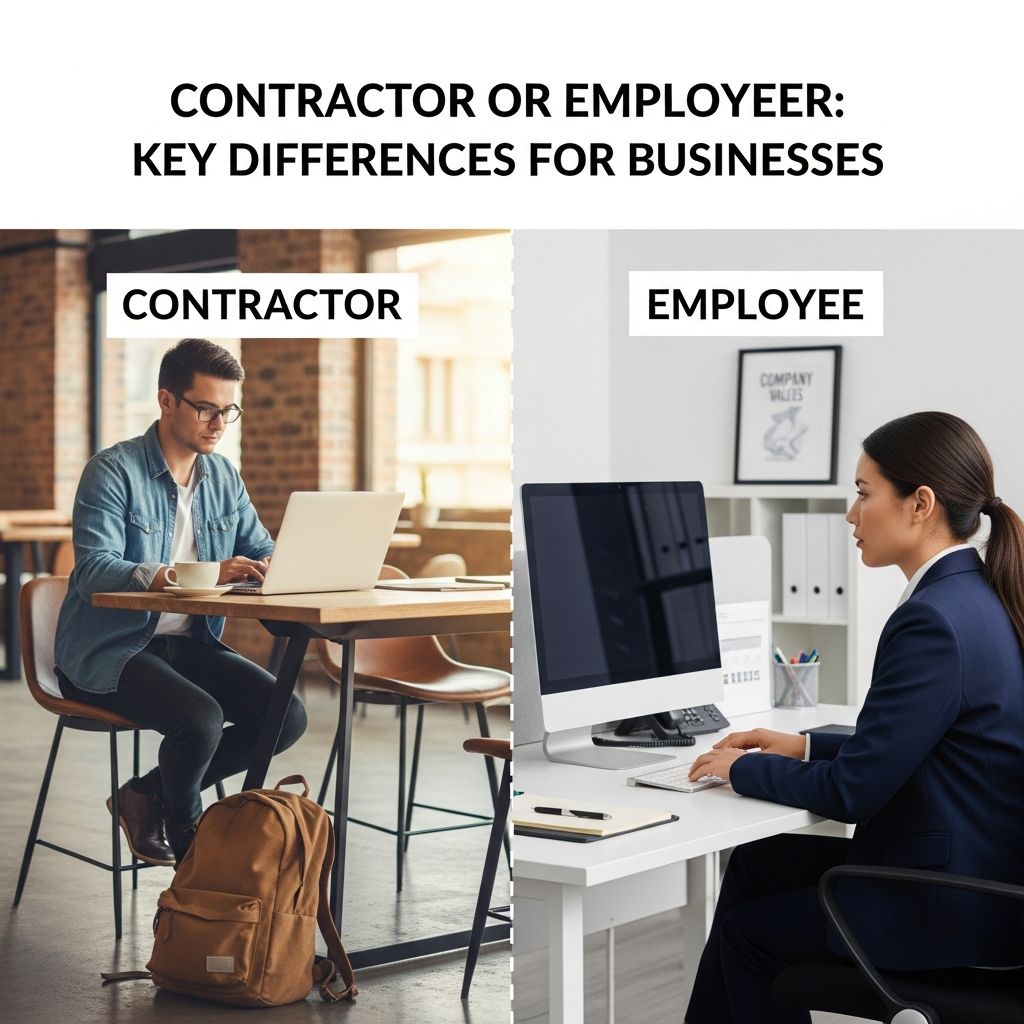
In today’s dynamic workforce, businesses frequently grapple with deciding whether to classify workers as
independent contractors
oremployees
. This choice carries profound legal, financial, and operational ramifications. Missteps in classification can trigger hefty penalties, back taxes, and lawsuits, making accurate determination essential for sustainable growth.Why Worker Classification Defines Business Success
The surge in gig economy platforms and flexible staffing has amplified reliance on independent contractors. Yet, as hiring trends shift toward more contract-based roles, the stakes grow higher. Proper classification safeguards against regulatory scrutiny from agencies like the IRS and Department of Labor (DOL).
Employees entitle businesses to specific obligations: withholding income, Social Security, and Medicare taxes (FICA), matching employer contributions, and providing unemployment insurance. Independent contractors, conversely, manage their own taxes and lack these mandates, offering cost efficiencies but demanding rigorous compliance verification.
Core Tests for Determining Worker Status
Federal agencies employ multifaceted tests to classify workers. No single factor is decisive; the holistic relationship prevails.
IRS Common Law Factors
The IRS evaluates three primary categories: behavioral control, financial control, and relationship type.
- Behavioral Control: Assesses if the business dictates task execution, methods, or schedules. High control signals employee status.
- Financial Control: Examines payment structures, reimbursement policies, tool provision, and investment opportunities. Unreimbursed expenses and fixed payments lean toward employee.
- Relationship Type: Reviews contract permanence, benefits offered, and work’s centrality to business. Ongoing, integral roles indicate employees.
Remote work doesn’t alter this; control over how and what is performed remains key, even off-site.
DOL Economic Reality Test
Under the Fair Labor Standards Act (FLSA), the DOL’s six-factor test, updated March 11, 2024, prioritizes economic dependence.
| Factor | Employee Indicator | Contractor Indicator |
|---|---|---|
| Integral Work | Core to business operations | Peripheral or specialized |
| Investment | Minimal personal tools/investment | Significant business expenses |
| Permanence | Indefinite or recurring | Project-based, finite |
| Control Level | High supervision/schedule dictates | Autonomy in methods |
| Initiative/Skill | Routine tasks | Independent business-like operation |
| Opportunity for Profit/Loss | Fixed pay, no risk | Assumes financial risks/rewards |
Workers economically dependent on the employer qualify as employees, gaining protections like minimum wage and overtime.
State-Specific Variations
Many states adopt the ‘ABC’ test: (A) Free from control, (B) Work outside usual business, (C) Customarily engaged in independent trade. Compliance requires navigating federal and state rules concurrently.
Tax and Financial Implications Compared
Classification directly impacts payroll and budgeting.
- Employees: Employers withhold FICA (7.65% employee + 7.65% employer), federal/state income taxes, and unemployment taxes. Additional costs include benefits like health insurance or PTO.
- Contractors: Paid gross; they handle self-employment taxes (15.3% FICA equivalent) via quarterly estimates. No employer matching or withholdings.
Businesses save on payroll taxes with contractors but forfeit flexibility in oversight. Offering employee-like perks to contractors risks reclassification.
Risks and Consequences of Misclassification
Improperly labeling employees as contractors invites severe repercussions.
- Tax Liabilities: Back taxes, penalties, and interest under IRC Section 3509. No ‘reasonable basis’ relief applies without documentation.
- Labor Violations: Unpaid overtime, minimum wage claims, plus workers’ comp and unemployment denials.
- Litigation: Class actions from workers seeking benefits; agency audits escalating to fines.
Common pitfalls: long-term engagements (>1 year), employee-only emails/meetings, or micromanagement.
Practical Strategies for Compliant Hiring
Proactive measures minimize exposure.
- Develop Policies: Outline contractor engagement criteria, approval processes, and duration caps.
- Train Managers: Educate on control boundaries—avoid performance reviews or discipline mimicking employees.
- Document Thoroughly: Use detailed contracts specifying scope, autonomy, payment terms, and non-exclusivity.
- Monitor Engagements: Review annually; transition long-term contractors to employees if needed.
- Consult Experts: Engage legal/HR pros for borderline cases, especially multi-state operations.
For remote setups, emphasize outcome-based metrics over process control.
Case Studies: Lessons from Real-World Scenarios
Consider a tech firm hiring a developer for ongoing app maintenance. Daily check-ins and company laptop provision tipped scales to employee status, incurring $50,000 in back taxes. Contrast with a marketing consultant delivering one-off campaigns using personal tools—clear contractor.
In gig sectors, rideshare drivers’ classification battles highlight economic reality: platform control often deems them employees under DOL rules.
Navigating the Evolving Regulatory Landscape
Recent DOL updates reinforce employee-friendly interpretations, complicating gig models. States like California enforce strict ABC tests via Proposition 22 challenges. Businesses must track federal shifts and state divergences.
Future trends: Increased audits targeting high-contractor industries. Automation tools for classification assessments are emerging, but human judgment remains paramount.
Frequently Asked Questions (FAQs)
What if a contractor works remotely—does that make them an employee?
No, remoteness alone doesn’t determine status. If you control work details, they may be employees regardless of location.
How long can I use a contractor before reclassifying?
No fixed limit, but engagements over one year warrant review to avoid employee treatment indicators.
What documents prove contractor status?
A robust contract, invoices, proof of other clients, and business licenses strengthen the case.
Can I require contractors to sign non-competes?
Yes, but excessive restrictions may imply employment control—balance is key.
What are the first steps if audited for misclassification?
Gather all documentation, cease improper practices, and consult tax counsel immediately.
Building a Flexible, Compliant Workforce
Strategic classification empowers scalability without compliance snares. By mastering tests, documenting relationships, and staying vigilant, businesses thrive amid regulatory flux. Prioritize audits, training, and expertise to harness contractor benefits lawfully.
References
- Independent contractor (self-employed) or employee? — IRS. 2024. https://www.irs.gov/businesses/small-businesses-self-employed/independent-contractor-self-employed-or-employee
- Independent contractor vs. employee, what does it matter? — Thomson Reuters Legal. 2023-10-12. https://legal.thomsonreuters.com/en/insights/articles/independent-contractor-vs-employee-what-does-it-matter
- Independent Contractor vs. Employee: Is Your Company Classifying… — Warren Averett. 2024-03-11. https://warrenaverett.com/insights/independent-contractor-vs-employee/
- Independent Contractor vs Employee: Key Differences — SurePayroll. 2024. https://www.surepayroll.com/resources/article/independent-contractor-vs-employee
- EMPLOYEES VS. INDEPENDENT CONTRACTORS — Albany Law School. 2013. https://www.albanylaw.edu/media/9971/download?attachment
Similar Articles








Read full bio of Sneha Tete




