
Cell Phones In Court: Rules, Risks, And Practical Preparation
Navigate the complex rules on cell phones in court: from bans to allowances, exemptions, and why they matter for justice.
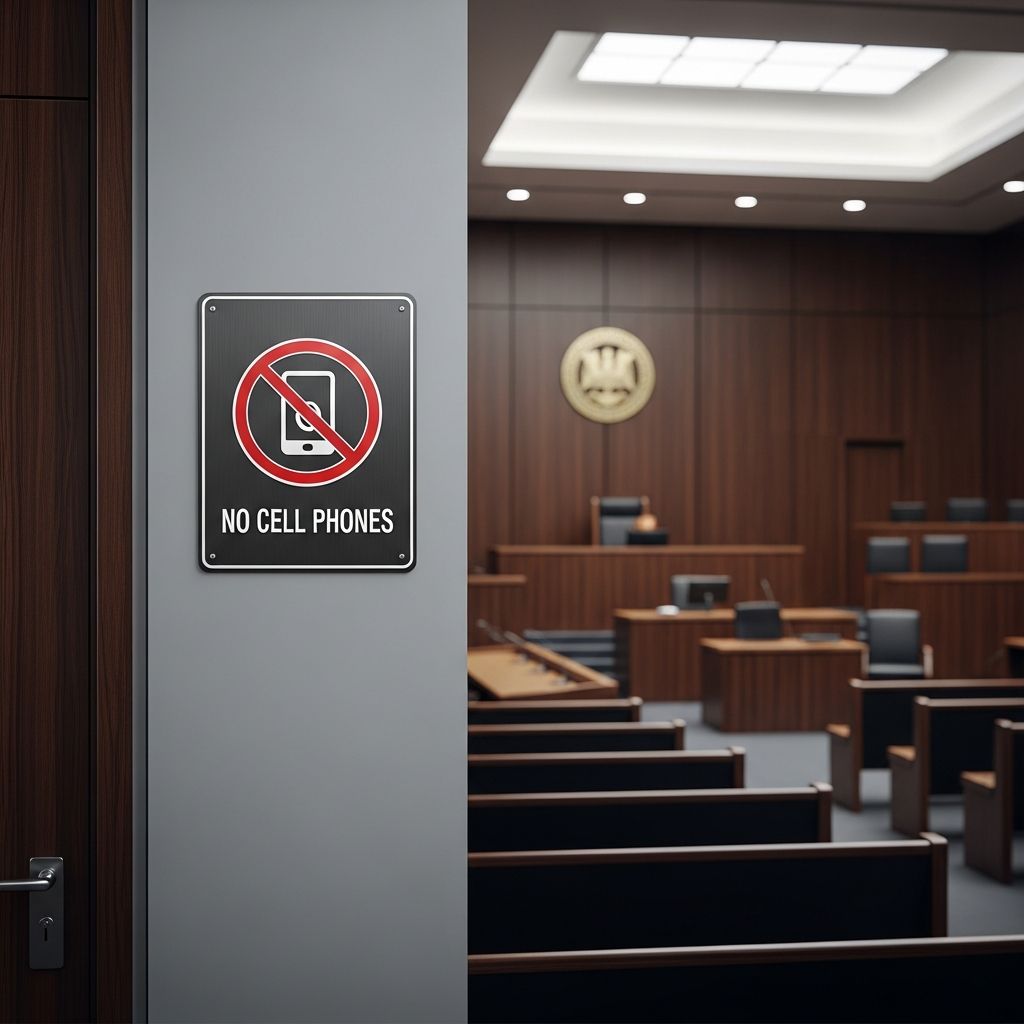
Cell phones have become indispensable tools in daily life, but entering a courthouse changes the rules dramatically. Across the United States, policies on electronic devices like smartphones vary widely, balancing public safety, procedural integrity, and access to justice. These regulations aim to prevent disruptions, unauthorized recordings, and security threats while accommodating essential users such as legal professionals.
Why Courts Restrict Cell Phones: Core Concerns
Courts impose strict limits on cell phones primarily to safeguard the judicial process. Disruptions from ringing devices can interrupt testimony or deliberations, undermining the solemnity of proceedings. More critically, smartphones’ cameras and recording features pose risks of capturing images or audio of witnesses, jurors, or evidence without permission, potentially compromising fair trials.
Security threats extend further: devices might conceal weapons or be mistaken for them, prompting bans in high-security environments. Legislatures and courts address these through statutes and rules; for instance, some states criminalize photographing jurors outright. Judges hold discretion to enforce or relax rules per case needs, ensuring policies adapt to specific risks.
- Disruption prevention: Ringing or vibrating phones halt proceedings.
- Recording bans: Prohibits capturing proceedings, violating rules like Arizona’s Rule 122.
- Security risks: Potential for hidden contraband or surveillance.
- Fair trial protection: Shields participants from intimidation or bias.
Federal vs. State Courtroom Guidelines
Federal courthouses often enforce blanket prohibitions on devices with recording capabilities. In California’s Central District, cell phones equipped for video, audio, or photos are barred entirely from court spaces. The Fourth Circuit Court of Appeals permits lawyers to possess devices but mandates they be off in courtrooms, except during oral arguments where silent-mode access to pre-loaded documents is allowed.
State courts exhibit greater variation. New Hampshire permits devices if set to silent mode, absent judicial findings of disruption. California Rules of Court 1.150 require phones off in courtrooms, with potential confiscation, and ban photography without judge approval. Local rules compound this patchwork: one county might ban phones building-wide, while adjacent facilities allow them.
| Jurisdiction | Key Policy | Exemptions | Source |
|---|---|---|---|
| Federal (CA Central Dist.) | Prohibits recording-capable phones | None specified | |
| Federal (4th Circuit) | Off in courtrooms; counsel use during arguments | Attorneys | |
| New Hampshire | Silent mode allowed | General unless disruptive | |
| California State | Off; confiscation possible; no photos | With judge approval |
Exemptions: Who Gets to Keep Their Phone?
Not all entrants face identical restrictions. Attorneys frequently receive exemptions, recognizing their need for quick access to case files, emails, or digital evidence. In Cook County, Illinois, professionals like social workers join lawyers in bypassing bans. Self-represented litigants (pro se) argue for parity, as phones aid in displaying texts, photos, or maps critical to their defense.
Judges may grant case-specific waivers, but public attendees rarely qualify. Enforcement falls to sheriffs or court security, who screen devices at entry. Violations risk device confiscation, fines, or contempt charges, emphasizing pre-arrival compliance checks.
Cell Phones as Evidence: From Seizure to Admissibility
Paradoxically, while possession is restricted, cell phone data often stars in trials. The U.S. Supreme Court’s 2014 Riley v. California ruling mandates warrants for searches, likening phones to personal repositories of intimate information. Probable cause unlocks contents like texts, GPS logs, or photos, admissible if relevant and authenticated.
Exceptions include exigent circumstances—imminent harm or evidence destruction—waiving warrants. Voluntary consent or plain-view incriminating data also suffices. Once obtained legally, evidence must prove more probative than prejudicial, with chains of custody intact to affirm integrity. Defense attorneys challenge admissibility on Fourth Amendment grounds or tampering claims.
Navigating Variations: Practical Advice for Attendees
Preparation averts mishaps. Research the specific courthouse online or call ahead; post signage often details rules. Power down devices fully or use airplane mode. Leave non-essential phones in vehicles or with companions outside. Attorneys should preload materials and seek permissions proactively.
For pro se parties needing phone evidence, print or screenshot in advance, filing digitally per local e-filing rules. Families attending hearings might designate one member phone-free. Ignorance invites penalties: a buzzing phone mid-testimony could lead to removal or sanctions.
Evolving Policies: Toward Balanced Access
Recognizing self-represented litigants’ rise, bodies like the Conference of Chief Justices urge policy reviews. A 2018 resolution promotes balancing security with needs, spurring states like Virginia to craft model guidelines. Modern definitions evolve beyond pagers to encompass smartwatches and tablets, demanding updated rules.
Courts weigh pro se reliance on devices for evidence display against risks. Some experiment with controlled access zones or charging lockers. Future trends may integrate secure digital tools, enhancing efficiency without compromising integrity.
Frequently Asked Questions (FAQs)
What happens if my phone rings in court?
Court staff may confiscate it temporarily, issue warnings, or charge contempt. Silence it completely before entering.
Can attorneys use phones during trials?
Yes, often in silent mode for documents, but recording or new searches require permission.
Is cell phone evidence always admissible?
No; requires warrant or exception, plus authentication and relevance.
Do all courthouses have the same rules?
No; federal, state, and local policies differ, even within buildings.
What about smartwatches or tablets?
Treated like phones; check specific rules as policies expand to multifunction devices.
State-by-State Snapshot of Policies
Policies reflect local priorities:
- Arizona: Recording needs court permission.
- Louisiana: Judges ensure consent for recordings.
- Virginia: Developing statewide models post-2018.
- Indiana: Rules cover PDAs and pagers.
This diversity underscores calling ahead. As technology advances, expect refinements prioritizing equity.
References
- What is Your Policy On Cell Phones in the Court House? — Criminal Law Library Blog. Accessed 2026. https://www.criminallawlibraryblog.com/what_is_your_policy_on_cell_ph/
- Cell Phones in Court: Court cell phone policies attempt to balance risks with litigants’ needs — Judicature (Duke University). 2018. https://judicature.duke.edu/articles/cell-phones-in-court-court-cell-phone-policies-attempt-to-balance-risks-with-litigants-needs/
- Can Cell Phone Evidence Be Used in Court? — Minkus Criminal Law. Accessed 2026. https://www.minkuscriminallaw.com/can-cell-phone-evidence-be-used-in-court/
- Electronic Device Policy — U.S. Court of Appeals for the Fourth Circuit (.gov). Accessed 2026. https://www.ca4.uscourts.gov/oral-argument/visiting-the-court/electronic-device-policy
- Cell Phones in the Courthouse — U.S. District Court Central District of California (.gov). Accessed 2026. https://www.cacd.uscourts.gov/news/cell-phones-courthouse
- Can Cell Phone Evidence Be Used in Court? — Friedman Criminal Law. 2023-08-14. https://friedmancriminallaw.com/2023/08/14/can-cell-phone-evidence-be-used-in-court/
Similar Articles








Read full bio of Sneha Tete




