
Business Gun Policies: Legal Rights and Limits
Navigate the complex landscape of firearm restrictions on private property for business owners across U.S. states.
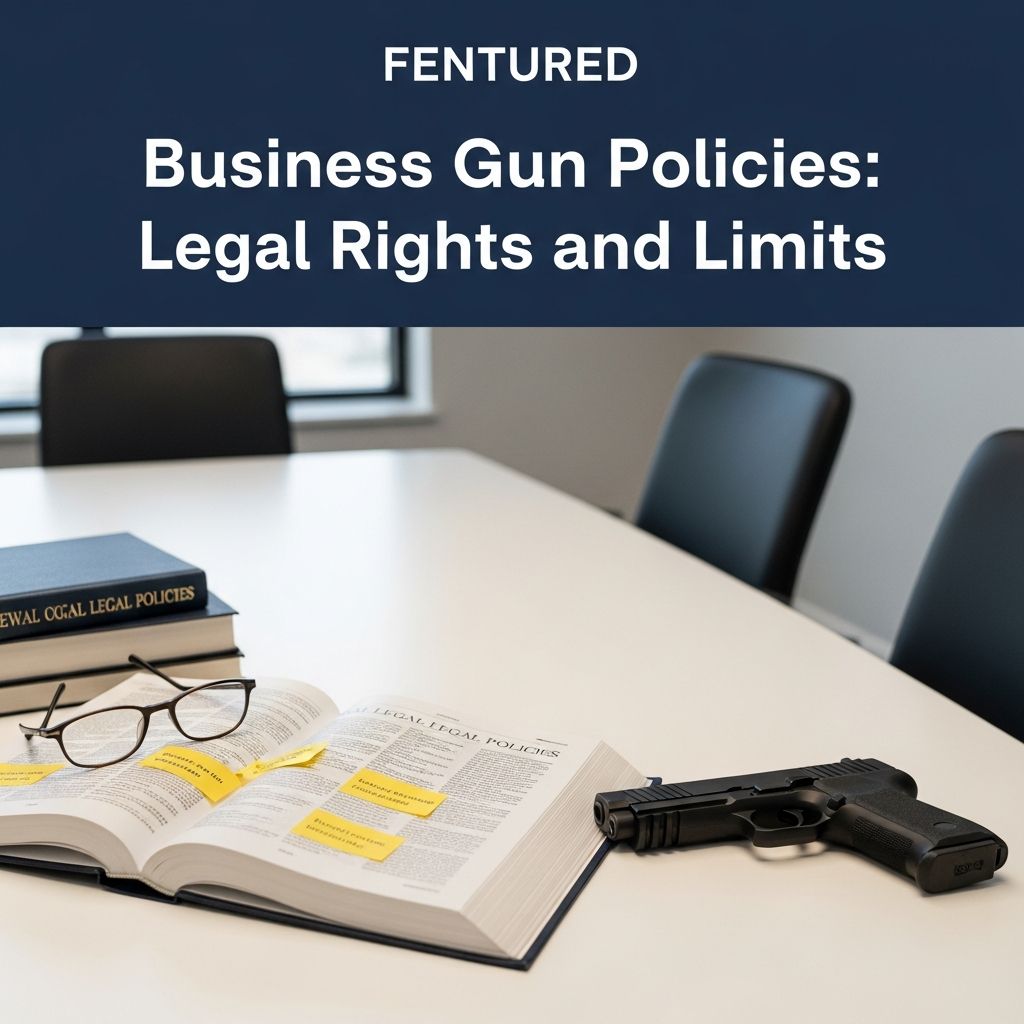
Private property owners, including business operators, hold significant authority to establish rules on their premises, but firearm regulations introduce unique challenges shaped by state laws and constitutional considerations. This article delves into the legal framework allowing or restricting businesses from banning guns, highlighting variations across states, employer protections, and practical implementation strategies.
Private Property Rights vs. Firearm Bearer Protections
At its core, the ability of a business to prohibit firearms stems from property rights under common law principles, where owners can dictate conduct on their land. However, the Second Amendment and state-specific statutes often intersect, granting licensed carriers certain privileges, particularly regarding vehicle storage. Businesses must post clear signage and enforce policies consistently to avoid disputes.
In many jurisdictions, owners can ban guns inside buildings but face limitations on parking lots. This balance aims to respect self-defense rights while permitting safety-focused environments.
National Overview: No Uniform Federal Mandate
The United States lacks a comprehensive federal law dictating workplace firearm policies, leaving regulation primarily to states. The Occupational Safety and Health Act (OSHA) imposes a general duty on employers to maintain safe workplaces, but it does not explicitly address guns. This vacuum empowers states to craft diverse approaches, from permissive ‘parking lot protections’ to outright bans.
| Aspect | Federal Role | State Dominance |
|---|---|---|
| Law Source | OSHA general duty | Primary authority |
| Business Bans | Not addressed | Varies widely |
| Vehicle Storage | No rule | Often protected |
State-by-State Breakdown of Key Provisions
Laws differ markedly, with some states explicitly shielding employee vehicle storage while allowing indoor prohibitions. Below is a synthesized view of representative examples.
- Georgia: Employers can prohibit weapons on premises but must permit locked storage in personal vehicles. The Safe Carry Protection Act (2014) expanded licensed carrier rights, limiting restrictions in certain public-leased spaces.
- Arizona: No mandate to allow guns; businesses may ban them entirely from premises, with exceptions for secured vehicles.
- Indiana: Prohibits employer policies blocking firearm possession in locked vehicles on business property.
- Kansas: Licensed individuals can store concealed handguns in vehicles on employer lots, even if indoor carry is banned.
- Nebraska: Employers may ban concealed handguns inside via posted notices but not in vehicles.
- North Dakota: Cannot prohibit locked firearms in employee vehicles, with exceptions for high-risk industries.
- Ohio: Private employers can ban carry on property and gain immunity from related liabilities.
These examples illustrate a trend: vehicle storage is frequently protected to uphold off-duty rights, while indoor spaces remain under business control.
Employer Liability Shields and Risk Management
Many states offer immunity to employers adopting reasonable gun policies. For instance, Georgia absolves businesses from liability for firearm incidents unless they foreseeably enable criminal acts. Ohio similarly immunizes private employers prohibiting weapons. This encourages proactive policies without fear of lawsuits from non-employees.
However, ambiguity persists in signage enforcement. Signs alone rarely carry criminal weight but enable trespass charges if violated. Businesses should combine visible postings with employee training.
Crafting an Effective No-Guns Policy
Successful policies clearly define prohibited areas, storage allowances, and consequences. Key steps include:
- Review state statutes for compliance.
- Post conspicuous signs at entrances: “No Firearms Allowed Beyond This Point Except as Permitted by Law.”
- Distribute handbooks detailing rules during onboarding.
- Train supervisors on de-escalation and law enforcement coordination.
- Consult legal counsel for updates, as laws evolve (e.g., Georgia’s 2014 changes).
For multi-state operations, tailor policies regionally to mitigate conflicts.
Workplace Safety Implications
Guns in workplaces contribute to violence risks, prompting bans. Federal data underscores the need: employers must reasonably prevent hazards under OSHA. Yet, outright prohibitions may alienate armed employees in high-crime areas, necessitating nuanced approaches like secure storage incentives.
Statistics from credible reports indicate workplaces account for a notable share of firearm incidents, reinforcing policy value. Businesses balancing inclusivity with security often succeed through transparent communication.
Special Cases: Nonprofits, Public Access, and Leased Spaces
Nonprofits serving vulnerable groups, like those in Georgia, face heightened scrutiny. The Safe Carry Protection Act curtailed bans in government-leased properties, compelling reviews. Public-facing businesses must weigh customer comfort against carrier rights; clear policies mitigate backlash.
Churches and schools often opt for discretion, permissible under exemptions. Leased spaces require landlord alignment to enforce bans uniformly.
Enforcement Challenges and Legal Recourse
Violations trigger requests to leave, escalating to trespass if ignored. Criminal charges are rare absent state-specific force. High-profile cases, like Georgia’s botanical garden dispute, spotlight tensions between open carry and private rules.
Courts generally uphold property rights, provided policies align with statutes. Businesses ignoring vehicle protections risk suits.
Recent Developments and Future Trends
Laws continue shifting toward carrier protections, as in ATF’s 2024 dealer definitions indirectly influencing business contexts. Post-2024, states may expand parking lot rules amid self-defense emphases. Employers should monitor legislatures annually.
Frequently Asked Questions
Can any business completely ban guns, including in parking lots?
No, many states protect locked vehicle storage regardless of employer preference. Check local laws for exceptions.
What signage is legally required to enforce a ban?
Conspicuous, readable notices suffice in most states; exact wording varies. Signs enable trespass enforcement.
Does OSHA require gun-free workplaces?
No, but its general duty clause mandates safe environments, supporting reasonable restrictions.
Are out-of-state carriers bound by my policy?
Yes, if on your property, but they must comply with host-state carry laws.
What if an employee conceals a gun despite the policy?
Discipline per handbook; search vehicles only under narrow exceptions like consent or imminent threat.
Best Practices Table
| Practice | Benefit | State Example |
|---|---|---|
| Clear Signage | Legal backing for trespass | Nebraska |
| Policy in Handbook | Employee awareness | Georgia |
| Annual Review | Compliance updates | All states |
| Training | Consistent enforcement | Ohio |
References
- GUN LAWS IN GEORGIA: CAN A NONPROFIT RESTRICT GUNS ON ITS PROPERTY? — Pro Bono Partnership of Atlanta. 2019-10. https://pbpatl.org/wp-content/uploads/2019/10/Updated-Article-Gun-Laws-in-Georgia-2019.pdf
- State laws on bringing weapons on employer premises — EHS Support / BLR. 2013-04. https://www.ehs-support.com/wp-content/uploads/State-laws-on-bringing-weapons-on-employer-premises.pdf
- Can business owners legally ban firearms on their private property? — YouTube (Video). Undated. https://www.youtube.com/watch?v=1I7q4VvnBuk
- Can I Bring My Gun to Work? — PCW Law Firm. Undated. https://www.pcwlawfirm.com/articles/can-i-bring-my-gun-to-work/
- Conceal and carry in businesses where they prohibit it — USCCA Community. Undated. https://community.usconcealedcarry.com/t/conceal-and-carry-in-businesses-where-they-prohibit-it/80654
- Definition of “Engaged in the Business” as a Dealer in Firearms — ATF (U.S. Dept. of Justice). 2024-04-10. https://www.atf.gov/rules-and-regulations/final-rule-definition-engaged-business-a-dealer-firearms
- Guns in the Workplace: What Has Changed, and What Can Employers Expect — SHRM. Undated. https://www.shrm.org/topics-tools/employment-law-compliance/guns-workplace-changed-can-employers-expect
Similar Articles








Read full bio of Sneha Tete




