
Broken Engagements: Who Retains the Engagement Ring?
Navigating the legal complexities of engagement ring ownership when weddings are canceled: state laws, fault rules, and practical advice.
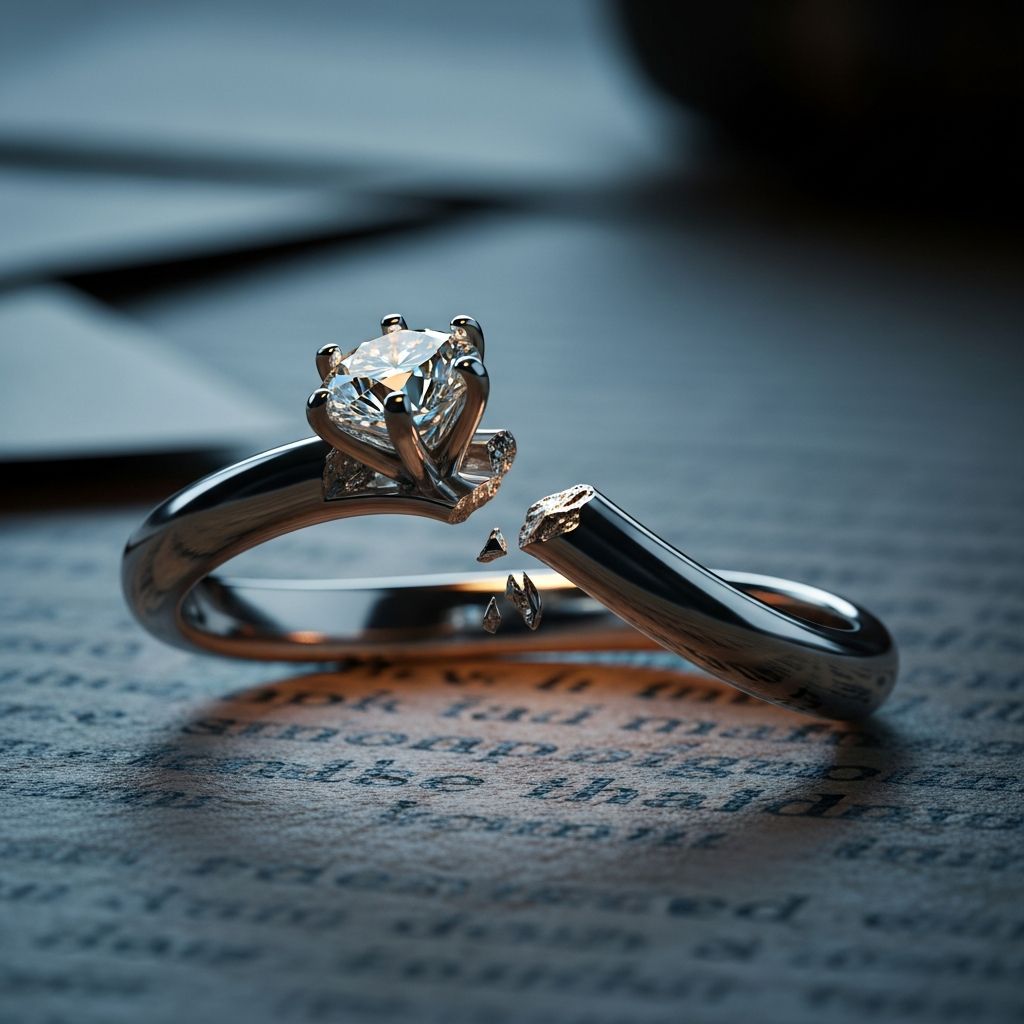
Engagement rings symbolize commitment, but when relationships end before marriage, disputes over their ownership frequently arise. Courts across the United States treat these rings primarily as conditional gifts, meaning their permanent transfer depends on the marriage occurring. This principle stems from longstanding legal precedents that view the ring as tied to the promise of matrimony. If the wedding proceeds, the ring typically becomes the recipient’s property; if not, return to the giver is often required, though rules vary by jurisdiction.
Understanding Conditional Gifts in Engagement Contexts
A conditional gift differs fundamentally from an unconditional one. The latter belongs irrevocably to the recipient upon acceptance, regardless of future events. In contrast, conditional gifts like engagement rings come with an explicit or implied stipulation—here, the condition is marriage. Legal scholars and courts emphasize that the proposer (donor) parts with the ring expecting reciprocity through wedlock. Failure to meet this condition reverts ownership.
This doctrine traces back to cases like New Jersey’s Aronow v. Silver, where courts ruled that even if fault for the breakup is disputed, the ring must return to the donor if no marriage happens. Such rulings establish that the ring’s symbolism underscores its conditional nature, preventing it from being treated as a simple present.
State-by-State Variations in Ring Ownership Rules
No uniform federal law governs engagement rings; instead, state courts apply property and contract principles. Most adopt a no-fault approach, prioritizing the unmet marriage condition over blame. Others incorporate fault, examining who ended the engagement and why. A few treat rings as unconditional gifts outright.
| State | Rule Type | Who Keeps the Ring (Broken Engagement) |
|---|---|---|
| California | No-Fault Conditional | Donor recovers ring or value |
| Delaware | Fault-Based Conditional | Recipient if donor at fault; else donor |
| Missouri | Fault-Based Conditional | Non-breaker keeps it |
| Montana | Unconditional | Recipient always |
| New Jersey | No-Fault Conditional | Donor |
| Texas | Fault-Based Conditional | Non-breaker |
| Washington | Fault-Based Conditional | Non-breaker |
This table highlights key examples; full lists reveal about 20 states as no-fault conditional (donor recovers regardless), 10 fault-based (hinges on who calls it off), and rare unconditional states like Montana. Grey areas in states like Utah lack precedent, leaving judges discretion.
No-Fault Jurisdictions: Simplicity Over Blame
In no-fault states such as California, New Jersey, and Nevada, the donor reclaims the ring irrespective of breakup circumstances. California’s Civil Code §1590 explicitly allows recovery if the recipient refuses marriage or if mutually canceled. New Jersey’s precedent ignores fault entirely, as in Aronow v. Silver, where a last-minute cancellation three days pre-wedding mandated return. This approach streamlines disputes, focusing solely on the failed condition.
- Advantages: Reduces litigation over motives like infidelity or arguments.
- Drawbacks: May seem unfair if the donor caused the split.
- Prevalence: Dominant in over half of states.
Fault-Based Approaches: Accountability in Breakups
Fault-based states like Missouri, Texas, and Washington probe the breakup’s cause. If the donor terminates without justification, the recipient retains the ring. Conversely, if the recipient ends it unjustly (e.g., fraud), return is required. Missouri exemplifies this: the giver keeps it only if not at fault for the split. Courts weigh evidence of bad behavior, making outcomes unpredictable.
These rules aim for equity but invite prolonged battles. Documentation like texts or witness statements becomes crucial to prove fault.
What Happens After Marriage and Divorce?
Once married, the condition is fulfilled, vesting the ring as the recipient’s separate property in most states. New Jersey courts affirm this: post-wedding, even divorce leaves the ring untouched by equitable distribution. It remains a non-marital asset, unlike upgraded wedding bands potentially deemed joint.
Exceptions arise via prenuptial agreements specifying otherwise. Without marriage, however, pre-wedding rules apply strictly.
Practical Steps to Safeguard Your Ring
Amid emotional turmoil, proactive measures prevent legal headaches:
- Document Everything: Retain receipts, appraisals, and photos proving value and ownership.
- Prenuptial Agreements: Explicitly address ring disposition in writing, enforceable across states.
- Insurance: Cover the ring under a policy naming the true owner, vital if sold prematurely.
- Communication: Discuss expectations early to avoid surprises.
- Legal Counsel: Consult family law attorneys for state-specific advice, especially high-value items.
Premarital contracts offer ironclad clarity, overriding default rules.
Frequently Asked Questions (FAQs)
What if the ring is lost or sold before the breakup?
Courts may order reimbursement of value if proven, but recovery depends on state law and evidence. Donors in conditional gift states often prevail.
Does it matter who proposed?
Typically no; the proposer is the donor, but same-sex or non-traditional proposals follow the same conditional rules.
Are heirloom rings treated differently?
Yes, courts may favor return to family origin, strengthening donor claims regardless of fault.
What about wedding bands?
These are usually unconditional post-exchange, becoming marital property subject to division in divorce.
Can I sue for the ring’s return?
Yes, via small claims or civil suit for conditional gift recovery, with success tied to state precedents.
Emerging Trends and Future Considerations
Modern engagements evolve with rising prenup normalization and jewelry insurance. Cohabitation without proposals blurs lines, prompting calls for uniform laws. High-profile cases continue shaping precedents, urging couples to prioritize legal foresight over romance. Economic factors, like average ring costs exceeding $5,000, amplify stakes.
In summary, while conditional gift rules predominate, state nuances demand awareness. Couples should blend heartfelt gestures with prudent planning to navigate potential heartbreaks smoothly.
References
- Who Keeps the Engagement Ring in a Divorce in NJ? — FYKGLaw. 2023. https://fykglaw.com/keeps-engagement-ring-divorce/
- Who Gets To Keep The Engagement Ring? — Weinberger Law Group. 2023. https://www.weinbergerlawgroup.com/blog/newjersey-divorce-mediation/who-gets-to-keep-the-engagement-ring/
- Engagement Ring Laws by State 2026 — World Population Review. 2026-04-01. https://worldpopulationreview.com/state-rankings/engagement-ring-laws-by-state
- Engagement Ring Laws by State in 2025 — BriteCo. 2025. https://brite.co/research/engagement-ring-laws-by-state/
- Who Owns the Engagement Ring if the Wedding Is Called Off? — Rocket Lawyer. 2023. https://www.rocketlawyer.com/family-and-personal/family-matters/marriage/legal-guide/who-owns-the-engagement-ring-if-the-wedding-is-called-off
- Who Gets the Ring When an Engagement Ends? — LawInfo. 2023. https://www.lawinfo.com/resources/divorce/happily-never-afterwho-gets-the-ring-when-an.html
- Is an Engagement Ring a Gift? — Envision Family Law. 2023. https://www.envisionfamilylaw.com/is-an-engagement-ring-a-gift/
Similar Articles








Read full bio of medha deb




