
Do ‘Break It, Buy It’ Signs Hold Legal Power?
Uncover the truth behind 'you break it, you buy it' signs: Are they enforceable law or just store policy? Essential insights for shoppers and owners.
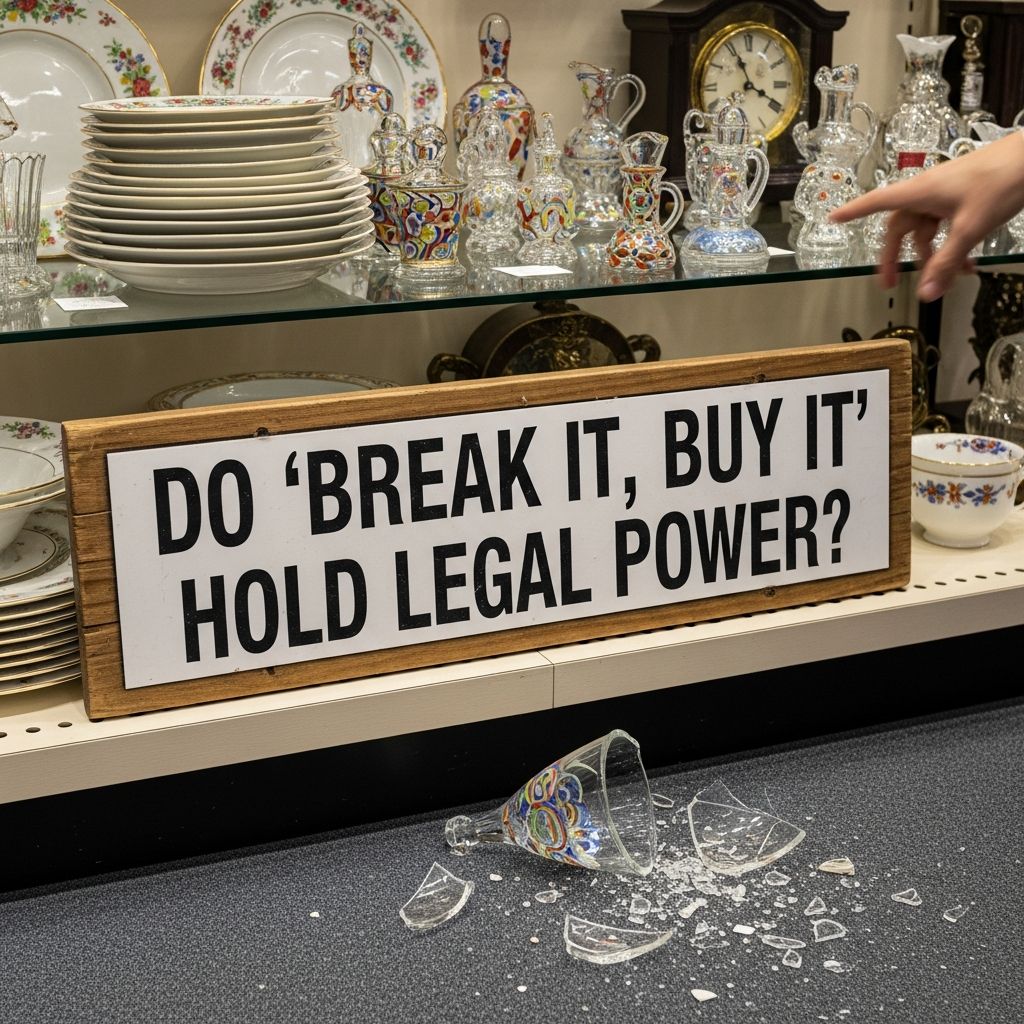
Retail stores often display prominent signs stating variations of ‘you break it, you buy it’ to deter careless handling of merchandise. These notices aim to shift responsibility for accidental damage onto customers. However, their actual legal enforceability is far more nuanced than the bold lettering suggests. While they serve as internal policies, they do not automatically create binding contracts or override fundamental consumer protections.
Historical Roots and Retail Intent Behind the Phrase
The phrase ‘you break it, you buy it’ traces back to mid-20th-century American retail practices, first documented in a 1952 Miami gift shop where it appeared as ‘if you break it, you’ve bought it.’ This warning emerged in an era when stores stocked fragile, high-value items like ceramics and glassware, vulnerable to browsing customers. The intent was straightforward: encourage caution to minimize losses from breakage.
Over decades, the slogan evolved into a cultural staple, appearing in movies, TV shows, and everyday signage. Retailers use it psychologically to make shoppers feel accountable, even if no formal agreement exists upon entry. Yet, history shows it’s more deterrent than decree—lacking the elements needed for legal compulsion.
Why These Signs Fail as Legally Binding Contracts
For a sign to function as a contract, it must meet strict criteria under contract law: offer, acceptance, and consideration. A posted notice offers terms unilaterally, but customers rarely explicitly accept them simply by entering. Courts view this as an ‘adhesion contract’—one-sided and unenforceable without clear mutual assent.
Key reasons they lack power include:
- No Mutual Agreement: Entering a store implies consent to shop, not to arbitrary liability rules. Verbal confirmation or signed waivers would be needed for validity.
- Vagueness: Signs rarely specify what constitutes ‘breaking’—does chipping count? Gross negligence or mere accident?
- Public Policy Limits: Laws protect consumers from unfair terms; forcing payment for accidents contradicts this.
In practice, stores treat these as policies, not laws. They signal expectations but cannot mandate immediate payment without court intervention.
Customer Duty of Care: When Liability Actually Arises
Customers entering stores owe a ‘duty of care’—a legal standard requiring reasonable caution to avoid harming property. This stems from tort law, where negligence occurs if someone breaches this duty, causing foreseeable damage.
To hold a customer liable, stores must prove:
| Element | Store’s Burden of Proof |
|---|---|
| Duty Existed | Customer was handling merchandise as invited. |
| Breach Occurred | Actions were unreasonably careless (not just accidental). |
| Causation | Breach directly caused the damage. |
| Damages | Quantifiable loss, like replacement cost. |
Simple accidents rarely meet the ‘gross negligence’ threshold needed to override defenses. For instance, a slip while reaching for an item differs from reckless smashing.
Shopkeeper’s Privilege: What Stores Cannot Do
Shopkeeper’s privilege allows merchants to detain suspected shoplifters briefly for investigation, but this applies only to theft—not accidents. Breaking an item is a civil matter, not criminal. Detaining a customer over breakage could expose the store to false imprisonment claims, potentially leading to lawsuits or police involvement against the retailer.
Real-world example: If an employee blocks the exit demanding payment, the customer can legally leave and report it. Police typically advise civil resolution over arrests for non-crimes.
Pursuing Civil Remedies: The Store’s Real Recourse
Stores can file small claims court actions for damages, seeking retail price recovery. Success hinges on evidence like video footage proving negligence. However, practical hurdles abound:
- Cost-Benefit: Legal fees often exceed item value, deterring suits over minor breaks.
- Proof Challenges: Without witnesses or cameras, cases falter.
- Defenses Available: Customers can argue accident, comparative fault (e.g., poor display), or store negligence.
Upscale boutiques with luxury goods pursue claims more aggressively, but grocery stores rarely bother for a $10 vase.
State Variations and Notable Court Rulings
Laws differ by jurisdiction. California emphasizes consumer protections, requiring clear signage and proof of knowledge for any policy enforcement. New York courts have ruled similar signs ineffective without explicit acceptance. No federal statute governs this directly; it’s state tort and contract law.
A landmark perspective from legal analyses: Unilateral notices do not bind invitees (customers invited to shop). Stores must rely on tort principles, not signage.
Best Practices for Retailers Managing Breakage Risks
To minimize losses legally and practically:
- Secure fragile items behind glass or high shelves.
- Use CCTV for evidence collection.
- Train staff on de-escalation: Politely request contact info for follow-up, avoid confrontation.
- Implement insurance covering customer accidents.
- Post clear policies alongside disclaimers: ‘Please handle with care’ over threats.
Proactive design reduces incidents far better than litigation threats.
Consumer Strategies: Protecting Yourself from Overreach
If faced with a breakage accusation:
- Stay Calm: Offer insurance details or photo ID for claims—do not pay under duress.
- Document: Note store layout, item placement, witnesses.
- Report Threats: Detention or aggression warrants police call.
- Seek Legal Aid: Free consultations via consumer protection agencies if sued.
Knowledge empowers; accidents happen, but rights endure.
Insurance and Financial Implications for Businesses
General liability insurance often covers customer-caused damage, with deductibles making claims viable only for high-value losses. Stores weigh suing (and risking countersuits) against insurer payouts. Statistically, most incidents resolve informally to avoid hassle.
Frequently Asked Questions (FAQs)
Can a store force me to pay for a broken item on the spot?
No. Demanding immediate payment without court order is coercive and illegal. They can request details but cannot detain you.
What if I was just browsing carefully and it fell?
If no negligence (e.g., unstable display), you’re not liable. Stores bear risk of invitation to handle goods.
Does ignoring the sign protect me legally?
Signs aren’t contracts anyway. Liability depends on negligence proof, not signage.
Can stores ban me for breaking something accidentally?
Yes, as private property owners, they can refuse future service without reason.
What evidence do stores need to win a lawsuit?
Proof of gross negligence, causation, and damages—often video or testimony.
Alternatives to Confrontational Signage
Modern retailers opt for ‘handle with care’ messaging, paired with protective displays. This fosters positive experiences over fear, boosting loyalty. Data from retail associations shows friendly policies correlate with higher sales and fewer incidents.
References
- Is the “You Break It, You Buy It” Rule Legal For Stores? — Express Legal Funding. 2023. https://expresslegalfunding.com/break-buy-rule-legal/
- Is the “You Break It, You Buy It” Policy Legally Enforceable by Stores? — Express Legal Funding (YouTube). 2023. https://www.youtube.com/watch?v=DkIX3zVEow4
- Shopkeeper’s Privilege. — Cornell Law School Legal Information Institute. 2024-01-15. https://www.law.cornell.edu/wex/shopkeepers_privilege
- Tort Law: Negligence Basics. — Nolo (Thomson Reuters). 2025. https://www.nolo.com/legal-encyclopedia/negligence.html
- Consumer Rights in Retail Settings. — Federal Trade Commission. 2024-06-10. https://consumer.ftc.gov/articles/shopping-rights
Similar Articles








Read full bio of medha deb




