
Artificial Wombs: Legal Challenges Ahead
Exploring the profound legal, ethical, and societal hurdles posed by emerging artificial womb technology in reproductive rights.
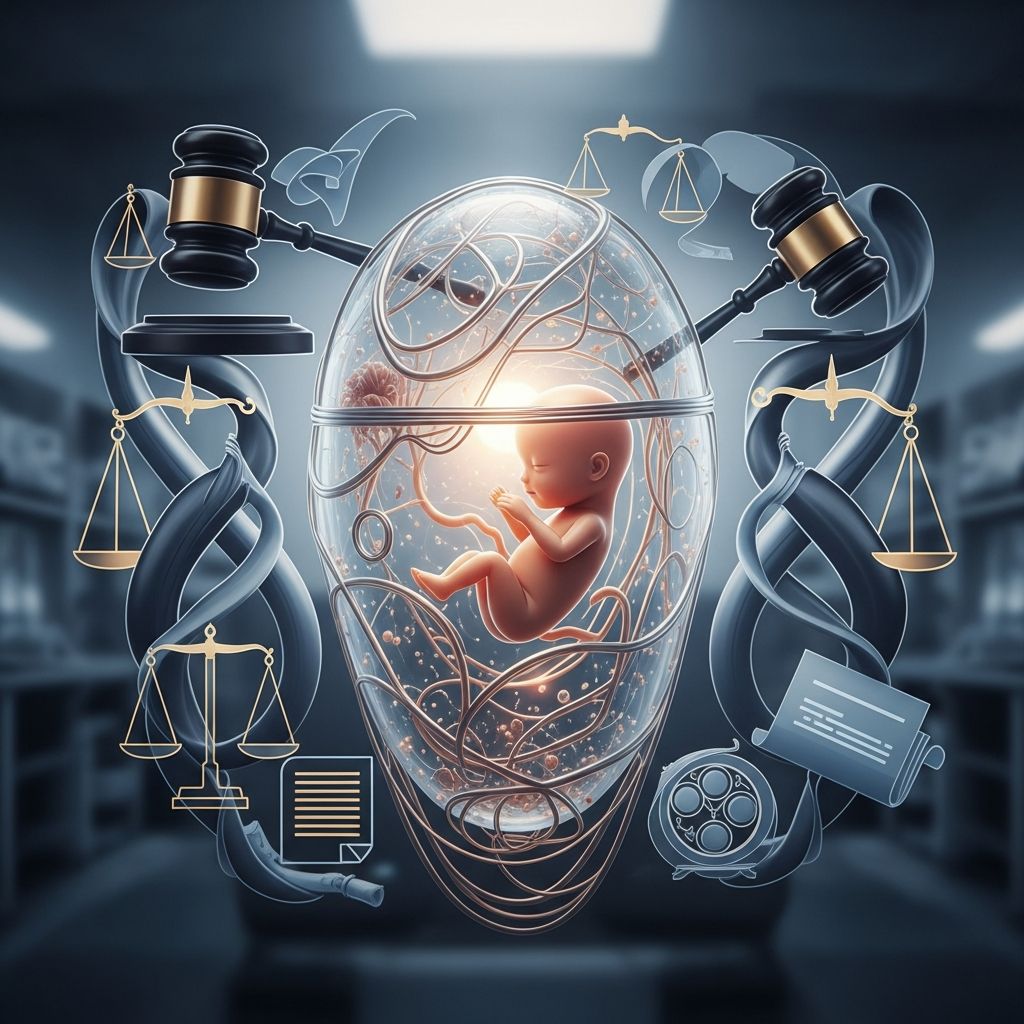
Advancements in artificial womb technology, known as ectogenesis, could fundamentally alter human reproduction by enabling fetuses to develop entirely outside the human body. This innovation challenges established legal frameworks surrounding pregnancy, abortion, and parental rights, particularly following the 2022 Dobbs v. Jackson Women’s Health Organization decision that overturned Roe v. Wade.
Understanding Ectogenesis and Its Technological Foundations
Ectogenesis refers to the complete or partial development of a fetus in an artificial environment, bypassing traditional gestation in a woman’s uterus. Recent prototypes, such as artificial placenta systems, have successfully sustained premature lamb fetuses, signaling potential human applications within the next decade. These devices mimic the placenta’s role in oxygenating blood, removing waste, and providing nutrients, potentially rescuing extremely preterm infants or enabling full-term ectogenesis.
While animal trials show promise, human implementation faces biological hurdles like immune responses and long-term developmental outcomes. Legally, this shift prompts reevaluation of concepts like fetal viability—the point at which a fetus can survive outside the womb—which has long anchored abortion regulations. Earlier viability enabled by ectogenesis could compress regulatory timelines, intensifying debates over state intervention in reproduction.
Redefining Fetal Viability in the Artificial Era
Viability traditionally marks the threshold for state protection of fetal life, typically around 24 weeks gestation. Artificial wombs could push this to as early as 12-16 weeks, upending trimester-based frameworks from Roe and Casey. Under an unmodified viability standard, states might restrict abortions earlier, arguing ectogenesis offers a viable alternative to termination.
This redefinition carries profound implications. Proponents argue it enhances fetal rescue, while critics warn it erodes women’s autonomy by mandating continuation via technology. Post-Dobbs, states with strict abortion bans could compel ectogenesis use, framing it as a non-lethal alternative, thus challenging bodily integrity rights.
Shifting Dynamics of Parental and State Interests
In natural pregnancy, maternal rights often supersede paternal and state interests due to bodily autonomy. Ectogenesis disrupts this balance: with the fetus ex utero, neither parent bears physical burdens, equalizing genetic parents’ claims. Courts might treat the artificial womb like frozen embryo disputes, where no single party holds unilateral unplugging rights.
State interests in fetal protection intensify. If personhood extends to ectogenic fetuses, governments could regulate devices as life-sustaining medical equipment, prohibiting disconnection akin to neonatal care. This raises coercion risks, especially for low-income women pressured into ectogenesis over abortion. Paternal rights could strengthen, allowing fathers veto power over termination if the fetus is transferred to an artificial system.
| Interest Holder | Natural Pregnancy | Artificial Womb Scenario |
|---|---|---|
| Maternal | Predominant due to bodily burden | Diminished; shared with father/state |
| Paternal | Secondary to mother’s autonomy | Equalized, potential veto on disconnection |
| State | Limited pre-viability | Expanded protection post-transfer |
Contractual Enforceability in Reproductive Technology
Agreements over ectogenic fetuses—such as custody arrangements or usage terms—pose enforceability challenges. Analogous to IVF embryo contracts, which vary by jurisdiction (e.g., enforceable in some states, favoring intent in others), artificial womb pacts could be deemed against public policy if they commodify life.
Parents might contract for gestation services, but disputes over ‘unplugging’ could arise. Courts may prioritize fetal welfare, invalidating clauses permitting termination. International variations complicate surrogacy-like arrangements, where ectogenesis blurs gestational and genetic roles. Robust regulation is needed to validate contracts while safeguarding against exploitation.
Liability Risks and Regulatory Gaps
Malfunctions in artificial wombs could cause fetal harm, spawning liability for manufacturers, operators, and parents. Existing tort law applies—negligence, products liability—but novel issues emerge: Who is liable if a parent disconnects prematurely? Does state-mandated use shield providers?
Insurance and malpractice frameworks must adapt. Premature infants from ectogenesis might face heightened disability risks, amplifying claims. Regulatory bodies like the FDA would oversee approval, but post-market surveillance lags behind the pace of innovation. International standards are absent, risking a patchwork of liability regimes.
- Manufacturer Liability: Defects leading to developmental issues.
- Provider Liability: Errors in monitoring or intervention.
- Parental Liability: Unauthorized modifications or disconnections.
- State Liability: Coercive policies resulting in harm.
Ethical Concerns and Societal Impacts
Beyond legality, ectogenesis risks commodifying reproduction, exacerbating inequalities. Wealthy access could widen divides, turning gestation into a luxury service. Ethical debates question moral status: Is an ex utero fetus equivalent to a neonate, barring ‘turning off’ even in suffering cases?
Gender equity promises—relieving women of gestation burdens—clash with fears of reduced abortion access. Reproductive justice demands equitable distribution to prevent eugenics-like selection.
Post-Dobbs Landscape: Abortion and Ectogenesis
Dobbs returned abortion regulation to states, many banning post-viability procedures. Ectogenesis could be positioned as an abortion alternative, pressuring women into technological gestation. Advocates warn this substitutes one burden for another, ignoring consent and costs.
Legal personhood debates intensify: If fetuses gain rights earlier via ectogenesis, bans expand. Conversely, it might liberalize access by decoupling abortion from fetal destruction.
Global Perspectives and International Law
Europe’s Abortion Convention and embryo research bans may restrict ectogenesis. The UN’s human rights framework emphasizes autonomy, potentially clashing with state fetal protections. Harmonized standards are crucial for cross-border reproduction.
Pathways for Legal Adaptation
Lawmakers must craft proactive frameworks: Define ectogenic viability, standardize contracts, allocate liabilities, and ensure access equity. Value-sensitive design—incorporating ethics from inception—mitigates risks. International collaboration could yield model legislation balancing innovation and rights.
Frequently Asked Questions (FAQs)
What is an artificial womb?
An artificial womb, or ectogenesis device, sustains fetal development outside the human body, mimicking placental functions.
How does ectogenesis affect abortion rights?
It could redefine viability earlier, enabling states to restrict abortions by offering technological alternatives post-Dobbs.
Who holds rights over an ectogenic fetus?
Balances shift; paternal and state interests may equalize with maternal, akin to embryo disputes.
Are contracts for artificial wombs enforceable?
Likely partial, drawing from IVF precedents, but fetal welfare may override.
What liabilities arise from artificial wombs?
Manufacturers, providers, and users face negligence and product claims for fetal harm.
References
- The Era of Artificial Womb Technology — Manasi Singh, Journal of Law and Technology at Richmond. 2023-01-26. https://jolt.richmond.edu/2023/01/26/the-era-of-artificial-womb-technology/
- How Viable is Viability? Artificial Womb Technology and the Threat… — Michigan Journal of Gender & Law. 2023. https://repository.law.umich.edu/cgi/viewcontent.cgi?article=1313&context=mjgl
- How Will Artificial Wombs Affect the Legal Status of a Fetus or… — Chicago-Kent Law Review. N/A. https://scholarship.kentlaw.iit.edu/cgi/viewcontent.cgi?article=3724&context=cklawreview
- Navigating the Legal and Ethical Implications of Artificial Womb… — Washington University University Law Review. 2024. https://journals.library.wustl.edu/wuulr/article/id/9075/
- Novel forms of assisted gestation, legal challenges, and… — Journal of Law and the Biosciences. 2023. https://academic.oup.com/jlb/article/10/2/lsad027/7335821
- Ethical, Translational, and Legal Issues Surrounding the Novel… — PMC (Peer-reviewed). 2022. https://pmc.ncbi.nlm.nih.gov/articles/PMC9704017/
Similar Articles








Read full bio of Sneha Tete




