
Airport Wi-Fi Security For Lawyers: Practical Travel Checklist
Essential strategies for attorneys to safeguard client data on airport Wi-Fi networks amid rising cyber threats.
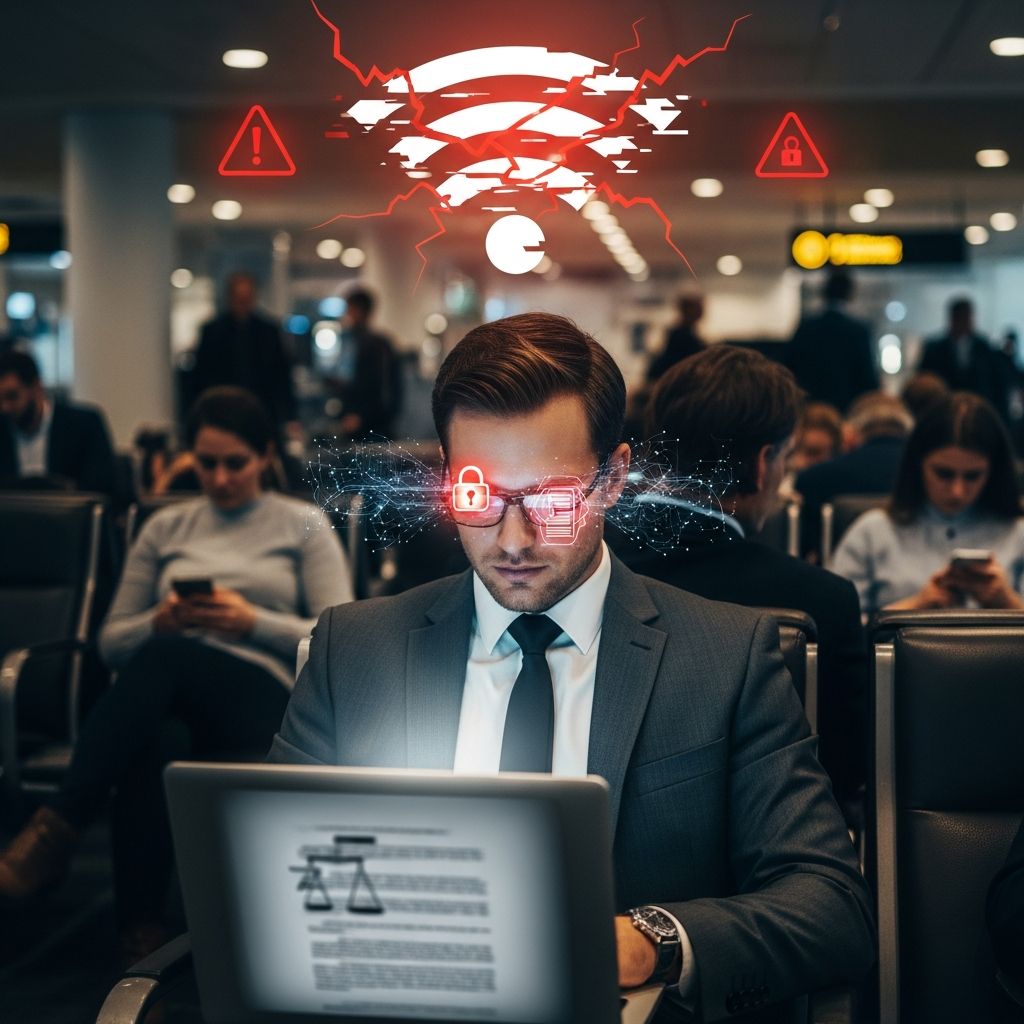
Attorneys frequently rely on airport Wi-Fi for urgent case reviews, client communications, and document access during travel. However, these public networks pose significant threats to client confidentiality and professional ethics. This article explores the vulnerabilities, legal responsibilities, and proven defenses to enable safe connectivity.
Understanding Vulnerabilities in Airport Networks
Airport Wi-Fi hotspots attract millions of travelers daily, creating fertile ground for cybercriminals. Unsecured connections allow hackers to monitor data flows, capturing login credentials, emails, and sensitive files transmitted without protection.
- Open Access Points: Networks labeled ‘Free Airport Wi-Fi’ often lack encryption, exposing all traffic to anyone on the same connection.
- Rogue Hotspots: Attackers deploy fake networks mimicking official ones to trick users into connecting and surrendering data.
- Man-in-the-Middle Exploits: Intermediaries intercept sessions, altering content or stealing information mid-transmission.
These risks escalate in high-traffic environments where oversight is minimal. A brief login to check emails can unwittingly expose entire case files.
Ethical Obligations Under Professional Rules
Lawyers must uphold confidentiality as mandated by rules like ABA Model Rule 1.6, requiring reasonable efforts to prevent unauthorized access to client information. Courts have clarified that public Wi-Fi transmissions are protected under federal law, yet ethical standards demand proactive safeguards beyond basic assumptions of privacy.
In Joffe v. Google, Inc., the Ninth Circuit ruled that Wi-Fi communications are not ‘readily accessible to the general public,’ invoking exceptions under the Wiretap Act (18 U.S.C. § 2511). This decision affirms that using such networks does not inherently breach confidentiality duties, provided additional precautions align with ‘reasonable efforts.’
| Risk Factor | Ethical Implication | Mitigation Strategy |
|---|---|---|
| Unencrypted Traffic | Potential Rule 1.6 Violation | Enable HTTPS and VPN |
| Fake Networks | Unauthorized Disclosure | Verify SSID with Official Sources |
| Device Border Searches | Compelled Data Exposure | Use Clean Devices or Cloud Disconnect |
Practical Steps for Secure Airport Connectivity
To minimize exposure, attorneys should adopt layered defenses. Start by confirming the legitimacy of the network through airport apps or signage, avoiding suspiciously named options.
- Activate VPN Immediately: A Virtual Private Network creates an encrypted tunnel, shielding data from local threats. Essential for accessing firm servers or cloud storage.
- Prefer Cellular Data: Switch to mobile hotspots when possible, as they offer inherent encryption superior to public Wi-Fi.
- Avoid Sensitive Tasks: Postpone filing documents, client calls, or financial transactions until secured environments.
- Enable Device Firewalls: Built-in tools on laptops and phones block unsolicited inbound connections.
For international travel, additional vigilance is required. U.S. Customs and Border Protection can inspect devices without warrants, potentially accessing unencrypted data.
Advanced Tools and Technologies for Protection
Beyond basics, specialized software fortifies defenses. Endpoint detection tools monitor for anomalies, while full-disk encryption (e.g., BitLocker or FileVault) protects stored files.
- Two-Factor Authentication (2FA): Adds a secondary verification layer, thwarting credential theft.
- Secure Browsers: Extensions like HTTPS Everywhere enforce encrypted connections.
- Remote Wipe Capabilities: Cloud services allowing data erasure if devices are lost or seized.
Firms should implement mobile device management (MDM) systems to enforce policies remotely, ensuring compliance across traveling staff.
International Travel: Heightened Border Risks
Crossing borders amplifies concerns, as agents may demand device unlocks. The ACLU notes that searches occur without probable cause, affecting citizens and residents alike. Legal ethics opinions recommend pre-trip preparations:
- Purchase burner devices loaded only with travel essentials.
- Disable cloud sync and log out of all accounts before arrival.
- Store critical data in segmented, access-restricted cloud vaults.
Post-search, conduct audits to verify no data was copied or compromised.
Building a Firm-Wide Travel Security Policy
Individual actions suffice for solo practitioners, but firms need comprehensive policies. Train staff on recognizing phishing via fake Wi-Fi and conduct regular simulations of airport scenarios.
Key policy elements include mandatory VPN usage, annual cybersecurity certifications, and incident response plans for breaches. The U.S. Department of Transportation oversees aviation consumer protections, which indirectly support secure travel tech.
| Policy Component | Implementation | Benefit |
|---|---|---|
| VPN Mandate | All remote connections | Encryption Guarantee |
| Device Inventory | Pre-travel checklists | Risk Assessment |
| Training Drills | Quarterly sessions | Heightened Awareness |
| Breach Reporting | 24-hour protocol | Swift Mitigation |
Case Studies: Lessons from Real Incidents
While specifics are often confidential, aggregated reports highlight patterns. A law firm once suffered a data leak from an airport lounge connection, leading to client alerts and regulatory scrutiny. Proper VPN use prevented escalation.
Another incident involved international travel where border agents accessed an unencrypted laptop, prompting ethics complaints. These underscore the need for diligence.
Frequently Asked Questions
Is airport Wi-Fi safe enough for basic emails?
No, even routine messages can contain metadata revealing client identities. Always use VPN for any firm-related activity.
Does the Wiretap Act fully protect public Wi-Fi use?
The Ninth Circuit’s Joffe ruling provides safeguards, but ethics require more than legal minimums.
What if I forget my VPN at the gate?
Fall back to cellular data or delay non-essential tasks. Never proceed unprotected.
Are there VPN recommendations for lawyers?
Choose enterprise-grade options with no-logs policies, kill switches, and legal jurisdiction transparency.
How often should firms update travel policies?
Annually or after major incidents like new border rules or cyber trends.
Future Trends in Travel Cybersecurity
Emerging 5G networks promise better security, but public 5G hotspots will inherit Wi-Fi flaws. Biometric firm logins and AI-driven threat detection are gaining traction, offering proactive shields for mobile attorneys.
Regulators may impose stricter airport network standards, aligning with FAA oversight of aviation tech.
References
- Why Lawyers Should Stop Worrying About Using Public Wi-Fi Networks — LA Legal Ethics. 2013-09-10. https://lalegalethics.org/lawyers-stop-worrying-using-public-wi-fi-networks/
- What Every Attorney Should Know About Using Public Wi-Fi and Remote Devices — EpiOn. N/A. https://www.epion.com/resources/blog/what-every-attorney-should-know-about-using-public-wi-fi-and-remote-devices
- How Lawyers Can Connect to Public Wi-Fi Safely — Legal Fuel. N/A. https://www.legalfuel.com/how-lawyers-can-connect-to-public-wi-fi-safely-guest-post/
- Ethical Implications for Attorneys Traveling Internationally — Attorney at Law Magazine. N/A. https://attorneyatlawmagazine.com/legal/legal-news/ethical-implications-for-attorneys-traveling-internationally
- Can Border Agents Search Your Electronic Devices? It’s Complicated — American Civil Liberties Union (ACLU). N/A. https://www.aclu.org/news/privacy-technology/can-border-agents-search-your-electronic
- Airports and FAA Regulatory — Snell & Wilmer. N/A. https://www.swlaw.com/service/airport-and-faa-regulatory/
- The Importance of VPNs for Lawyers on the Move — Oklahoma Bar Association. N/A. https://www.okbar.org/cm_articles/the-importance-of-vpns-for-lawyers-on-the-move/
Similar Articles








Read full bio of medha deb




