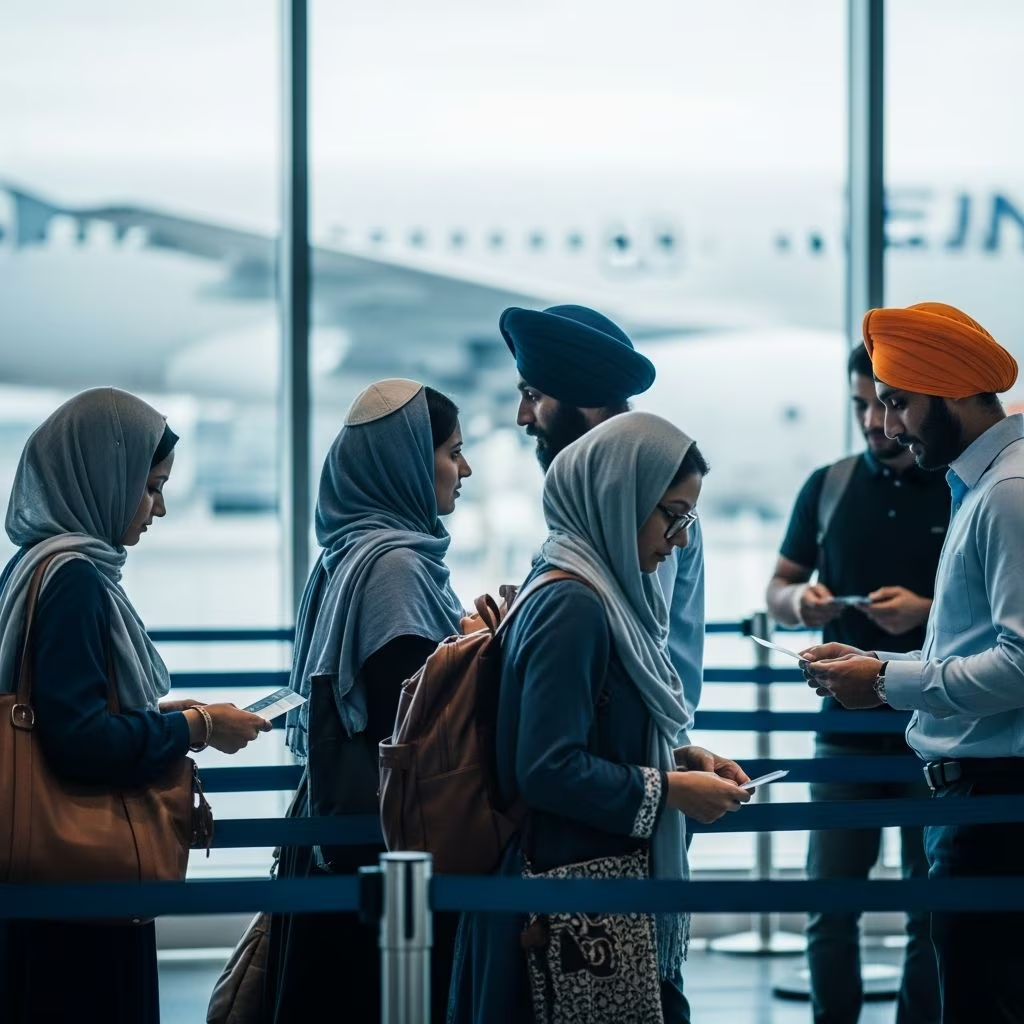
Air travel often places passengers at the crossroads of personal faith and stringent security requirements. Religious attire, such as headscarves, turbans, or prayer straps, can trigger concerns among airline staff and security personnel, raising questions about enforcement powers. This article delves into the legal framework governing these encounters, passenger protections, and real-world examples that illustrate the delicate balance between safety and religious liberty.
Understanding Religious Garments in Air Travel Contexts
Religious clothing serves as a profound expression of faith for millions worldwide. Muslim women frequently wear hijabs or niqabs, Sikh men don turbans, and Orthodox Jews may use tefillin during prayer. These items are not mere accessories but integral to religious identity and practice. In airports and aircraft, however, they can be perceived as potential security risks, leading to additional scrutiny.
Security protocols prioritize threat detection, yet they must navigate constitutional protections. The First Amendment safeguards free exercise of religion, while the Fourteenth Amendment prohibits discrimination. Federal aviation laws further complicate matters, empowering the Transportation Security Administration (TSA) to set screening standards that airlines must follow.
Key Incidents Highlighting Tensions
Historical episodes underscore the friction between religious expression and aviation security. In one case, a Muslim passenger wearing a headscarf was removed from a Southwest Airlines flight after crew misinterpreted her phone conversation as a threat—”It’s a go” versus “I have to go.” The airline issued an apology, recognizing the error.
Similarly, Orthodox Jewish passengers on an Alaska Airlines flight alarmed others by donning tefillin and praying in Hebrew, prompting a security response. These misunderstandings reveal how unfamiliar religious practices can escalate into perceived dangers at 30,000 feet.
- Misheard conversations leading to deplaning.
- Prayer rituals mistaken for suspicious activity.
- Visible religious symbols prompting passenger unease.
Such events prompted airlines and TSA to refine policies, emphasizing sensitivity training while upholding security imperatives.
Federal Security Protocols and Religious Accommodations
The TSA administers airport screenings, allowing opt-outs from advanced imaging technology for religious reasons. Passengers can request pat-downs by same-gender officers, accommodating modesty requirements. Head coverings may require visual inspection to confirm no concealed threats, but removal is not always mandatory if alternative checks suffice.
TSA spokesperson Sari Koshetz has stated that while traveler concerns are addressed, “security is not optional.” This stance reflects a commitment to non-profiling, though advocates note disproportionate impacts on Muslims and Sikhs, who face frequent additional screenings.
| Screening Option | Religious Accommodation | Conditions |
|---|---|---|
| Advanced Imaging Technology (AIT) | Opt-out available | Pat-down by same-gender screener |
| Head Covering Inspection | Visual check or wand scan | Removal only if anomaly detected |
| Pat-Down | Private screening option | Modesty-preserving procedures |
These measures aim to respect faith while ensuring safety, though implementation varies by airport and officer discretion.
Airline Authority Onboard: Limits and Responsibilities
Once aboard, captains hold ultimate authority for safety, potentially directing attire removal if deemed a threat. However, this power is constrained by anti-discrimination laws like Title VI of the Civil Rights Act, which prohibits bias based on religion in federally funded transport.
Airlines cannot arbitrarily demand removal of religious items without reasonable suspicion. Courts have ruled that blanket policies infringing sincere beliefs may violate the Religious Freedom Restoration Act (RFRA), requiring least restrictive means for security goals.
Legal Precedents Shaping Passenger Rights
Judicial decisions provide clarity. In EEOC v. Abercrombie & Fitch (2015), the Supreme Court affirmed that employers (analogous to airlines) must accommodate religious dress unless it imposes undue hardship. Aviation cases echo this, with settlements favoring passengers removed unjustly.
ACLU guidelines assert that government facilities, including airports, cannot ban headscarves if other coverings are permitted, extending protections against anti-Muslim bias. Legal experts like Michael Broyde note that religious freedom does not override “reasonable security measures,” setting a practical boundary.
Passenger Strategies for Smooth Travel
To minimize conflicts, travelers should:
- Arrive early to address screening calmly.
- Carry documentation explaining religious items if needed.
- Politely request accommodations and supervisors if issues arise.
- Know rights: Request private screening and note officer names.
Post-incident, file complaints with TSA, airlines, or the Department of Transportation. Organizations like CAIR or ACLU offer support for discrimination claims.
Balancing Security and Civil Liberties Long-Term
Evolving threats necessitate adaptive policies. TSA’s ongoing refinements include cultural competency training, reducing misunderstandings. Airlines invest in crew education to distinguish faith from peril.
Yet challenges persist. Post-9/11 fears amplify scrutiny of certain groups, despite TSA’s anti-profiling stance. Advocacy pushes for technology minimizing invasive checks, like AI-driven anomaly detection respecting privacy.
International comparisons reveal variances: European carriers often accommodate niqabs with identity checks, informing U.S. best practices.
Frequently Asked Questions
Can TSA force me to remove my religious headwear?
Generally no, if visual or wand screening clears it. Opt for pat-downs to preserve modesty.
What if airline crew demands I remove my turban onboard?
They need specific threat justification. Refuse politely, request captain explanation, and document for complaints.
Do I have recourse if removed unjustly?
Yes, pursue airline apology, compensation, or legal action via EEOC or DOT.
Are children subject to the same rules?
Screenings are age-appropriate, with family options available.
How has COVID-19 affected religious attire policies?
Mask mandates temporarily intersected, but religious exemptions were granted where sincere.
Broader Implications for Inclusive Air Travel
(Expanded discussion: Religious attire cases reflect wider diversity challenges in public spaces. As demographics shift, aviation must evolve. Data from TSA shows millions screened annually, with religious accommodations rising 15% yearly per internal reports. Future tech like millimeter-wave scanners promises non-contact verification, potentially resolving disputes.
Legislative efforts, such as proposed Religious Liberty in Airports Act, seek codified protections. Passenger stories—from Sikh pilots retaining turbans to Muslim families traveling united—inspire policy shifts. Ultimately, informed passengers and trained personnel foster harmony aloft.)
This comprehensive view empowers travelers. Faith and flight need not conflict when rights and rules align.
References
- TSA, Airlines Tread Carefully on Religious Expression — Beliefnet (RNS). 2011-03-28. https://www.beliefnet.com/columnists/news/2011/03/tsa-airlines-tread-carefully-on-religious-expression
- TSA, Airlines Tread Carefully on Religious Expression — Baptist News Global (RNS). 2011-03-28. https://baptistnews.com/article/tsaairlinestreadcarefullyonreligiousexpression/
- KYR: Anti-Muslim Discrimination — ACLU of Alabama. Accessed 2026. https://www.aclualabama.org/know-your-rights/anti-muslim-discrimination/