
ADA Website Compliance for Small Businesses
Essential guide for small businesses to achieve ADA-compliant websites, avoid lawsuits, and serve all customers effectively.
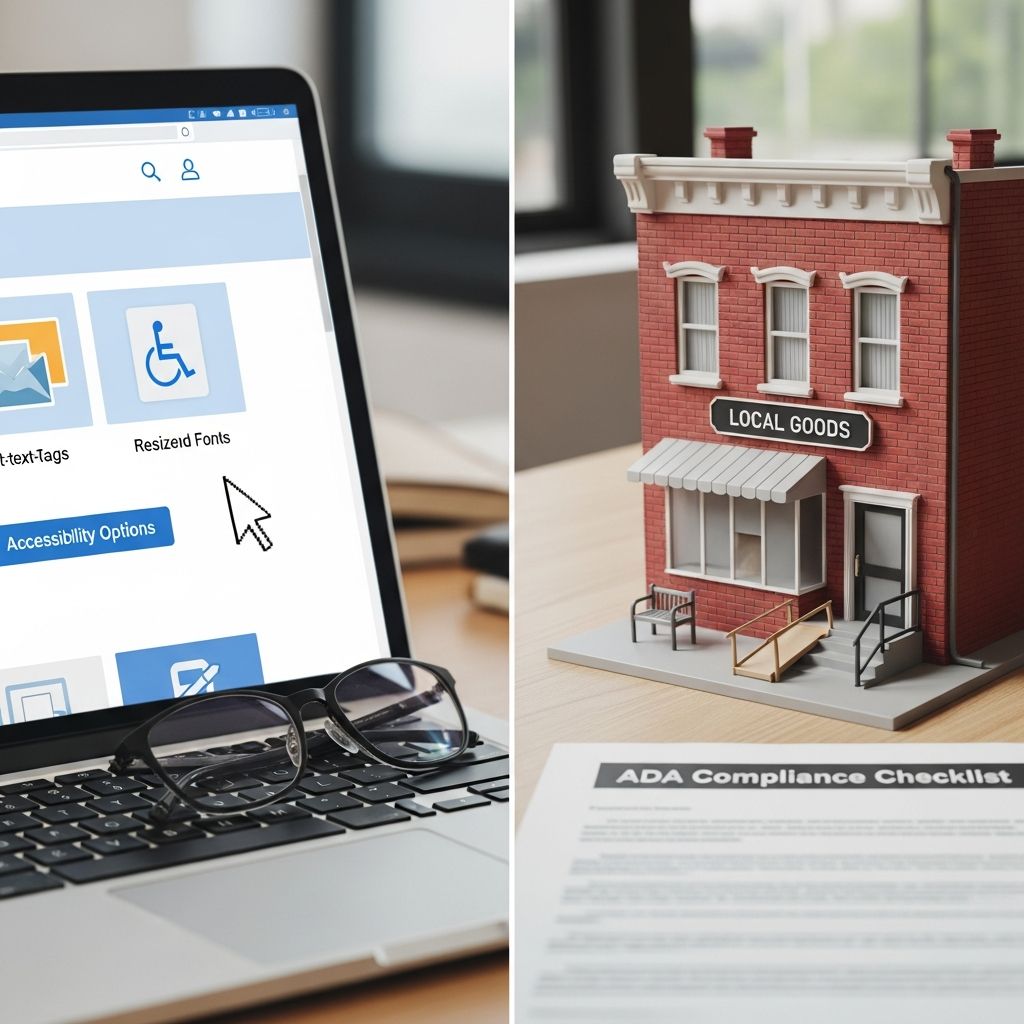
Small businesses must ensure their websites are accessible to people with disabilities to comply with the Americans with Disabilities Act (ADA), primarily under Title III, which covers public accommodations. Courts have extended ADA requirements to digital spaces, referencing WCAG 2.1 Level AA as the standard benchmark for navigation, forms, media, and documents.
Understanding ADA Applicability to Online Platforms
The ADA, enacted in 1990, prohibits discrimination against individuals with disabilities in public accommodations, and U.S. courts have ruled that websites qualify as such spaces. This applies to small businesses regardless of size if they offer goods or services online, including e-commerce sites and informational pages. The U.S. Department of Justice (DOJ) guidance confirms that businesses open to the public must make websites usable by people with disabilities, covering issues like visual, auditory, motor, cognitive, and seizure-related impairments.
Physical locations aren’t the only focus; digital barriers, such as unlabelled images or incompatible forms, can exclude users relying on assistive technologies like screen readers. Failure to comply risks lawsuits, with plaintiffs often using ‘drive-by’ tactics to target non-compliant sites.
Core Principles of Web Accessibility
Web accessibility follows four key principles from WCAG, developed by the World Wide Web Consortium (W3C): Perceivable, Operable, Understandable, and Robust (POUR).
- Perceivable: Content must be presented in ways users can perceive, e.g., text alternatives for images, captions for videos.
- Operable: Interfaces must be navigable via keyboard, with no timing traps or low-contrast elements that could trigger seizures.
- Understandable: Content and operation should be predictable, with readable text and clear error messages.
- Robust: Compatible with assistive technologies like screen readers (e.g., NVDA, JAWS).
WCAG 2.1 Level AA is the most commonly referenced level in lawsuits and DOJ interpretations, building on WCAG 2.0.
Legal Risks and Rising Litigation Trends
Small businesses face increasing ADA website lawsuits, often from serial litigants scanning for violations. Title III allows private suits for injunctive relief, and while monetary damages are rare without ‘auxiliary aids’ violations, legal fees can exceed $25,000 per case. The DOJ has not yet finalized rules for private businesses like Title II for governments (effective 2024), but guidance urges proactive compliance.
| Risk Factor | Potential Consequence | Mitigation |
|---|---|---|
| Inaccessible forms/buttons | Lawsuit for navigation barriers | Keyboard navigation testing |
| Missing alt text on images | Exclusion of blind users | Implement descriptive alt attributes |
| No captions on videos | Auditory impairment exclusion | Add transcripts/captions |
| Low color contrast | Low-vision user issues | Meet 4.5:1 ratio |
Practical Steps to Achieve Compliance
Start with an audit using automated tools like accessScan, which scores sites against WCAG 2.1 AA after URL submission. Follow up with manual testing by experts or users with disabilities for comprehensive coverage, as automation misses contextual issues.
- Conduct Initial Audit: Use free tools like WAVE or Lighthouse; aim for WCAG 2.1 AA.
- Remediate Issues: Fix code-level problems, e.g., semantic HTML, ARIA labels.
- Test with Assistive Tech: Verify screen reader compatibility and keyboard-only navigation.
- Document Efforts: Maintain an accessibility statement and VPAT (Voluntary Product Accessibility Template).
- Ongoing Monitoring: Schedule quarterly audits as content evolves.
Accessibility for E-Commerce and Documents
E-commerce sites need simple navigation, clear labels, and product descriptions readable by screen readers. Ensure checkout processes are barrier-free. For documents like PDFs, use built-in checkers in Adobe Acrobat or Microsoft Office to add tags, alt text for images, and logical reading order.
Alternate formats for media: Provide transcripts for podcasts, captions for videos. Tax incentives like the Disabled Access Credit (up to $5,000) and Architectural Barrier Removal Deduction (up to $15,000) can offset costs.
Employee Training and Broader Compliance
ADA Title I requires workplace accommodations, complementing Title III. Train staff on disability etiquette, screen reader basics, and policy implementation. The DOJ’s 2010 Standards and primer guide small businesses on integrated physical-digital accessibility.
Benefits Beyond Compliance
Accessible sites reach 15% of the U.S. population with disabilities, boosting SEO, market share, and loyalty. User-friendly design benefits all, improving conversion rates.
Frequently Asked Questions
Does ADA apply to all small businesses with websites?
Yes, if offering public accommodations online, regardless of employee count.
What is WCAG 2.1 AA?
Web Content Accessibility Guidelines Level AA, the court-referenced standard for perceivable/operable content.
How much does compliance cost small businesses?
Varies; overlays start at $500/year, full remediation $5,000+, with tax credits available.
Can automated tools ensure full compliance?
No; they handle 30-50% of issues—manual testing is essential.
What if my site links to third-party content?
You may be liable; choose accessible vendors and provide alternatives.
References
- What You Need to Know About ADA Compliance for Small Business — accessiBe. 2023. https://accessibe.com/blog/knowledgebase/ada-compliance-for-small-businesses
- Small Businesses and Website Accessibility under the ADA — Brown Fox Law. 2023-05-15. https://brownfoxlaw.com/small-businesses-and-website-accessibility-under-the-ada/
- ADA Compliance Solutions for Small Businesses — EqualWeb. 2024. https://www.equalweb.com/11584/11529/ada_and_small_businesses
- ADA Website Accessibility — NFIB. 2025-08. https://www.nfib.com/wp-content/uploads/2025/08/ADA-Website-Accessibility.pdf
- ADA Website Accessibility Lawsuits: How to Protect Your Business — U.S. Chamber of Commerce. 2024. https://www.uschamber.com/co/run/technology/ada-website-accessibility-compliance
- ADA Update: A Primer for Small Business — U.S. Department of Justice (ada.gov). 2011-03-15. https://www.ada.gov/resources/title-iii-primer/
- Accessibility of Web Content and Mobile Apps Provided by State and Local Government Entities: A Small Entity Compliance Guide — U.S. Department of Justice (ada.gov). 2024-04-24. https://www.ada.gov/resources/small-entity-compliance-guide/
- Guidance on Web Accessibility and the ADA — U.S. Department of Justice (ada.gov). 2024. https://www.ada.gov/resources/web-guidance/
Similar Articles








Read full bio of medha deb




