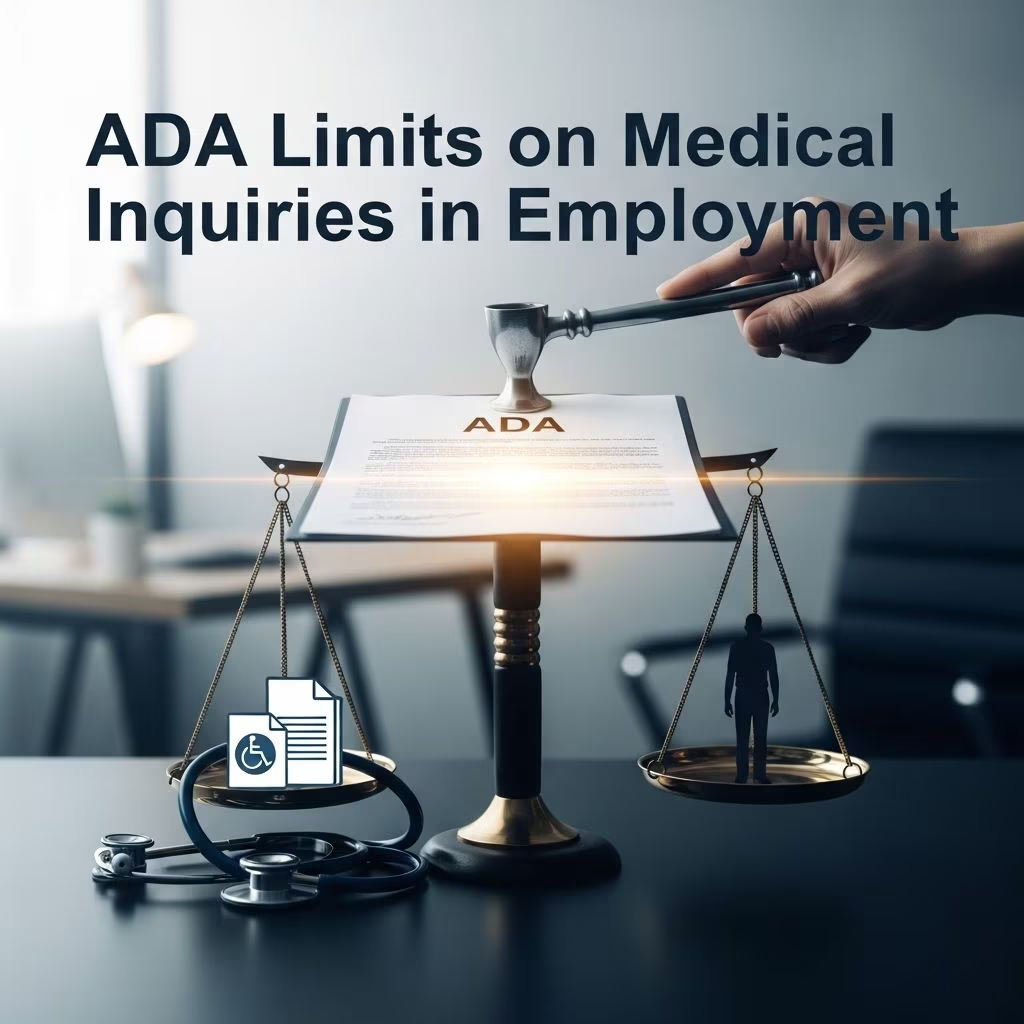
Employers navigating the Americans with Disabilities Act (ADA) must carefully balance workplace safety with employee privacy. The law strictly regulates when and how companies can request health information from workers, prohibiting inquiries that are not directly tied to job performance or safety. Violations can lead to costly lawsuits and settlements, making compliance essential for businesses of all sizes.
Core Principles of ADA Medical Inquiry Restrictions
The ADA, enforced by the Equal Employment Opportunity Commission (EEOC), divides employment into three stages: pre-offer, post-offer (before starting work), and during employment. Each stage has unique rules to prevent discrimination against individuals with disabilities.
- Pre-offer phase: No questions about disabilities or health history are allowed, as they could screen out qualified applicants unfairly.
- Post-conditional offer: Medical exams are permitted but must be job-related and applied uniformly to all entering the same job category.
- Current employees: Inquiries are limited to those that are job-related and consistent with business necessity.
These rules aim to protect workers from intrusive probing while allowing employers to assess genuine risks. For instance, a “disability-related inquiry” is any question likely to reveal a disability, such as asking about past hospitalizations or medications unrelated to the role.
When Can Employers Legally Request Health Information?
Medical inquiries and exams are not outright banned but must meet strict criteria. During employment, they are justifiable only if based on objective evidence, like observed performance issues or safety concerns.
| Permissible Scenarios | Examples | Requirements |
|---|---|---|
| Job-related and business necessity | Fitness-for-duty exam after an accident | Objective evidence of impairment affecting essential functions |
| Federal or safety regulations | DOT physicals for drivers | Mandated by law, narrowly tailored |
| Return from leave | Eval for high-risk roles post-absence | Not blanket policy; individualized assessment |
| Voluntary wellness programs | Optional health screenings | No coercion; incentives limited |
Employers must demonstrate a “reasonable belief” supported by facts, not rumors or stereotypes. For example, if an employee’s behavior raises safety flags, a targeted exam by a qualified professional is allowable, but demanding full medical records is not.
Defining Overly Broad or Intrusive Inquiries
Overly broad inquiries seek information beyond what’s needed to evaluate job fitness. Common mistakes include requesting complete medical histories, genetic data, or details about family health, which violate ADA confidentiality mandates. In one case, an employer faced a $70,000 EEOC settlement for demanding an expansive exam unrelated to the worker’s forklift operation, coupled with premature termination threats.
Courts evaluate breadth using factors like the exam’s scope, invasiveness, and purpose. Personality tests measuring mental health traits, such as depression or paranoia, have been ruled medical exams under the ADA, even if non-medical staff administer them. Blanket policies, like requiring psych evals for all returning from any leave, often fail scrutiny, as seen in lawsuits against police departments.
Practical Strategies for Compliance
To stay within ADA bounds, employers should adopt targeted approaches.
- Document concerns objectively: Base requests on specific incidents, e.g., “Employee struggled with heavy lifting after injury,” not “Seems unhealthy.”
- Limit scope: Ask only for info on ability to perform essential functions, like “Can you safely operate machinery?”
- Use experts: Select examiners knowledgeable in the condition, ensuring reports focus on job fitness.
- Maintain confidentiality: Store medical data separately, accessible only to HR and supervisors needing it.
- Train staff: Educate managers on ADA dos and don’ts to prevent rogue inquiries.
During the accommodation process, acknowledge requests promptly and request documentation only if the need isn’t obvious. Avoid demanding diagnoses; functional limitations suffice.
Consequences of Non-Compliance
Breaches trigger EEOC investigations, lawsuits, and penalties. Employees need only show the inquiry could elicit disability info; the burden then shifts to employers to prove job-relatedness. Settlements often exceed $50,000, plus legal fees, and damage employer reputation. Recent court rulings reinforce these limits, with circuits upholding exams only when narrowly tailored.
Special Considerations for High-Risk Industries
Manufacturing, transportation, and public safety roles permit more inquiries due to inherent risks. However, even here, exams must address specific concerns, like a machine operator’s opioid use confirmed by doctor’s notes. Periodic physicals for safety-sensitive positions are okay if uniformly applied and focused.
Wellness programs offer another avenue but must remain voluntary. Post-2017 court challenges, EEOC rules cap incentives at 30% of health premiums to avoid coercion.
Frequently Asked Questions
Can I ask about an employee’s COVID-19 vaccination status?
Yes, if job-related, like for healthcare workers, but not generally for office roles unless safety necessitates it.
What if an employee requests an accommodation?
Request supporting docs on limitations, not full diagnosis. Keep it minimal and relevant.
Is a return-to-work exam always required after FMLA leave?
No; only if reasonable belief of unfitness based on evidence, not automatically.
How do I handle observed erratic behavior?
Conduct a fitness-for-duty exam focused on safety risks, using objective observations.
What counts as a medical exam under ADA?
Any test seeking physical/mental impairment info, including some psychological assessments.
Navigating Evolving ADA Interpretations
ADA rules have evolved with the 2008 Amendments, broadening disability definitions and tightening inquiry standards. EEOC guidance, though pre-ADAAA, remains foundational, emphasizing proportionality. Recent cases underscore avoiding speculation-driven probes, prioritizing accommodations over exclusion.
Businesses should consult legal experts for tailored advice, especially amid post-pandemic shifts in health inquiries. Proactive policies foster inclusive environments while mitigating risks.
References
- Enforcement Guidance on Disability-Related Inquiries and Medical Examinations of Employees under the ADA — U.S. Equal Employment Opportunity Commission (EEOC). 1999-07-27 (authoritative pre-ADAAA guidance, still cited). https://www.eeoc.gov/laws/guidance/enforcement-guidance-disability-related-inquiries-and-medical-examinations-employees
- Legal Brief: Revisiting Disability-Related Inquiries and Medical Examinations under Title I of the ADA — ADA National Network. 2023 (recent analysis). https://adata.org/legal_brief/legal-brief-revisiting-disability-related-inquiries-and-medical-examinations-under-title
- The Americans with Disabilities Act and Medical Examinations — Federal Bar Association. 2010-03 (official bar publication). https://www.fedbar.org/wp-content/uploads/2010/03/le-marapr2010-pdf-1.pdf
- USA: Best Practices for Manufacturers Managing Employee Medical Inquiries under the ADA — L&E Global (drawing on official sources). 2023-03-29. https://leglobal.law/2023/03/29/usa-best-practices-for-manufacturers-managing-employee-medical-inquiries-under-the-ada/
- Mistakes Employers Make During the ADA Accommodation Process — Green Bay Innovation Group (EEOC-informed). 2023 (recent). https://greenbayinnovationgroup.com/mistakes-employers-make-during-the-ada-accommodation-process-and-how-to-avoid-them/