Voting is widely considered the cornerstone of civic duty in a democratic society. It is the defining moment where every citizen, regardless of their socioeconomic status, background, or physical ability, stands on equal footing to influence the trajectory of their local and national government. However, for millions of visually impaired and blind Americans, the simple act of casting a ballot remains fraught with systemic obstacles. While the concept of the secret ballot is fiercely protected in American political culture, it is a fundamental right that is routinely compromised for voters who cannot see a traditional paper ballot or interact with an inaccessible digital screen.
When a visually impaired voter arrives at a polling station, their expectation should be identical to that of any other citizen: to verify their identity, receive a ballot, cast their choices in complete privacy, and verify that their vote was recorded accurately. Unfortunately, the reality is often drastically different. Many visually impaired individuals are forced to rely on the assistance of a poll worker, a family member, or a friend to read the options aloud and mark the ballot on their behalf. This forced reliance not only strips the voter of their autonomy but fundamentally violates the principle of the secret ballot. The ongoing fight for accessible elections is not simply about securing physical access to a public building; it is about guaranteeing that the act of voting itself is private, independent, and secure for everyone.
The Core Principle: Why Independence Matters in Voting
To fully understand the gravity of this issue, one must consider what it means to vote without privacy. When a voter has to vocalize their choices to another person, they inadvertently open themselves up to potential judgment, coercion, or simple human error. An assistant might accidentally mark the wrong candidate, misunderstand the voter’s intention on a complex ballot measure, or, in the worst-case scenario, intentionally manipulate the voter’s choice to align with their own political preferences. Even in the best-case scenario—where an assistant is perfectly neutral, respectful, and accurate—the mere presence of another person during the act of voting fundamentally alters the democratic experience.
This lack of privacy diminishes the voter from an independent participant in a democracy to a dependent participant. It carries the unspoken implication that their civic participation requires a chaperone. In a society that deeply values independence and individual agency, this structural barrier sends a powerful, alienating message to people with disabilities. Civil rights advocates argue that an inaccessible voting process inherently disenfranchises the disabled community, suppressing voter turnout and silencing voices that already face significant societal marginalization. The psychological toll of constantly having to advocate for basic accommodations, just to participate in a fundamental civic duty, is an exhausting burden that sighted voters simply do not have to carry.
Legal Foundations Mandating Equal Access
The push for voting accessibility is backed by several critical pieces of federal legislation designed to ensure that no citizen is left behind at the ballot box. These laws form the bedrock of voting rights for the disabled community in the United States.
| Federal Legislation | Year Enacted | Key Accessibility Mandate |
|---|---|---|
| Americans with Disabilities Act (ADA) | 1990 | Requires state and local governments to provide full and equal access to the voting process, including polling place entryways, pathways, and the voting booth itself . |
| Help America Vote Act (HAVA) | 2002 | Mandates that every polling place must have at least one voting system equipped for individuals with disabilities, ensuring privacy and independence . |
Enacted in 1990, the Americans with Disabilities Act is a landmark civil rights law that prohibits discrimination based on disability. Title II of the ADA specifically applies to state and local governments, explicitly requiring them to ensure that people with disabilities have a full and equal opportunity to vote. This mandate encompasses all aspects of the voting process, from voter registration and polling place accessibility to the actual casting of ballots. The Department of Justice mandates that the physical route to the polling station, the entrance, and the voting area itself must be completely free of architectural barriers. However, the ADA’s protections extend well beyond physical ramps; they demand that the voting experience itself be accessible.
Following the administrative chaos of the 2000 presidential election, Congress passed the Help America Vote Act (HAVA) to enact sweeping reforms to the nation’s voting processes. A crucial component of HAVA was its targeted focus on disability rights. The law created mandatory minimum standards for election administration and specifically mandated that every single polling place in the country must feature at least one voting system equipped for individuals with disabilities. Crucially, HAVA explicitly states that this system must provide the exact same opportunity for access and participation—specifically noting privacy and independence—as is provided to other voters.
Systemic Barriers Still Faced at the Ballot Box
Despite the clear, unequivocal mandates established by the ADA and HAVA, the reality on the ground often falls woefully short of legal requirements. Reports from organizations like the National Council on Disability have repeatedly highlighted the persistent gap between federal legislation and local execution .
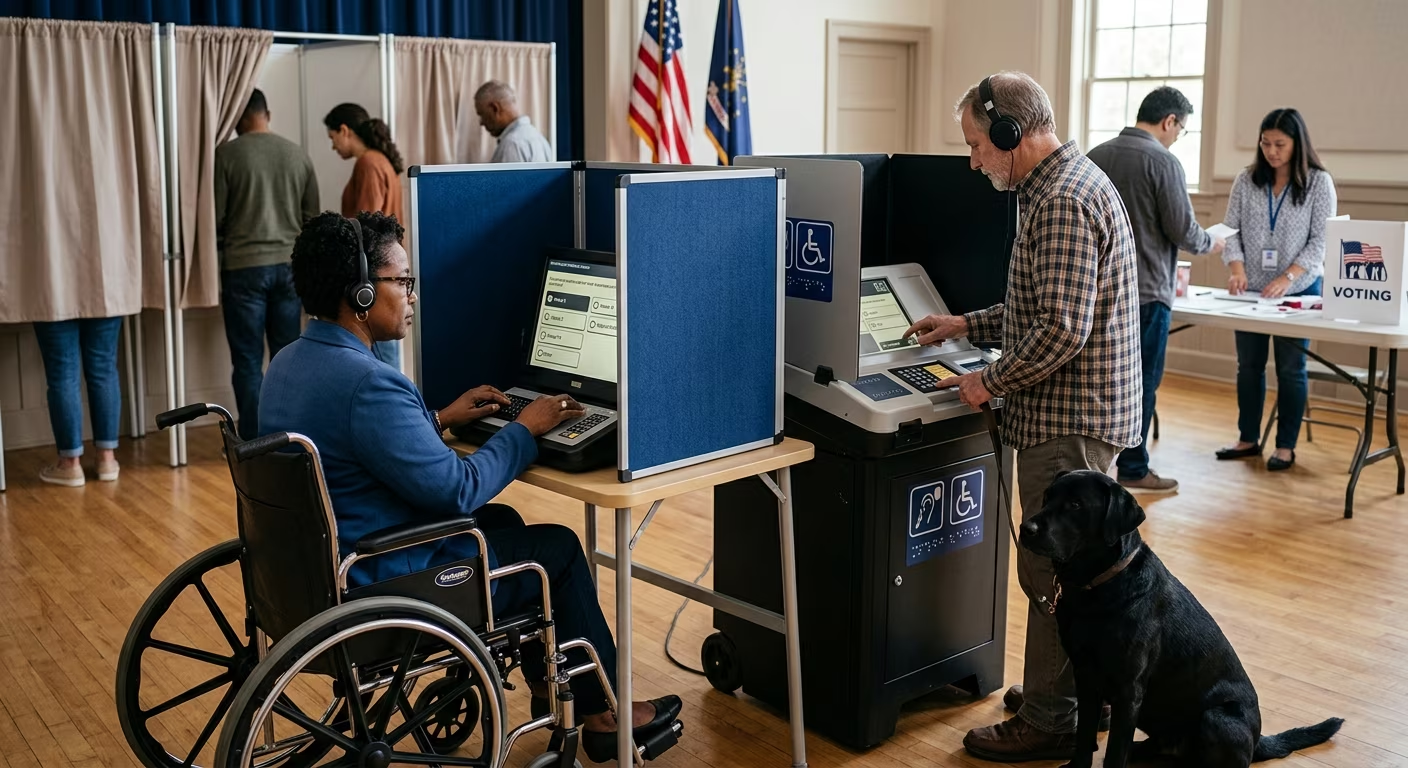
- Inaccessible Physical Layouts: Even if a voting machine is technically accessible, the physical environment often presents a barrier. Machines might be placed in tight corners where guide dogs cannot fit, or positioned at a height that is entirely unmanageable for voters who use mobility aids in conjunction with their visual impairment.
- Broken or Misconfigured Equipment: Frequently, visually impaired voters arrive at a polling location only to discover that the single accessible machine is unplugged, experiencing software glitches, or missing crucial components. Audio headphones required to listen to the ballot might be lost, or the tactile keypad might be unresponsive.
- The Shortcomings of Absentee and Mail-In Voting: In recent years, there has been a massive shift toward mail-in voting. While often praised as a convenient alternative, traditional mail-in voting presents a massive barrier for visually impaired voters. A standard paper absentee ballot requires the voter to read fine-printed text, align a pen perfectly within specific bubbles, and sign a physical envelope. For a blind individual, completing this process independently is a physical impossibility. When states tighten restrictions on voting by mail, or fail to provide electronic alternatives to paper absentee ballots, they disproportionately disenfranchise voters with visual impairments.
Technological Solutions Bridging the Gap
The challenges are undeniably significant, but modern technology offers robust solutions to ensure an independent and secret ballot. Election administrators across the country are increasingly turning to innovative software and hardware systems to bridge the accessibility gap and bring elections into full compliance with federal law.
- Audio-Tactile Voting Interfaces (ATVI): An Audio-Tactile Voting Interface is a specialized peripheral system integrated directly into electronic voting machines. It allows a visually impaired voter to navigate the digital ballot using an audio headset and a tactile controller. These controllers typically feature distinctively shaped buttons—such as a raised cross for moving forward, a circle for making a selection, and prominent Braille lettering indicating the specific function of each key. The system reads the candidate names, party affiliations, and ballot measure descriptions aloud in real time, and the voter uses the controller to make their selections securely. The machine then either prints a paper record of the vote or records it directly into a digital tally. When properly maintained and correctly set up, ATVIs are highly effective at restoring the secret ballot.
- Electronic Ballot Delivery Systems: To solve the inherent accessibility issues of traditional mail-in voting, many states have implemented Remote Accessible Vote by Mail (RAVBM) systems. These platforms allow a voter to receive their ballot electronically, securely download it to their personal computer, and mark it using their own assistive technology, such as a third-party screen reader or a refreshable Braille display. Once marked, the ballot can be printed and mailed back, or in some progressive jurisdictions, submitted electronically through a secure portal. This allows visually impaired individuals to vote from the comfort of their homes with the same level of privacy as their sighted peers.
Training the Frontlines: The Role of Poll Workers
Technology, however, is only as effective as the human beings tasked with operating it. One of the most frequently cited barriers by visually impaired voters is the severe lack of proper training among volunteer poll workers.
A polling place can possess state-of-the-art ATVI equipment, but if the volunteers working the desk do not know how to turn it on, troubleshoot minor errors, or provide the voter with the necessary headphones, the machine is functionally useless. Many voters recount frustrating experiences of arriving at the polls only to be told by a well-meaning but uninformed poll worker that the accessible machine is simply out of order, or that they should just let the worker fill out a standard paper ballot for them.
Addressing this critical failure point requires a systemic overhaul in how election administrators train their seasonal staff. Poll worker training must prioritize hands-on, practical experience with accessible voting technology. Volunteers should be required to run simulated test ballots through the ATVIs to familiarize themselves with the audio prompts and tactile controls. Furthermore, training must emphasize the civil rights aspect of the job: poll workers must deeply understand that providing an accessible, private voting experience is not a special favor, but a federally mandated civil right that they are obligated to uphold.
Moving Forward: Toward an Inclusive Democracy
A democracy is only as strong, legitimate, and representative as its most vulnerable participants. As long as visually impaired and blind citizens are forced to surrender their right to a secret ballot, the foundational promise of equal access to the polls remains unfulfilled. Securing this right requires a multifaceted approach: robust, uncompromising enforcement of the ADA and HAVA, continuous financial investment in accessible voting technologies like ATVIs and electronic ballot delivery systems, and comprehensive, mandatory training for all election workers.
The ultimate goal is a seamless, frictionless voting experience where a blind voter can arrive at a polling place, or access their ballot from home, and cast their vote with the exact same level of independence, privacy, and confidence as any other citizen. Voting is not a conditional privilege reserved for the able-bodied; it is a fundamental, unalienable right. Ensuring that this right is vigorously protected for everyone is not just an issue of regulatory compliance—it is a profound issue of basic human dignity, equity, and democratic integrity.
Frequently Asked Questions (FAQ)
What exactly is the secret ballot and why is it so important for visually impaired voters?
The secret ballot is the constitutional and civic right to cast a vote in total privacy without anyone else knowing who you voted for. It prevents systemic coercion, vote-buying, and protects the voter’s autonomy. For visually impaired voters, this crucial right is often violated when they are forced to rely on another person to read and mark their ballot for them, exposing their political choices to outside judgment.
How does the Americans with Disabilities Act (ADA) protect voters?
Title II of the ADA mandates that state and local governments provide people with disabilities a full and equal opportunity to participate in the voting process. This legal requirement encompasses ensuring physical access to polling places, clearing architectural barriers, and providing accessible methods for independently casting a ballot .
What is an Audio-Tactile Voting Interface (ATVI)?
An ATVI is an assistive device connected to an electronic voting machine that utilizes an audio headset to read the ballot aloud. It is paired with a tactile keypad (often utilizing unique shapes and Braille) to allow a visually impaired voter to navigate the options and make selections independently without needing to view a screen.
Can visually impaired individuals vote by mail independently?
Traditional paper mail-in ballots are largely inaccessible to blind voters without external assistance. However, Remote Accessible Vote by Mail (RAVBM) systems allow voters to receive and mark their ballots electronically using their own personal screen-reading software, thereby restoring their independence and privacy.
Are polling places legally required to have accessible voting machines?
Yes. The Help America Vote Act (HAVA) of 2002 established a federal mandate requiring that every single polling place in the United States must have at least one voting system equipped for individuals with disabilities, intentionally designed to ensure privacy and independence .
References
- Voting and Polling Places | ADA.gov — U.S. Department of Justice. 2024-04-18. https://www.ada.gov/topics/voting/
- Help America Vote Act — U.S. Election Assistance Commission. 2025-12-23. https://www.eac.gov/about-the-eac/help-america-vote-act
- Voting Fact Sheet — National Council on Disability. https://ncd.gov/voting-fact-sheet/