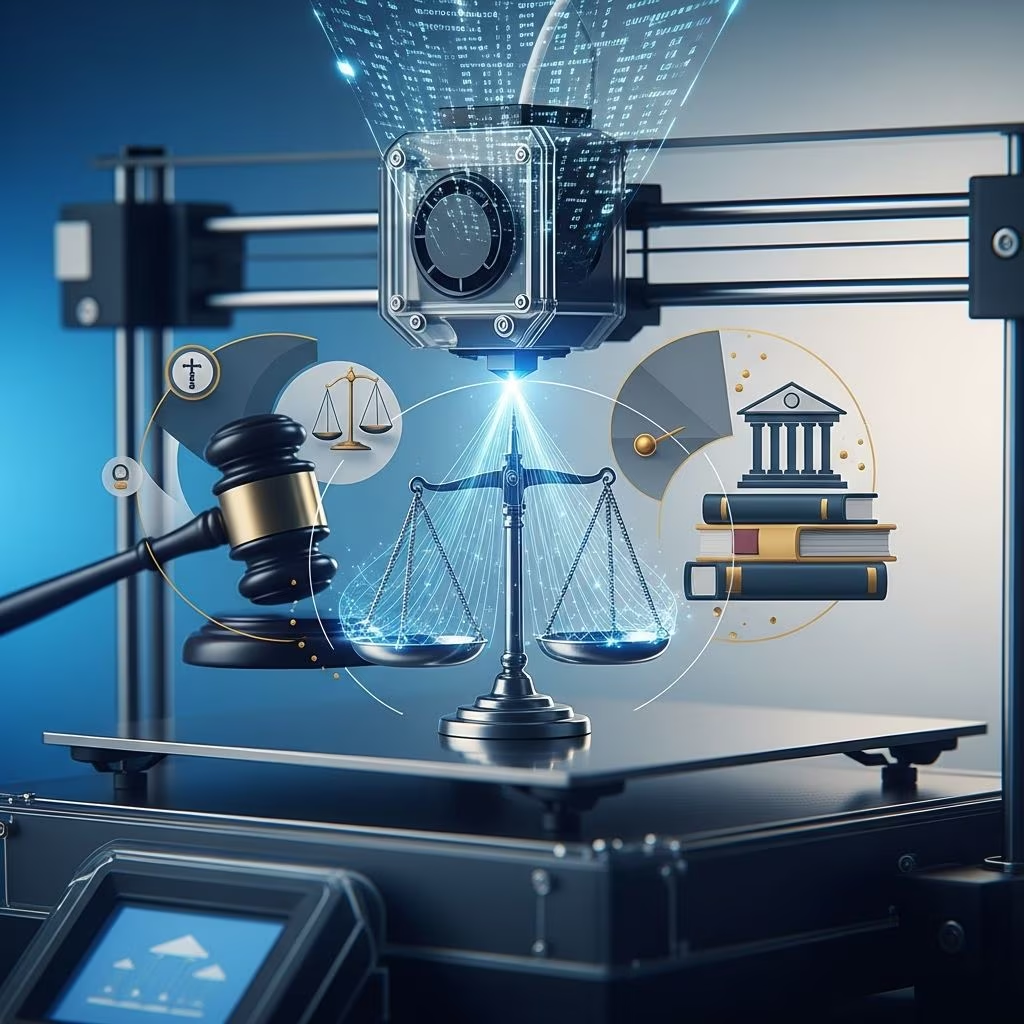
Three-dimensional printing technology has evolved from a niche manufacturing tool into a powerful asset for legal professionals. By producing physical models from digital data, lawyers can make complex evidence tangible, clarify expert testimony, and address emerging intellectual property issues. This article examines how 3D printing creates competitive edges in litigation, IP protection, and business development for law firms.
Transforming Courtroom Demonstrations with Physical Models
In litigation, the ability to help jurors visualize abstract concepts can sway outcomes. Traditional diagrams and photos often fall short in conveying spatial relationships or intricate details. 3D printing bridges this gap by generating accurate, scalable replicas that jurors can examine closely.
For instance, in personal injury cases, attorneys use 3D-printed models of accident scenes reconstructed from photographs. These allow jurors to assess angles, distances, and dynamics firsthand, reducing confusion during testimony. Similarly, medical malpractice suits benefit from printed anatomical models showing injury mechanisms or surgical errors, making expert explanations more persuasive.
- Key advantages in demonstrations: Tangible evidence eliminates ambiguity in spatial and anatomical contexts.
- Scalability: Models can be life-sized or miniaturized for courtroom practicality.
- Material variety: From plastics mimicking human tissue to metals for machinery parts.
Expert witnesses report that handling these models significantly boosts comprehension, particularly in technical fields like product liability where defective components must be illustrated. Law enforcement also leverages this for crime scene recreations, aiding lawyers in criminal defenses or prosecutions.
Applications Across Diverse Legal Fields
3D printing’s versatility extends to multiple practice areas, offering tailored solutions that enhance case preparation and presentation.
| Practice Area | 3D Printing Use Case | Benefit |
|---|---|---|
| Product Liability | Printed replicas of faulty parts | Shows design flaws jurors can touch |
| Medical Malpractice | Anatomical injury models | Clarifies complex medical testimony |
| Patent Infringement | Prototypes of claimed inventions | Demonstrates novelty and functionality |
| Criminal Defense | Crime scene scale models | Reenacts events for reasonable doubt |
| Workers’ Compensation | Body part injury simulations | Visualizes extent of harm |
In intellectual property disputes, 3D prints serve as demonstrative aids to prove infringement or invalidity. Judges and arbitrators appreciate the precision, which combines with digital animations for comprehensive arguments. Insurance firms employ them for claims assessment, while military lawyers use them in operational reconstructions.
Navigating Intellectual Property Challenges in the 3D Era
As 3D printing democratizes manufacturing, it poses risks and opportunities for IP law. The technology enables rapid replication of patented designs, copyrighted works, or protected trademarks from digital files, complicating enforcement.
Global market projections underscore urgency: the industry is expected to reach $57.1 billion by 2028, driven by metal printing growth at 30% annually and adoption in unexpected sectors like agriculture. This surge demands updated IP strategies.
- Patents: Protect 3D printing processes and novel materials; challenges arise when users print patented objects at home.
- Copyright and Designs: Digital scan-to-print workflows may infringe artistic or industrial designs.
- Trademarks: Counterfeit goods production becomes easier and cheaper.
Lawyers advise clients to secure robust portfolios, including software for printing controls and trade secrets for proprietary files. Emerging reforms in the UK and EU bolster software protection, creating a favorable environment for innovation. Firms specializing in IP can capitalize by auditing 3D workflows and litigating boundary-pushing cases.
Business Development: Turning Technology into Revenue
Beyond casework, 3D printing opens entrepreneurial avenues for law practices. Firms can partner with printing services to offer value-added demonstratives, differentiating from competitors.
Marketing potential is immense: showcase 3D models in client pitches to demonstrate tech-savvy approaches. In-house printers lower costs for routine models, while outsourcing handles complex jobs. This positions firms as innovators, attracting tech-forward clients in manufacturing, biotech, and aerospace.
Practice growth examples include:
- Launching 3D evidence divisions for trial support.
- Consulting on IP compliance for 3D printing startups.
- Training programs for lawyers on integrating prints with VR/AR presentations.
Early adopters report higher win rates and client retention, as tangible aids correlate with favorable verdicts.
Practical Steps for Integrating 3D Printing
Adopting this technology requires strategic planning. Start with vendor assessments for accuracy and admissibility compliance. Ensure models meet evidentiary standards: chain of custody, scale certification, and expert validation.
Cost analysis reveals quick ROI: a mid-range printer costs under $5,000, with prints at pennies per gram versus thousands for custom machining. Software like CAD integrates seamlessly with case management systems.
- Identify high-impact cases (e.g., those reliant on visuals).
- Collaborate with forensic or engineering experts for data.
- Test models in mock trials for juror feedback.
- Document processes for court authentication.
Future Trends and Regulatory Evolution
Advancements like multi-material printing and bioprinting will expand applications to pharmaceutical patents and organ injury models. Regulatory bodies, including WIPO, are adapting IP frameworks to address scan-to-print liabilities.
By 2028, widespread adoption will normalize 3D evidence, pressuring laggard firms. Proactive lawyers will lead, blending this tech with AI for predictive modeling.
Frequently Asked Questions
What types of cases benefit most from 3D printed evidence?
Complex visualization cases like product liability, malpractice, and accident reconstructions see the greatest impact, as models clarify spatial and technical details.
Is 3D printed evidence admissible in court?
Yes, when properly authenticated with expert testimony on creation methods and accuracy, similar to photographs or diagrams.
How does 3D printing affect IP enforcement?
It heightens infringement risks via easy replication but strengthens defenses through precise prototypes; updated laws are emerging.
What is the cost of starting with 3D printing for a law firm?
Entry-level setups range from $1,000-$10,000, with outsourcing options for scalability and expertise.
Can small firms compete using this technology?
Absolutely; affordable services and cloud-based design tools level the playing field against larger practices.
References
- 3D Printing a New Tool for Attorneys — Clark Fountain. 2023. https://www.clarkfountain.com/blog/3d-printing-a-new-tool-for-attorneys/
- How Trial Lawyers Win with 3D Printing Technology — 3D Musketeers. 2023. https://3dmusketeers.com/how-trial-lawyers-win-with-3d-printing-technology/
- 3D Printing: A New Dimension of Expert Testimony — Expert Institute. 2023. https://www.expertinstitute.com/resources/insights/3d-printing-a-new-dimension-of-expert-testimony/
- 3D Printing for Litigation — Demonstratives. 2023. https://www.demonstratives.com/demonstratives-production/3d-printing
- 3D printing growth surges ahead of schedule amid IP reforms — Marks & Clerk. 2025-07-29. https://www.marks-clerk.com/insights/news/102kxzz-3d-printing-growth-surges-ahead-of-schedule-amid-ip-reforms/
- The impact of 3D printing on IP law: potential challenges and solutions — Patent Lawyer Magazine. 2023. https://patentlawyermagazine.com/the-impact-of-3d-printing-on-ip-law-potential-challenges-and-solutions/
- 3D printing and IP law — World Intellectual Property Organization (WIPO). 2018. https://www.wipo.int/en/web/wipo-magazine/articles/3d-printing-and-ip-law-39896