
Undefined 3D Printed Guns: 16 State Laws And Key Risks In 2025
Navigate the complex legality of manufacturing 3D printed firearms in the US: federal allowances vs state restrictions.
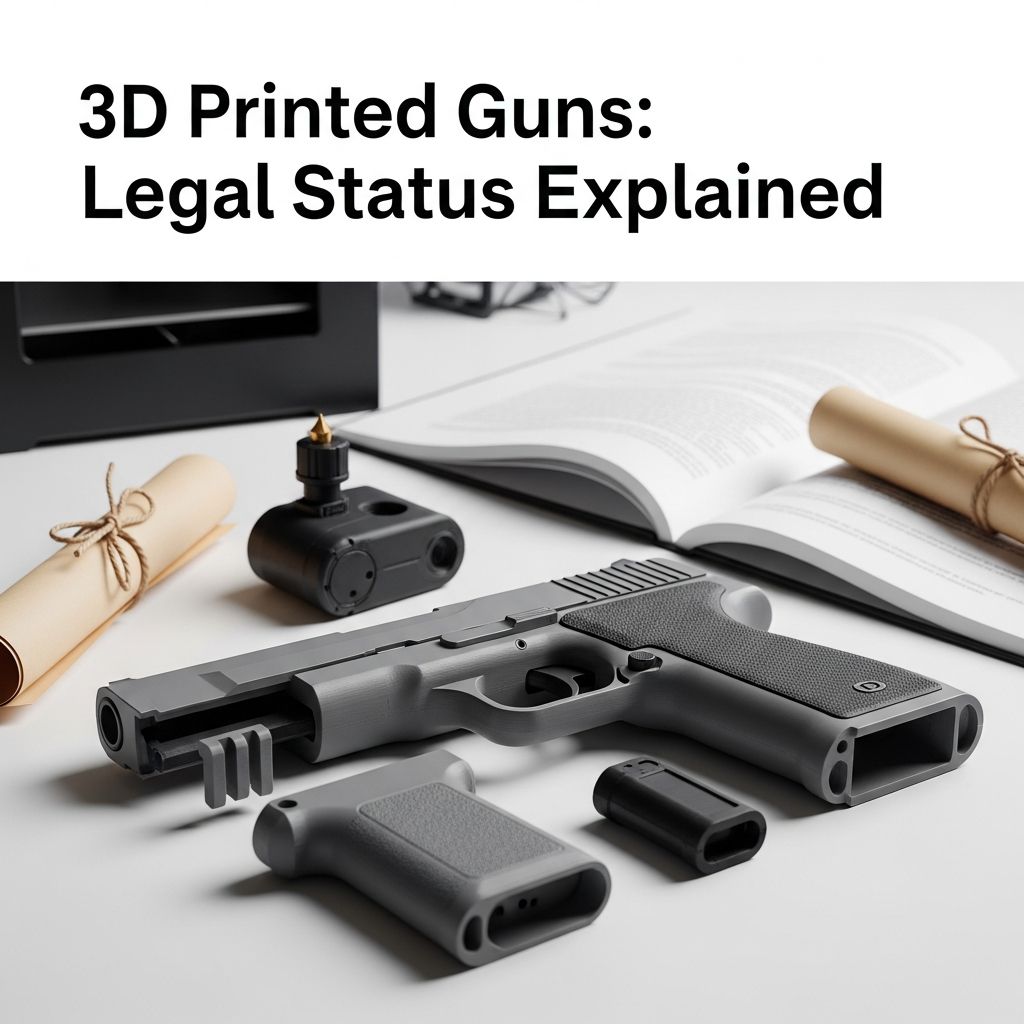
Manufacturing firearms at home using 3D printers raises significant legal questions in the United States, where federal law permits personal use but imposes strict detectability standards, while states enact varied restrictions on these so-called ghost guns.
Federal Framework for Homemade Firearms
Under U.S. federal law, individuals may legally construct firearms for personal use without a license, provided they are not intended for sale or distribution. This longstanding right extends to 3D printed guns, often called privately made firearms (PMFs), as long as basic requirements are met.
The Gun Control Act of 1968 allows non-prohibited persons to build their own guns. No background check, serial number, or registration is required for purely personal firearms. However, producing for commercial purposes demands a Federal Firearms License (FFL).
- No federal prohibition on 3D printing guns for personal possession.
- Prohibited if assembled from 10+ imported parts (non-sporting rifles/shotguns).
- NFA items (e.g., machine guns) require ATF approval and tax stamps.
The Bureau of Alcohol, Tobacco, Firearms and Explosives (ATF) defines a firearm by its frame or receiver, which must comply with serialization if transferred.
Undetectable Firearms Act: Core Restriction
The Undetectable Firearms Act (UFA), originally passed in 1988 and renewed multiple times (most recently in 2013 for 10 years), bans firearms not detectable by metal detectors or X-ray machines.
Legal 3D printed guns must incorporate sufficient metal—typically a plate in the body—to trigger security screening. Purely plastic designs violate this law, though enforcement relies on self-compliance since home production lacks oversight.
| Requirement | Description | Consequence of Violation |
|---|---|---|
| Metal Content | Enough ferrous metal to be visible on walk-through detectors | Federal felony, up to 5 years imprisonment |
| Barrel Test | Must block X-ray imaging of a metal bullet | Same penalties apply |
| Renewal Status | Extended through 2023; discussions for permanence | Non-compliant guns illegal nationwide |
This act targets “plastic guns” but applies broadly to any undetectable weapon, including advanced 3D prints.
Ghost Guns and Traceability Challenges
3D printed firearms are prime examples of ghost guns—unserialized, untraceable weapons. Federal law does not mandate serial numbers for personal guns, enabling anonymous production.
However, the ATF’s 2022 Frame or Receiver Rule expanded definitions to include unfinished frames/kits, requiring serialization for sales. Home 3D printing remains exempt if not sold.
Concerns include proliferation without background checks, fueling crime. Lacking serial numbers hinders investigations.
State-by-State Regulations: A Patchwork Landscape
With federal law permissive for personal use, 16 states regulate ghost guns, including 3D printed variants, via serialization, licensing, or outright bans.
Strictest states demand serial numbers, background checks for parts, and prohibit untraceable guns.
| State | Key Regulations | 3D Printing Specifics |
|---|---|---|
| California | Serial numbers from DOJ; background checks; license for 3D printing frames/receivers | Bans unlicensed 3D printed firearms/precursors (AB 2156, 2022) |
| New Jersey | Restricts manufacturing/distribution; cease-and-desist to blueprint sharers | Licensed manufacturers only |
| Massachusetts | Bans undetectable/concealed weapons | Applies to plastic-heavy 3D guns |
| Oregon | Bans undetectable/untraceable guns; serialization required | 2023 law targets 3D prints |
| Washington | Illegal to make/possess/distribute untraceable firearms | Specifically names 3D printers/CNC |
| Rhode Island | Serial numbers/background checks; no 3D gun printing | Explicit prohibition |
Other regulating states: Connecticut, Delaware, Hawaii, Illinois, Maryland, Nevada, New York, Virginia, Washington D.C. Non-regulating states like Texas, Florida defer to federal law.
Landmark Legal Battles and Blueprint Battles
3D printed guns gained notoriety with Defense Distributed’s 2013 Liberator pistol, whose blueprints were shared online. A 2018 court injunction blocked publication nationwide.
The Trump Administration’s 2019 settlement allowed State Department to lift export controls, shifting to Commerce. A 2020 rule delisted blueprints from munitions.
Settlements were vacated; Biden-era DOJ sued, reinstating blocks. Ongoing litigation (e.g., Defense Distributed v. Grewal in NJ) tests First Amendment rights to share files.
Platforms like GitHub removed repositories, citing policies.
International Perspectives on 3D Firearms
Unlike the U.S., many nations strictly ban 3D printed guns. The UK’s Firearms Act 1968 prohibits unlicensed manufacturing, explicitly covering 3D prints per Home Office guidance.
Australia, Canada, and EU countries require licenses for any firearm production, rendering home 3D printing illegal without permits.
Practical Considerations for Makers
Compliance Checklist
- Check state laws: Use ATF site or state AG resources.
- Add metal: Embed steel plate per UFA.
- Personal use only: No sales without FFL.
- Prohibited persons: Felons, etc., cannot possess any firearm.
- Test detectability: Ensure passes metal detector/X-ray.
Risks and Penalties
Violations carry felonies: 5-10 years federal prison, fines. States add penalties (e.g., CA: up to 3 years).
Safety issues: 3D prints fail catastrophically; use high-strength filaments, reinforce.
Future Regulatory Outlook
Biden Administration pushes ghost gun rules, including serialization for kits. Proposed bills seek national serialization/background checks for PMFs.
14+ states act independently; expect more (e.g., NY requires licensed gunsmiths). Tech advances (hybrid metal-plastic prints) challenge regulators.
Frequently Asked Questions (FAQs)
Can I legally 3D print a gun for personal use?
Yes federally if detectable and for personal use; check state laws—banned in CA, NJ, etc.
Do 3D printed guns need serial numbers?
No federally for personal guns; yes in regulating states like CA, OR.
Is sharing 3D gun blueprints legal?
Contested; court blocks remain, First Amendment suits ongoing.
What makes a 3D gun ‘undetectable’?
Lacking metal to trigger detectors/X-rays—illegal under UFA.
Which states ban 3D printed guns outright?
RI, NJ (manufacturing); OR, WA (untraceable); varies by specifics.
References
- 3D-Printed Guns: Regulations and Legal Implications — AMU Edge. 2023-05-15. https://amuedge.com/3d-printed-guns-regulations-and-legal-implications/
- 3D-printed firearm — Wikipedia. 2026-03-28. https://en.wikipedia.org/wiki/3D-printed_firearm
- A Landscape of 3D Printed Gun Regulations in the U.S. — 3DPrint.com. 2023-11-20. https://3dprint.com/305251/a-landscape-of-3d-printed-gun-regulations-in-the-u-s/
- Which states regulate ghost guns? — Everytown Research & Policy. 2025-09-12. https://everytownresearch.org/rankings/law/ghost-guns-regulated/
Similar Articles








Read full bio of Sneha Tete




