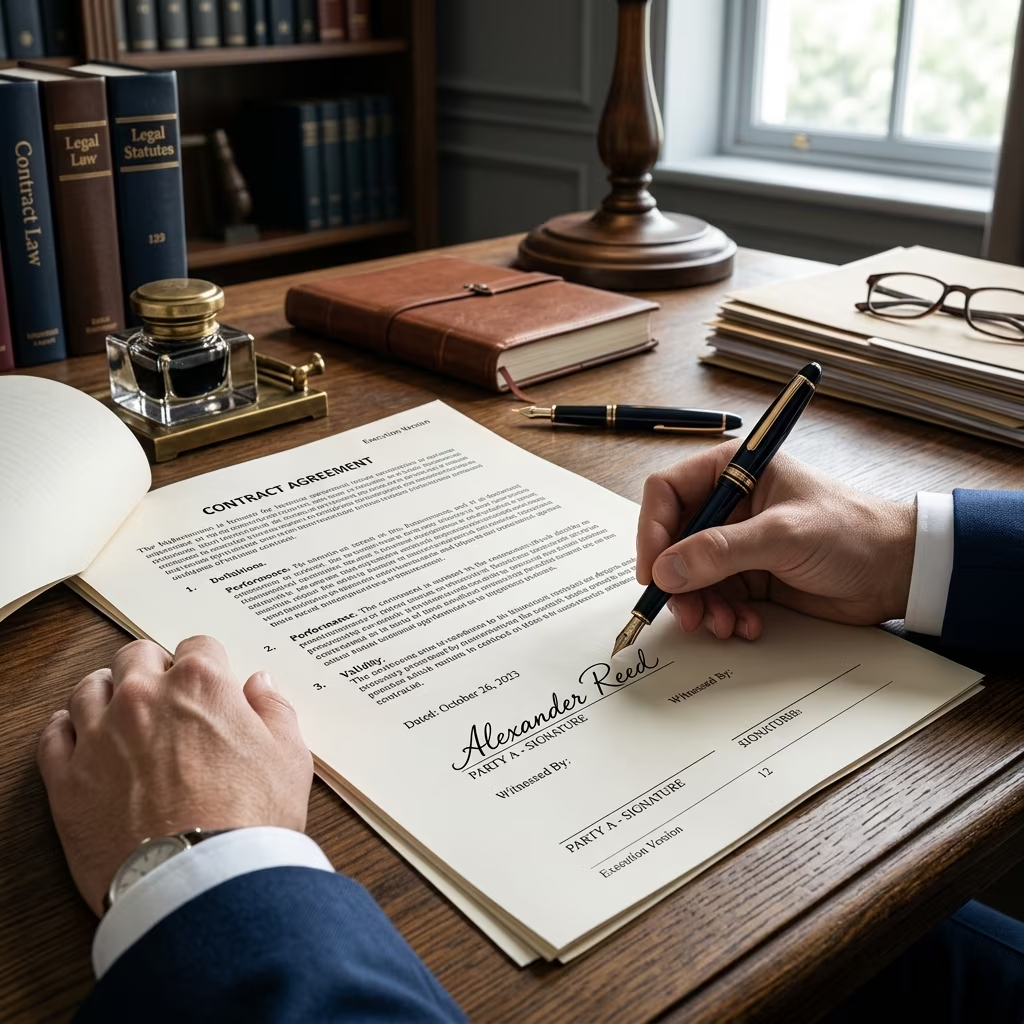
Contracts are at the core of nearly every business and personal transaction. While many agreements can be made orally and still be legally binding, the law imposes special writing and signature requirements on certain kinds of promises. Understanding these rules is essential if you want your agreements to be enforceable in court and not just based on trust.
Why Writing and Signatures Matter in Contract Law
At its most basic level, a contract is a legally enforceable promise between two or more parties. Traditional contract law recognizes both written and oral agreements, but some deals must be written and signed to be enforceable. This requirement arises from a group of rules often referred to as the statute of frauds, which dates back centuries and aims to reduce fraud and misunderstandings in significant transactions.
A written contract supported by clear signatures:
- Provides reliable evidence of the agreement’s terms.
- Reduces disputes over what was promised or agreed.
- Helps courts interpret and enforce the parties’ obligations.
- Clarifies key commercial details such as price, quantity, and timing.
Because of these benefits, legal systems in the United States and many other jurisdictions treat written, signed agreements as the gold standard, particularly in transactions involving real estate, long-term commitments, and high-value goods.
Core Elements of Any Valid Contract
Whether a contract must be in writing or not, it still needs to satisfy basic legal requirements. If these elements are missing, the agreement can be void or unenforceable even if it is carefully drafted and signed.
| Element | What It Means | Typical Issues |
|---|---|---|
| Legal purpose | The agreement must concern a lawful objective. | Contracts for illegal activities are automatically void regardless of form. |
| Offer and acceptance | One party clearly proposes terms; the other clearly agrees. | Ambiguous or incomplete offers, or conditional acceptance, can prevent formation. |
| Consideration | Each side gives something of value in exchange for something else. | Promises with no real exchange (e.g., gifts) may not be contracts. |
| Capacity | Parties must understand they are entering a contract and have legal ability to do so. | Minors, severely intoxicated persons, and people lacking mental capacity may not be bound. |
| Voluntary consent | Agreement must be free from duress, fraud, and serious mistake. | Contracts signed under pressure, deception, or major misunderstanding can be invalid. |
Only after these building blocks are in place does it make sense to ask whether the law requires the contract to be written and signed.
When Must a Contract Be in Writing?
Most jurisdictions follow a form of the statute of frauds, a legal doctrine that specifies categories of contracts that must be in writing to be enforceable. While details vary by state, the categories are remarkably similar across U.S. law and under the Uniform Commercial Code (UCC).
Typical Transactions Requiring Written Agreements
Common types of contracts that generally need a written document include:
- Sales of real estate (land and buildings).
- Leases of real estate that last longer than one year.
- Promises to pay another person’s debt (guarantees).
- Contracts not performable within one year from the date of the agreement.
- Sale of goods for $500 or more under the UCC.
- Certain agreements that extend beyond the life of a party or relate to property transferred upon death.
An oral agreement in one of these categories is not necessarily void, but it is often difficult or impossible to enforce because the statute of frauds allows the parties to avoid performance if no adequate written evidence exists.
The UCC and Goods Over $500
The Uniform Commercial Code (UCC), adopted in most U.S. states, governs contracts for the sale of goods. It generally requires a writing for contracts where the price of goods is $500 or more, subject to certain exceptions.
Under UCC section 2-201, a contract for the sale of goods at or above this threshold is enforceable only if there is a written record that:
- Indicates that a contract for sale has been made.
- Specifies the quantity of the goods being sold.
- Is signed by the party against whom enforcement is sought.
Interestingly, UCC writings do not need to contain every detail of the transaction. Price, delivery terms, and other material terms can sometimes be supplied by course of dealing or default rules, as long as quantity is clear and the writing signals that a contract exists.
Leases of Goods and Other Statutory Requirements
Similar rules apply to leases of goods under UCC Article 2A, which may require written agreements for leases above certain value thresholds. Beyond the UCC, specialized statutes require written contracts for particular transactions, such as assignments of interests in land or formal powers of attorney.
What Counts as a “Writing” for Contract Purposes?
Contrary to popular belief, the law does not demand a long formal contract with numerous clauses to satisfy the writing requirement. Many forms of written evidence can be sufficient, so long as they contain enough information to show that a contract exists, identify the subject matter, and specify essential terms.
Types of Acceptable Writings
Authorities in contract law recognize a wide range of documents as potential writings that can satisfy the statute of frauds, including:
- Signed letters or emails confirming essential terms of a deal.
- Invoices, receipts, or purchase orders referencing the transaction.
- Memoranda or notes that describe the property or goods and price.
- Multiple documents read together, if they clearly relate to the same agreement.
The key is not the format but the content. To satisfy the writing requirement, a document generally must:
- Reasonably identify the subject matter of the contract (for example, a specific parcel of land or described goods).
- Indicate that a contract exists between the parties.
- State essential terms with reasonable certainty—such as price, quantity, and timing—unless covered by statutory defaults.
Combining Multiple Writings
Sometimes no single document contains all the necessary information. Courts may allow parties to piece together several writings to satisfy the statute of frauds, as long as they are clearly related and collectively provide enough detail. For example, a signed email referencing a quote and an attached proposal might be read together as one written contract.
Understanding the Signature Requirement
In addition to writing, many contracts must be signed to be enforceable against a particular party. A signature serves as evidence that the signer intended to be bound by the agreement. Modern law is flexible about what counts as a signature, especially in the age of electronic communications.
What Is a Valid Signature?
Courts and statutes often define signatures broadly. A signature can be any symbol or mark made or adopted with the intention of authenticating a writing.
Examples of accepted signatures include:
- Handwritten signatures using pen or stylus.
- Typed names at the end of emails, if intended as a signature.
- Initials placed next to key clauses.
- Digital signatures generated by secure signing platforms.
- Unique marks or even thumbprints, if they clearly identify the signer and show intent.
The critical factor is intent: the person must intend the mark or symbol to serve as their signature and to authenticate the document.
Electronic Signatures
Electronic signatures are now commonplace in business thanks to laws such as the U.S. Electronic Signatures in Global and National Commerce Act (E-SIGN Act) and the Uniform Electronic Transactions Act (UETA). Under these frameworks, an electronic sound, symbol, or process attached to or logically associated with a contract and executed with intent to sign can satisfy signature requirements.
Practical examples include:
- Clicking an “I agree” button on a website after reviewing terms.
- Using a secure digital signature service to sign PDFs.
- Typing a name and checking a box indicating agreement.
When properly implemented, electronic signatures generally carry the same legal force as handwritten signatures for most types of contracts.
Which Party Needs to Sign?
The statute of frauds usually insists that the contract be signed by the party against whom enforcement is sought—that is, the person you want to sue. If a defendant never signed the document, it can be difficult to force them to perform the contract, even if you signed and relied on it.
For clarity and fairness, best practice is to ensure that all parties sign the agreement, whether in ink or electronically.
Putting It Together: Satisfying the Statute of Frauds
To comply with writing and signature requirements, you must focus on both form and substance. The following checklist can help you determine whether your contract is likely to satisfy the statute of frauds in typical U.S. contexts:
- Identify whether the statute of frauds applies
Ask whether the deal involves real estate, a guarantee of another’s debt, a long-term promise, or goods worth $500 or more. - Create a written record
Prepare a document (or set of documents) that describes the subject matter, price or method of calculation, quantity (for goods), and key obligations. - Ensure the writing indicates a contract
Use language showing that a binding agreement exists, not merely negotiations or drafts. - Obtain signatures with clear intent
Have each party sign, whether on paper or electronically, and retain proof of how and when signing occurred. - Retain copies and confirmations
Store executed copies and related communications (emails, confirmations, amendments) to show the contract’s history.
Exceptions and Special Rules
Even when a contract falls within a statute of frauds category, certain doctrines and exceptions can make an otherwise unwritten agreement enforceable.
Specially Manufactured Goods
Under the UCC, if goods are specially manufactured for the buyer and are not suitable for sale to others in the ordinary course of the seller’s business, a court may enforce the contract even in the absence of a signed writing. This exception protects sellers who reasonably rely on oral orders for custom products.
Partial Performance and Reliance
In some cases, courts enforce oral agreements when one party has already performed or substantially relied on the promise, particularly with respect to real estate. For example, if a party takes possession of land and makes improvements based on an oral sale agreement, a court might find that justice requires enforcing the deal. These equitable doctrines vary widely and are fact-specific, so relying on them is risky compared to obtaining a written contract.
Drafting Clear Written Contracts
Once you decide to put a contract in writing, clarity becomes as important as legal compliance. Poorly drafted documents can generate disputes even when they technically satisfy writing and signature requirements. Legal drafting guidance emphasizes simple, direct language and thoughtful structure.
Practical Drafting Tips
To improve the readability and effectiveness of your contracts:
- Use short, direct sentences instead of long, complex clauses.
- Write in the active voice (“Party A shall pay” rather than “Payment shall be made by Party A”).
- Avoid heavy legal jargon unless a term has a precise legal meaning that cannot be easily replaced.
- Organize the contract with headings and white space, making it easier to navigate.
- Define key terms clearly at the beginning and use them consistently.
- Remove redundant language and “doublets” (repeating similar words like “null and void”) where not required by statute.
Good drafting not only helps parties understand their obligations but also helps judges and arbitrators interpret the contract if a dispute arises.
FAQs About Writing and Signature Requirements
1. Are oral contracts ever enforceable?
Yes. Many everyday agreements are oral and still legally enforceable if they meet basic contract elements like offer, acceptance, consideration, capacity, and consent. However, if the agreement falls into a statute of frauds category—such as a sale of land or goods over $500—it generally must be in writing to be enforced in court.
2. Do both parties have to sign a written contract?
From a legal perspective, the statute of frauds typically requires a signature from the party against whom you want to enforce the contract. In practice, best practice is to have all parties sign, ensuring mutual assent is clear and reducing the chance of later disputes over whether someone agreed to be bound.
3. Is a contract valid if it is missing some terms?
It can be, depending on the nature of the transaction. Under the UCC, contracts for the sale of goods can be enforceable even if some terms are missing, as long as there is a writing indicating a contract and specifying quantity. For other types of contracts, courts often require that significant material terms—such as price and identity of property—be stated with reasonable certainty.
4. Are text messages or emails considered “writings”?
Yes, courts increasingly treat emails and other electronic communications as writings for statute of frauds purposes if they contain essential terms and show a present intent to contract. A typed name or clear indication of agreement at the end of such messages can function as an electronic signature.
5. What happens if a contract that should be in writing is only oral?
Such a contract may be unenforceable under the statute of frauds. That means a party who wishes to avoid the agreement can raise the absence of a sufficient writing as a defense. The court might refuse to award damages or specific performance, although certain exceptions or equitable doctrines could apply in limited circumstances.
References
- When Is a Written Contract Required Under the UCC? — Nolo. 2023-01-01. https://www.nolo.com/legal-encyclopedia/when-is-written-contract-required-under-the-ucc.html
- What Contracts Are Required To Be In Writing? — FindLaw. 2021-07-15. https://www.findlaw.com/smallbusiness/business-contracts-forms/what-contracts-are-required-to-be-in-writing.html
- Contract Writing Requirement and Statute of Frauds — LegalMatch. 2020-06-10. https://www.legalmatch.com/law-library/article/contract-writing-requirement.html
- Contract Law and the Writing Requirement: Satisfying the Statute of Frauds — LawShelf Educational Media. 2019-03-01. https://www.lawshelf.com/shortvideoscontentview/satisfying-the-statute-of-frauds/
- Ten Tips for Writing Clear Contracts — Foster Swift Collins & Smith PC. 2018-10-30. https://www.fosterswift.com/newsroom/publications-ten-tips-writing-clear-contracts.html