
Wisconsin Identity Theft Laws: Rights, Risks, and Penalties
A practical guide to Wisconsin identity theft laws, criminal penalties, and what victims and accused individuals need to know.
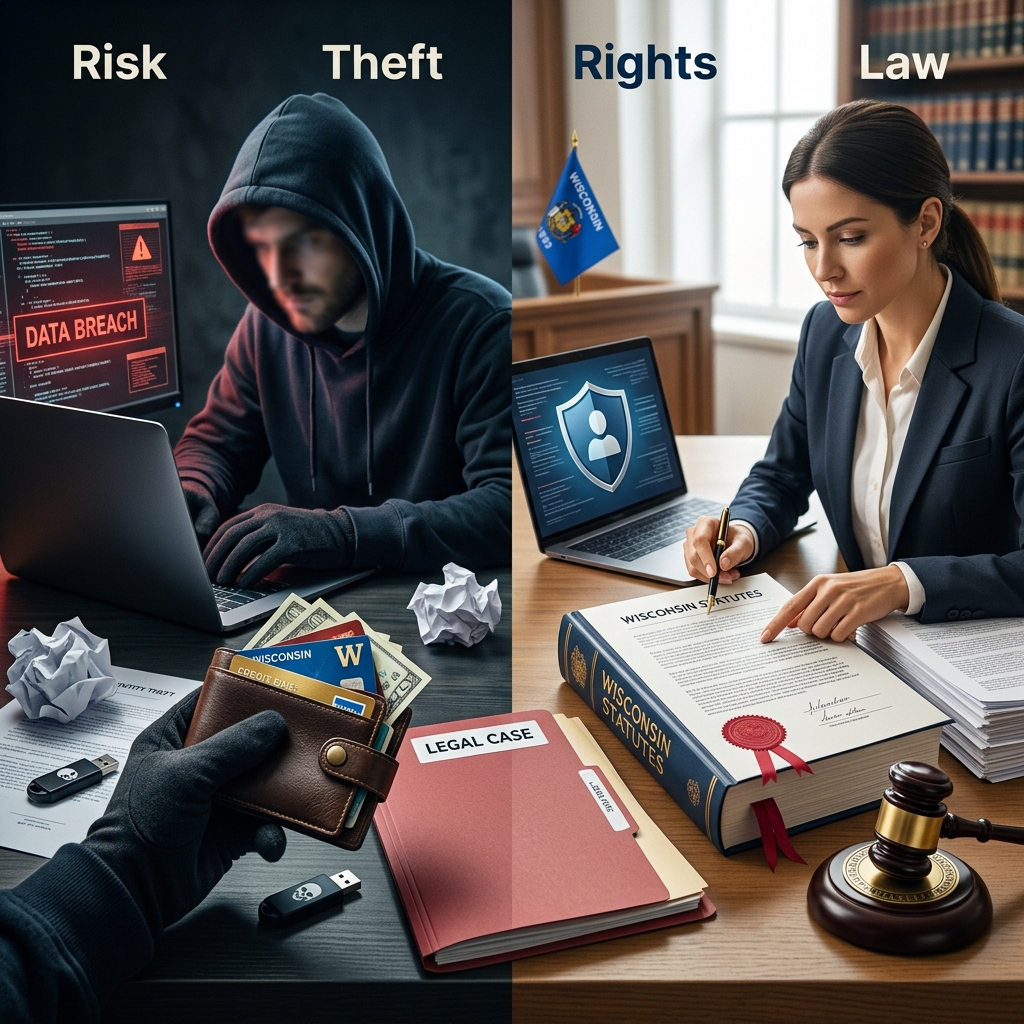
Identity theft is one of the fastest-growing forms of fraud, and Wisconsin has developed detailed laws to address it. These laws cover the misuse of an individual’s personal data, unauthorized use of business information, and related financial crimes, all of which can lead to serious felony charges and long-term consequences.
This article explains how Wisconsin legally defines identity theft, outlines the primary statutes, summarizes penalties, and offers practical guidance for both victims and people facing accusations. It is an informational overview and is not a substitute for legal advice.
What Counts as Identity Theft in Wisconsin?
Under Wisconsin law, identity theft occurs when someone uses another person’s identifying information or identification documents without consent for specific prohibited purposes, such as obtaining money, goods, services, credit, employment, or to avoid prosecution or harm someone’s reputation.
Wisconsin treats identity theft as a distinct offense from general theft or fraud because it focuses on the misuse of personal data rather than just taking property.
Core Legal Definition
Wisconsin Statute § 943.201 governs the unauthorized use of an individual’s personal identifying information or documents. A person can be guilty if they:
- Intentionally use, attempt to use, or possess with intent to use another individual’s personal identifying information or personal identification document.
- Act without that individual’s authorization or consent and know they do not have consent.
- Represent themselves as that individual, claim to be acting with that person’s authorization, or claim that the information belongs to them.
- Use the information for one of the purposes listed in the statute, such as obtaining something of value, avoiding legal consequences, or harming the individual.
Importantly, the statute applies even if the person whose identity is misused is deceased.
Personal Identifying Information: What It Includes
The term personal identifying information in Wisconsin law is intentionally broad, covering a wide range of data that can be used to impersonate someone or access financial benefits.
Examples include:
- Basic identity details – name, address, telephone number, and date of birth.
- Government identifiers – Social Security number, driver’s license number, or other government-issued ID numbers.
- Financial account data – bank account numbers, credit card numbers, debit card numbers, and associated PINs.
- Employment-related identifiers – employer-issued ID numbers or codes used to access systems or benefits.
- Biometric data – fingerprint data, facial recognition information, or similar unique biological identifiers.
- Any device or data used to access value – passwords, tokens, or other information used to obtain money, services, employment, benefits, or credit.
Because the definition is broad, many modern forms of digital access credentials and security tokens can fall under the statute.
Identity Theft Involving Businesses and Other Entities
Wisconsin law does not limit identity theft to individuals. It also criminalizes the unauthorized use of identifying information belonging to a business, nonprofit, or other organization.
Wis. Stat. § 943.203: Entity Identifying Information
Wisconsin Statute § 943.203 addresses identity theft involving an entity’s identifying information or documents. Although the detailed language differs from the individual-focused statute, the concept is similar: using an entity’s unique identifiers without consent to obtain value or cause harm can lead to criminal charges.
Typical types of entity information include:
- Business name and address.
- Employer Identification Number (EIN) or similar tax IDs.
- Account numbers for business bank accounts or lines of credit.
- Electronic access credentials that permit transactions or financial operations.
Misusing a business’s identity can involve opening accounts in the business’s name, redirecting payments, or using its credit profile to obtain loans or services.
Key Purposes That Make Identity Theft a Crime
Wisconsin’s identity theft statutes center on why the information was used. The law lists specific purposes that convert misuse of data into a criminal offense.
| Purpose | Examples |
|---|---|
| Obtain credit, money, goods, services, employment, or any thing of value | Using another person’s credit card to make purchases; opening a loan in someone else’s name; using their identity to get a job. |
| Avoid civil or criminal process or penalty | Presenting someone else’s identity during a traffic stop to avoid a warrant or fines. |
| Harm the individual’s reputation, property, person, or estate | Impersonating someone online to damage their reputation or interfere with their assets. |
These listed purposes are crucial. If the State cannot prove that the accused acted for one of these reasons, a conviction under § 943.201 may not be legally supported.
Felony Classification and Criminal Penalties
Identity theft in Wisconsin is treated seriously, regardless of the exact value obtained. Violations under § 943.201 and § 943.203 are classified as Class H felonies.
Class H Felony Consequences
Under Wisconsin’s felony sentencing structure, a Class H felony can include:
- Up to six years of total imprisonment, typically divided into initial confinement and extended supervision.
- Fines of up to $10,000.
- Possible restitution orders requiring repayment of financial losses to victims.
- Conditions such as probation, counseling, or restrictions on financial activities, depending on the case.
Courts may impose any combination of these penalties, and the specific sentence depends on factors like prior criminal history, the scope of the identity misuse, and the impact on victims.
Continuing Offense Concept
Wisconsin treats identity theft as a continuing offense when multiple uses are part of a single ongoing scheme. This means that the criminal conduct may be considered to continue until the last benefit is obtained, which can affect how charges are filed, how the statute of limitations is applied, and how sentences are calculated.
Related Wisconsin Laws and Cross-References
Identity theft in Wisconsin does not exist in isolation. Several related statutes address specific types of financial and consumer fraud that may overlap with or accompany identity theft.
- Wis. Stat. § 943.41(3) – addresses theft involving credit cards or similar instruments.
- Wis. Stat. § 943.82 – covers fraud against financial institutions.
- Harassment statutes – provisions such as § 947.013 sometimes intersect when personally identifiable information is used to harass or threaten.
Prosecutors may charge identity theft along with these related offenses when the conduct fits multiple legal definitions.
Affirmative Defense: Lawful Authority
Wisconsin recognizes that some people lawfully use another person’s identifying information, such as police officers, court officials, or others acting under specific legal authority.
Statute § 943.201 explicitly provides an affirmative defense for individuals who can prove they were authorized by law to engage in the conduct in question.
- The defendant must raise this defense and has the burden to prove it by a preponderance of the evidence, meaning it is more likely than not that the defense is true.
- Examples can include lawful investigations, court-ordered actions, or legally mandated uses of information.
Practical Steps for Identity Theft Victims in Wisconsin
Victims of identity theft face both legal and practical challenges. Wisconsin’s Bureau of Consumer Protection and other agencies offer guidance on how to respond.
Immediate Actions to Take
If you suspect your identity has been misused, you can take several steps recommended by Wisconsin consumer protection authorities.
- Close fraudulent accounts – contact banks, credit card issuers, or lenders to close accounts where unauthorized activity occurred. Ask for the security or fraud department.
- Update passwords and PINs – change login credentials for financial accounts, email, and other sensitive services to prevent further misuse.
- Review credit reports – obtain free annual credit reports from each major bureau and check for accounts or debts you do not recognize.
- Correct inaccurate information – request removal of fraudulent accounts or entries on your reports.
Report the Crime
Reporting identity theft helps establish a record and may support criminal investigation or civil dispute resolution.
- File a police report with your local law enforcement agency or the agency where the identity misuse occurred.
- Place fraud alerts or credit freezes with credit reporting agencies to limit new accounts being opened in your name.
- Submit a complaint to the Wisconsin Department of Agriculture, Trade and Consumer Protection (DATCP) Bureau of Consumer Protection, using its identity theft complaint process.
Wisconsin DATCP Complaint Process
The DATCP Bureau of Consumer Protection provides a structured process for victims to file complaints related to identity theft.
- Victims complete a detailed complaint form and may need to submit a notarized non-consent form.
- Supporting documentation, such as bank statements, credit reports, or correspondence with creditors, strengthens the complaint.
- Complaints can be filed online or by mail to the DATCP Bureau of Consumer Protection in Madison.
Facing Identity Theft Charges: What Defendants Should Know
Because identity theft is a felony in Wisconsin, anyone under investigation or charged should understand the seriousness of the situation.
Elements the State Must Prove
To obtain a conviction under § 943.201, the State must prove several specific elements beyond a reasonable doubt.
- The accused intentionally used, attempted to use, or possessed with intent to use another individual’s personal identifying information or identification document.
- The information qualifies legally as personal identifying information or a personal identification document.
- The accused acted for one of the enumerated purposes, such as obtaining credit or harming reputation.
- The accused lacked authorization or consent, knew there was no consent, and represented that the information belonged to them or that they were acting as or for the individual.
Defense strategies often examine whether these elements can be established, whether there was actual consent, whether the accused knew they lacked consent, and whether the alleged purpose fits the statute.
Potential Collateral Consequences
Beyond imprisonment and fines, an identity theft conviction can have long-term effects:
- Employment barriers – many employers review criminal records and may be reluctant to hire individuals with fraud-related felonies.
- Professional licensing issues – certain professions require clean backgrounds or may impose conditions after felony convictions.
- Reputational damage – being associated with identity theft may affect personal relationships and community standing.
- Financial restrictions – restitution obligations and court-imposed conditions can influence future financial decisions.
Preventing Identity Theft: Practical Tips for Wisconsin Residents
While legal remedies exist, prevention remains critical. Simple precautions can significantly reduce the risk of identity theft.
- Limit sharing sensitive information – be cautious about providing Social Security numbers, dates of birth, and financial account details, especially over the phone or online.
- Use secure ATMs and payment devices – prefer bank-affiliated ATMs or machines in secure locations to reduce the risk of skimming.
- Monitor accounts regularly – review bank and credit card statements to detect unusual transactions quickly.
- Protect devices – use strong passwords, enable multi-factor authentication, and keep software updated to limit unauthorized access.
- Shred documents – destroy papers containing personal data before discarding to prevent dumpster diving.
Frequently Asked Questions (FAQs)
Is identity theft always a felony in Wisconsin?
Yes. Violations of Wis. Stat. § 943.201 (individuals) and § 943.203 (entities) are classified as Class H felonies regardless of the amount of money or value involved.
Can identity theft charges apply if no money was actually obtained?
Yes. The statute covers attempts and possession with intent to use personal identifying information or documents for prohibited purposes. A person may be charged even if they are stopped before successfully obtaining money or credit.
Does Wisconsin law protect businesses from identity theft?
Yes. Wis. Stat. § 943.203 specifically addresses unauthorized use of an entity’s identifying information or documents, providing similar protections and penalties as those for individuals.
What should I do if I discover a fraudulent account in my name?
Contact the issuer’s fraud department, close the fraudulent account, update your passwords, review your credit reports, and file complaints with law enforcement and the Wisconsin DATCP Bureau of Consumer Protection.
Is using another person’s credit card without permission considered identity theft?
Yes. Using another person’s credit card without consent to buy goods or services can qualify as identity theft under Wisconsin law, in addition to other theft-related statutes.
References
- Wisconsin Legislature: Statute 943.201 — Wisconsin Legislature. 2025-01-01. https://docs.legis.wisconsin.gov/document/statutes/943.201
- Wisconsin Statutes § 943.201 (Unauthorized use of an individual’s personal identifying information or documents) — Justia. 2025-01-01. https://law.justia.com/codes/wisconsin/chapter-943/section-943-201/
- Identity Theft in Wisconsin: 2 Laws to Understand — Stangl Law Offices. 2023-06-01. https://www.stangllaw.com/blog/identity-theft-in-wisconsin-2-laws-to-understand
- Identity Theft Defense Lawyer in Wisconsin — Chirafisi & Anderson, S.C. 2024-03-01. https://chirafisianderson.com/property-crimes/fraud-forgery/identity-theft/
- Identity Theft – Wisconsin State Law Library — Wisconsin State Law Library. 2023-09-01. https://wilawlibrary.gov/topics/consumer/idtheft.php
- Identity Theft and Privacy Protection — Wisconsin Department of Agriculture, Trade and Consumer Protection. 2024-05-01. https://datcp.wi.gov/Pages/Programs_Services/IdentityTheft.aspx
- Waukesha Identity Theft Criminal Attorneys — Bucher, Wolff & Sonderhouse, LLP. 2026-01-01. https://www.wolffsonderhouse.com/criminal-defense/theft/identity-theft
Similar Articles








Read full bio of medha deb




