Most people assume their mail is completely private, but criminal investigations, national security concerns, and postal regulations sometimes bring law enforcement into the picture. Understanding when police and postal inspectors may legally open or search your letters and packages is critical to protecting your rights and avoiding accidental violations of federal law.
Why Mail Is Legally Special
Mailed letters and packages are not treated like ordinary property under U.S. law. They are protected by a combination of:
- Federal criminal statutes that prohibit obstructing or stealing mail, including opening mail addressed to someone else in certain circumstances.
- The Fourth Amendment, which protects against unreasonable searches and seizures and has been interpreted to cover sealed mail in transit.
- Postal regulations governing what inspectors and other officials may do, especially with first-class mail and suspicious packages.
Together, these rules create a framework where your mail is generally private, but subject to lawful searches under specific, limited conditions.
Key Legal Terms You Should Know
| Term | What It Means |
|---|---|
| First-class mail | Standard letters and many small parcels that are sealed against inspection; government officials typically need a warrant to open them while in transit. |
| Search warrant | A judge’s written authorization allowing officers to search specific property (such as a mailbox, home, or package) for evidence of a crime. |
| Probable cause | Facts and circumstances that would lead a reasonable person to believe that evidence of a crime is present. |
| Exigent circumstances | Emergency situations—such as threats to life or serious injury—that sometimes justify searches without a warrant. |
| Mail obstruction | Interfering with the delivery or receipt of mail, which can be a federal crime under statutes such as 18 U.S.C. § 1702. |
General Rule: Mail Is Protected, But Not Untouchable
As a baseline, sealed first-class mail is considered private and cannot normally be opened by government officials without a warrant. Courts and the Postal Service treat these items similarly to the contents of a home or closed container, meaning law enforcement generally must:
- Show probable cause that the mail contains evidence of a crime; and
- Obtain a search warrant from a judge before opening it.
If officers open first-class mail without proper legal authority, any evidence they obtain may be excluded from use in court as a violation of the Fourth Amendment.
Who Is Allowed to Open Mail in Criminal Investigations?
Not every officer or agency has the same authority when it comes to mail. Different actors play different roles:
- Local and state police may seek a warrant to search mail when it is relevant to an investigation, but they typically work with or defer to federal postal authorities for mail that is still in transit.
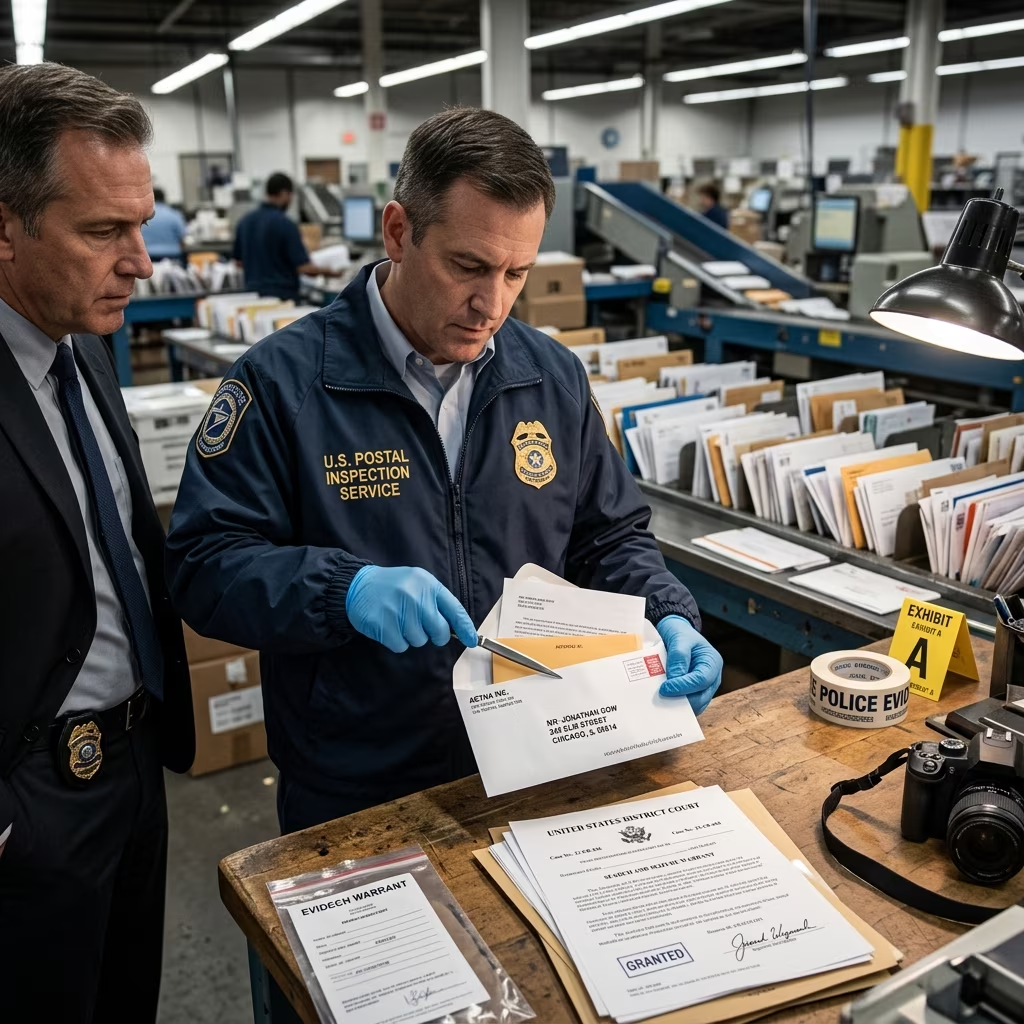
- The U.S. Postal Inspection Service (USPIS), the law enforcement arm of the Postal Service, has primary responsibility for investigating crimes involving mail and often handles the actual opening of items under a warrant or recognized exception.
- Federal agencies involved in national security or border enforcement (such as customs officials) may conduct searches of mail crossing the border under specific statutory authority.
In many cases, local police will simply secure suspicious mail as evidence and then coordinate with postal inspectors to conduct any lawful opening or examination.
Situations Where Officials May Lawfully Open Mail
Although the default rule is privacy, the law recognizes specific situations where mail can be inspected or opened legally:
1. Search Warrant for Mail or Mailbox
When officers can establish probable cause—for example, that a package contains illegal drugs or stolen items—they may apply to a judge for a warrant covering:
- A specific package or envelope being mailed or delivered; or
- The contents of a mailbox at a home or business.
Once granted, the warrant allows law enforcement to open the mail described in the order. The scope of the warrant matters: if it is limited to a particular package, officers cannot lawfully rummage through unrelated letters in the same mailbox.
2. Exigent Circumstances: Emergencies Involving Mail
Under long-recognized Fourth Amendment principles, officials may conduct warrantless searches to address emergencies that threaten life or serious injury. Applied to mail, this can include:
- A package that appears to contain a dangerous device (for example, vibrating, emitting noises, or leaking suspicious substances).
- Letters or parcels associated with an immediate threat, such as an ongoing attempt to harm someone.
Postal regulations explicitly contemplate “exigent circumstance” searches where inspectors act quickly to neutralize potential dangers before seeking a warrant.
3. Border Searches of Mail
Mail that is entering or leaving the United States is subject to different rules than domestic mail that never crosses the border. Congress has authorized customs and related officials to examine certain categories of mail without a warrant under 19 U.S.C. § 1583, particularly:
- Mail of domestic origin intended for export; and
- Foreign mail transiting the United States.
Even in these situations, there are limits. For instance, opening and inspecting the physical contents of heavier first-class mail may be allowed when there is reasonable cause to suspect contraband, but reading correspondence often still requires either a warrant or consent.
4. National Security and Intelligence Searches
Provisions in the Foreign Intelligence Surveillance Act (FISA) permit certain emergency physical searches, including of property in transit to or from foreign powers or their agents, without prior judicial authorization under tightly defined conditions. These powers are not used for ordinary criminal cases; they are reserved for specific national security scenarios and are subject to subsequent judicial review and internal oversight.
Opening Mail Not Addressed to You
Federal law does not only govern what police and inspectors can do; it also restricts what private individuals may do with mail addressed to someone else. A key statute, 18 U.S.C. § 1702, makes it a crime to obstruct or intercept correspondence addressed to another person under specified circumstances.
Important points about opening another person’s mail include:
- If you knowingly open mail addressed to someone else and interfere with delivery or receipt, you may violate federal law.
- If you accidentally open mail without realizing it is addressed to another person, you typically have not committed a crime, but you should promptly return it to the Postal Service (for example, by marking “Wrong Address” or “Return to Sender”).
- If the addressee has explicitly authorized you to open their mail (such as a neighbor collecting mail while they are away), that consent generally avoids liability.
Destroying or discarding another person’s mail after opening it can be treated as intentional obstruction of correspondence, which may carry both fines and possible imprisonment.
Your Mailbox and the Fourth Amendment
Your home mailbox is usually considered part of the area protected by the Fourth Amendment. Courts have recognized that its contents are generally subject to the same privacy expectations as other property stored on or immediately adjacent to your home. As a result:
- Police officers usually cannot open and search your mailbox or its contents without a warrant or a recognized exception to the warrant requirement.
- Random “rummaging” through mailboxes by officers, without probable cause or legal authority, can raise serious constitutional and federal law concerns.
If an officer searches your mailbox unlawfully, you may have grounds to challenge any resulting evidence and to raise potential civil rights claims, depending on the circumstances.
What Police Cannot Do With Your Mail
There are clear limits on law enforcement authority where mail is involved. In general, officers may not:
- Open sealed first-class letters or parcels in transit without either a warrant, exigent circumstances, border authority, or another recognized legal basis.
- Compel you to consent to a mail search through improper coercion or threats; consent must be voluntary.
- Search your mail simply because it is present in your car, home, or on your person, absent a lawful basis for searching those areas.
When these boundaries are crossed, defendants can seek suppression of the evidence and may explore remedies for unlawful search and seizure.
Practical Tips to Protect Your Mail-Related Rights
While every situation is unique, some general practices can help safeguard both your privacy and your legal position when dealing with mail and law enforcement:
- Do not open mail clearly addressed to someone else unless they have given you permission or you reasonably believe it is accidental and promptly return it.
- If police ask to open your mail, you may politely decline consent and indicate that you prefer they obtain a warrant.
- If you suspect a package is dangerous (for example, leaking, vibrating, or emitting fumes), do not open it yourself; contact authorities or the Postal Service immediately.
- Document any interaction where officers access your mailbox or mail without presenting a warrant, and consider speaking with a criminal defense lawyer afterward.
Frequently Asked Questions
Can police open my outgoing mail at the post office or drop box?
Ordinarily, police cannot open your outgoing first-class mail without a warrant. Standard letters and many sealed parcels are protected while in transit, and law enforcement generally must obtain judicial authorization before opening them, unless an exception such as exigent circumstances or border authority applies.
Is it a crime for me to open mail that is misdelivered to my address?
If you accidentally open misdelivered mail without noticing that it is addressed to someone else, you typically have not violated federal law. Once you realize the mistake, you should avoid destroying or discarding the mail and instead mark it for return and place it back in the postal system. Intentionally obstructing the delivery or receipt of the correspondence can be criminal.
Can officers search my mailbox as part of a broader search of my property?
When police execute a valid search warrant that covers your home and its curtilage (the immediate surroundings), your mailbox and its contents may fall within the authorized search area. However, officers still must stay within the scope of the warrant—for example, focusing on specified evidence rather than unrelated personal letters.
Do customs officials need a warrant to open packages sent internationally?
Customs and related officials have statutory authority to inspect certain categories of mail entering or leaving the United States, especially when they have reasonable cause to suspect contraband. However, reading purely private correspondence inside first-class mail often requires either a warrant or consent, even in the border context.
What should I do if I believe police unlawfully opened my mail?
If you suspect your mail has been opened or searched without lawful authority, consider taking these steps:
- Write down details of the incident, including dates, locations, involved agencies, and what was opened.
- Preserve any envelopes, packaging, or documents showing tampering.
- Consult a criminal defense attorney or civil rights lawyer to discuss possible suppression of evidence and other remedies.
- You may also contact the U.S. Postal Inspection Service to report suspected mail-related violations.
References
- Can the Police Open Your Mail? — LegalMatch Law Library. 2023-08-15. https://www.legalmatch.com/law-library/article/can-the-police-open-your-mail.html
- Yes, the government can open your mail without a warrant — R Street Institute. 2016-02-03. https://www.rstreet.org/commentary/yes-the-government-can-open-your-mail-without-a-warrant/
- 19 U.S.C. § 1583 – Examination of baggage and other merchandise — U.S. Government Publishing Office. 2024-01-01. https://www.govinfo.gov/app/details/USCODE-2022-title19/USCODE-2022-title19-chap8-sec1583
- 18 U.S.C. § 1702 – Obstruction of correspondence — U.S. Government Publishing Office. 2024-01-01. https://www.govinfo.gov/app/details/USCODE-2022-title18/USCODE-2022-title18-partI-chap83-sec1702
- What Is The Federal Law For Opening Mail Not Addressed To You? — The Law Dictionary. 2019-09-10. https://thelawdictionary.org/article/what-is-the-federal-law-for-opening-mail-not-addressed-to-you/
- Q: What can I do if a police officer searched my mailbox without a warrant? — Justia Ask a Lawyer. 2026-04-09. https://answers.justia.com/question/2026/04/09/what-can-i-do-if-a-police-officer-search-1112037