
Immigration Marriage Rules for Same‑Sex Couples
How lawful same‑sex marriages are treated in U.S. immigration, from green cards to visas and naturalization.
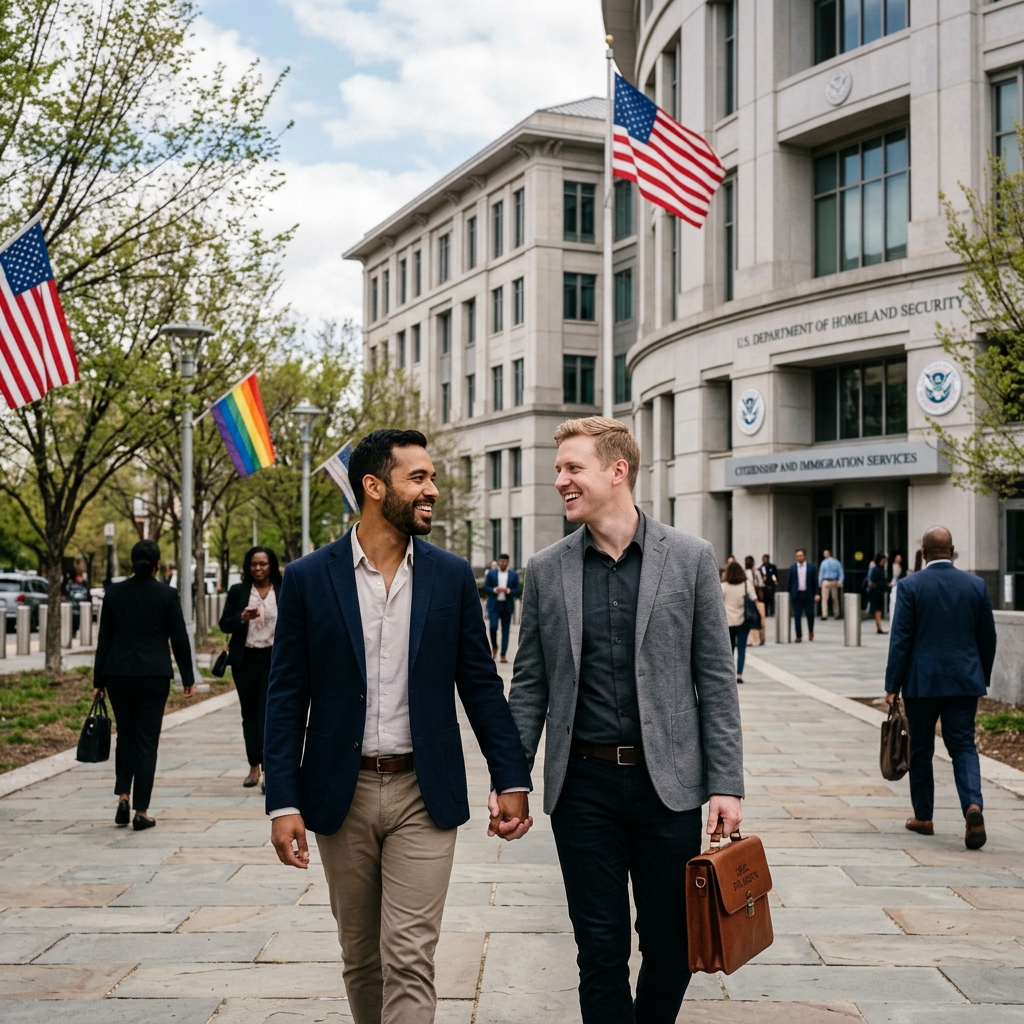
Same‑sex couples now enjoy broad access to U.S. immigration benefits when they are legally married, but the rules have specific requirements and limits that are important to understand. This guide explains how immigration law treats same‑sex marriages, what benefits are available, and what evidence couples must provide.
From Exclusion to Recognition: Legal Background
For many years, U.S. immigration law did not recognize same‑sex relationships for family‑based benefits. That changed after a series of legal and policy developments.
The impact of DOMA and its repeal
The Defense of Marriage Act (DOMA), enacted in 1996, prevented the federal government from recognizing same‑sex marriages for all federal purposes, including immigration. Under DOMA:
- Same‑sex spouses of U.S. citizens or permanent residents could not be petitioned for a green card.
- Lawful same‑sex marriages were treated as if the couples were unmarried for immigration benefits.
- Same‑sex spouses could not obtain waivers or relief from removal on the basis of their marriage.
In 2013, the Supreme Court’s decision in United States v. Windsor struck down Section 3 of DOMA, allowing federal agencies to recognize lawful same‑sex marriages. Within days, U.S. immigration authorities began approving marriage‑based petitions and green cards for same‑sex spouses on the same terms as different‑sex couples.
Place‑of‑celebration rule
U.S. Citizenship and Immigration Services (USCIS) applies a place‑of‑celebration rule when deciding whether a marriage is valid for immigration purposes. Under this approach:
- A marriage is generally recognized if it was legally performed in the jurisdiction where the ceremony occurred.
- This rule applies equally to same‑sex and different‑sex marriages.
- USCIS does not recognize certain relationships even if valid locally, such as polygamous marriages or civil unions that are not defined as marriage in the jurisdiction.
For same‑sex couples, the key question is whether the jurisdiction where they married legally recognizes their marriage as such. If it does, U.S. immigration authorities treat the marriage as valid, subject to general marriage law requirements.
Major Immigration Benefits Available to Same‑Sex Spouses
Once a same‑sex marriage is recognized, most family‑related immigration benefits become available on the same terms as for different‑sex couples.
Marriage‑based green cards
A U.S. citizen or lawful permanent resident may petition for a foreign national spouse based on a valid same‑sex marriage. Core features include:
- Immediate relatives: Same‑sex spouses of U.S. citizens qualify as “immediate relatives” with no numerical quota.
- Permanent resident sponsors: Same‑sex spouses of green card holders are treated under the family preference system, identical to different‑sex spouses.
- Process: The process involves filing a family petition (Form I‑130), plus adjustment of status in the U.S. or consular processing abroad.
Immigration officers evaluate whether the marriage is genuine (bona fide) and not entered into solely for immigration purposes, without applying different standards to same‑sex couples.
Derivative visas for temporary stays
When a primary visa holder comes to the United States for work, study, or other temporary purposes, a legally married same‑sex spouse can often obtain a derivative visa and accompany them. Examples include:
- Spouses of students (e.g., F‑1 principal with F‑2 spouse), workers (H‑1B principal with H‑4 spouse), and other nonimmigrant categories.
- Derivative visas are adjudicated “in the same way” for same‑sex spouses as for different‑sex spouses.
Consulates and embassies worldwide have been instructed to treat lawful same‑sex marriages as qualifying relationships for derivative spousal and stepchild visas where permitted by law.
Fiancé visas
U.S. fiancé visas allow a foreign national engaged to a U.S. citizen to enter the country to marry and then pursue permanent residence. According to official guidance, a same‑sex engagement can qualify for a fiancé visa as long as all other requirements are met. The couple must intend to enter into a marriage recognized as valid in the jurisdiction where it will occur.
Asylum‑related benefits for spouses
When an individual has been granted asylum in the United States, a spouse married before the asylum grant may be eligible to obtain asylum status as a derivative beneficiary, even if currently outside the United States. This principle applies to same‑sex spouses if the marriage is legally recognized.
Naturalization based on marriage
A spouse of a U.S. citizen may be eligible for an expedited path to naturalization based on the marital relationship. USCIS guidance clarifies:
- The applicant must submit an official civil record showing a legal and valid marriage.
- USCIS considers a marriage certificate prima facie evidence that the marriage was properly and legally performed, including for same‑sex marriages.
- Some spousal naturalization provisions require living in “marital union” with the citizen spouse for a specified period, which generally means actually residing together.
Same‑sex spouses are evaluated under the same validity and marital union rules as different‑sex spouses.
Recognition Limits: Civil Unions, Domestic Partnerships, and Public Policy
Although immigration law now recognizes lawful same‑sex marriages, not every formalized relationship qualifies as a “marriage” for federal immigration purposes.
Relationships that generally do not qualify
USCIS policy identifies several categories that do not count as marriages, even if valid in the place where they were formed.
- Civil unions and domestic partnerships: These are usually not recognized as marriages unless the jurisdiction explicitly treats them as marriage for all purposes.
- Polygamous marriages: Such marriages are not recognized for immigration benefits.
- Marriages violating strong public policy: Certain marriages may be excluded if they violate the strong public policy of the couple’s state of residence.
At the same time, the place‑of‑celebration rule generally prevents a couple’s home jurisdiction from invalidating a marriage that was lawful where celebrated, unless a specific exception applies.
Table: Relationship types and typical immigration treatment
| Relationship type | Typical immigration treatment |
|---|---|
| Legally recognized same‑sex marriage | Generally qualifies for spousal immigration benefits if valid where celebrated. |
| Civil union / registered partnership | Usually does not qualify as a “marriage” for federal immigration purposes. |
| Unregistered cohabiting partnership | May allow some visitor or cohabiting partner options, but not marriage‑based green cards. |
| Polygamous marriage | Not recognized for immigration benefits. |
Abuse, Safety, and Independent Immigration Relief
Same‑sex spouses who experience abuse in their relationship with a U.S. citizen or lawful permanent resident may have independent avenues for immigration relief. After the fall of DOMA, provisions under laws like the Violence Against Women Act (VAWA) were interpreted to cover LGBT spouses. This means:
- Abused same‑sex spouses and certain children of U.S. citizens or permanent residents may self‑petition for permanent residency without relying on the abuser.
- The ability to remain in the United States is not lost solely because the victim leaves the abusive household or relationship.
These protections can be critical where the abusive partner threatens to withdraw immigration sponsorship or uses immigration status as a tool of control.
Bona Fide Marriage: Evidence and Interview Expectations
USCIS and consular officers assess whether a marriage is genuine, not entered primarily to obtain immigration benefits. The same evidentiary expectations apply regardless of the couple’s genders.
Typical evidence of a genuine marriage
Applicants are generally expected to submit documents that show shared life and obligations. Common categories of evidence include:
- Marriage certificate from the jurisdiction where the marriage was celebrated.
- Joint lease or mortgage and shared utility bills.
- Joint bank accounts, insurance policies, or tax filings.
- Photographs together across time and with family and friends.
- Travel records, messages, and other proof of a continuing relationship.
Officers may conduct interviews focusing on the couple’s history, daily life, and plans. While same‑sex couples may sometimes face unique social circumstances, the legal standard applied is the same as for different‑sex couples.
Special Issues for Bi‑National Same‑Sex Couples
Bi‑national same‑sex couples often navigate complex legal landscapes involving different countries’ marriage and immigration laws. Several recurring issues include:
Marrying in a third country
If the couple’s home country does not permit same‑sex marriage, they may marry in a third country or in the United States where same‑sex marriage is legal. U.S. immigration authorities focus on whether the marriage is lawful where celebrated, not whether it is recognized in the couple’s country of origin.
Consular processing vs. adjustment of status
Some couples may have the option either to apply for permanent residence from inside the United States (adjustment of status) or through a U.S. consulate abroad (consular processing). Factors that influence this decision include:
- Current immigration status of the foreign national spouse.
- Overstays or prior violations of immigration law.
- Practical concerns about travel and safety, particularly where the foreign national’s home country criminalizes same‑sex relationships.
Key Takeaways for Same‑Sex Couples Considering Immigration Options
- Legal marriage matters: Immigration benefits hinge on having a relationship recognized as marriage under the law of the jurisdiction where the ceremony occurs.
- Equal treatment is the stated policy: Federal guidance makes clear that lawful same‑sex marriages are adjudicated on the same basis as different‑sex marriages.
- Evidence of a bona fide relationship is essential: Strong documentation of shared life helps support petitions and applications.
- Alternative protections exist: Abused spouses and certain family members may access protections that do not depend on the abuser’s cooperation.
- Legal advice can be valuable: Because circumstances vary and immigration consequences can be significant, consulting qualified immigration counsel is often prudent for complex cases.
Frequently Asked Questions
Do same‑sex spouses have the same immigration rights as different‑sex spouses?
Yes. Since the Windsor decision and subsequent policy changes, U.S. immigration agencies are required to treat lawful same‑sex marriages the same as different‑sex marriages for visa, green card, and naturalization purposes.
Is a civil union enough to sponsor my partner for a green card?
Generally no. USCIS does not treat civil unions, domestic partnerships, or similar statuses as marriages unless the jurisdiction clearly defines them as marriage. A legal marriage recognized where celebrated is usually required.
Can I bring my same‑sex spouse as a derivative on my work or study visa?
Yes, if you are lawfully married and the visa category allows spouses to receive derivative status. Consular guidance instructs embassies to adjudicate same‑sex spousal derivative visas the same way they adjudicate different‑sex spousal visas.
Does my marriage need to be recognized in my home country to qualify for U.S. immigration benefits?
No. The key factor for U.S. immigration purposes is that the marriage is legally valid where it was celebrated. Recognition in the couple’s home country is not generally required.
What if my U.S. citizen same‑sex spouse is abusive and threatens my status?
Abused spouses of U.S. citizens or permanent residents, including same‑sex spouses, may qualify for independent immigration relief without relying on the abuser’s sponsorship. Legal assistance is strongly recommended in such situations.
References
- US Visas for Same-Sex Spouses (DOMA FAQs) — U.S. Department of State. 2015-06-26. https://travel.state.gov/content/dam/visas/DOMA/DOMA%20FAQs%20-%202015%20Supreme%20Court%20Ruling.pdf
- USCIS Policy Manual, Volume 12, Part G, Chapter 2: Marriage and Marital Union for Naturalization — U.S. Citizenship and Immigration Services. 2022-03-11. https://www.uscis.gov/policy-manual/volume-12-part-g-chapter-2
- Same-Sex Immigration Policy of the United States — Summary of federal policy changes. 2013-06-26. https://en.wikipedia.org/wiki/Same-sex_immigration_policy_of_the_United_States
- Additional Immigration Benefits Are Available for Same-Sex Couples After DOMA Repeal — Center for American Progress. 2013-07-09. https://www.americanprogress.org/article/additional-immigration-benefits-are-available-for-same-sex-couples-after-doma-repeal/
- US Immigration Options for Same-Sex Couples — Immigrate-US. 2013-07-15. https://www.immigrate-us.net/lgbt-immigration/same-sex-marriage-immigration-fact-sheet/
- USCIS Approves First Green Cards for Same Sex Couples — American Immigration Council. 2013-07-01. https://www.americanimmigrationcouncil.org/blog/uscis-approves-first-green-cards-for-same-sex-couples
Similar Articles








Read full bio of medha deb


