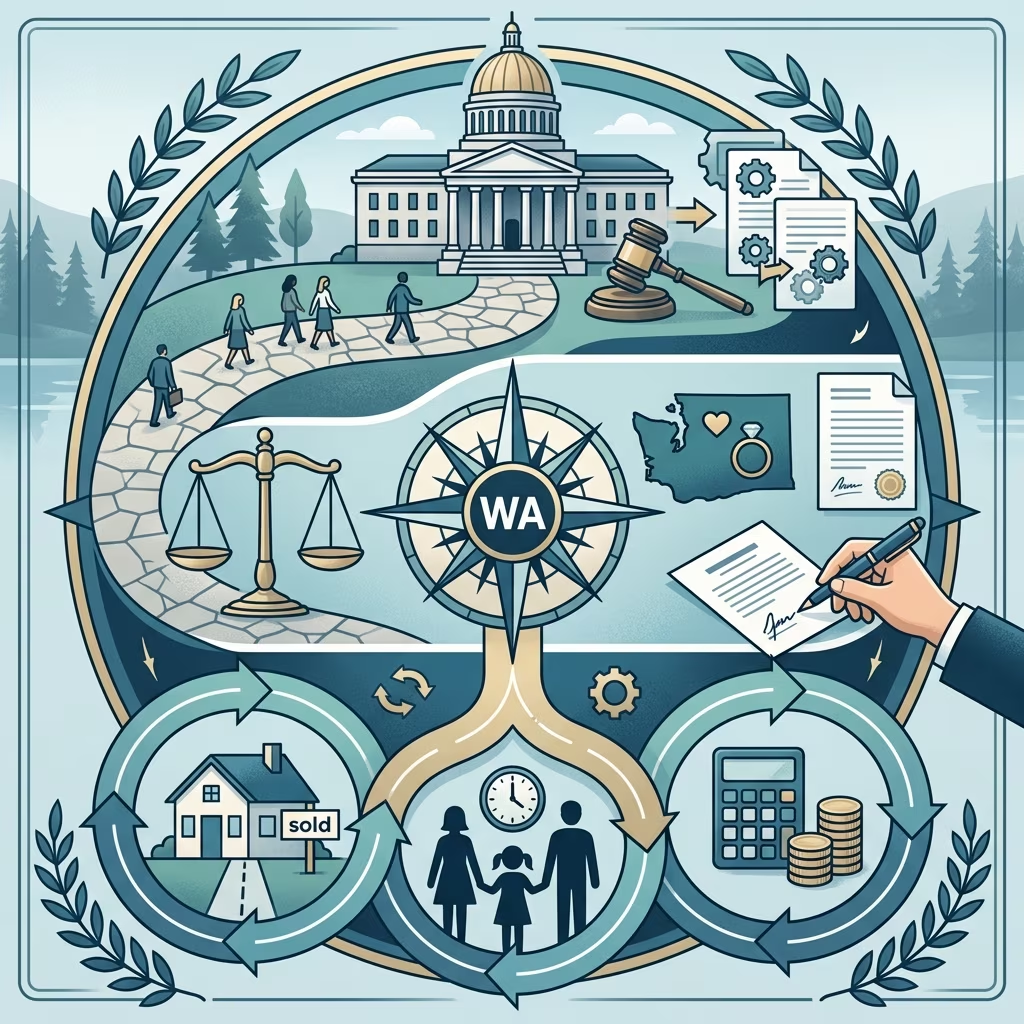
Ending a marriage is both an emotional and legal transition. If you live in Washington State, or your spouse does, understanding how divorce works here can help you make informed decisions and avoid costly mistakes. This guide explains Washington divorce basics, from residency and grounds to court forms, timelines, parenting plans, and property division, using plain language so you can follow each step with confidence.
Washington as a No-Fault Divorce State
Washington is a no-fault divorce state. You do not have to prove that your spouse did something wrong, such as adultery or cruelty, to obtain a divorce. Instead, the legal standard is that the marriage is irretrievably broken, meaning there is no reasonable chance the relationship can be repaired.
In practice, this means:
- Only one spouse needs to state that the marriage is irretrievably broken.
- Misconduct (like cheating or hurtful behavior) generally does not affect whether the court will grant the divorce.
- The focus of the case is on issues like children, finances, and property rather than proving fault.
Basic Eligibility: Residency and Jurisdiction
Before a Washington court can grant a divorce, it must have legal authority—called jurisdiction—over your case. In Washington, residency rules are relatively flexible.
You can usually file for divorce in Washington if any of the following apply:
- You are a resident of Washington State.
- You are married to a spouse who is a resident of Washington.
- You are a military member stationed in Washington.
- You are married to or in a domestic partnership with a military member stationed in Washington.
If you or your spouse are in the military, Washington courts can still handle your divorce even if the service member plans to remain stationed in the state for at least 90 days after starting the case.
Choosing the Right County
Divorce cases are filed in the Superior Court of a Washington county. Most people file in the county where they live, but in some circumstances it may be possible to file in another county that is more convenient or has different local procedures.
Key considerations when choosing a county:
- Where you and your spouse live.
- Where children primarily reside (for parenting plan issues).
- Local filing fees and rules (each county sets some of its own procedures).
Core Documents to Start a Divorce
To begin the divorce process, you file legal documents with the Superior Court clerk. In Washington, a divorce is legally called a Dissolution of Marriage. The two core documents are:
- Summons – Notifies your spouse that a divorce case has been filed and sets response deadlines.
- Petition for Dissolution of Marriage – Explains who the spouses are, what the marriage involves (children, property, debts), and what you are asking the court to decide.
The Washington State Courts provide official forms for dissolution of marriage, including petitions, summonses, and related paperwork. Washington Law Help also offers guided online tools to help you fill out the forms step-by-step.
What the Petition Typically Covers
While each case is unique, a Petition for Dissolution of Marriage commonly addresses:
- Basic information about you, your spouse, and your marriage date.
- Whether there are minor children and what you propose for parenting arrangements.
- How you want property and debts to be divided.
- Whether you seek spousal support (maintenance).
- Any temporary orders you may request while the case is pending.
Filing the Case: Clerk, Fees, and Case Number
Once your forms are prepared, you file them with the Superior Court Clerk in your chosen county.
At filing, typically:
- You bring (or e-file, if permitted) the original signed forms.
- You pay a filing fee, which varies by county and may be a few hundred dollars.
- The clerk assigns a case number and stamps copies to show the filing date.
If you cannot afford the filing fee, you may ask the court to waive it by submitting appropriate forms and financial information. After filing, you must properly notify (serve) your spouse.
Serving Your Spouse: Proper Legal Notice
Service of process is the formal way of giving your spouse the Summons, Petition, and other initial documents so they know a case has been started and can respond. Washington has detailed rules about service.
Common Methods of Service
Typically, you cannot serve the papers yourself. A neutral adult or professional process server must do it. Common methods include:
- Personal service – Handing the documents directly to your spouse.
- Service outside Washington – If your spouse lives in another state, they can still be personally served there, but response times differ.
- Alternative service – In limited situations, the court may allow service by mail or publication if you cannot find your spouse, but specific court approval is required.
Response Deadlines After Service
Once served, your spouse has a set amount of time to file a formal Response:
- About 20 days if served within Washington.
- 60 days if served outside Washington.
- Up to 90 days if service is by mail or publication, when permitted by court order.
If your spouse disagrees with anything in the Petition, they can explain their viewpoint in the Response and ask for different terms regarding children, property, or support.
Contested vs. Agreed (Uncontested) Divorce
Washington divorces generally fall into two broad categories: contested and agreed/uncontested.
Agreed or Uncontested Divorce
An agreed divorce occurs when both spouses reach alignment on all major issues and sign the final paperwork. In some counties, additional local forms may be required, but the process can be significantly simpler.
Typical characteristics of an agreed divorce:
- Both spouses sign the proposed final orders.
- No trial is needed; in many cases, only a brief court hearing or even written submission is required.
- It is often faster and less expensive because there is less litigation.
Contested Divorce
If spouses disagree on any significant issue—such as custody, support, or division of assets—the divorce becomes contested.
Contested cases may involve:
- Multiple court hearings.
- Exchange of financial information and other evidence.
- Negotiations or mediation to try to reach a settlement.
- Potential trial, where a judge decides unresolved issues.
The Mandatory 90-Day Waiting Period
Washington law requires a minimum 90-day waiting period before a divorce can be finalized. This period starts on the later of either the filing date or the date your spouse is served or signs the paperwork.
Key points about the waiting period:
- 90 days is the earliest point at which the court can finalize the divorce, even if you both agree on everything.
- Many cases take longer if issues remain unresolved, discovery is needed, or court schedules are busy.
- The waiting period can be used to gather information, negotiate, and prepare final orders.
Major Issues the Court Can Decide
A Washington divorce is not just about ending the legal relationship. The court can decide several important issues, especially when spouses cannot reach agreement.
| Issue | What the Court May Address |
|---|---|
| Parenting plan | Where children live, decision-making authority, and schedules for time with each parent. |
| Child support | Financial support for children, calculated using Washington’s child support guidelines. |
| Property division | Allocation of assets such as homes, vehicles, bank accounts, and retirement plans. |
| Debt division | Responsibility for mortgages, loans, credit card balances, and other obligations. |
| Spousal support | Ongoing financial support (maintenance) from one spouse to the other when appropriate. |
Parenting Plans and Child-Related Orders
If you have minor children, the court usually requires a detailed parenting plan. This plan sets out where the children will live, holiday schedules, and how major decisions (education, medical care, etc.) will be made. Special protections may be available in cases involving domestic violence or high conflict.
Property, Debts, and Financial Support
During the divorce, you generally must address the division of property and debts or risk losing the opportunity to have the court decide them later. These issues can be resolved through settlement negotiations and then incorporated into the final decree, or they may be decided by the judge after hearings or trial.
Temporary Orders During the Case
Because divorce cases can take months, spouses often need interim rules. Either party can ask the court for temporary orders to create structure while the case is pending.
Temporary orders can address:
- Who will live in the family home during the case.
- Temporary parenting arrangements and schedules.
- Temporary child support and, in some situations, spousal support.
- Protection orders or limits on contact in unsafe situations.
Finalizing a Washington Divorce
You are legally divorced only after the judge signs your final divorce order and it is filed with the court clerk. To reach this point, you must either reach an agreement with your spouse or obtain court decisions on unresolved issues.
Steps to Completion
Although specific procedures vary by county, finalization typically involves:
- Preparing final documents, such as a final divorce order, parenting plan, and child support order when applicable.
- Ensuring all required forms and attachments are completed and signed.
- Scheduling a final hearing date, often using a Notice of Hearing or local scheduling form.
- Attending a brief court hearing, where the judge reviews the paperwork and signs the final orders if everything is in order.
Once the final orders are signed and filed, your marriage is legally dissolved, and the terms of the orders govern future rights and responsibilities.
Helpful Resources for Washington Divorces
Several official and nonprofit resources can help you navigate the process:
- Washington State Courts Forms – Official dissolution (divorce) forms and instructions.
- Washington Law Help Divorce Guide – Step-by-step explanations and online form tools, including divorce with and without children.
- County Clerk and Court Facilitators – Many counties offer facilitators or self-help staff who answer questions about procedure and forms.
FAQs: Divorce in Washington State
Do I have to prove my spouse did something wrong to get divorced?
No. Washington is a no-fault state. You only need to state that the marriage is irretrievably broken. Misconduct usually does not affect whether the divorce is granted.
How long will my divorce take?
The shortest possible time is generally 90 days from filing and service, due to the mandatory waiting period. Contested cases often take longer, depending on complexity and court schedules.
Can I file for divorce if my spouse lives in another state?
Yes, if Washington has jurisdiction based on residency or military stationing. Your spouse can be served outside Washington, but response deadlines may be different.
What happens if my spouse does not respond?
If your spouse is properly served and does not respond within the required time, you may be able to ask the court for a default judgment. The court still reviews your paperwork, but it may grant orders based on your proposed terms if they comply with Washington law.
Do we need a trial if we agree on everything?
Usually not. In an agreed divorce, you and your spouse sign final orders and schedule a short hearing. The judge typically reviews the documents and, if acceptable, signs them without a trial.
Where can I find the official forms?
Official divorce forms are available through the Washington State Courts website, under the dissolution (divorce) category. Washington Law Help offers guided online tools that fill these forms in based on your answers.
References
- Filing for divorce in Washington State — Washington Courts Information Center. 2023-03-01. https://info.courts.wa.gov/support/solutions/articles/72000577384-filing-for-divorce-in-washington-state
- Basics of Divorce in Washington State – Part 1 of 3: Filing for Divorce — Fairchild Air Force Base Legal Office. 2015-07-31. https://www.fairchild.af.mil/News/Commentaries/Display/Article/763001/basics-of-divorce-in-washington-state-part-1-of-3-filing-for-divorce/
- Divorce guide — Washington Law Help, Northwest Justice Project. 2024-01-10. https://www.washingtonlawhelp.org/en/divorce-guide
- Washington Divorce — WomensLaw.org, National Network to End Domestic Violence. 2022-06-15. https://www.womenslaw.org/laws/wa/divorce
- Filing for Divorce – Agreed (Uncontested) — Lincoln County, Washington. 2023-08-01. https://www.lincolncountywa.com/490/Filing-for-Divorce—Agreed-Without-Chil
- Divorce, Legal Separation, or Invalidity — Pierce County Superior Court. 2022-11-01. https://www.piercecountywa.gov/7781/Divorce-Legal-Separation-or-Invalidity
- Court Forms – Dissolution (Divorce) — Washington State Courts. 2026-03-01. https://www.courts.wa.gov/forms/?fa=forms.contribute&formID=13