Marriage to a U.S. citizen or lawful permanent resident can open the door to a green card, but the immigration consequences of a later divorce depend heavily on timing, type of green card, and evidence that the marriage was genuine. Understanding how the two-year wedding anniversary interacts with divorce is critical for protecting your immigration status.
Marriage-Based Green Cards: Conditional vs. Permanent
When a person obtains a green card through marriage, U.S. immigration law distinguishes between conditional permanent residents and 10-year permanent residents.
| Type of status | When granted | Validity period | Key requirement |
|---|---|---|---|
| Conditional permanent residence | Marriage less than 2 years old at time of approval | 2 years | Must file Form I-751 to remove conditions |
| Permanent (10-year) green card | Marriage at least 2 years old at time of approval or conditions already removed | 10 years (renewable) | Renew with Form I-90; no marital proof generally required |
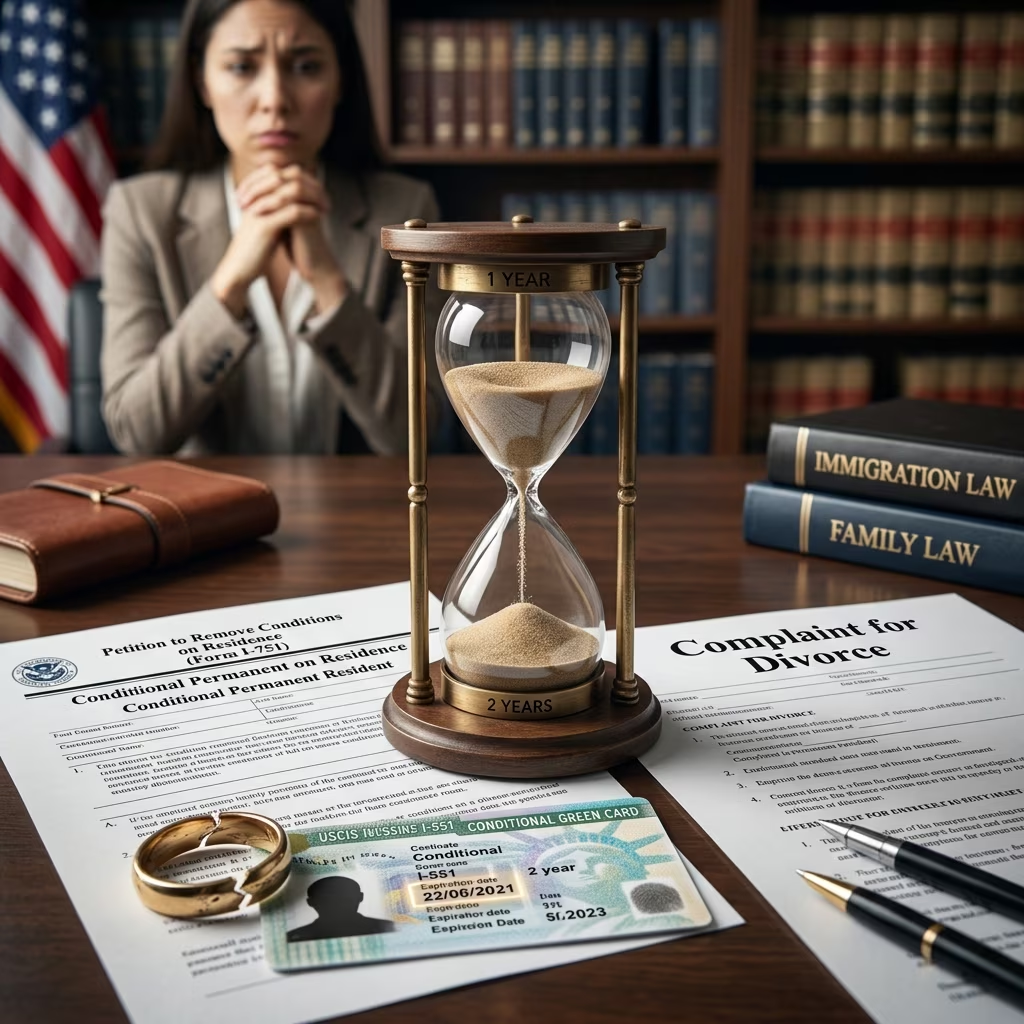
Under immigration law, a marriage-based green card is conditional if you were married for less than two years on the day permanent residence was granted. The government uses this conditional period to ensure that short-term marriages are genuine and not solely for immigration benefits.
Why the Second Wedding Anniversary Matters
The second wedding anniversary functions as a practical deadline in most marriage-based green card cases:
- If your green card was approved before your marriage was two years old, you become a conditional resident with a two-year card.
- Within the 90 days before that conditional card expires, you generally must file Form I-751 to remove conditions.
- Once conditions are removed, you receive a green card valid for ten years, no longer tied to ongoing proof of a current marriage.
Although the statute focuses on the two-year mark from the date the green card is granted, the second wedding anniversary and the expiration of the conditional card usually occur close in time. For many couples, this period becomes a decisive moment if the marriage is unstable or heading toward divorce.
Proving a Real Marriage for Immigration Purposes
To obtain or keep a marriage-based green card, the immigrant must demonstrate that the marriage was entered into in good faith, not primarily to secure immigration status. Evidence of a genuine relationship often includes:
- Joint bank or investment accounts and shared financial records.
- Leases or property deeds in both spouses’ names.
- Joint federal and state tax returns.
- Birth certificates of children born to the marriage.
- Shared insurance policies (health, auto, life) naming both spouses.
- Travel records, family photographs, and messages showing a real shared life.
- Affidavits from friends or relatives describing the relationship.
This type of documentation becomes especially important if the marriage breaks down before conditions are removed, because U.S. Citizenship and Immigration Services (USCIS) will scrutinize the case for possible fraud.
Divorce While You Have a Pending Marriage-Based Case
Divorce can have the most drastic effect when it occurs before you receive any form of permanent residence. If a marriage-based green card application is still pending—either for adjustment of status inside the United States or through consular processing abroad—and the spouses divorce, USCIS typically stops processing that application.
The reason is straightforward: eligibility for a marriage-based immigrant visa assumes the existence of a valid qualifying relationship. Once the marriage ends, the underlying petition is no longer supported, and the foreign spouse generally loses eligibility on that basis.
- The petitioning spouse can withdraw the petition.
- USCIS may deny the adjustment application because the qualifying relationship no longer exists.
- The foreign spouse must look for another immigration avenue, such as employment-based sponsorship, a different family relationship, or in some cases humanitarian relief.
Because of these risks, couples whose relationships are unstable during the application phase should seek legal advice before filing or withdrawing a marriage-based petition.
Divorce During Conditional Residence (Two-Year Card)
Divorce poses the greatest legal complexity for those who already hold a conditional green card. As a conditional resident, you must file Form I-751 to remove conditions and obtain a regular ten-year green card.
Joint Filing vs. Waiver Filing
Ordinarily, spouses file Form I-751 jointly during the 90 days before the conditional card expires. Divorce or separation can make joint filing impossible, but immigration law offers waiver options.
You may request a waiver of the joint filing requirement and file Form I-751 alone if, for example:
- The marriage was entered into in good faith but ended in divorce or annulment.
- You or your child were subjected to battery or extreme cruelty by your spouse.
- Termination of your status and removal would cause extreme hardship.
In these situations, your task is to prove that the marriage was authentic despite its breakdown. USCIS may schedule an in-depth interview and closely review your evidence.
Risks of Not Filing or Filing Late
If a conditional resident fails to properly file Form I-751—even with a waiver—before the card expires, they generally lose lawful permanent resident status and become deportable. USCIS can issue a notice to appear in immigration court, where a judge reviews the case and any arguments for relief.
However, filing a complete and timely waiver petition can allow a divorced conditional resident to keep their status and eventually secure a ten-year card, as long as they demonstrate good faith in entering the marriage.
Divorce After Obtaining a 10-Year Green Card
Once conditions are removed and a person holds a standard 10-year green card, divorce usually has a much smaller impact on basic immigration status.
- The divorce does not automatically cancel a 10-year green card.
- Renewal is generally done on Form I-90 and does not focus on marital status.
- The permanent resident can continue living and working in the United States so long as they do not commit removable offenses and do not abandon residence.
However, USCIS may examine the original marriage-based case again during future applications—particularly when the person later applies for naturalization. Officers have authority to revisit prior records and ask questions to ensure there was no marriage fraud.
How Divorce Affects U.S. Citizenship Eligibility
Divorce does not just affect green card status; it can also change how long a person must wait before applying for U.S. citizenship. Under U.S. law, most permanent residents must wait five years before applying for naturalization, but marriage to a U.S. citizen can reduce this wait to three years if certain conditions are met.
When a marriage ends, the shorter three-year path usually no longer applies.
- If you divorced after getting a 10-year green card based on marriage, your basic status remains, but you typically must wait five years from the date you became a permanent resident to apply for citizenship.
- USCIS can review your marital history and ask questions about the divorce to rule out fraud, but a genuine marriage that ended will not automatically bar naturalization.
For conditional residents, the timeline extends because they must first complete the I-751 process, obtain a 10-year green card, and then meet the residency requirements for naturalization. Divorce during the conditional period can therefore delay citizenship even if the person ultimately keeps their status.
Special Considerations: Abuse, Separation, and Dependent Visas
Marital Abuse and Immigration Protection
Some immigrants face divorce because of domestic violence or severe abuse. U.S. law recognizes this reality and offers specific protections. For example, a conditional resident who has been battered or subjected to extreme cruelty by a spouse can seek a waiver of the joint filing requirement when removing conditions. They must still establish that the marriage itself was entered in good faith, but the abuse is a basis for filing independently.
Legal Separation vs. Divorce
A legal separation generally does not terminate a marriage; the couple remains legally married, even if they live apart or have court orders governing property or custody. Because the marriage technically continues, a legal separation often carries fewer immediate immigration risks than a finalized divorce, especially for conditional residents.
However, extended separation can still raise questions about the genuineness of the marriage, and couples should approach immigration filings cautiously during this period.
Dependent Spouses on Other Visa Types
Not all immigrant spouses hold marriage-based green cards. Some are present on dependent visas, such as the H-4 (dependent of an H-1B worker) or similar categories. In many of these arrangements, a dependent spouse’s status is tied directly to the principal visa holder. When divorce is finalized, the dependent status may terminate, requiring the former spouse to seek another legal status or depart the country.
These situations differ from marriage-based permanent residence and require careful analysis by an immigration professional.
Common Mistakes and Practical Tips
Divorce and immigration are both stressful processes. Avoiding common mistakes can help prevent unintended loss of status or delays in future applications.
Frequent Errors
- Missing the I-751 deadline because of confusion around divorce or separation during conditional residence.
- Failing to collect evidence of a genuine marriage before or during divorce proceedings.
- Assuming a 10-year card is at risk simply because the marriage ended, without checking actual rules.
- Not updating USCIS about changes in marital status when required, which can appear as misrepresentation.
- Relying on informal advice instead of consulting a qualified immigration attorney when the situation is complex.
Best Practices
- Maintain organized records of joint finances, housing, and family life from the beginning of the marriage.
- Monitor expiration dates on conditional cards and calendar the 90-day filing window for Form I-751.
- Seek legal guidance early if divorce, legal separation, or abuse arises during conditional residence.
- Be prepared for questions about your marriage history during naturalization and answer truthfully, with supporting documentation.
- Consider broader immigration planning—career-based options, alternate family categories, or humanitarian relief—if a marriage-based path becomes uncertain.
FAQs: Divorce and Marriage-Based Green Cards
Does divorce automatically cancel my green card?
If you already hold a 10-year permanent green card, divorce generally does not cancel it. If you have a conditional 2-year card, divorce does not automatically cancel status but can complicate your I-751 filing and require a waiver.
What happens if I divorce before my conditional card expires?
You can usually file Form I-751 with a request to waive the joint filing requirement, explaining that the marriage was genuine but ended in divorce and providing strong evidence of the relationship. Failure to file puts your status at risk and may lead to removal proceedings.
Can I still become a U.S. citizen after divorcing my U.S. citizen spouse?
Yes, most divorced permanent residents can eventually apply for citizenship as long as they maintain lawful permanent residence and meet all other requirements. However, you will usually need to wait five years from the date you became a permanent resident, instead of the shorter three-year route reserved for those still married to and living with a U.S. citizen.
Is legal separation treated the same as divorce?
No. Legal separation generally does not terminate the marriage, so immigration consequences can be different. Separation may carry fewer immediate risks than divorce for conditional residents, but long-term separation can still prompt questions about whether the marriage is genuine.
What if my spouse was abusive and I need to leave the marriage?
U.S. law allows certain abused spouses to file independently to remove conditions, using a waiver, and still keep their status if they prove the marriage was entered in good faith. They may also explore other protections, such as humanitarian programs, with the assistance of legal counsel.
References
- Removing Conditions on Permanent Residence Based on Marriage — U.S. Citizenship and Immigration Services (USCIS). 2024-02-01. https://www.uscis.gov/green-card/after-we-grant-your-green-card/conditional-permanent-residence/removing-conditions-on-permanent-residence-based-on-marriage
- Divorce and Your Green Card: Risks, Waivers, and Citizenship — The Law Office of Dixler & Associates. 2023-08-10. https://dixler.com/what-are-the-consequences-of-divorce-on-a-marriage-based-green-card/
- Divorce After Getting a Green Card: What It Means for Your Immigration Status — Godoy Law Office. 2023-05-15. https://godoyolivieri.com/blog/divorce-after-getting-a-green-card-what-it-means-for-your-immigration-status/
- How Will Divorce or Separation Affect My Immigration Status? — Peoples Law Library of Maryland. 2022-11-30. https://www.peoples-law.org/how-will-divorce-or-separation-affect-my-immigration-status
- Will I Lose My Green Card If I Divorce My U.S. Citizen Spouse? — Immigration Legal Advisors, PLLC. 2023-04-20. https://www.immigrationabogado.com/blog/will-i-lose-my-green-card-if-i-divorce-my-u-s-citizen-spouse