
Understanding GAP Insurance for Auto Loans
Learn how GAP insurance protects you from owing thousands on a totaled or stolen vehicle you can no longer drive.
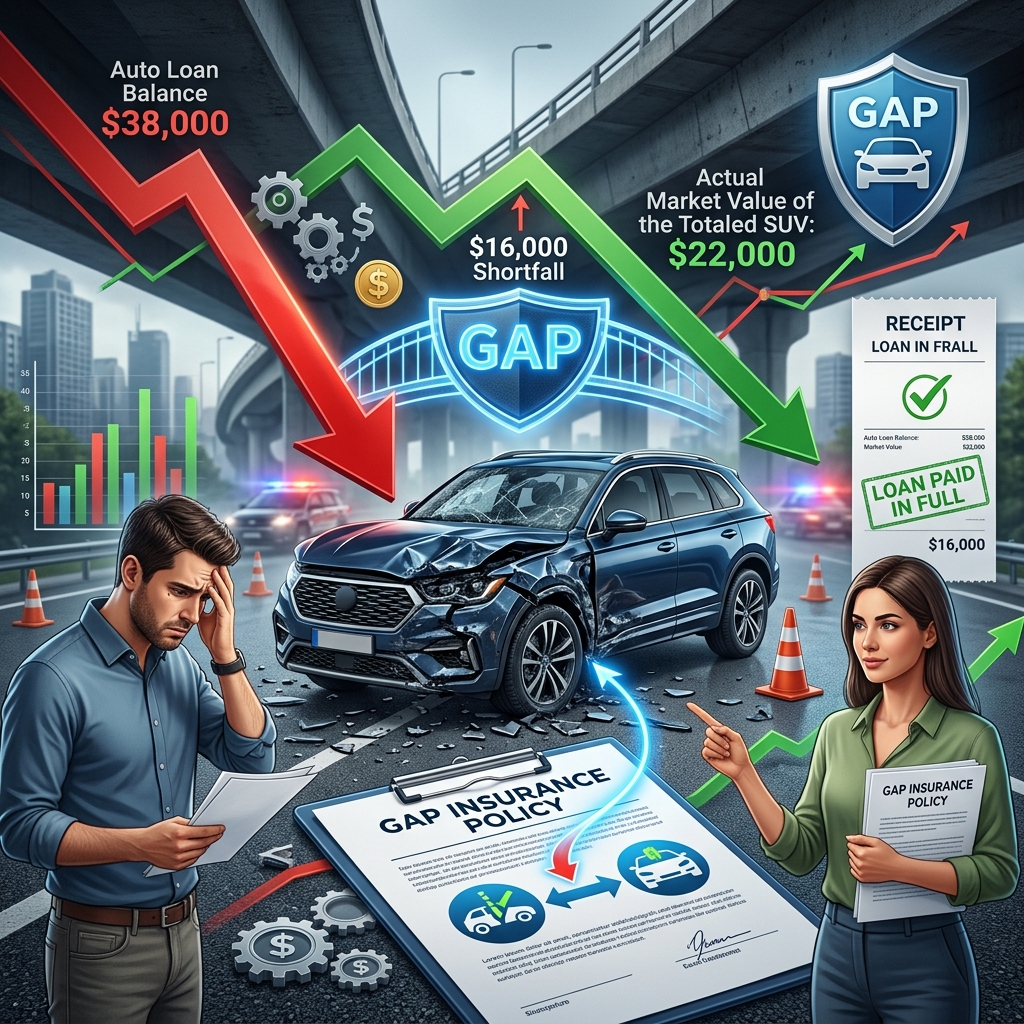
When you finance or lease a car, you may face a hidden financial risk if the vehicle is totaled or stolen before the loan is paid off. Guaranteed Asset Protection (GAP) insurance is designed to address that risk by covering the difference between what your car is worth and what you still owe on it.
This guide explains in detail how GAP insurance works, what it covers and excludes, who is most likely to benefit from it, and how to decide whether it is right for your next vehicle purchase.
What GAP Insurance Is and Why It Exists
New vehicles lose value quickly due to depreciation. In many cases, a car’s market value can fall faster than the loan or lease balance is paid down. If the vehicle is declared a total loss, standard auto insurance typically pays only its actual cash value (ACV)—its current market value, not the original price you paid or the remaining loan balance.
GAP insurance is an optional coverage that helps pay the difference between:
- The ACV payout from your regular auto insurance, and
- The outstanding balance on your auto loan or lease agreement.
By filling this “gap,” the coverage helps prevent drivers from owing money on a vehicle they no longer own or can drive.
How GAP Insurance Works After a Total Loss
GAP insurance does not activate for routine repairs. It comes into play only when your vehicle is considered a total loss or is stolen and not recovered. The process generally unfolds in several steps:
- A covered event occurs, such as a major collision or theft, and the vehicle is declared a total loss by your auto insurer.
- Your standard auto policy pays the vehicle’s ACV, usually reduced by your applicable deductible.
- You still owe some amount on the loan or lease. If this amount is greater than the ACV payment, a negative balance remains.
- Your GAP policy then pays some or all of that remaining balance, subject to its limits and exclusions.
Important: you must have comprehensive and collision coverage in place for GAP insurance to apply, because GAP coverage supplements those primary protections rather than replacing them.
Example of a GAP Insurance Claim
Consider a driver who buys a new car for $30,000 with a low down payment and a long-term loan. After an accident a year later, the insurer determines that the vehicle’s ACV is $22,000. The driver still owes $26,000 on the loan.
| Item | Amount (USD) |
|---|---|
| Outstanding loan balance | $26,000 |
| Standard auto insurance ACV payout | $22,000 |
| Remaining balance after ACV payment | $4,000 |
| Amount GAP insurance may cover | Up to $4,000 (subject to policy terms) |
Without GAP insurance, the driver must pay the $4,000 difference out of pocket to satisfy the lender, despite no longer having the car. With GAP coverage, much or all of that remaining amount is typically covered.
What GAP Insurance Typically Covers
While exact terms vary by provider, most GAP policies are designed to protect against the risk of a loan or lease balance exceeding the car’s value after a total loss. They generally include:
- Total loss from collision – when repairs would cost more than the vehicle’s value and your insurer deems it uneconomical to fix.
- Theft where the vehicle is not recovered – standard coverage pays the ACV, and GAP helps address any remaining loan or lease balance.
- Depreciation-related shortfalls – the financial gap created when your vehicle’s market value drops faster than your loan balance declines.
In all cases, GAP insurance focuses on the financial obligation to your lender or lessor, not the physical damage itself.
What GAP Insurance Does Not Cover
Because GAP insurance has a narrow purpose, many possible costs related to owning and operating a vehicle remain outside its scope. Policies commonly exclude the following:
- Medical expenses or injury-related costs following an accident.
- Damage to other vehicles or property.
- Routine mechanical issues, maintenance, or engine failure.
- Minor damage that does not qualify the vehicle as a total loss.
- Loan costs beyond principal, such as extended warranties, finance charges, or certain excess mileage fees on leases.
GAP coverage also does not replace the need for liability, collision, or comprehensive insurance. Instead, it is a supplemental protection aimed strictly at the risk of owing more than a totaled car is worth.
Who Typically Needs GAP Insurance?
Not every driver needs GAP insurance. It is primarily relevant for people whose loan or lease structure and vehicle choice make them vulnerable to large negative equity (owing more than the car’s value). You are more likely to benefit from GAP coverage if one or more of the following apply:
- You financed a new vehicle with a small or no down payment.
- Your loan term is five years or longer, which slows the pace at which the balance is paid down.
- The vehicle is known to depreciate quickly, losing a significant portion of its value in the first years of ownership.
- You are leasing rather than buying, and the lease structure results in a large balance relative to the vehicle’s resale value.
- Covering a potential shortfall out of pocket would cause financial strain or force you to take on additional debt.
If your car is worth more than you owe, or if you have substantial equity due to a large down payment, GAP insurance may offer limited practical benefit.
Where You Can Buy GAP Insurance
Drivers typically encounter GAP insurance from three main sources:
- Auto insurance companies – many major insurers offer GAP coverage as an add-on to an existing auto policy. This is often one of the most cost-effective options.
- Dealerships – dealers frequently promote GAP coverage at the time of purchase or lease. These plans may be convenient, but they can carry higher prices or be rolled into the loan amount.
- Banks and credit unions – some lenders offer GAP protection alongside auto loans or leases, usually for a flat fee.
Consumer and industry sources indicate that GAP insurance purchased through an auto insurer tends to be cheaper than policies sold by dealers or private lenders, which often charge several hundred dollars as a one-time fee.
Cost Considerations and Typical Pricing
GAP insurance is generally less expensive than major coverages like collision and comprehensive. A review of credit union guidance and insurance industry data suggests:
- Many insurers price GAP coverage at 5–6% of the collision and comprehensive premium.
- Dealer or lender GAP protection often costs a flat fee, commonly cited in ranges of $500–$700 when rolled into the financing.
- Annual premiums for GAP insurance through an auto insurer can be modest relative to the potential benefit, though exact costs depend on the vehicle, location, and insurer.
When evaluating cost, it is useful to compare:
- The total potential shortfall you might face if the car is totaled in the early years of the loan.
- The cumulative amount you would pay for GAP coverage over the period when you are most at risk of owing more than the car’s value.
When You Can Cancel or Stop GAP Coverage
GAP insurance is intended to be temporary. Once your loan or lease balance falls below the vehicle’s market value, the gap that the coverage was designed to protect against essentially disappears.
At that point, you can usually:
- Contact your insurer to remove GAP coverage from your auto policy.
- Review any lender or dealer contract to see whether early cancellation or refunds are available for prepaid GAP plans.
Regularly checking your payout value (using market pricing tools or insurer estimates) and comparing it to your current loan balance can help you determine when GAP insurance is no longer necessary.
Pros and Cons of GAP Insurance
Like any insurance product, GAP coverage provides clear protection in specific scenarios but may be unnecessary in others. Understanding its advantages and disadvantages can support better decision-making.
| Advantages | Limitations |
|---|---|
|
|
Key Factors to Evaluate Before Buying GAP Insurance
To decide whether GAP insurance fits your situation, consider the following practical questions:
- Loan-to-value ratio: How much do you owe relative to the car’s current value? A high ratio suggests a greater potential gap if the car is totaled.
- Down payment size: Did you put down less than 20% of the purchase price? Smaller down payments mean you start out with less equity.
- Loan term length: Is your loan spread over five or more years, which keeps the balance higher for longer?
- Vehicle type and depreciation: Is your vehicle known to lose value faster than average? Certain models and luxury vehicles can drop sharply in value.
- Personal financial cushion: Could you pay several thousand dollars toward a remaining loan balance without causing hardship?
Answering these questions honestly can reveal whether the probability and impact of a gap are significant enough to justify the added premium or fee.
Frequently Asked Questions About GAP Insurance
Is GAP insurance required by law?
No. GAP insurance is not legally required. It is an optional coverage offered by insurers, dealerships, and lenders. However, some financing or leasing contracts may strongly recommend or encourage it due to the lender’s risk exposure.
Can I buy GAP insurance for a used car?
In many cases, yes. Although GAP coverage is most commonly associated with new vehicles, some insurers and lenders allow it for used cars that are financed or leased, as long as the loan structure could realistically lead to negative equity.
Does GAP insurance cover my deductible?
Policies differ. Some GAP plans may reimburse or partially cover the deductible associated with the primary auto insurance claim, while others do not. It is important to review your individual policy details or ask your provider directly.
What happens if I refinance my auto loan?
Refinancing can affect your GAP coverage, particularly if the policy was tied to the original lender or loan terms. You may need to obtain new GAP insurance or confirm with your insurer that your existing coverage still applies under the refinanced agreement.
Can I transfer GAP insurance to another vehicle?
Generally, GAP insurance is specific to a particular loan or lease and vehicle. If you trade in or sell your car, you will typically have to cancel the existing GAP policy and purchase new coverage if desired for a different vehicle.
Practical Tips for Managing GAP Insurance
To make effective use of GAP insurance while avoiding unnecessary costs, consider these practical steps:
- Review your auto loan or lease statement regularly to track your remaining balance.
- Check estimated market values through reputable pricing guides to understand depreciation.
- Compare GAP offers from your insurer, dealer, and lender, focusing on total cost and exclusions.
- Reassess the need for GAP coverage annually, especially as you pay down your loan.
- Read policy documents carefully to understand what is included and excluded before you sign.
Strategic use of GAP insurance can provide targeted protection during the most financially vulnerable period of vehicle ownership, while allowing you to reduce coverage once the risk of negative equity declines.
References
- What Is Gap Insurance and How Does It Work? — Progressive. 2024-01-10. https://www.progressive.com/answers/gap-insurance/
- Automobile GAP Insurance: What It Covers & Do You Need It? — Heritage Family Credit Union. 2023-06-15. https://www.hfcuvt.com/post/automobile-gap-insurance-what-it-covers-do-you-need-it.html
- What Is Gap Insurance? — GEICO. 2023-09-01. https://www.geico.com/auto-insurance/gap-insurance-coverage/
- What Is Gap Insurance? — Allstate Insurance. 2023-05-20. https://www.allstate.com/resources/car-insurance/gap-insurance-coverage
- What Is Gap Insurance? — Insurance Information Institute. 2022-11-03. https://www.iii.org/article/what-gap-insurance
- Is Gap Insurance Worth It? — Orange County’s Credit Union. 2023-08-12. https://www.ocfederal.com/blog/is-gap-insurance-worth-it/
- Do You Need Gap Insurance for Your Car? How Does It Work? — Texas Department of Insurance. 2022-04-26. https://www.tdi.texas.gov/tips/gap-insurance.html
Similar Articles








Read full bio of medha deb




