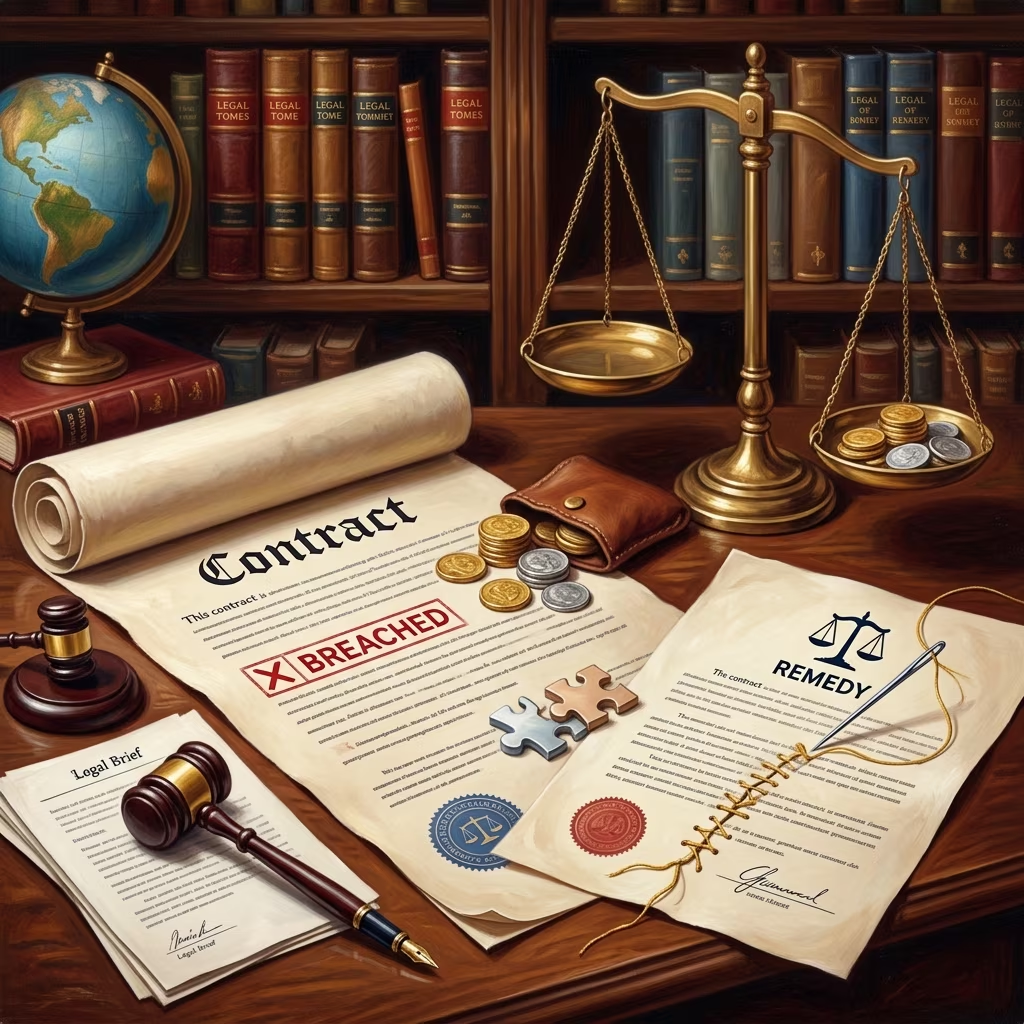
When one party fails to live up to a legally binding agreement, the law provides tools to repair the harm or, in some cases, unwind the relationship entirely. Understanding these remedies for breach of contract helps businesses and individuals decide whether to negotiate, walk away, or pursue legal action.
This guide explains the major remedies, when they are available, and the key legal ideas courts use to decide what relief is fair.
1. What Counts as a Breach of Contract?
A contract is breached when a party does not perform a duty required by the agreement and has no valid legal excuse for that failure. Breaches can occur in several ways, and the type of breach often influences which remedies make sense.
1.1 Common Types of Breach
- Failure to perform: A party simply does not do what the contract requires, such as not delivering goods or failing to provide services on time.
- Hindering performance: One party obstructs or prevents the other from performing, for example by denying access to a job site.
- Repudiation (anticipatory breach): A party clearly indicates, through words or conduct, that it does not intend to perform before performance is due.
1.2 Material vs. Minor Breach
Not all breaches are equal in severity. Courts often distinguish between material (serious) and minor (partial) breaches.
| Type of Breach | Definition | Typical Consequences |
|---|---|---|
| Material breach | A significant violation that defeats the essential purpose of the contract and causes substantial harm. | Non-breaching party can usually suspend performance, terminate the contract, and seek substantial damages. |
| Minor breach | A less serious failure where the main benefit of the bargain is still delivered. | Non-breaching party generally must still perform but can claim damages for the shortfall. |
The more serious the breach, the broader the range of remedies that may be available, including the right to cancel the agreement.
2. Overview of Contract Remedies
In contract law, a remedy is the legal response when one party breaks its promises. Remedies fall into two broad categories: legal remedies (money damages) and equitable remedies (non-monetary relief ordered by a court).
- Legal remedies: Primarily involve payment of money to compensate for losses caused by the breach.
- Equitable remedies: Aim to ensure fairness by compelling or prohibiting certain actions, or by undoing the contract and restoring the parties to their prior positions.
Courts generally start from the presumption that monetary damages are the default response to a breach, and only move to equitable remedies when money is not adequate.
3. Legal Remedies: Monetary Damages
Most breach of contract claims are resolved through some form of damages. The core goal is not to punish the breaching party but to put the injured party in the economic position they would have been in if the contract had been properly performed.
3.1 Compensatory Damages
Compensatory damages are the most common remedy in contract disputes. They are intended to cover the direct loss caused by the breach, such as the difference between the contract price and the cost to obtain substitute performance.
Courts often break compensatory damages into two components:
- Direct damages: The immediate financial loss from the breach (for example, the cost of hiring another contractor).
- Incidental damages: Reasonable additional costs tied to dealing with the breach, such as inspection or storage expenses.
3.2 Consequential Damages
Consequential damages (also called special damages) compensate for additional losses that flow from the breach, such as lost profits, provided these losses were reasonably foreseeable at the time the contract was formed. In many jurisdictions, these are recoverable only when the breaching party had reason to know of the potential downstream losses.
3.3 Liquidated Damages
Liquidated damages are amounts specified in the contract itself as the agreed compensation if a breach occurs. These clauses are common in construction, technology, and other fields where delays or non-performance can be costly but difficult to quantify precisely.
- The amount must be a reasonable estimate of anticipated harm at the time of contracting.
- If the figure is unreasonably high and functions as a penalty, many courts will refuse to enforce it.
3.4 Nominal and Punitive Damages
In some cases, courts award additional types of monetary damages:
- Nominal damages: A small, symbolic sum awarded where a breach occurred but the plaintiff cannot show actual financial loss.
- Punitive damages: Damages intended to punish and deter wrongful conduct. These are rare in contract law and typically available only where the breach is tied to separate egregious conduct, such as fraud or bad-faith behavior.
3.5 Reliance and Restitutionary Damages
In certain situations, courts may measure damages based on the injured party’s reliance or the breaching party’s gains.
- Reliance damages: Compensate the injured party for expenses they reasonably incurred by relying on the contract, such as preparatory costs, even if expected profits are uncertain.
- Restitutionary damages: Focus on stripping unjust enrichment from the breaching party and returning benefits conferred by the non-breaching party.
4. Equitable Remedies: When Money Is Not Enough
Sometimes money cannot adequately address the harm caused by a breach. In such cases, courts may use equitable remedies, which are discretionary tools grounded in fairness.
4.1 Specific Performance
Specific performance is a court order requiring the breaching party to perform its contractual obligations rather than simply paying damages. This remedy is typically reserved for situations in which the subject matter of the contract is unique or difficult to replace—such as real property, rare items, or particular business interests.
- Common in agreements for the sale of land, because every parcel of real estate is considered unique.
- Generally not available for personal service contracts, where forcing someone to work would raise serious policy concerns.
- Used only when monetary damages would be inadequate compensation.
4.2 Injunctions
An injunction is a judicial order directing a party to do or stop doing something. In contract disputes, injunctions are often used to prevent ongoing or threatened breaches rather than to remedy past ones.
- Prohibitory injunction: Orders a party not to engage in certain conduct, such as disclosing trade secrets or competing within a restricted area.
- Mandatory injunction: Compels a party to take positive steps, such as returning proprietary information.
Like specific performance, injunctions are discretionary and typically granted only when damages would be inadequate and the plaintiff faces irreparable harm.
4.3 Rescission and Restitution
Rescission cancels the contract, releasing both parties from further obligations. Restitution then returns the parties, as far as possible, to the positions they occupied before contracting.
- Rescission is common where the contract was formed through fraud, mistake, undue influence, or other serious defects in consent.
- Restitution may require each side to return money, property, or other benefits exchanged under the agreement.
4.4 Reformation
Reformation allows a court to rewrite a contract to reflect the parties’ actual intentions, usually where the written document fails to match the agreement due to mistake or misrepresentation. Instead of canceling the contract, the court corrects it and then enforces the revised terms.
5. Limits on Recovering Damages
Even when a breach is clear, there are important limits on the amount and type of damages an injured party can recover. Courts rely on several key doctrines to decide how far liability extends.
5.1 Foreseeability and Remoteness
Damages must not be too remote. A party can only recover for losses that were reasonably foreseeable at the time of contracting as a probable result of breach. Unusual or highly speculative losses are often excluded unless they were specifically communicated and contemplated by both sides.
5.2 Duty to Mitigate
The injured party has a legal obligation to take reasonable steps to limit their losses after a breach, known as the duty to mitigate damages. For example, an employer whose employee breaches a contract must make reasonable efforts to find a replacement rather than leaving the position vacant and then claiming extensive lost profits.
- Failure to mitigate does not erase the breach but can reduce the damages awarded.
- What counts as “reasonable” mitigation depends on the circumstances and industry practice.
5.3 Certainty and Proof of Loss
Courts require that damages be proven with reasonable certainty. While exact mathematical precision is not necessary, purely speculative estimates are generally not recoverable. Business claimants, for instance, may need financial records or expert testimony to support claims for lost profits.
6. Practical Steps When a Breach Occurs
When you suspect a contract has been breached, it is important to act thoughtfully and systematically. Rash decisions can undermine your legal position or expand your losses.
6.1 Document the Problem
- Gather and organize the contract and all amendments.
- Save emails, letters, messages, and notes of phone calls.
- Record dates, missed deadlines, nonconforming performance, and resulting costs.
Clear records make it easier to prove both the breach and the resulting damages.
6.2 Review the Contract Terms
- Look for any notice requirements, cure periods, or dispute resolution clauses (such as mediation or arbitration).
- Check for liquidated damages or limitation-of-liability provisions that may cap recovery.
- Identify any termination rights or procedures for declaring default.
6.3 Attempt Negotiated Solutions
Many disputes can be resolved without going to court. Parties may renegotiate timelines, agree on partial refunds, or modify the scope of work. Bars, consumer agencies, and business associations often encourage negotiation and mediation as first-line solutions for contract problems.
6.4 Consider Formal Legal Remedies
If informal efforts fail, legal action may be necessary. Courts can award damages, order specific performance, or cancel or modify the contract in appropriate cases. Before filing suit, it is wise to consult with counsel about:
- The strength of your evidence and the type of breach (material or minor).
- The likely remedies and whether damages justify the cost of litigation.
- Any applicable limitations period for bringing claims.
7. Frequently Asked Questions
7.1 Do I always have to sue to get a remedy?
No. Many contract disputes are resolved through negotiation, informal settlement, or mediation. Courts and bar associations often encourage parties to attempt non-judicial solutions first. Lawsuits become more likely when the losses are substantial, the relationship has broken down, or urgent relief (such as an injunction) is required.
7.2 Can I recover more than the amount stated in the contract?
In general, damages aim to put you in the position you would have been in if the contract had been performed, which often corresponds to the contract’s economic value. However, in some cases, reliance or consequential damages may exceed the contract price if they were reasonably foreseeable and properly proven. Limitations-of-liability and liquidated damages clauses can also restrict recovery if they are enforceable.
7.3 When will a court order specific performance instead of money?
Courts typically reserve specific performance for situations where money cannot adequately make up for the loss, such as the sale of unique real estate or rare goods. The requesting party must show that damages are inadequate and that the contract is clear and fair. Personal service contracts almost never receive specific performance orders because forcing individuals to work against their will is disfavored.
7.4 What if the other party is insolvent or out of business?
If a breaching party has no meaningful assets, collecting on a judgment may be challenging. In some situations, the only realistic options may include filing a claim in bankruptcy proceedings or exploring claims against guarantors or other responsible parties, if any are available. This practical dimension should be part of any decision to pursue litigation.
7.5 How do courts decide whether my losses are too remote?
Courts look at what both parties could reasonably have expected at the time they made the contract. Losses that would normally flow from the type of breach at issue, or that were specifically communicated as potential risks, are more likely to be compensable. Highly unusual or unforeseeable harms, particularly those not disclosed during negotiations, are often deemed too remote.
8. Key Takeaways
- Contract remedies are designed primarily to make the non-breaching party whole, not to punish the breacher.
- Monetary damages are the default remedy, with compensatory damages playing the central role.
- Equitable remedies, such as specific performance, injunctions, rescission, restitution, and reformation, are available where money alone is insufficient.
- Doctrines of foreseeability, mitigation, and certainty limit the scope of recoverable damages.
- Careful documentation, contract review, and early legal advice significantly improve your ability to obtain an effective remedy.
References
- Breach of Contract — Legal Information Institute, Cornell Law School. 2021-06-01. https://www.law.cornell.edu/wex/breach_of_contract
- Contract Breaches and Remedies — The Mississippi Bar. 2018-01-01. https://www.msbar.org/for-the-public/consumer-information/contract-breaches-and-remedies/
- Chapter 10 – Remedies — Torts, Contracts & Legal Writing, SAALCK Pressbooks. 2020-08-15. https://saalck.pressbooks.pub/tortscontractsandlegalwriting/chapter/chapter-14-remedies/
- Remedies for Breach of Contract Explained — O’Flaherty Law. 2022-03-10. https://www.oflaherty-law.com/learn-about-law/what-are-some-remedies-for-breach-of-contract
- Remedies for Breach of Contract — Practical Law, Thomson Reuters. 2023-05-01. https://uk.practicallaw.thomsonreuters.com/7-101-0603